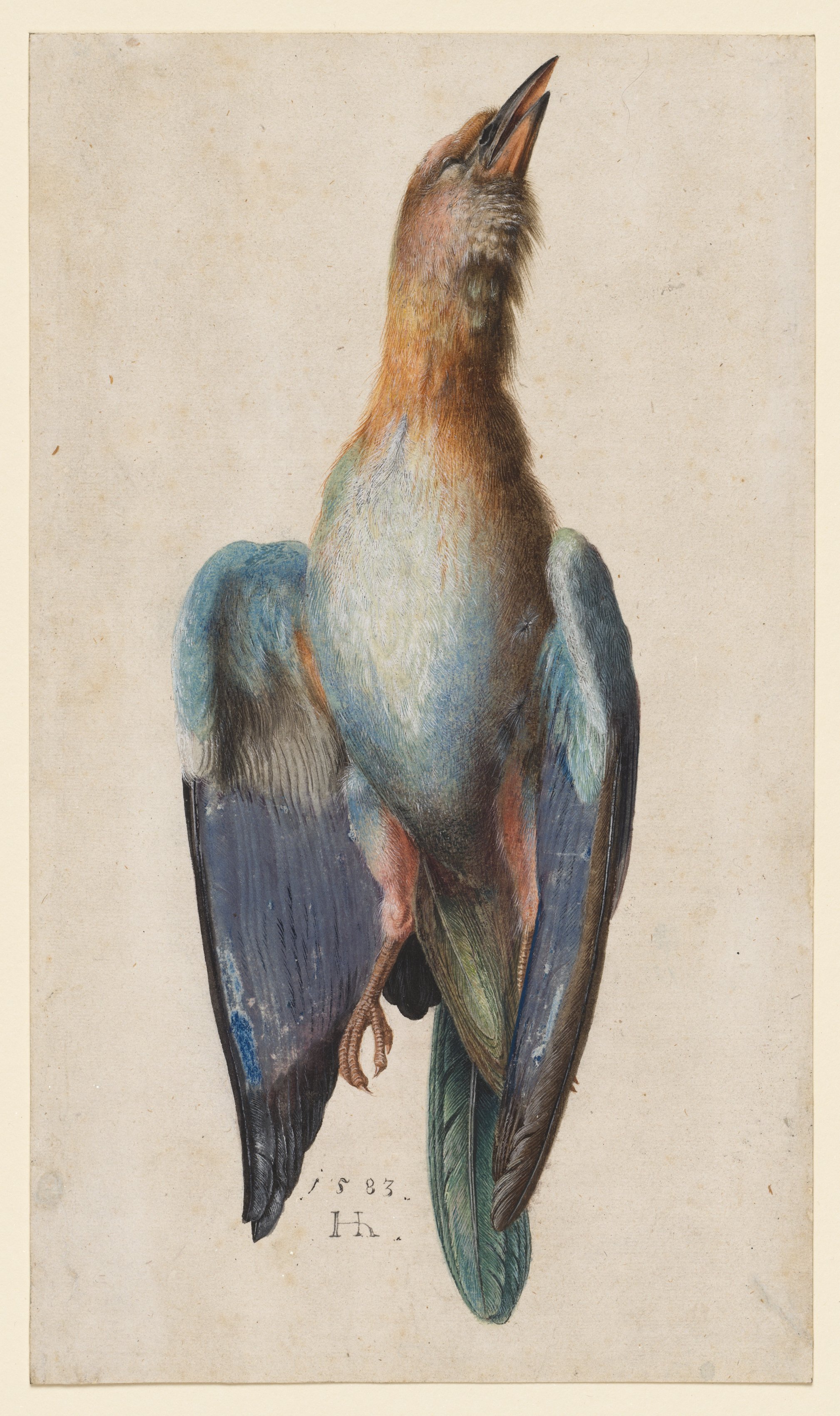
Dead Blue Roller1583
Half a century after the death of the German Renaissance artist Albrecht Dürer, his work continued to inspire artists and collectors. More about this work
About this work
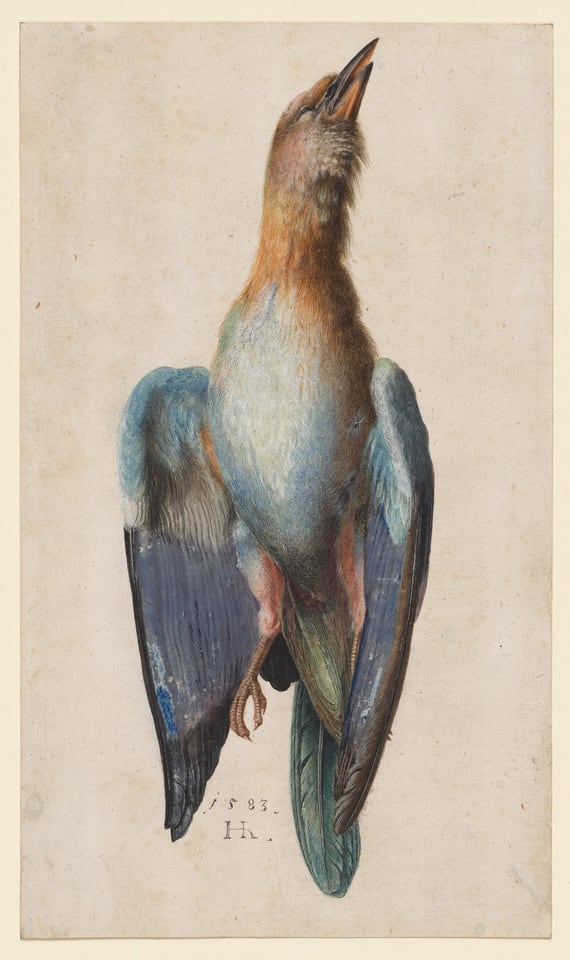
Half a century after the death of the German Renaissance artist Albrecht Dürer, his work continued to inspire artists and collectors. Hans Hoffmann was well known for his copies of Dürer’s nature studies, and in 1583 he faithfully copied Dürer’s celebrated drawing of a dead blue roller of 1512 in this exquisite watercolor. A network of very fine brushstrokes imitates the individual plumes of the bird’s underside while simultaneously suggesting an overall soft, downy texture. Several other copies of Dürer's composition exist, including one by Hoffmann in London. Both the London sheet and this sheet were signed with Hoffman’s prominent monogram and dated, indicating that he could not have intended them to pass as originals by the older master. Likely, he meant the drawing as an homage to the greatest German artist of the 1500s; his endeavor may have been sponsored by the Nuremberg-based Imhoff family, who owned Dürer's blue roller around the time this drawing was made.
Text from the Cleveland Museum of Art.
How it was made
- Opaque watercolour
- Watercolour made opaque with white or chalk and laid in flat, even layers. Persian and Indian painters ground their colours from minerals, applied them with the finest brushes and burnished the finished page.
- Watercolour
- Pigment in gum arabic, thinned with water and laid in transparent washes. Nothing white is painted: the light is the paper showing through.
Hans Hoffmann
German, 1545/50–1591/92
Renaissance
European art from about 1400 to 1600, when painters rediscovered perspective and the classical past.
Rights and the museum’s record
Public domain. The Cleveland Museum of Art has dedicated this image to the public domain under CC0, so anyone may copy, adapt and use it, for any purpose, without asking. Our prints and files are reproductions made from the museum’s image; the museum doesn’t endorse them.
- Object number
- 1946.217
- Credit
- Courtesy of the Cleveland Museum of Art
- Type
- Drawing
- Department
- Drawings
- Licence
- CC0 1.0 Universal
- Museum record
- See it on the museum’s site