Skip to content
Ochre Editions
ArtArtistsCollectionsGalleriesDrops
SearchSign inCart (0)
The galleries · Style galleries

The Italian Renaissance

Florence, Venice and Rome from 1400 to 1600: perspective, anatomy and the classical past.

61 works · hang 4082 ·

Share The Italian Renaissance, in the galleries

The rooms are imagined; every work on their walls is real.

Walk this roomRehang this room

First room, north wall

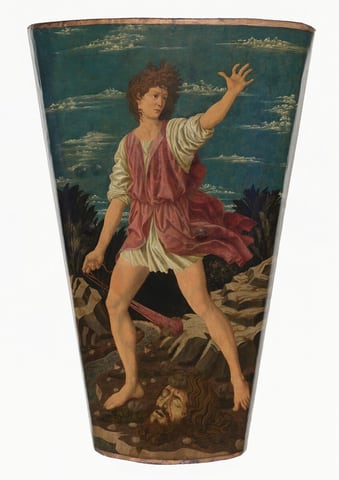
  1. This shield-shaped painting shows a young man with pale, peachy skin and curling brown hair standing astride the severed head of a man with dark hair and tanned skin. The painting is wider at the top and tapers like a pint glass to a narrower base. The young man, David, holds the end of long red slingshot with his right hand. The slingshot is weighted by a rock and swings behind his body. His sleeveless rust-red garment is cinched at his waist over a long white shirt. Both garments skim David’s thighs and his legs and feet are bare. Long, curling brown hair frames the ashen and bloodied upturned face of the head at David’s feet. A palm-sized stone is embedded in that forehead. The landscape background is made up of gray boulders, a meandering river, and low palm-like trees. Frothy white clouds sweep across an azure-blue sky.
    David with the Head of GoliathAndrea del Castagno, c. 1450/1455Courtesy National Gallery of Art, Washington
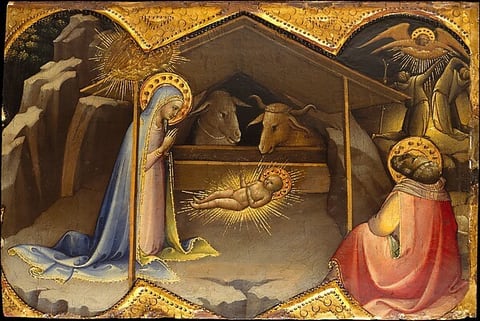
  2. The Nativity, by Lorenzo Monaco, ca. 1406–10
    The NativityLorenzo Monaco, ca. 1406–10Courtesy of The Metropolitan Museum of Art
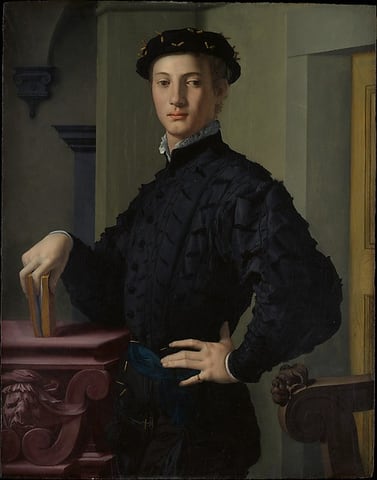
  3. Portrait of a Young Man, by Agnolo Bronzino, 1530s
    Portrait of a Young ManAgnolo Bronzino, 1530sCourtesy of The Metropolitan Museum of Art

First room, south wall
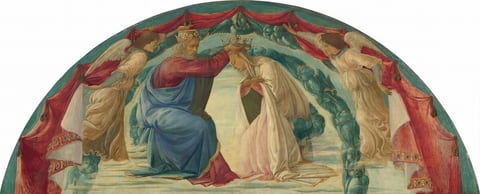
  1. In a wide, arched panel, a bearded man wearing a crown places another crown on the head of a woman. To our right, the woman bows her head with her eyes nearly closed and crosses her wrists over her chest. A white cloak covers her head, drapes over her shoulders, and pools in deep folds around her feet. The cloak is lined with pine green, and she wears a shell-pink dress. To our left, the man has shoulder-length, curly gray hair and a beard. His robe is dark rose pink, and the cloak is azure blue lined with pine green. Two winged angels have brown hair, short, white wings, and wear voluminous white robes. They stand to either side of the man and woman and hold up a swag of raspberry-red cloth hung with gold tassels. All the people have pale, peachy skin. Winged baby heads encircled with gold rays create an arch behind the man and woman, who sit on clouds. The background is pale blue sky.
    The Coronation of the VirginFilippino Lippi, c. 1475Courtesy National Gallery of Art, Washington
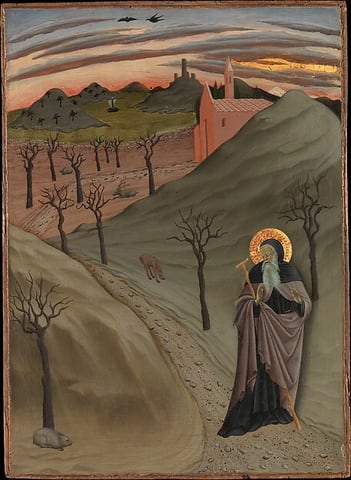
  2. Saint Anthony the Abbot in the Wilderness, by Sano di Pietro (Ansano di Pietro di Mencio), ca. 1440
    Saint Anthony the Abbot in the WildernessSano di Pietro (Ansano di Pietro di Mencio), ca. 1440Courtesy of The Metropolitan Museum of Art
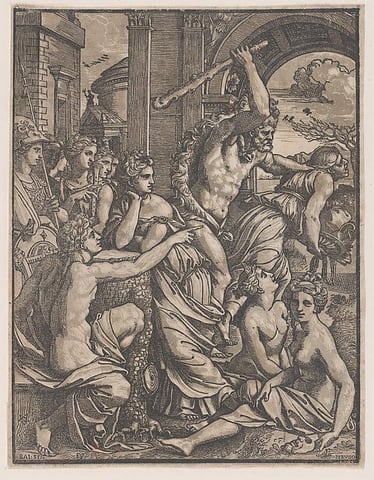
  3. Hercules chasing Avarice from the Temple of the Muses, by Ugo da Carpi, ca. 1520–27
    Hercules chasing Avarice from the Temple of the MusesUgo da Carpi, ca. 1520–27Courtesy of The Metropolitan Museum of Art

Second room, south wall
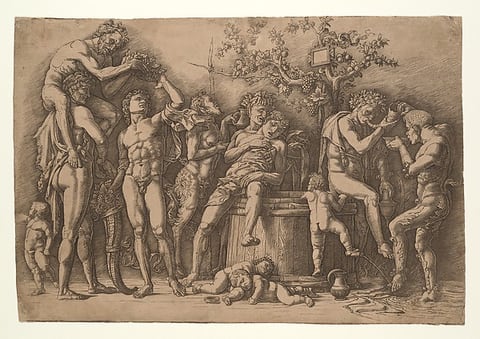
  1. Bacchanal with a Wine Vat, by Andrea Mantegna, Before 1475
    Bacchanal with a Wine VatAndrea Mantegna, Before 1475Courtesy of The Metropolitan Museum of Art
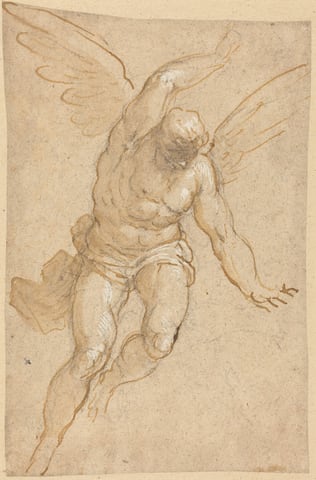
  2. The image shows a human figure with wings positioned as though in flight. The figure is captured from a slightly frontal perspective, with the head turned downwards and the right arm outstretched. The facial features are undefined, focusing more on the body's muscular structure. The figure wears a cloth or drapery around the waist and has well-defined muscles on the chest, arms, and legs. Large wings extend out behind the figure, adding to the sense of flight. The background is plain with a light texture.
    A Flying AngelJacopo Palma il Giovane, 1580/1590Courtesy National Gallery of Art, Washington
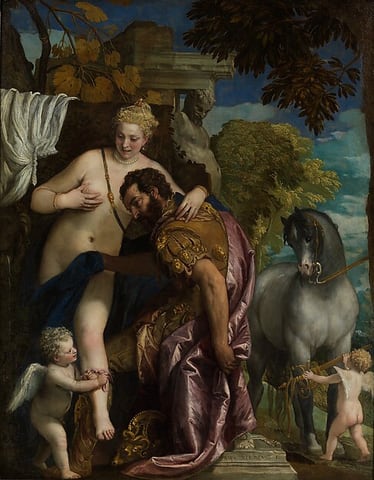
  3. Mars and Venus United by Love, by Paolo Veronese (Paolo Caliari), 1570s
    Mars and Venus United by LovePaolo Veronese (Paolo Caliari), 1570sCourtesy of The Metropolitan Museum of Art

Second room, north wall
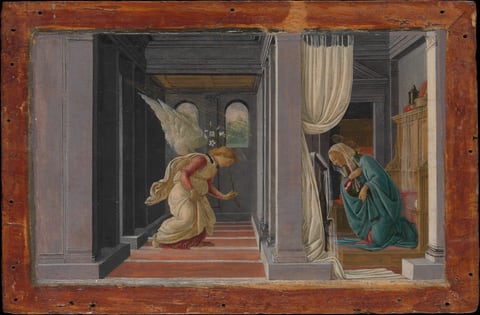
  1. The Annunciation, by Botticelli (Alessandro di Mariano Filipepi), ca. 1490
    The AnnunciationBotticelli (Alessandro di Mariano Filipepi), ca. 1490Courtesy of The Metropolitan Museum of Art
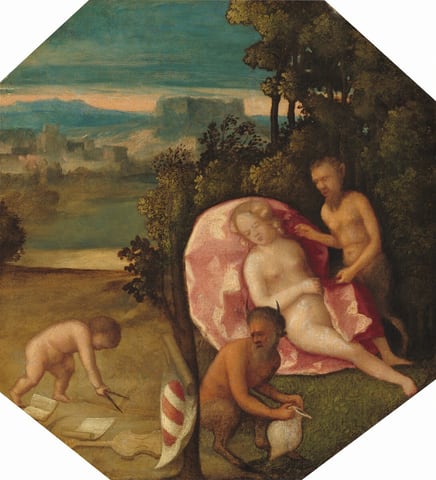
  2. A nude woman, pudgy child, and two satyrs, which have men’s heads and torsos with goat’s legs and horns, are in a landscape in this octagonal painting. The scene is divided in half by a tree stump which only reaches to the center of the composition. To the left of the stump, the pale-skinned, nude child stands and hunches over to draw on the ground with a V-shaped compass. Two pieces of paper and a violin lie nearby. The landscape behind him has a body of water leading back to a town with buildings streaked with peach, perhaps flames. A band of peach sky separates the blue silhouettes of mountains lining the horizon from the vivid blue sky above. At the bottom center of the painting, a shield with an oval horizontally striped with red and white leans on the boy’s side of the tree, which has one leafy branch growing on the left side. One satyr holds a jug and kneels close to the tree with his back to it as he looks back over one shoulder. He and the other satyr both have dark, peach-toned skin and full beards. The second satyr hovers to the right of the nude, sleeping woman, both hands reaching for her or the rose-pink cloth surrounding her. The woman has blond curls, a round face, and she sleeps with one hand resting across her belly and her head tipped to our left. The trio are on a grassy area enclosed by dense, dark-green bushes and trees.
    AllegoryPietro degli Ingannati, c. 1515-1525Courtesy National Gallery of Art, Washington
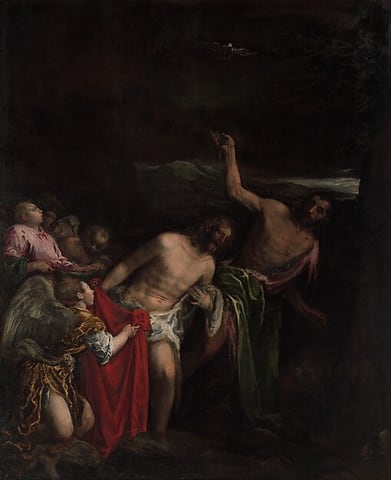
  3. The Baptism of Christ, by Jacopo Bassano, ca. 1590
    The Baptism of ChristJacopo Bassano, ca. 1590Courtesy of The Metropolitan Museum of Art

Third room, north wall
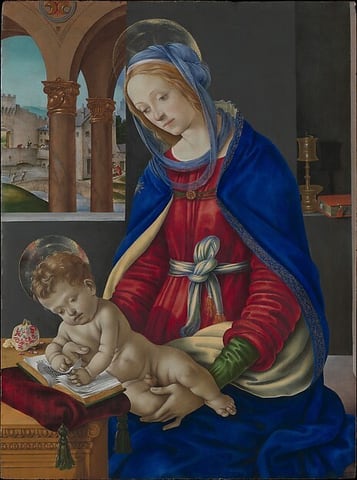
  1. Madonna and Child, by Filippino Lippi, ca. 1483–84
    Madonna and ChildFilippino Lippi, ca. 1483–84Courtesy of The Metropolitan Museum of Art
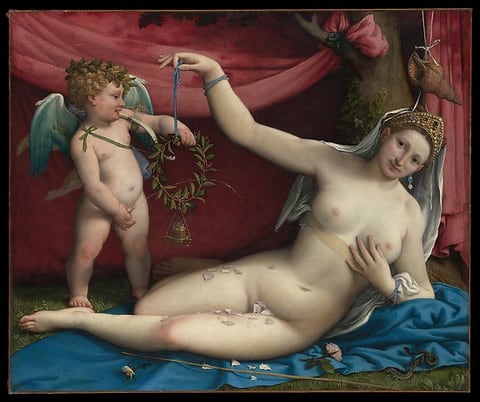
  2. Venus and Cupid, by Lorenzo Lotto, 1520s
    Venus and CupidLorenzo Lotto, 1520sCourtesy of The Metropolitan Museum of Art

Third room, south wall
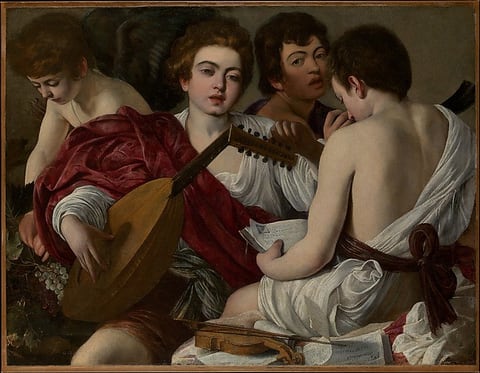
  1. The Musicians, by Caravaggio, 1597
    The MusiciansCaravaggio, 1597Courtesy of The Metropolitan Museum of Art
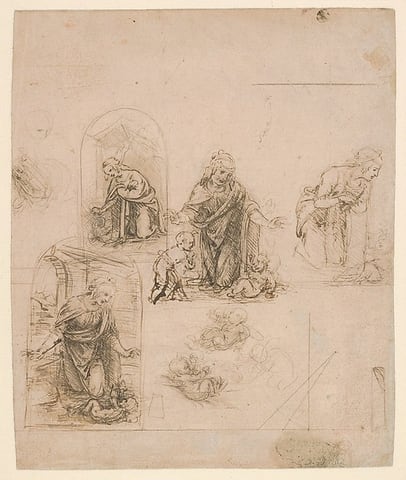
  2. Compositional Sketches for the Virgin Adoring the Christ Child, with and without the Infant St. John the Baptist; Diagram of a Perspectival Projection (recto); Slight Doodles (verso), by Leonardo da Vinci, 1480–85
    Compositional Sketches for the Virgin Adoring the Christ Child, with and without the Infant St. John the Baptist; Diagram of a Perspectival Projection (recto); Slight Doodles (verso)Leonardo da Vinci, 1480–85Courtesy of The Metropolitan Museum of Art

Walk on

  • The Italian Renaissance, room 2
  • More by Leonardo da Vinci 3 works
  • 15th-century Italy 57 works
Ochre Editions

The world's museums, on your wall. Every work here is a reproduction of a public-domain original, credited to the museum that holds it.

Shop

All artCollectionsLimited dropsPrints and framing

Help

Find an orderShippingReturnsVerify a certificate

About

About Ochre EditionsMuseum creditsFor agentsDevelopers

Legal

Terms of UseTerms of SaleLimited Editions and CertificatesPrivacy PolicyCookie PolicyAcceptable Use PolicyAgent & API TermsCopyright and DMCA PolicyPrinting Your Own PhotoVulnerability Disclosure PolicyAccessibility StatementOpen-Access Credits
© 2026 Ochre EditionsPrices in US dollars. Prints ship within the United States.