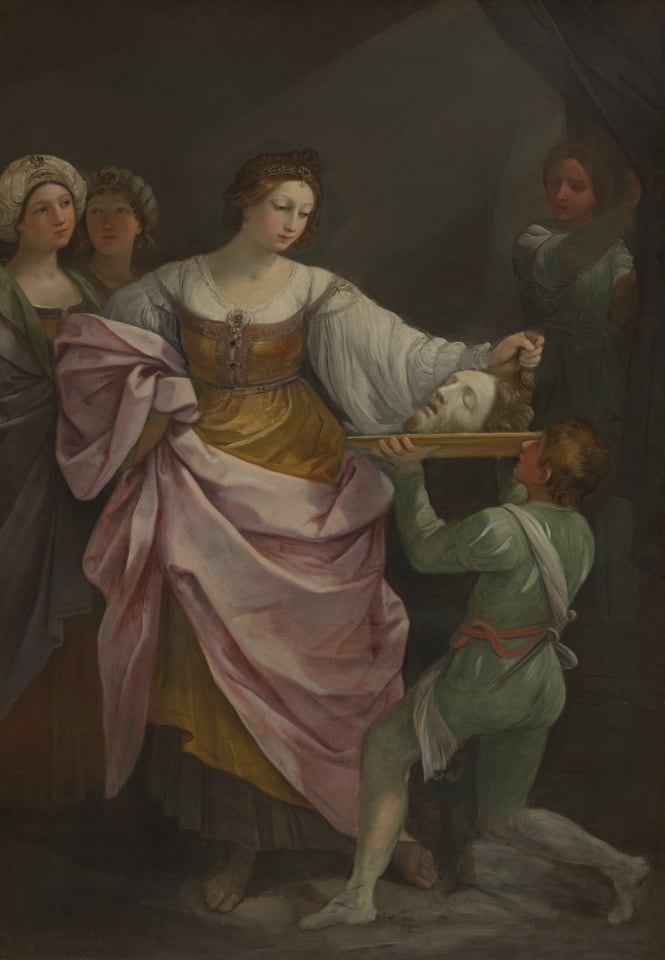
Salome with the Head of Saint John the Baptistc. 1639–42
Guido Reni was the most famous and successful Italian painter of his day. More about this work
About this work
Guido Reni was the most famous and successful Italian painter of his day. This painting depicts Salome receiving the head of John the Baptist on a platter, the gruesome reward she chose for having pleased her stepfather, Herod, by performing a seductive dance. This episode from the New Testament had long been popular in Italian art thanks to its combination of religiosity, violence, and eroticism.
Text from the Art Institute of Chicago.
What you’re looking at
Large painting of woman, in gold and pink dress, placing severed head on platter.
Description from the Art Institute of Chicago.
How it was made
- Oil paint
- Pigment ground in a drying oil, usually linseed. It dries slowly, so painters could blend on the canvas, build up thin translucent glazes, and rework a picture over weeks. Canvas replaced wooden panels in the 1500s because it is lighter and can be rolled.
Guido Reni
Italian, 1575–1642 · Born and died in Bologna.
Reni trained in Bologna, first with Denys Calvaert and then at the Carracci academy, and spent the early 1600s in Rome, where his fresco Aurora won wide fame. Returning to Bologna, he ran a large studio and became the most admired painter of his generation, prized for idealised figures, cool, clear colour and graceful movement. His late works, such as Salome with the Head of Saint John the Baptist, are freer in handling and paler in tone.
Written by Ochre Editions.
Rights and the museum’s record
Public domain. The Art Institute of Chicago has dedicated this image to the public domain under CC0, so anyone may copy, adapt and use it, for any purpose, without asking. Our prints and files are reproductions made from the museum’s image; the museum doesn’t endorse them.
- Object number
- 1960.3
- Credit
- Courtesy of the Art Institute of Chicago
- Type
- Painting
- Department
- Painting and Sculpture of Europe
- Licence
- CC0 1.0 Universal
- Museum record
- See it on the museum’s site
Report this work
More by Guido Reni
All their works

Close in colour