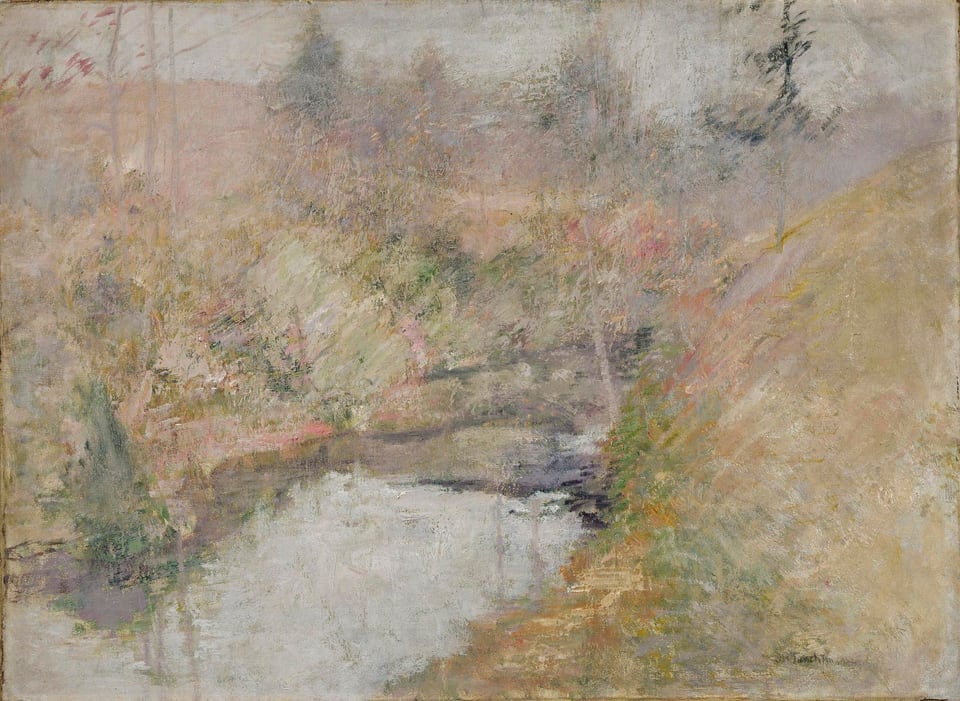
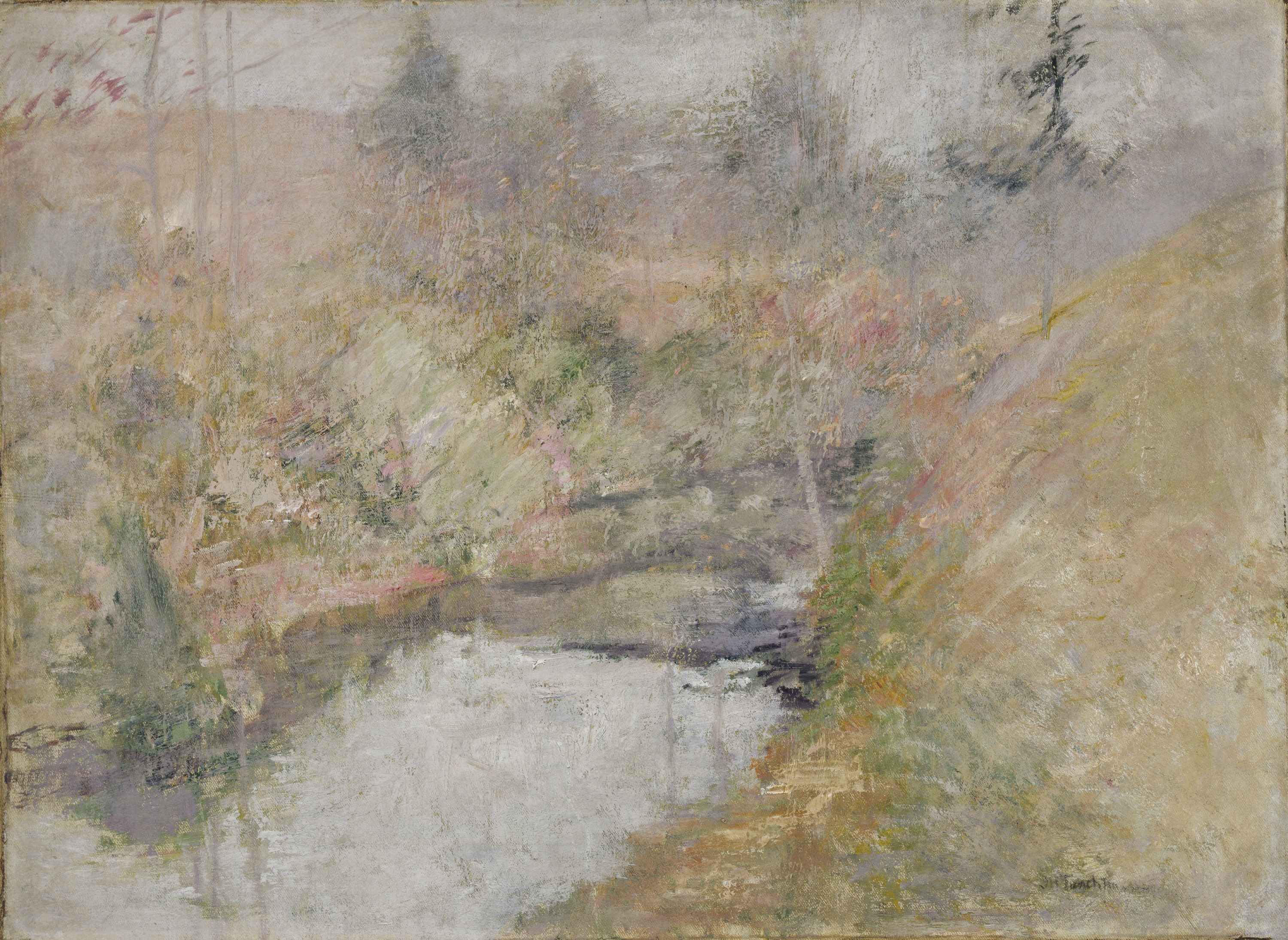
Hemlock Poolca. 1890-1900
John Twachtman painted this scene in all different seasons. More about this work
About this work
John Twachtman painted this scene in all different seasons. He drew inspiration from his seventeen acres of land in Greenwich, Connecticut, and his paintings of the property express the emotional and spiritual comfort he found there. This image, likely made in autumn, shows a pond located behind his house at the bottom of a steep incline along the Horseneck Brook. Twachtman created many images of streams and brooks, and these ceaselessly moving bodies of water might have held a deeper significance for him. By the time Twachtman painted his Connecticut landscapes, American artists and intellectuals had been interested in Buddhism for more than two decades, and the artist himself had studied Zen philosophy and Japanese art. (Pyne, "John Twachtman and the Therapeutic Landscape," in Chotner et al., John Twachtman: Connecticut Landscapes, 1989) This may account for the meditative quality of his pictures, the sense of looking not at an actual landscape, but at an inward image of something seen long before.
Text from the Smithsonian American Art Museum.
How it was made
- Oil paint
- Pigment ground in a drying oil, usually linseed. It dries slowly, so painters could blend on the canvas, build up thin translucent glazes, and rework a picture over weeks. Canvas replaced wooden panels in the 1500s because it is lighter and can be rolled.
John Henry Twachtman
born Cincinnati, OH 1853-died Gloucester, MA 1902
Rights and the museum’s record
Public domain. The Smithsonian American Art Museum has dedicated this image to the public domain under CC0, so anyone may copy, adapt and use it, for any purpose, without asking. Our prints and files are reproductions made from the museum’s image; the museum doesn’t endorse them.
- Object number
- 1929.6.140
- Credit
- Courtesy of the Smithsonian American Art Museum
- Type
- Painting
- Department
- Painting and Sculpture
- Licence
- CC0 1.0 Universal
- Museum record
- See it on the museum’s site
Report this work
More by John Henry Twachtman
All their works
Close in colour