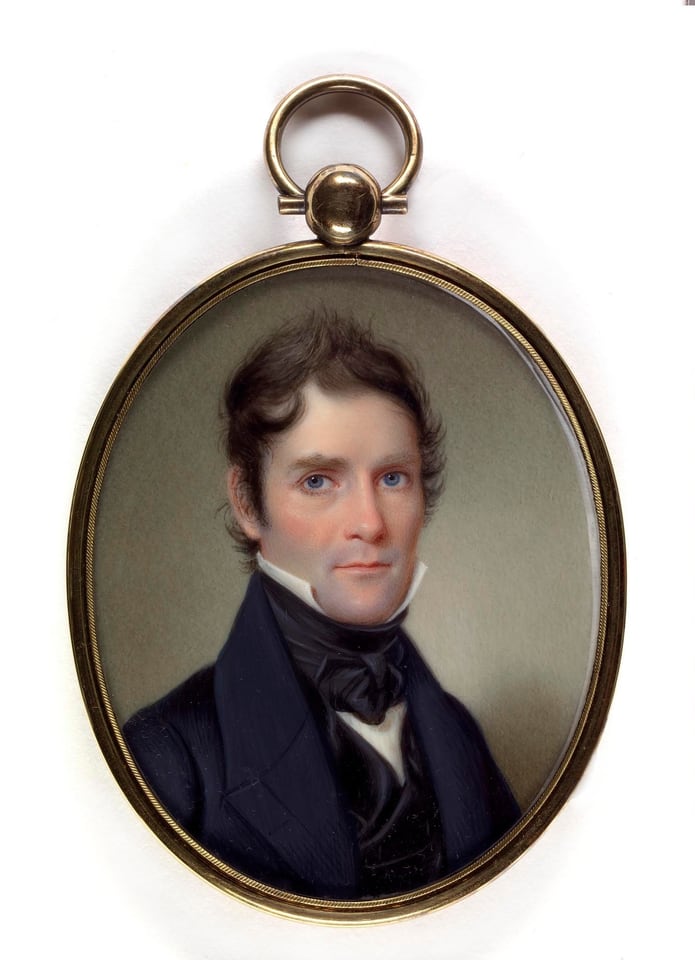
Colonel Elijah Rice1839
Colonel Elijah Rice invested heavily in sugar cane in Cuba, as a thriving part of the slave trade before the Civil War. More about this work
About this work
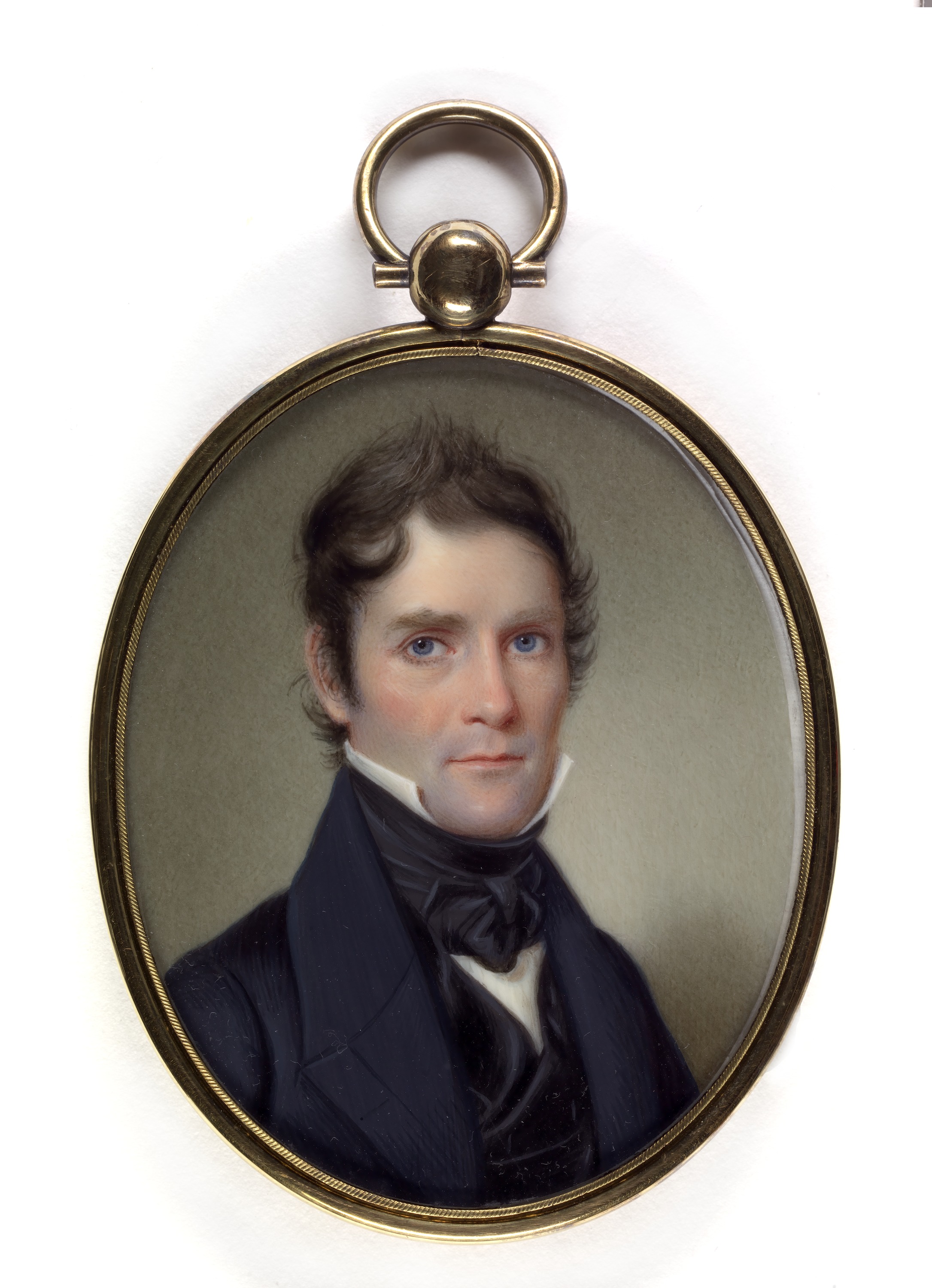
Colonel Elijah Rice invested heavily in sugar cane in Cuba, as a thriving part of the slave trade before the Civil War. His life ended in tragedy when he and all but one of his fourteen children died of consumption in Cuba. His widow, with her surviving daughter, Amanda, returned to Huntsville, Alabama, where John Wood Dodge painted this piece. The locket has elaborate hairwork on the reverse.
Text from the Smithsonian American Art Museum.
How it was made
- Watercolour on ivory
- Thin sheets of ivory gave watercolour a luminous, skin-like glow, which made them the favourite support for portrait miniatures from the early 1700s.
- Watercolour
- Pigment in gum arabic, thinned with water and laid in transparent washes. Nothing white is painted: the light is the paper showing through.
John Wood Dodge
born New York City 1807-died Pomona, TN 1893
Rights and the museum’s record
Public domain. The Smithsonian American Art Museum has dedicated this image to the public domain under CC0, so anyone may copy, adapt and use it, for any purpose, without asking. Our prints and files are reproductions made from the museum’s image; the museum doesn’t endorse them.
- Object number
- 1973.40
- Credit
- Courtesy of the Smithsonian American Art Museum
- Type
- Painting-Miniature
- Department
- Painting and Sculpture
- Licence
- CC0 1.0 Universal
- Museum record
- See it on the museum’s site
Report this work
Close in colour