Floor plan

Style galleriesPost-Impressionism

Post-Impressionism

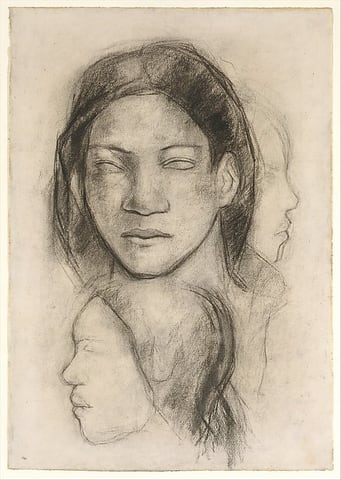
Tahitian Faces (Frontal View and Profiles), by Paul Gauguin, ca. 1899
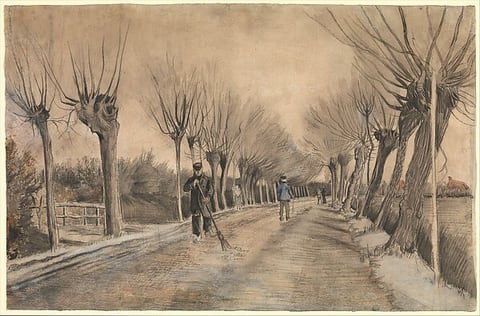
Road in Etten, by Vincent van Gogh, 1881
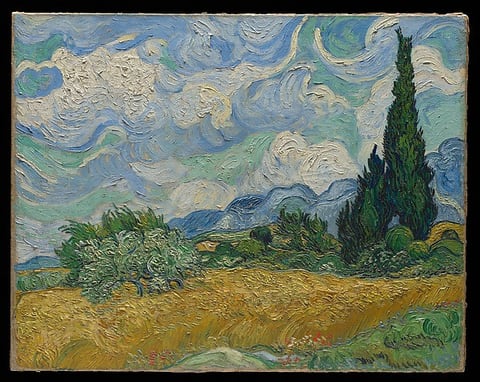
Wheat Field with Cypresses, by Vincent van Gogh, 1889
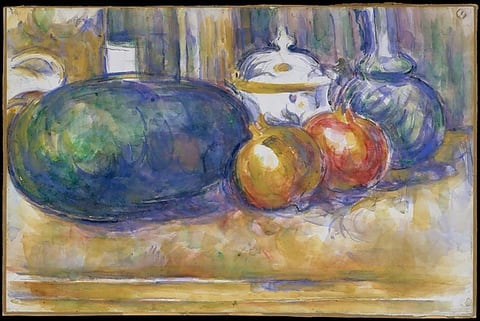
Still-Life with a Watermelon and Pomegranates, by Paul Cézanne, 1900–1906
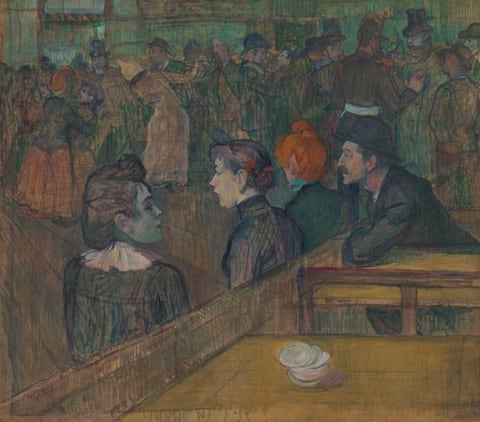
A scene in brown and green tones of people dancing indoors. In the foreground, three women stand near boothed tables while a man sits.
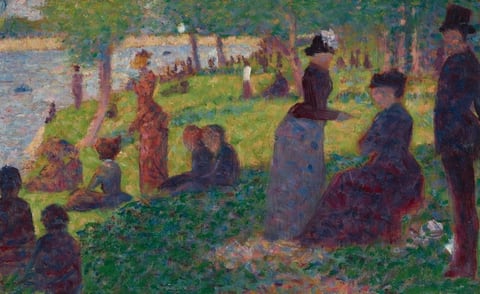
Heavy daubs of pigment form a crowded scene of roughly defined, finely dressed individuals in a brightly color park along a riverbank.
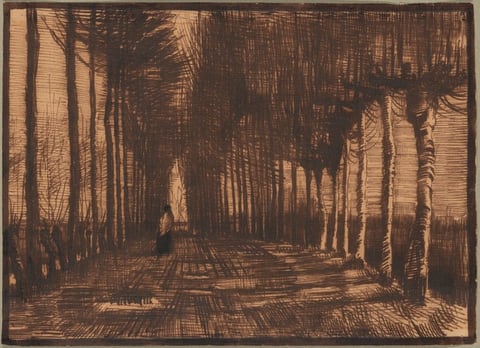
A work made of reed pen and iron-gall ink on tan laid paper.
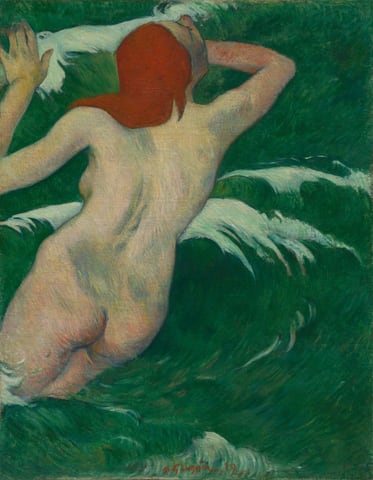
In the Waves (Dans les Vagues), by Paul Gauguin, 1889

The works in this room are listed below.

Works in this room

Artists who kept Impressionism's colour but pushed towards structure, symbol and feeling.

First room, north wall

  1. Tahitian Faces (Frontal View and Profiles), by Paul Gauguin, ca. 1899
    Tahitian Faces (Frontal View and Profiles)Paul Gauguin, ca. 1899Courtesy of The Metropolitan Museum of Art
  2. Road in Etten, by Vincent van Gogh, 1881
    Road in EttenVincent van Gogh, 1881Courtesy of The Metropolitan Museum of Art
  3. Wheat Field with Cypresses, by Vincent van Gogh, 1889
    Wheat Field with CypressesVincent van Gogh, 1889Courtesy of The Metropolitan Museum of Art
  4. Still-Life with a Watermelon and Pomegranates, by Paul Cézanne, 1900–1906
    Still-Life with a Watermelon and PomegranatesPaul Cézanne, 1900–1906Courtesy of The Metropolitan Museum of Art

First room, south wall

  1. A scene in brown and green tones of people dancing indoors. In the foreground, three women stand near boothed tables while a man sits.
    Moulin de la GaletteHenri de Toulouse-Lautrec, 1889Courtesy of the Art Institute of Chicago
  2. Heavy daubs of pigment form a crowded scene of roughly defined, finely dressed individuals in a brightly color park along a riverbank.
    Oil Sketch for "A Sunday on La Grande Jatte — 1884"Georges Seurat, 1884Courtesy of the Art Institute of Chicago
  3. A work made of reed pen and iron-gall ink on tan laid paper.
    Avenue of Pollard Birches and PoplarsVincent van Gogh, March 1884Courtesy of the Art Institute of Chicago
  4. In the Waves (Dans les Vagues), by Paul Gauguin, 1889
    In the Waves (Dans les Vagues)Paul Gauguin, 1889Courtesy of the Cleveland Museum of Art

Second room, south wall
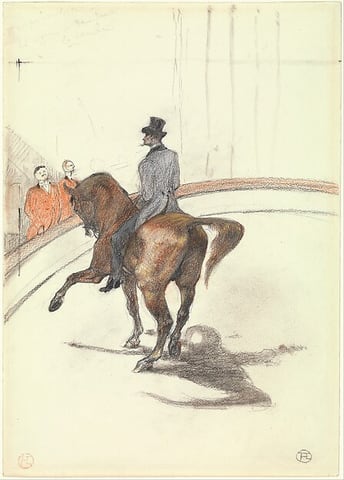
  1. At the Circus: The Spanish Walk (Au Cirque: Le Pas espagnol), by Henri de Toulouse-Lautrec, 1899
    At the Circus: The Spanish Walk (Au Cirque: Le Pas espagnol)Henri de Toulouse-Lautrec, 1899Courtesy of The Metropolitan Museum of Art
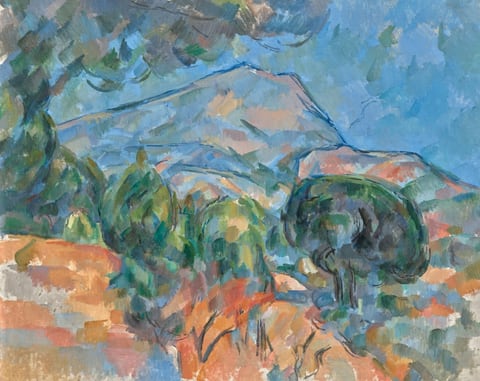
  2. Mount Sainte-Victoire, by Paul Cézanne, c. 1904
    Mount Sainte-VictoirePaul Cézanne, c. 1904Courtesy of the Cleveland Museum of Art
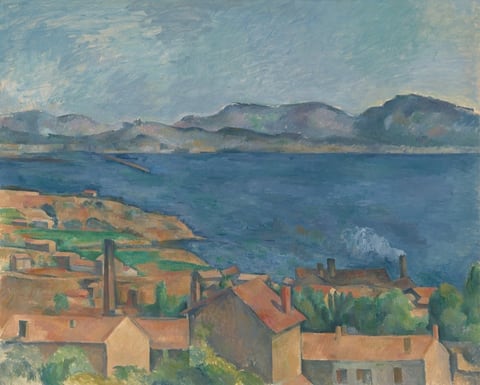
  3. Impressionist sea landscape, tan houses, blue ocean, distant mountains.
    The Bay of Marseille, Seen from L'EstaquePaul Cézanne, c. 1885Courtesy of the Art Institute of Chicago

Second room, north wall
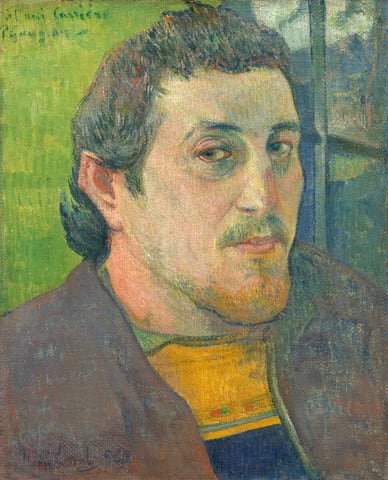
  1. Painted in muted lime green, plum purple, buttercup yellow, slate and royal blue, the head and shoulders of a man with peach-colored skin sitting in front of a window looks at us in this stylized, vertical portrait. His body and face are angled to our right but he looks at us from the corners of his eyes, which are grass-green with touches of yellow. One cobalt-blue eyebrow is cocked, and shading in denim blue, butter yellow, and fern green create hollows under both eyes. His flat nose has a broad bridge, and his pale pink lips are closed, the far corner pulled slightly up. His mustache is painted with visible strokes of forest green and his ginger-orange beard is trimmed along his prominent, jutting chin. His short, dark hair is brushed back from his temples and is painted with strokes of pine green, navy blue, and coral orange. His shirt has a wide, golden yellow stripe along the collar above indigo blue, under a grayish-violet purple jacket. The wall over his shoulder, in the upper left corner, is painted vivid lime green with long, vertical brushstrokes. The view through the window beyond his other shoulder is of vegetation and mountains. The portrait is painted with visible brushstrokes throughout, and is especially loose in the background, hair, and jacket. An inscription in dark green script in the upper left reads, “a l'ami Carriere PGauguin.” A second inscription in the lower left is written with dark brown paint: “l'ami Laval PGo.”
    Self-Portrait Dedicated to CarrièrePaul Gauguin, 1888 or 1889Courtesy National Gallery of Art, Washington
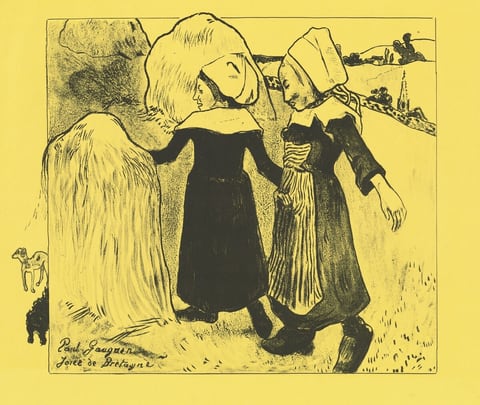
  2. The image shows two women walking arm in arm, both in traditional attire. One woman is facing away with a slight profile, while the other is seen from the side. Their faces are stylized and simplistic with covered hair. They wear long dresses with aprons and collars, and one has a striped apron. Haystacks and greenery surround them. Faint figures are in the background, as well as a spire-like structure. A dog is seen near the haystack, with simple lines suggesting a landscape.
    Pleasures of Brittany (Joies de Bretagne)Paul Gauguin, 1889Courtesy National Gallery of Art, Washington
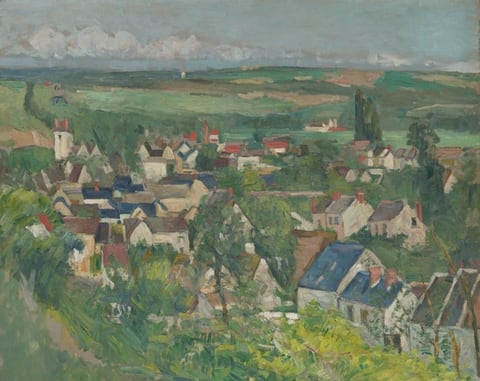
  3. View of a village surrounded by hills, fields, and trees, shown from a vantage point above the scene. Subtly rolling hills recede into a bluish gray-ish sky punctuated by white clouds. Thick brushstrokes built up atop each other are visible throughout.
    Auvers, Panoramic ViewPaul Cézanne, 1873–75Courtesy of the Art Institute of Chicago

Third room, north wall
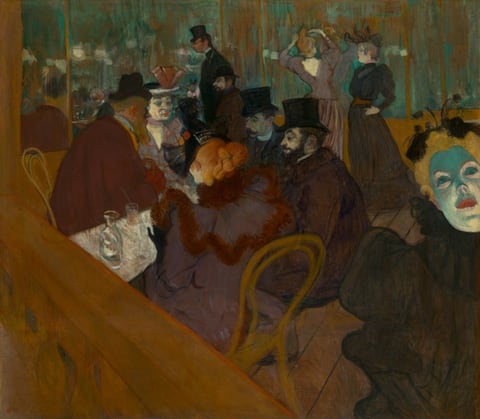
  1. Painting, heavy in tones of blue-green and burnt orange, depicting a bar scene at night. The men wear top hats and many are bearded; the women are dressed in voluminous gowns and decorative hats. Five people converse in the center of the composition and a woman with a green face dominates the right foreground.
    At the Moulin RougeHenri de Toulouse-Lautrec, 1892–95Courtesy of the Art Institute of Chicago
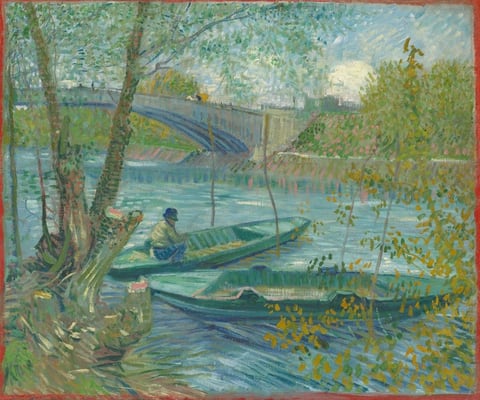
  2. Painting in short strokes of pale blue, green, white, yellow, and pink, of a fisherman in one of two small boats on a river, a tree-lined bank and a bridge in the background.
    Fishing in Spring, the Pont de Clichy (Asnières)Vincent van Gogh, 1887Courtesy of the Art Institute of Chicago