Floor plan

Time and placeThe 19th century

The 19th century

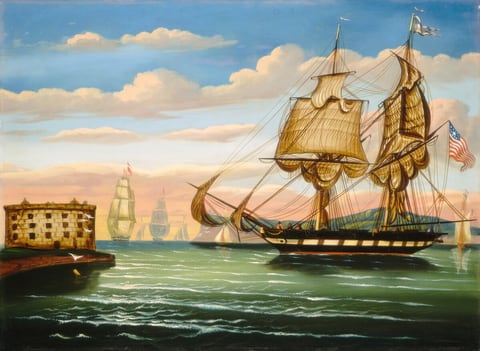
Bay of New York, Sunset, by Thomas Chambers, mid 19th century
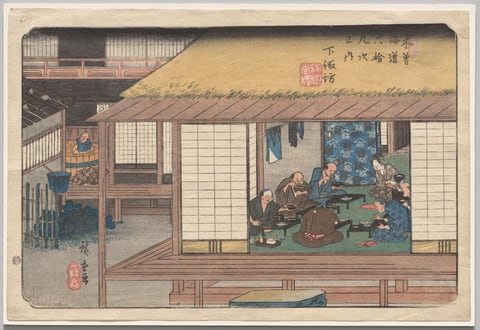
Shimosuwa, from Sixty-Nine Stations of the Kisokaidō, by Utagawa Hiroshige, 1835–38
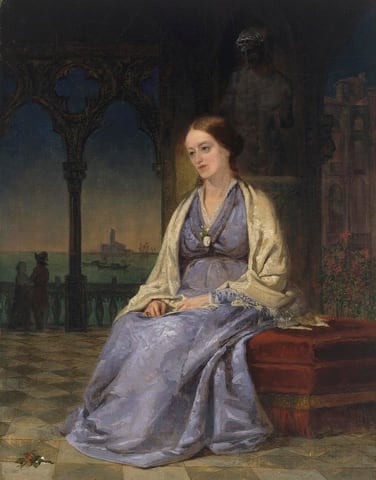
Artist: Thomas Hicks, Sitter: Margaret Fuller, Current owner: National Portrait Gallery, Smithsonian Institution
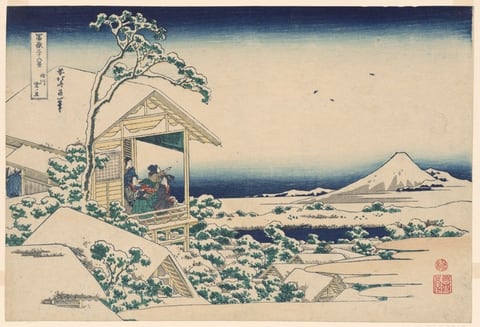
A work made of color woodblock print; oban.
A work made of oil on canvas.
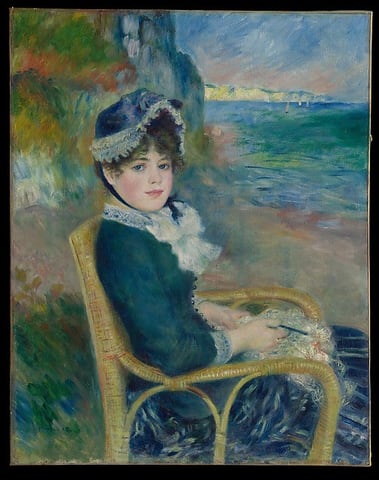
By the Seashore, by Pierre-Auguste Renoir, 1883
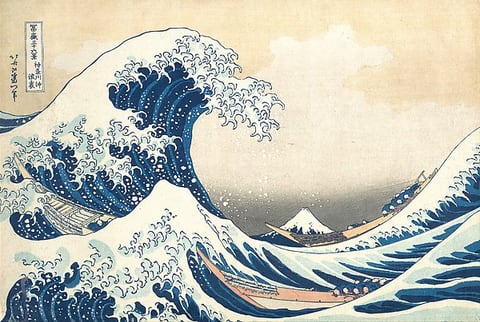
Under the Wave off Kanagawa (Kanagawa oki nami ura), also known as The Great Wave, from the series Thirty-six Views of Mount Fuji (Fugaku sanjūrokkei), by Katsushika Hokusai, ca. 1830–32
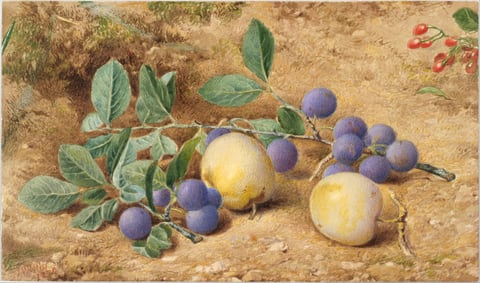
Plums, by John William Hill, 1870

The works in this room are listed below.

Works in this room

Works made in the 19th century, anywhere in the world.

Section 1, north wall

  1. Bay of New York, Sunset, by Thomas Chambers, mid 19th century
    Bay of New York, SunsetThomas Chambers, mid 19th centuryCourtesy National Gallery of Art, Washington
  2. Shimosuwa, from Sixty-Nine Stations of the Kisokaidō, by Utagawa Hiroshige, 1835–38
    Shimosuwa, from Sixty-Nine Stations of the KisokaidōUtagawa Hiroshige, 1835–38Courtesy of the Cleveland Museum of Art
  3. Artist: Thomas Hicks, Sitter: Margaret Fuller, Current owner: National Portrait Gallery, Smithsonian Institution
    Margaret FullerThomas Hicks, 1848Courtesy of the National Portrait Gallery, Smithsonian Institution
  4. A work made of color woodblock print; oban.
    Snowy Morning from Koishikawa (Koishikawa yuki no ashita), from the series "Thirty-six Views of Mount Fuji (Fugaku sanjurokkei)"Katsushika Hokusai, c. 1830/33Courtesy of the Art Institute of Chicago

Section 1, south wall

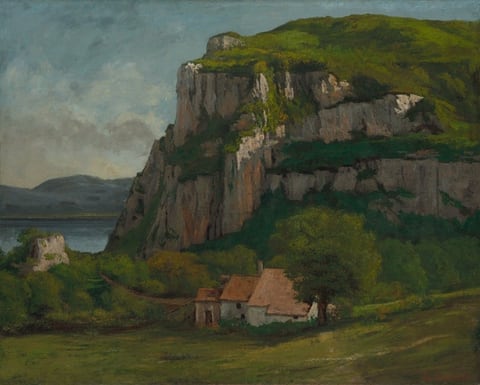
  1. A work made of oil on canvas.
    The Rock of HautepierreGustave Courbet, c. 1869Courtesy of the Art Institute of Chicago
  2. By the Seashore, by Pierre-Auguste Renoir, 1883
    By the SeashorePierre-Auguste Renoir, 1883Courtesy of The Metropolitan Museum of Art
  3. Under the Wave off Kanagawa (Kanagawa oki nami ura), also known as The Great Wave, from the series Thirty-six Views of Mount Fuji (Fugaku sanjūrokkei), by Katsushika Hokusai, ca. 1830–32
    Under the Wave off Kanagawa (Kanagawa oki nami ura), also known as The Great Wave, from the series Thirty-six Views of Mount Fuji (Fugaku sanjūrokkei)Katsushika Hokusai, ca. 1830–32Courtesy of The Metropolitan Museum of Art
  4. Plums, by John William Hill, 1870
    PlumsJohn William Hill, 1870Courtesy of The Metropolitan Museum of Art

Section 2, south wall
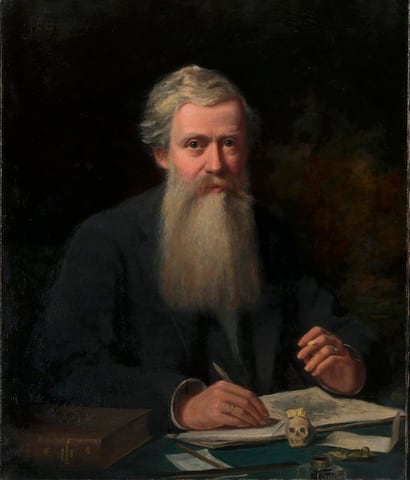
  1. Portrait of Elliot Coues, by J. Edward Barclay, 1898
    Portrait of Elliot CouesJ. Edward Barclay, 1898Courtesy of the Smithsonian American Art Museum
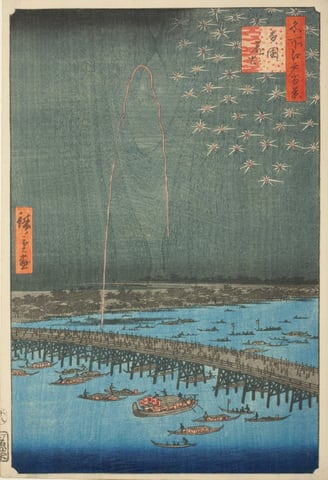
  2. A work made of color woodblock print; oban.
    Fireworks at Ryōgoku (Ryōgoku hanabi), from the series One Hundred Famous Views of Edo (Meisho Edo hyakkei)Utagawa Hiroshige, 1858Courtesy of the Art Institute of Chicago
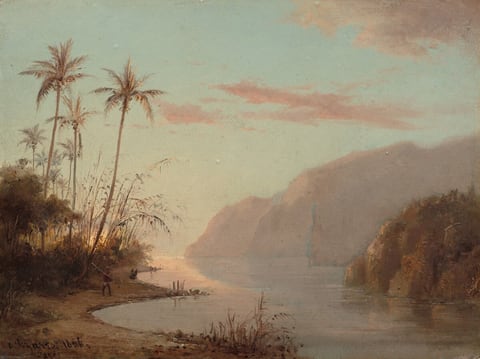
  3. A wide creek winds between a tree-lined bank to our left and hazy mountains to our right in this horizontal landscape painting. The riverbank curves deeply like a backward capital letter B. Marshy grasses grow in tufts, and palm and other trees grow in a grove to our left. One brown-skinned person wearing only a white cloth around the hips carries a long stick near the shoreline. Dabs of brown and muted dark pink suggest other people farther along the riverside. Tree-covered boulders jut into the creek from our right. A band of rocky, mountains are smoky mauve-pink across the rightmost two-thirds of the horizon, which comes a third of the way up the composition. The butter-yellow sun is low on the horizon to our right, peeking through the grove of palm trees. The light pours across the placid surface of the creek, creating a soft yellow streak next to the reflection of the mountain ridge. A few heather-pink clouds drift across the pale turquoise sky. The artist signed and dated the painting in the lower left corner, “C. Pizarro. 1856. Paris.”
    A Creek in St. Thomas (Virgin Islands)Camille Pissarro, 1856Courtesy National Gallery of Art, Washington
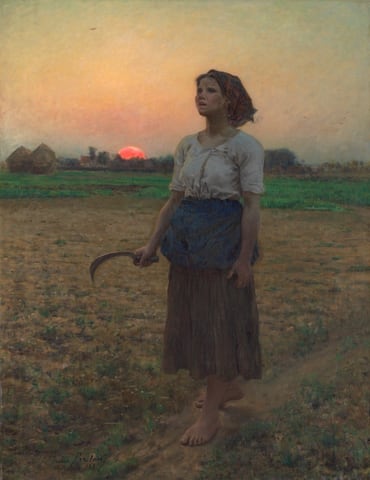
  4. A work made of oil on canvas.
    The Song of the LarkJules Breton, 1884Courtesy of the Art Institute of Chicago

Section 2, north wall
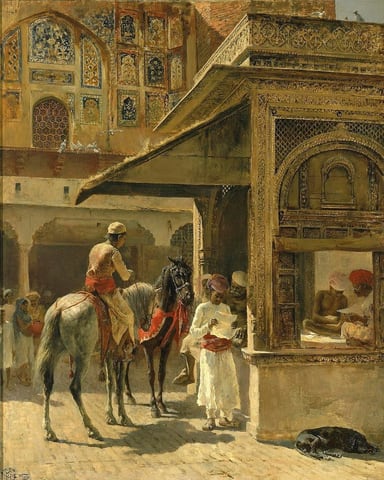
  1. Hindu Merchants, by Edwin Lord Weeks, ca. 1885
    Hindu MerchantsEdwin Lord Weeks, ca. 1885Courtesy of the Smithsonian American Art Museum
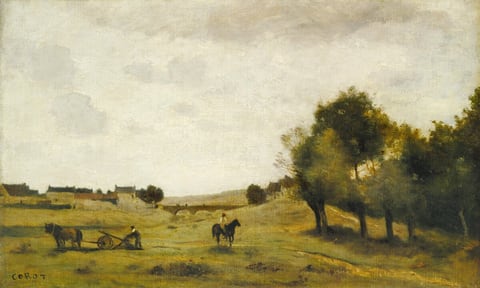
  2. A person at the center of this loosely painted horizontal landscape rides a dark horse across a field as a man to the left works the field behind a horse-drawn plow. The field is carpeted with muted and gold-shaded green, and a grove of trees in the right third of the composition are painted in fern, olive, and dark green. A patch of darker green near us and to left of center is dotted with red and yellow to suggest flowers. The men and horses are small in relation to the composition. The people have brown skin and are painted with a few strokes in dark gray and muted green for the man behind the plow to the left and pale yellow and white and a red cap for the person on horseback. A band of houses with tan or light yellow walls and gray or terracotta red roofs line the far side of the field to the left, and an arched bridge crosses what appears to be a shallow, grassy ravine near the center. The horizon comes about a third of the way up this composition and a few smoke-gray clouds line the upper edge of the otherwise milk-white sky. The artist signed the lower left corner, “COROT.”
    View near EpernonJean Baptiste Camille Corot, 1850/1860Courtesy National Gallery of Art, Washington
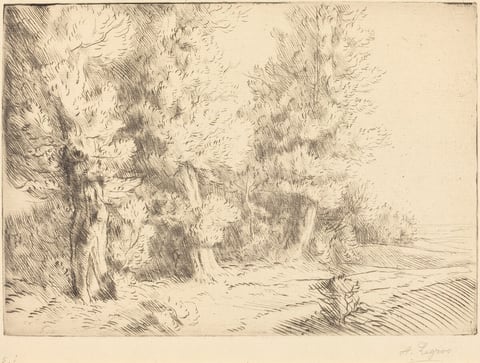
  3. The image shows a sketch-like scene viewed from a slightly elevated perspective, depicting a landscape dominated by a line of trees. The horizon is low in the image, just above a rising slope, with tall trees extending towards the sky. The trees and foliage are characterized by brushstrokes and crosshatching technique, conveying texture and shading. The color palette is monochromatic, with dark and light tones for a serene, natural quality. Line and shadow add movement and highlight the beauty of the trees as they recede into the distance, merging with the sky.
    In the Forest of Fontainebleau (Dans la foret de Fontainebleau)Alphonse LegrosCourtesy National Gallery of Art, Washington
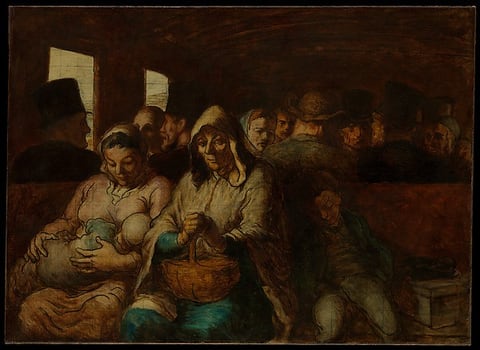
  4. The Third-Class Carriage, by Honoré Daumier, 1864
    The Third-Class CarriageHonoré Daumier, 1864Courtesy of The Metropolitan Museum of Art