Floor plan

Time and placeFlanders

Flanders

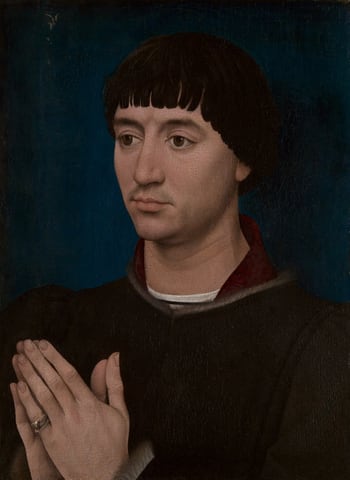
Painted dark colored portrait of man, hands in prayer.
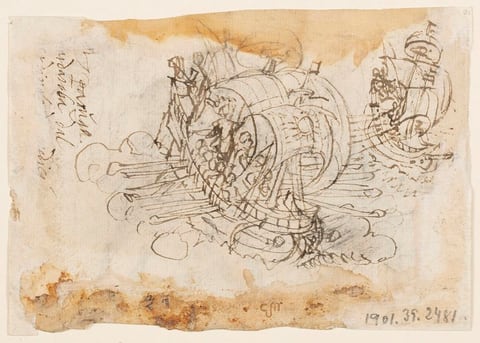
TWO GALLEYS AT SEA
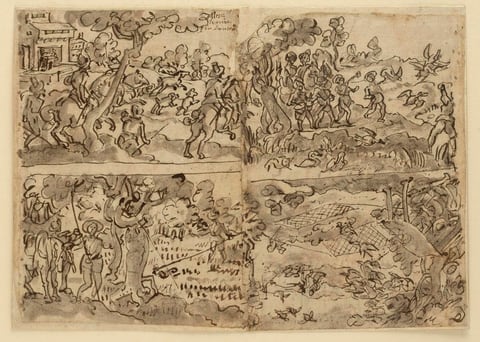
1901-39-151-a: DEER HUNT WITH HOUNDS [ABOVE]; SKYLARK HUNT WITH FALCONS [BELOW]; 1901-39-151-b: GOOSE AND DUCK HUNT WITH FALCONS [ABOVE RIGHT]; GOOSE HUNT [BELOW RIGHT]
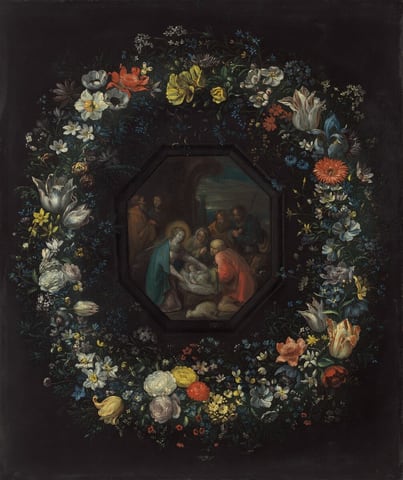
A scene with seven men and women gathered around an infant is enclosed in an eight-sided, octagonal painted frame, which is surrounded by a wreath of flowers in this vertical painting. The painted black frame-within-a-frame resembles molding. The people in the scene have pale skin and wear robes in shades of teal blue, burnt orange, red, muted purple, or red. A woman reaching for the bed on which the child lies and the child have gold halos. Others crouch or bend toward the child, and one pair, to our left, turn toward each other, presumably talking. The nighttime-blue sky is streaked with nickel-gray clouds beyond a partially ruined stone arch. A lamb with all four feet tired together lies at the foot of the child’s bed. The wreath surrounding the painting-within-a-painting is dense with tulips, roses, daffodils, poppies, violets, and other flowers and greenery painted in shades of lemon and butter yellow, opal and pearl white, brick and coral red, and sky and slate blue against an inky-black background. One artist signed the painting-within-a-painting near the bottom left corner, “FF F.” The second artist who painted this signed his initials, “HDB”, on the bottom edge of the painted frame.
A work made of oil on panel.
The image features a detailed black and white illustration with multiple human and animal figures in a symbolic arrangement. In the foreground, two full-body figures are depicted in long robes and sandals, positioned on either side of a large draped banner with text. One figure holds an open book. Above the banner are celestial figures in dynamic poses. To the left is a winged bull-like creature and a seated male figure with a beard, next to a female figure in classical attire. They are all surrounded by flowing fabric and a lion-like animal. In the lower center foreground, there is an emblem resembling a coat of arms with an eagle and a crowned shield. The background is textured, with no natural landscape or architecture present, allowing the figures to stand out. The illustration is framed by the margins of an open book.
We look slightly down onto a scene with people gathering in small groups in a cobblestone town square lined with rows of brick, wood, and stone buildings, many with stepped rooflines, in this horizontal painting. Singly or in pairs or trios, men, women, and children walk across the square, move goods around, or talk to merchants. All the people have light skin. Many of the men have mustaches and wear hats, and some carry swords. In tones of black, olive green, brick red, and plum purple, they wear hip-length cloaks over jackets, with white collars or ruffs and brass buttons, and knee-length breeches over yellow or black stockings. The women all wear long dresses in salmon pink, coral red, or golden yellow, with white collars or ruffs, and many wear black, ankle-length cloaks, some with hoods. Closest to us, a sumptuously dressed man and woman walk toward us while another similarly elegant couple walks away. Also facing away from us, to our left, a man wearing a large drum strapped around his waist raises one drumstick as he looks over his left shoulder. Nearby, a woman peers up out of a cellar door that opens on an angle to the street. More couples gather around a well across the square, and two women and a child talk to a third woman selling wares at a wooden table to our right. A pair of hooded priests or monks walk near a man blowing on a trumpet on horseback. The buildings are mostly shades of brick red and brown, and most have three or four stories with steeply pitched roofs. More people walk along side streets leading off the main square. One gap in the buildings across from us leads to a nickel-gray stone church with a pointed spire and square tower. A grassy, green hill rises steeply beyond the buildings to our right, leading down to a waterway that extends up and away into the distance. A few boats float in the water, which reflects the leaden-gray sky. Beyond the town square, a brown stone structure like a fortress with turret towers and crenellated walls looms along the ridge of the hill to our right. Tiny in scale, people on horseback and tending sheep dot the hillside below. The date “1590” is painted on the front of one of the buildings across from us while another date, “1597,” is painted on the end of a short wall near the lower left corner.
Guardroom with the Deliverance of Saint Peter, by David Teniers the Younger, ca. 1645–47

The works in this room are listed below.

Works in this room

Works made in Flanders, from every century in the collection.

First room, north wall

  1. Painted dark colored portrait of man, hands in prayer.
    Portrait of Jean Gros (recto); Coat of Arms of Jean Gros (verso)Rogier van der Weyden, 1460–64Courtesy of the Art Institute of Chicago
  2. TWO GALLEYS AT SEA
    Two Galleys at SeaJan van der Straet, called Stradanus, ca. 1587 – 1590Courtesy of Cooper Hewitt, Smithsonian Design Museum
  3. 1901-39-151-a: DEER HUNT WITH HOUNDS [ABOVE]; SKYLARK HUNT WITH FALCONS [BELOW]; 1901-39-151-b: GOOSE AND DUCK HUNT WITH FALCONS [ABOVE RIGHT]; GOOSE HUNT [BELOW RIGHT]
    Goose and Duck Hunt with Falcons [above right]; Goose Hunt [below right]Jan van der Straet, called Stradanus, ca. 1596-99Courtesy of Cooper Hewitt, Smithsonian Design Museum
  4. A scene with seven men and women gathered around an infant is enclosed in an eight-sided, octagonal painted frame, which is surrounded by a wreath of flowers in this vertical painting. The painted black frame-within-a-frame resembles molding. The people in the scene have pale skin and wear robes in shades of teal blue, burnt orange, red, muted purple, or red. A woman reaching for the bed on which the child lies and the child have gold halos. Others crouch or bend toward the child, and one pair, to our left, turn toward each other, presumably talking. The nighttime-blue sky is streaked with nickel-gray clouds beyond a partially ruined stone arch. A lamb with all four feet tired together lies at the foot of the child’s bed. The wreath surrounding the painting-within-a-painting is dense with tulips, roses, daffodils, poppies, violets, and other flowers and greenery painted in shades of lemon and butter yellow, opal and pearl white, brick and coral red, and sky and slate blue against an inky-black background. One artist signed the painting-within-a-painting near the bottom left corner, “FF F.” The second artist who painted this signed his initials, “HDB”, on the bottom edge of the painted frame.
    Garland of Flowers with Adoration of the ShepherdsFrans Francken the Younger, c. 1625/1630Courtesy National Gallery of Art, Washington

First room, south wall

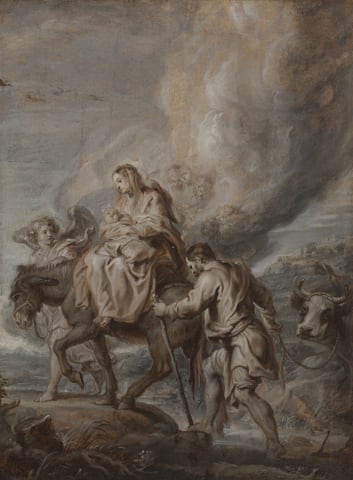
  1. A work made of oil on panel.
    The Flight into EgyptAbraham Jansz. van Diepenbeeck, c. 1650Courtesy of the Art Institute of Chicago
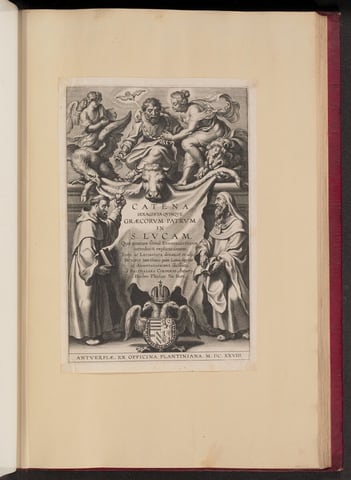
  2. The image features a detailed black and white illustration with multiple human and animal figures in a symbolic arrangement. In the foreground, two full-body figures are depicted in long robes and sandals, positioned on either side of a large draped banner with text. One figure holds an open book. Above the banner are celestial figures in dynamic poses. To the left is a winged bull-like creature and a seated male figure with a beard, next to a female figure in classical attire. They are all surrounded by flowing fabric and a lion-like animal. In the lower center foreground, there is an emblem resembling a coat of arms with an eagle and a crowned shield. The background is textured, with no natural landscape or architecture present, allowing the figures to stand out. The illustration is framed by the margins of an open book.
    Title Page for Balthasar Cordier, Catena Sexaginta Qvinqve Graecorvm Patrvm in S. Lvcam...Cornelis Galle I, 1628Courtesy National Gallery of Art, Washington
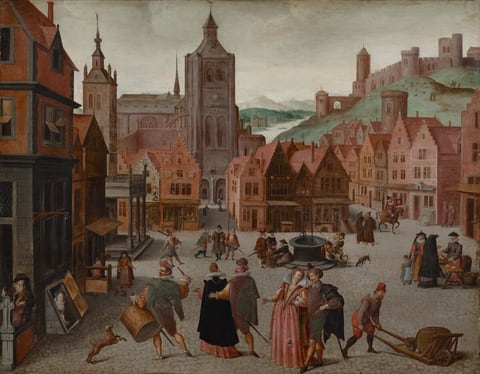
  3. We look slightly down onto a scene with people gathering in small groups in a cobblestone town square lined with rows of brick, wood, and stone buildings, many with stepped rooflines, in this horizontal painting. Singly or in pairs or trios, men, women, and children walk across the square, move goods around, or talk to merchants. All the people have light skin. Many of the men have mustaches and wear hats, and some carry swords. In tones of black, olive green, brick red, and plum purple, they wear hip-length cloaks over jackets, with white collars or ruffs and brass buttons, and knee-length breeches over yellow or black stockings. The women all wear long dresses in salmon pink, coral red, or golden yellow, with white collars or ruffs, and many wear black, ankle-length cloaks, some with hoods. Closest to us, a sumptuously dressed man and woman walk toward us while another similarly elegant couple walks away. Also facing away from us, to our left, a man wearing a large drum strapped around his waist raises one drumstick as he looks over his left shoulder. Nearby, a woman peers up out of a cellar door that opens on an angle to the street. More couples gather around a well across the square, and two women and a child talk to a third woman selling wares at a wooden table to our right. A pair of hooded priests or monks walk near a man blowing on a trumpet on horseback. The buildings are mostly shades of brick red and brown, and most have three or four stories with steeply pitched roofs. More people walk along side streets leading off the main square. One gap in the buildings across from us leads to a nickel-gray stone church with a pointed spire and square tower. A grassy, green hill rises steeply beyond the buildings to our right, leading down to a waterway that extends up and away into the distance. A few boats float in the water, which reflects the leaden-gray sky. Beyond the town square, a brown stone structure like a fortress with turret towers and crenellated walls looms along the ridge of the hill to our right. Tiny in scale, people on horseback and tending sheep dot the hillside below. The date “1590” is painted on the front of one of the buildings across from us while another date, “1597,” is painted on the end of a short wall near the lower left corner.
    The Marketplace in Bergen op ZoomAbel Grimmer, probably 1590 and 1597Courtesy National Gallery of Art, Washington
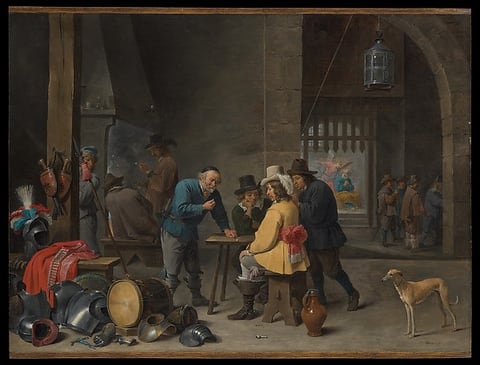
  4. Guardroom with the Deliverance of Saint Peter, by David Teniers the Younger, ca. 1645–47
    Guardroom with the Deliverance of Saint PeterDavid Teniers the Younger, ca. 1645–47Courtesy of The Metropolitan Museum of Art

Second room, south wall
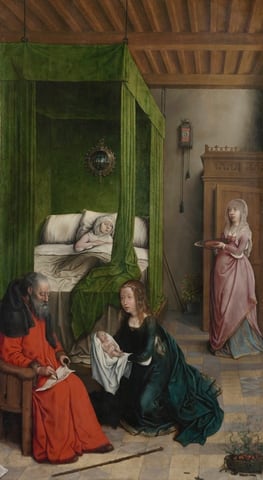
  1. The Birth and Naming of John the Baptist, by Juan de Flandes, 1496–99
    The Birth and Naming of John the BaptistJuan de Flandes, 1496–99Courtesy of the Cleveland Museum of Art
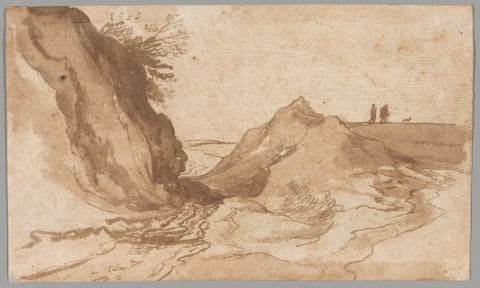
  2. A work made of pen and brush and brown ink and brush and brown wash on ivory laid paper.
    A Hilly Landscape with Figures Near a RavineJan Brueghel the Elder, 1595Courtesy of the Art Institute of Chicago
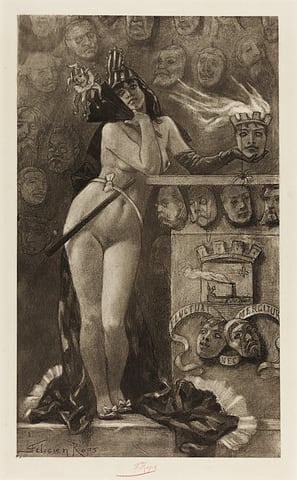
  3. A work made of photogravure in dark brown retouched with soft varnish (vernis mou), roulette and blue handcoloring on thick cream wove paper.
    Modern MasksFélicien Rops, 1889Courtesy of the Art Institute of Chicago
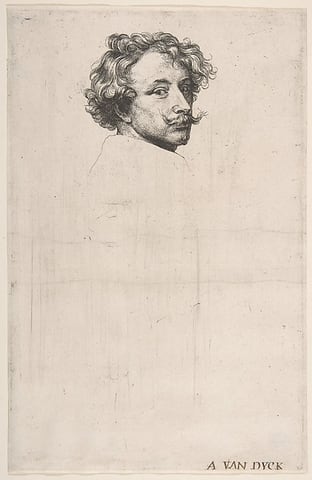
  4. Self-Portrait, from "The Iconography", by Anthony van Dyck, ca. 1640
    Self-Portrait, from "The Iconography"Anthony van Dyck, ca. 1640Courtesy of The Metropolitan Museum of Art

Second room, north wall
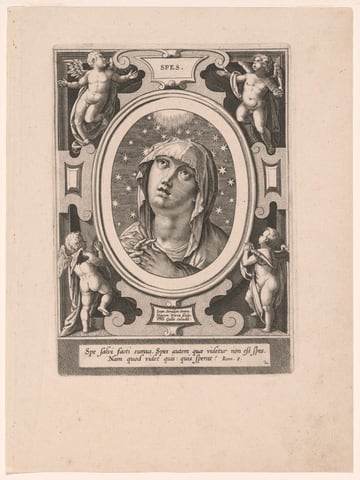
  1. A work made of engraving on paper.
    Spes, plate 2 from The Seven VirtuesHieronymous Wierix, c. 1598Courtesy of the Art Institute of Chicago
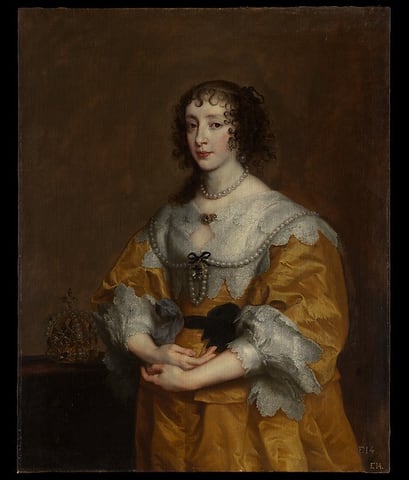
  2. Queen Henrietta Maria, by Anthony van Dyck, 1636
    Queen Henrietta MariaAnthony van Dyck, 1636Courtesy of The Metropolitan Museum of Art
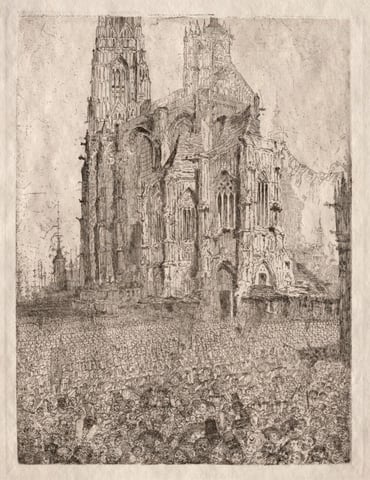
  3. The Cathedral, by James Ensor, 1886
    The CathedralJames Ensor, 1886Courtesy of the Cleveland Museum of Art
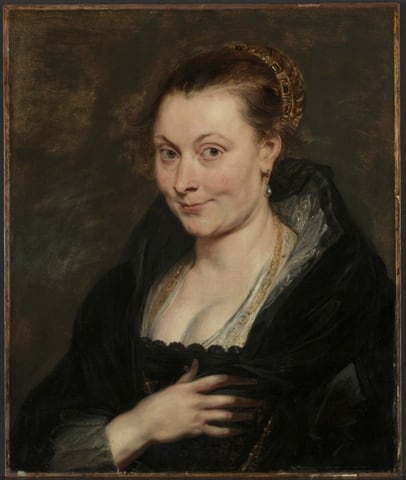
  4. Portrait of Isabella Brant, by Peter Paul Rubens, c. 1620–25
    Portrait of Isabella BrantPeter Paul Rubens, c. 1620–25Courtesy of the Cleveland Museum of Art