Floor plan

Time and place19th-century United States
19th-century United States
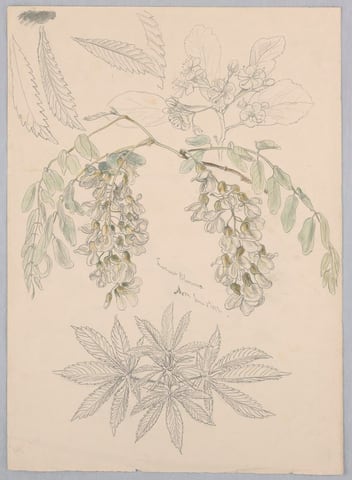
LOCUST BLOSSOMS
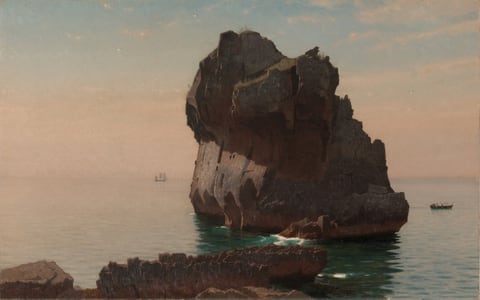
Capri, by William Stanley Haseltine, 1869
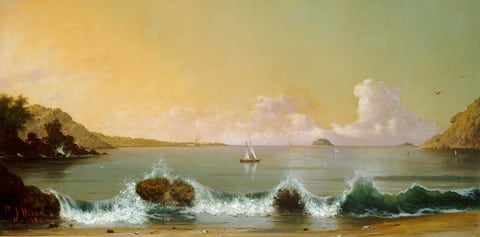
Across a short stretch of sand in front of us, waves of bottle-green water break over two boulders on the shoreline, with sailboats in the water beyond, in this wide, horizontal painting. One boulder is at the left edge of the painting; the other is a short distance away, about a quarter of the way across. The water cascades down between those large rocks. Across the rest of the beach, the waves flare up to break toward us in white, foamy surf. The land curves back into view on both sides of the canvas with muted, sage-green hills and, to our left, dark green trees on more craggy boulders. A more distant finger of land to our left stretches nearly halfway across the horizon, which comes about halfway up the composition. Minuscule in scale there, smoke pours out of a chimney, which is surrounded by pale yellow buildings. A mound emerges from the horizon to our right of center. About ten sailboats float on the water. The closest one to us is near the center of the painting, and the tiny forms of people aboard can just barely be made out. The other boats become smaller as they move back to the horizon, and some are only a touch of white or gray on the canvas. White and pale lavender-purple clouds sweep up from the horizon into the sky, which glows butter yellow along the left edge. The sky cools to mint green in the upper right corner. Several white or brown birds fly across the sky or low over the water. The artist signed and dated the lower left, “M. J. Heade 1864.”
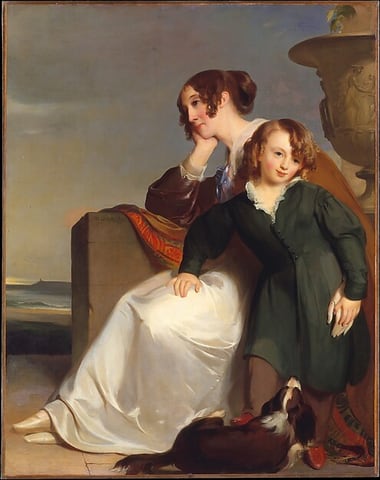
Mother and Son, by Thomas Sully, 1840
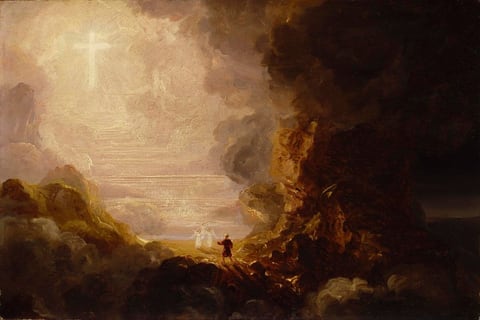
The Pilgrim of the Cross at the End of His Journey (study for series, The Cross and the World), by Thomas Cole, ca. 1846-1848
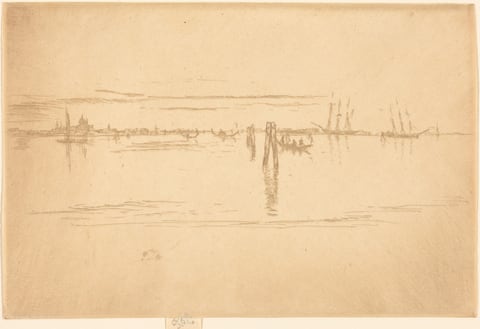
The image shows a landscape with a waterscape. The horizon separates the water and the sky. In the distance, there are buildings, structures, and ships with tall masts. Close to us, there are reflections of the ships and structures in the water with fine brushstrokes. The style is impressionistic with thin lines conveying details. The color palette is monochromatic with sepia tones.

The works in this room are listed below.

Works in this room

Works made in the United States in the 19th century.

Section 1, north wall

  1. LOCUST BLOSSOMS
    Locust BlossomsSamuel Colman, June 6, 1877Courtesy of Cooper Hewitt, Smithsonian Design Museum
  2. Capri, by William Stanley Haseltine, 1869
    CapriWilliam Stanley Haseltine, 1869Courtesy of the Cleveland Museum of Art
  3. Across a short stretch of sand in front of us, waves of bottle-green water break over two boulders on the shoreline, with sailboats in the water beyond, in this wide, horizontal painting. One boulder is at the left edge of the painting; the other is a short distance away, about a quarter of the way across. The water cascades down between those large rocks. Across the rest of the beach, the waves flare up to break toward us in white, foamy surf. The land curves back into view on both sides of the canvas with muted, sage-green hills and, to our left, dark green trees on more craggy boulders. A more distant finger of land to our left stretches nearly halfway across the horizon, which comes about halfway up the composition. Minuscule in scale there, smoke pours out of a chimney, which is surrounded by pale yellow buildings. A mound emerges from the horizon to our right of center. About ten sailboats float on the water. The closest one to us is near the center of the painting, and the tiny forms of people aboard can just barely be made out. The other boats become smaller as they move back to the horizon, and some are only a touch of white or gray on the canvas. White and pale lavender-purple clouds sweep up from the horizon into the sky, which glows butter yellow along the left edge. The sky cools to mint green in the upper right corner. Several white or brown birds fly across the sky or low over the water. The artist signed and dated the lower left, “M. J. Heade 1864.”
    Rio de Janeiro BayMartin Johnson Heade, 1864Courtesy National Gallery of Art, Washington

Section 1, south wall

  1. Mother and Son, by Thomas Sully, 1840
    Mother and SonThomas Sully, 1840Courtesy of The Metropolitan Museum of Art
  2. The Pilgrim of the Cross at the End of His Journey (study for series, The Cross and the World), by Thomas Cole, ca. 1846-1848
    The Pilgrim of the Cross at the End of His Journey (study for series, The Cross and the World)Thomas Cole, ca. 1846-1848Courtesy of the Smithsonian American Art Museum
  3. The image shows a landscape with a waterscape. The horizon separates the water and the sky. In the distance, there are buildings, structures, and ships with tall masts. Close to us, there are reflections of the ships and structures in the water with fine brushstrokes. The style is impressionistic with thin lines conveying details. The color palette is monochromatic with sepia tones.
    Long LagoonJames McNeill Whistler, 1880Courtesy National Gallery of Art, Washington

Section 2, south wall
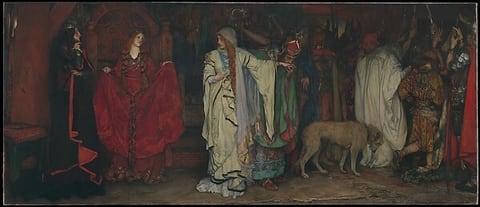
  1. "King Lear," Act I, Scene I, by Edwin Austin Abbey, 1898
    "King Lear," Act I, Scene IEdwin Austin Abbey, 1898Courtesy of The Metropolitan Museum of Art
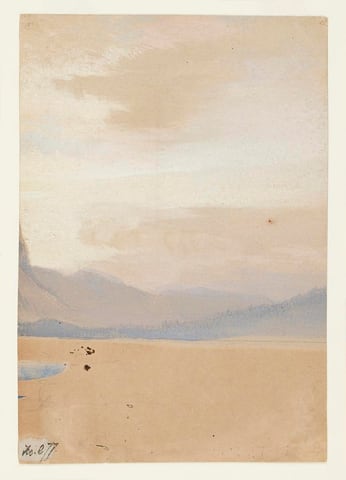
  2. AMERICAN PLAINS WITH MOUNTAIN RANGE IN THE DISTANCE
    American Plains with Mountain Range in the DistanceThomas Moran, before 1872Courtesy of Cooper Hewitt, Smithsonian Design Museum
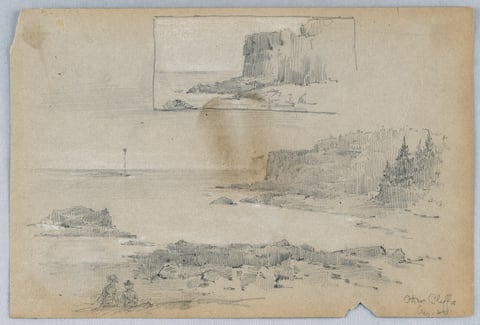
  3. OTTER CLIFFS
    Otter CliffsArnold William Brunner, 1879–80Courtesy of Cooper Hewitt, Smithsonian Design Museum

Section 2, north wall
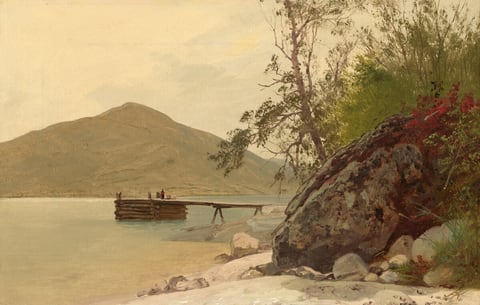
  1. The painting depicts a tranquil lake scene with a low horizon line showing a pale green hill in the background under a pale, cloudy sky. Closer to us, on the right, there is a large, textured rock surrounded by greenery and red flowers. In the distance, a wooden dock extends into the lake on the left, and a person wearing red appears to sit or stand with their back to us.
    Landing at Sabbath Day PointJohn Frederick Kensett, c. 1853Courtesy National Gallery of Art, Washington
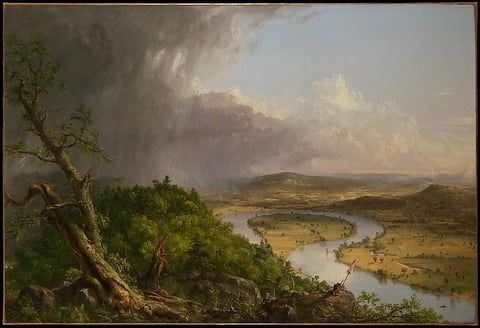
  2. View from Mount Holyoke, Northampton, Massachusetts, after a Thunderstorm—The Oxbow, by Thomas Cole, 1836
    View from Mount Holyoke, Northampton, Massachusetts, after a Thunderstorm—The OxbowThomas Cole, 1836Courtesy of The Metropolitan Museum of Art
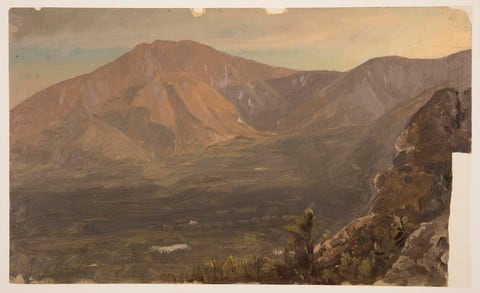
  3. MT. KATAHDIN FROM SOUTH TURNER MOUNTAIN, MAINE
    Mt. Katahdin from South Turner Mountain, MaineFrederic Edwin Church, 1877–78Courtesy of Cooper Hewitt, Smithsonian Design Museum

Section 3, north wall
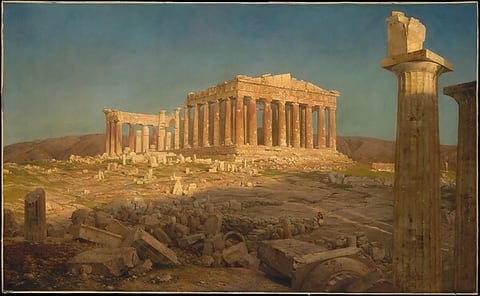
  1. The Parthenon, by Frederic Edwin Church, 1871
    The ParthenonFrederic Edwin Church, 1871Courtesy of The Metropolitan Museum of Art
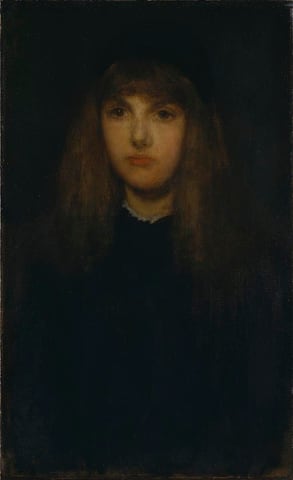
  2. James Abbott McNeill Whistler
    Girl in Black (Pouting Tom)James McNeill Whistler, (1896-1901)Courtesy of the Hirshhorn Museum and Sculpture Garden, Smithsonian Institution

Section 3, south wall
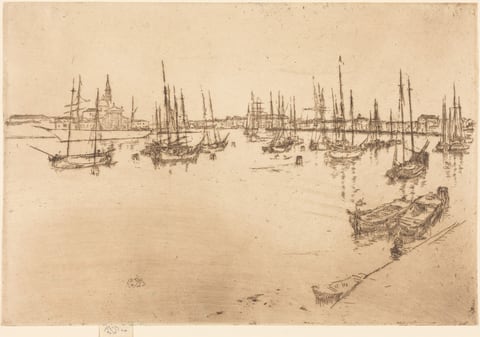
  1. The image displays a harbor filled with boats and ships. The perspective is slightly elevated, likely from a dock, with a partially visible boat and dock at the forefront. The horizon is in the upper third of the image, showing a distant cityscape with spires and structures. The brushwork is delicate, with fine, linear strokes typical of etching. The color palette is monochromatic, sepia tones creating a vintage and serene mood. The ships with tall masts populate the water, with reflections giving a sense of stillness. In the distance, faint impressions of buildings line the harbor, blending into the horizon.
    San GiorgioJames McNeill Whistler, 1880Courtesy National Gallery of Art, Washington
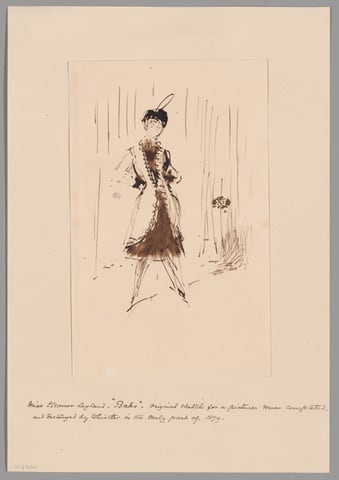
  2. A work made of pen and brown ink, with brush and brown ink, on cream pseudo-laid paper tipped onto cream wove paper.
    Study for "The Blue Girl: Portrait of Miss Elinor Leyland"James McNeill Whistler, c. 1879Courtesy of the Art Institute of Chicago