Floor plan

Time and place19th-century France

19th-century France

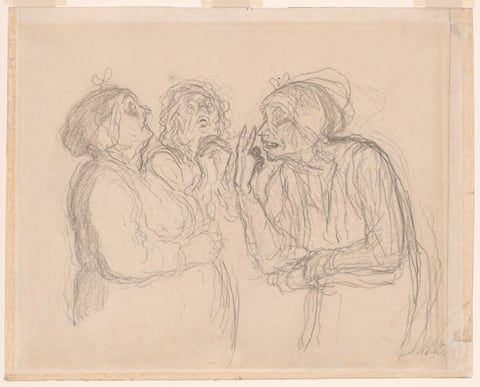
A work made of black crayon and charcoal, on ivory laid paper.
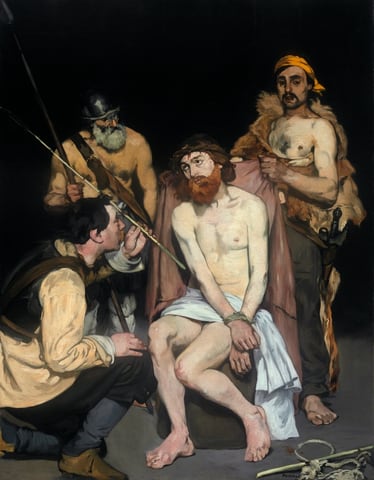
Large, dark painting of Jesus sitting with three standing soldiers.
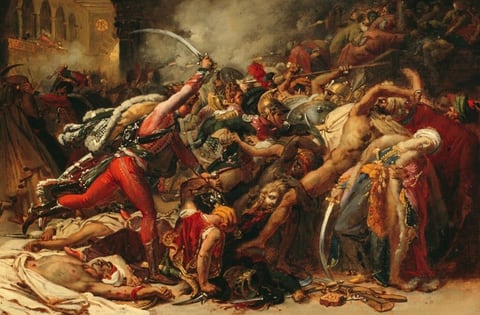
A work made of oil and ink on paper, laid down on canvas.
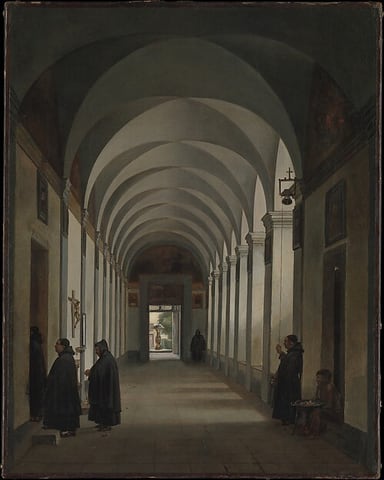
Monks in the Cloister of the Church of Gesù e Maria, Rome, by François Marius Granet, 1808
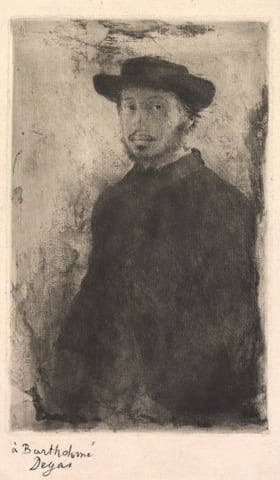
Self-Portrait, by Edgar Degas, 1857
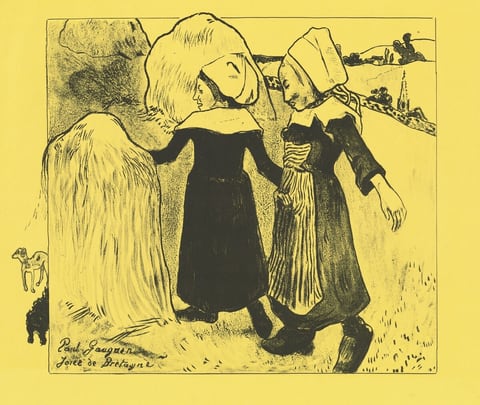
The image shows two women walking arm in arm, both in traditional attire. One woman is facing away with a slight profile, while the other is seen from the side. Their faces are stylized and simplistic with covered hair. They wear long dresses with aprons and collars, and one has a striped apron. Haystacks and greenery surround them. Faint figures are in the background, as well as a spire-like structure. A dog is seen near the haystack, with simple lines suggesting a landscape.
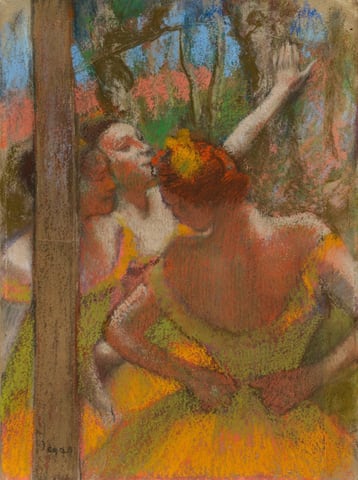
Dancers, by Edgar Degas, c. 1896

The works in this room are listed below.

Works in this room

Works made in France in the 19th century.

First room, north wall

  1. A work made of black crayon and charcoal, on ivory laid paper.
    Three GossipsHonoré Daumier, 1865/1867Courtesy of the Art Institute of Chicago
  2. Large, dark painting of Jesus sitting with three standing soldiers.
    Jesus Mocked by the SoldiersÉdouard Manet, 1865Courtesy of the Art Institute of Chicago
  3. A work made of oil and ink on paper, laid down on canvas.
    Sketch for The Revolt of CairoAnne-Louis Girodet de Roussy-Trioson, c. 1810Courtesy of the Art Institute of Chicago

First room, south wall

  1. Monks in the Cloister of the Church of Gesù e Maria, Rome, by François Marius Granet, 1808
    Monks in the Cloister of the Church of Gesù e Maria, RomeFrançois Marius Granet, 1808Courtesy of The Metropolitan Museum of Art
  2. Self-Portrait, by Edgar Degas, 1857
    Self-PortraitEdgar Degas, 1857Courtesy of the Cleveland Museum of Art
  3. The image shows two women walking arm in arm, both in traditional attire. One woman is facing away with a slight profile, while the other is seen from the side. Their faces are stylized and simplistic with covered hair. They wear long dresses with aprons and collars, and one has a striped apron. Haystacks and greenery surround them. Faint figures are in the background, as well as a spire-like structure. A dog is seen near the haystack, with simple lines suggesting a landscape.
    Pleasures of Brittany (Joies de Bretagne)Paul Gauguin, 1889Courtesy National Gallery of Art, Washington
  4. Dancers, by Edgar Degas, c. 1896
    DancersEdgar Degas, c. 1896Courtesy of the Cleveland Museum of Art

Second room, south wall
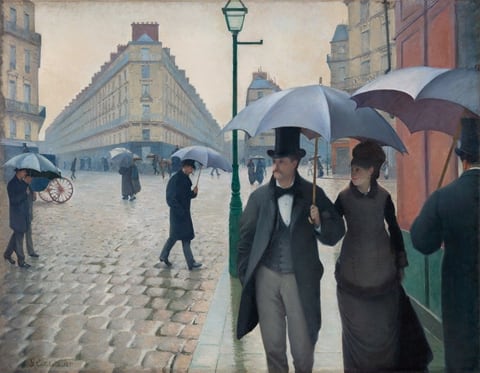
  1. Life-size painting of an urban scene in Paris. A man in a top hat holding an umbrella and a woman in a long fashionable dark dress walk arm in arm toward the viewer as other city dwellers with umbrellas walk in various directions across cobblestone roads and sidewalks.
    Paris Street; Rainy DayGustave Caillebotte, 1877Courtesy of the Art Institute of Chicago
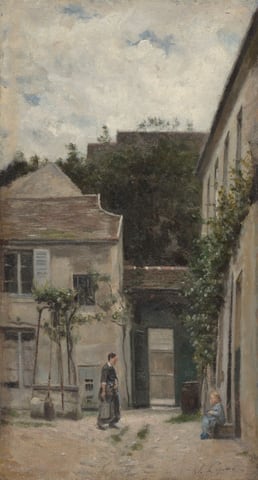
  2. A work made of oil on canvas.
    The CourtyardStanislas Lépine, c. 1880Courtesy of the Art Institute of Chicago

Second room, north wall
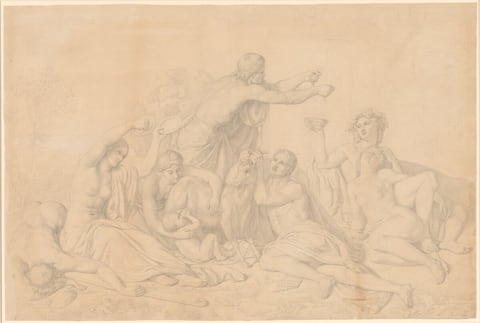
  1. This is a drawing of a group of mythological figures in a ceremonial scene. The composition features multiple figures in various poses, centered around a symbolic gathering. The drawing is detailed, providing a classical representation of human forms, draped fabrics, and an animal. A plateau with trees is subtly depicted in the background. The figures display expressions ranging from serene to contemplative.
    The Nursing of JupiterThéodore ChassériauCourtesy National Gallery of Art, Washington
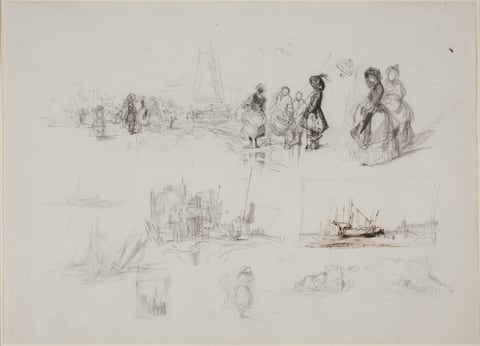
  2. This image is a pencil sketch on paper with a monochrome palette of graphite gray. The viewer sees various scenes without a defined horizon line. The upper section shows figures in period clothing, possibly mid-19th century women's fashion. The middle area has abstract architectural forms. In the lower right corner, a sailing ship or boat is sketched with more detail than the rest. The drawing style consists of quick, expressive strokes. The image conveys multiple narrative or compositional ideas on a single sheet.
    Seaside StudiesEugène Isabey, 1830sCourtesy National Gallery of Art, Washington
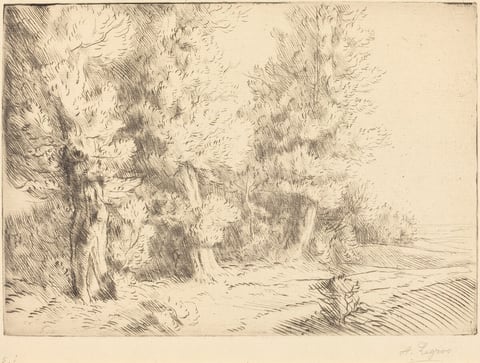
  3. The image shows a sketch-like scene viewed from a slightly elevated perspective, depicting a landscape dominated by a line of trees. The horizon is low in the image, just above a rising slope, with tall trees extending towards the sky. The trees and foliage are characterized by brushstrokes and crosshatching technique, conveying texture and shading. The color palette is monochromatic, with dark and light tones for a serene, natural quality. Line and shadow add movement and highlight the beauty of the trees as they recede into the distance, merging with the sky.
    In the Forest of Fontainebleau (Dans la foret de Fontainebleau)Alphonse LegrosCourtesy National Gallery of Art, Washington

Third room, north wall
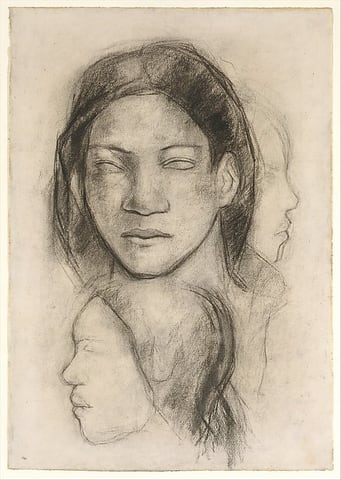
  1. Tahitian Faces (Frontal View and Profiles), by Paul Gauguin, ca. 1899
    Tahitian Faces (Frontal View and Profiles)Paul Gauguin, ca. 1899Courtesy of The Metropolitan Museum of Art
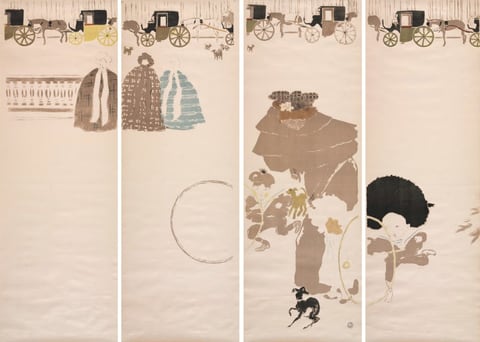
  2. Nursemaids’ Promenade, Frieze of Carriages, by Pierre Bonnard, 1895
    Nursemaids’ Promenade, Frieze of CarriagesPierre Bonnard, 1895Courtesy of the Cleveland Museum of Art
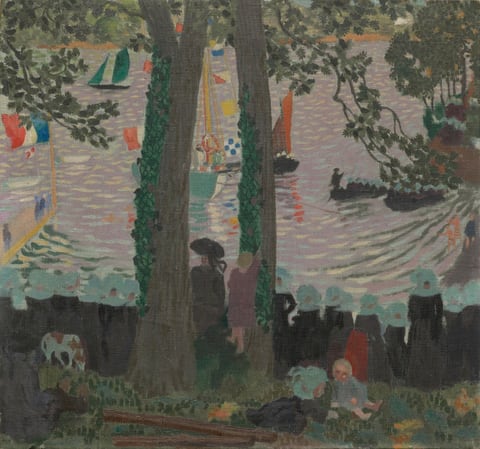
  3. Blessing of a Yacht on the Belon River, by Maurice Denis, 1899
    Blessing of a Yacht on the Belon RiverMaurice Denis, 1899Courtesy of the Cleveland Museum of Art
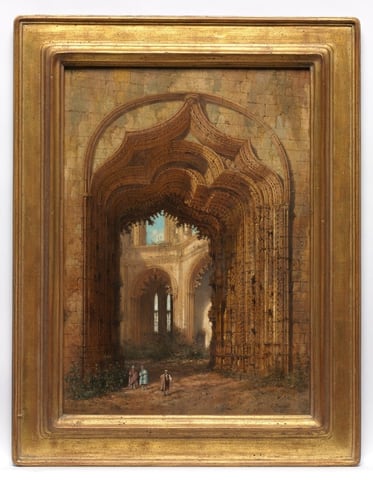
  4. Ruined Church, by Adrien Dauzats, c. 1840
    Ruined ChurchAdrien Dauzats, c. 1840Courtesy of the Cleveland Museum of Art