Floor plan

Time and place17th-century Netherlands
17th-century Netherlands
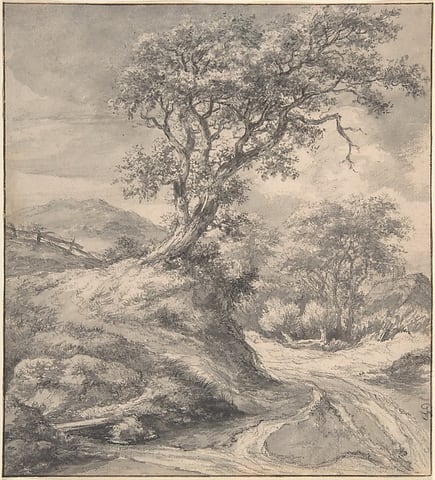
Dune Landscape with Oak Tree, by Jacob van Ruisdael, 1650–55
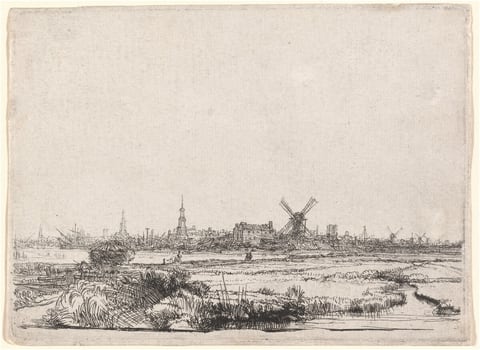
View of Amsterdam from the Northwest, by Rembrandt van Rijn, c. 1640
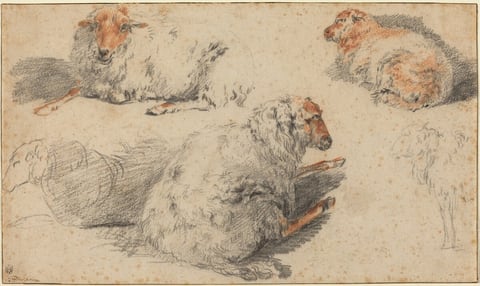
This is a drawing of multiple sheep in various poses. The full-page illustration depicts several sheep lying down. The fur of the sheep is textured with detailed pencil strokes, and there are subtle hints of shadow beneath each animal. There is a combination of different angles and poses, showing the sheep from different perspectives. The drawing also contains some rough sketches and outlines, suggesting movement and presence without complete detail. The background is plain.
A work made of pen and brown ink and brush and brown wash, with traces of black chalk and opaque white watercolor, on cream laid paper, laid down on cream laid paper.
Rush Gatherers, by Nicolaes Berchem, 1657
Gathered in a round glass vase, a tall bouquet of flowers in shades of light and deep pink, sunshine yellow, and white with pine-green leaves nearly fills this vertical still life painting. Shown against an gray background, the vase sits on a narrow ledge, perhaps made of wood. A label with looping, cursive French text painted in gold against a baby blue background is affixed to the front of the ledge, along the bottom edge of the composition. The text reads, “C'est l'Angelicq main du grad Peinctre de Flore AMBROISE, renommé jusqu' au Rivage Moré.” A few of the flowers draw the eye, including a tulip and iris at the top of the bouquet. To our left, the tulip is mauve pink with cream-colored streaks, and one petal folds down to reveal the stamen inside. Next to it, a damselfly, an insect like a delicate dragonfly, rests on the vibrant yellow iris. The petals curling down from the iris are veined in muted burgundy red. Flowers filling in the bouquet below include a shell-pink cyclamen, a white gardenia, a closed blue and white striped columbine, a slate-blue grape hyacinth, lily of the valley, pale blue forget-me-nots, and a pink peony interspersed with leaves and greenery. The round glass vase has a narrow opening. A sprig of viola rests to our left of the vase on the ledge, and an orange, black, white, and brown butterfly perches on the stem of a pink cyclamen laying to our right of the vase. The artist signed the painting with a monogram and dated it in dark paint to our right on the face of the ledge: “AB 1621.”
A work made of oil on canvas.

The works in this room are listed below.

Works in this room

Works made in the Netherlands in the 17th century.

First room, north wall

  1. Dune Landscape with Oak Tree, by Jacob van Ruisdael, 1650–55
    Dune Landscape with Oak TreeJacob van Ruisdael, 1650–55Courtesy of The Metropolitan Museum of Art
  2. View of Amsterdam from the Northwest, by Rembrandt van Rijn, c. 1640
    View of Amsterdam from the NorthwestRembrandt van Rijn, c. 1640Courtesy National Gallery of Art, Washington
  3. This is a drawing of multiple sheep in various poses. The full-page illustration depicts several sheep lying down. The fur of the sheep is textured with detailed pencil strokes, and there are subtle hints of shadow beneath each animal. There is a combination of different angles and poses, showing the sheep from different perspectives. The drawing also contains some rough sketches and outlines, suggesting movement and presence without complete detail. The background is plain.
    SheepNicolaes BerchemCourtesy National Gallery of Art, Washington
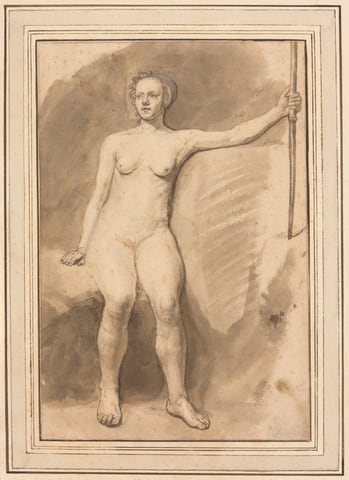
  4. A work made of pen and brown ink and brush and brown wash, with traces of black chalk and opaque white watercolor, on cream laid paper, laid down on cream laid paper.
    Seated Female NudeSamuel van Hoogstraten, 1647/78Courtesy of the Art Institute of Chicago

First room, south wall

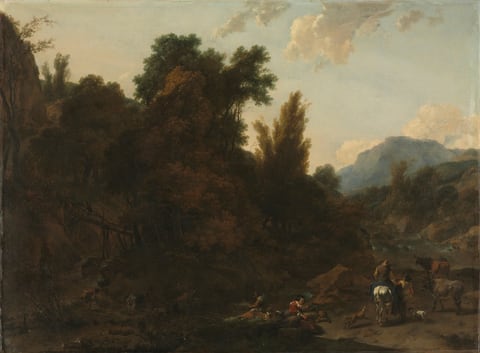
  1. Rush Gatherers, by Nicolaes Berchem, 1657
    Rush GatherersNicolaes Berchem, 1657Courtesy of the Cleveland Museum of Art
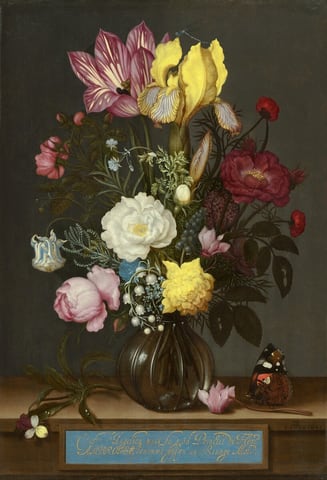
  2. Gathered in a round glass vase, a tall bouquet of flowers in shades of light and deep pink, sunshine yellow, and white with pine-green leaves nearly fills this vertical still life painting. Shown against an gray background, the vase sits on a narrow ledge, perhaps made of wood. A label with looping, cursive French text painted in gold against a baby blue background is affixed to the front of the ledge, along the bottom edge of the composition. The text reads, “C'est l'Angelicq main du grad Peinctre de Flore AMBROISE, renommé jusqu' au Rivage Moré.” A few of the flowers draw the eye, including a tulip and iris at the top of the bouquet. To our left, the tulip is mauve pink with cream-colored streaks, and one petal folds down to reveal the stamen inside. Next to it, a damselfly, an insect like a delicate dragonfly, rests on the vibrant yellow iris. The petals curling down from the iris are veined in muted burgundy red. Flowers filling in the bouquet below include a shell-pink cyclamen, a white gardenia, a closed blue and white striped columbine, a slate-blue grape hyacinth, lily of the valley, pale blue forget-me-nots, and a pink peony interspersed with leaves and greenery. The round glass vase has a narrow opening. A sprig of viola rests to our left of the vase on the ledge, and an orange, black, white, and brown butterfly perches on the stem of a pink cyclamen laying to our right of the vase. The artist signed the painting with a monogram and dated it in dark paint to our right on the face of the ledge: “AB 1621.”
    Bouquet of Flowers in a Glass VaseAmbrosius Bosschaert, 1621Courtesy National Gallery of Art, Washington
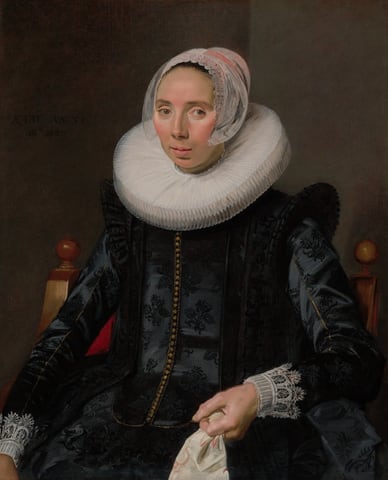
  3. A work made of oil on canvas.
    Portrait of a LadyFrans Hals, 1627Courtesy of the Art Institute of Chicago

Second room, south wall
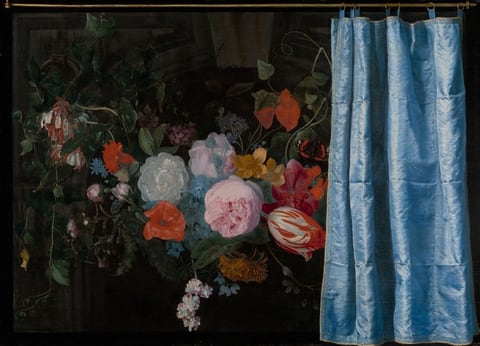
  1. A work made of oil on panel.
    Trompe-l'Oeil Still Life with a Flower Garland and a CurtainAdriaen van der Spelt, 1658Courtesy of the Art Institute of Chicago
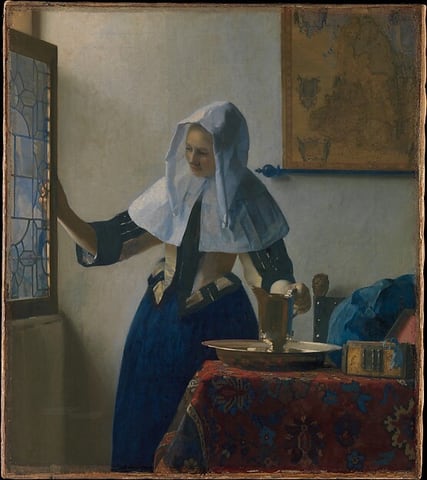
  2. Young Woman with a Water Pitcher, by Johannes Vermeer, ca. 1662
    Young Woman with a Water PitcherJohannes Vermeer, ca. 1662Courtesy of The Metropolitan Museum of Art
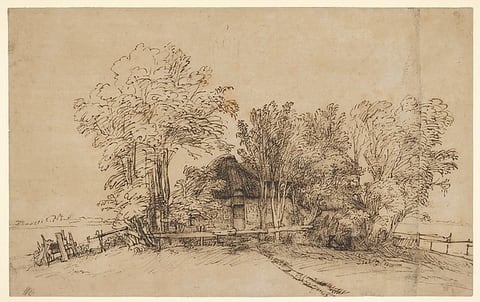
  3. Cottage among Trees, by Rembrandt van Rijn, ca. 1650
    Cottage among TreesRembrandt van Rijn, ca. 1650Courtesy of The Metropolitan Museum of Art

Second room, north wall
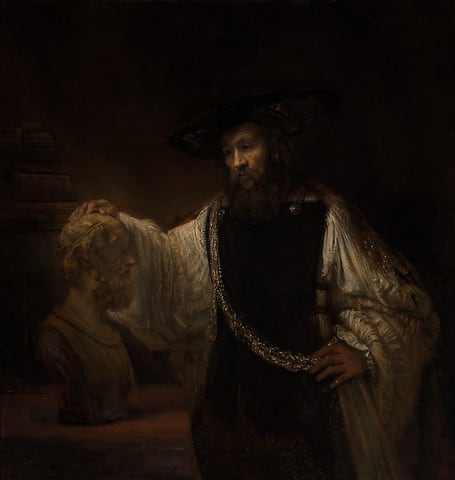
  1. Aristotle with a Bust of Homer, by Rembrandt van Rijn, 1653
    Aristotle with a Bust of HomerRembrandt van Rijn, 1653Courtesy of The Metropolitan Museum of Art
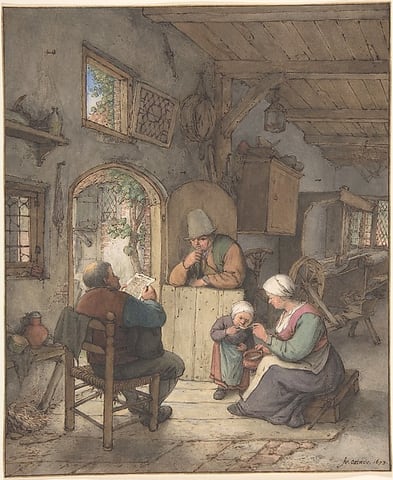
  2. Reading the News at the Weavers' Cottage, by Adriaen van Ostade, 1673
    Reading the News at the Weavers' CottageAdriaen van Ostade, 1673Courtesy of The Metropolitan Museum of Art
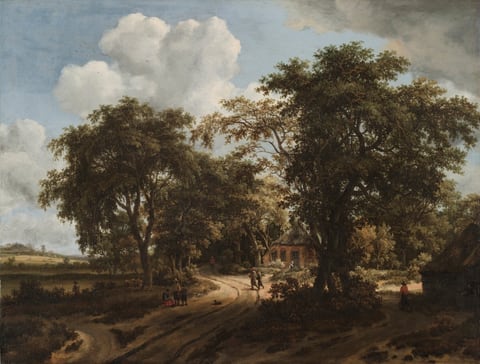
  3. A Cottage in the Woods, by Meindert Hobbema, c. 1662
    A Cottage in the WoodsMeindert Hobbema, c. 1662Courtesy of the Cleveland Museum of Art

Third room, north wall
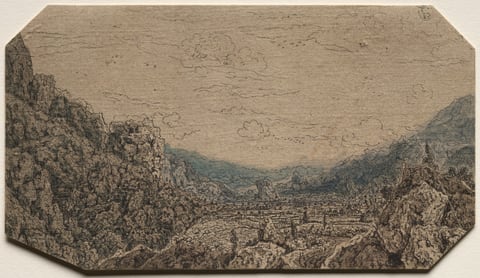
  1. Enclosed Valley, by Hercules Seghers, c. 1623–30
    Enclosed ValleyHercules Seghers, c. 1623–30Courtesy of the Cleveland Museum of Art
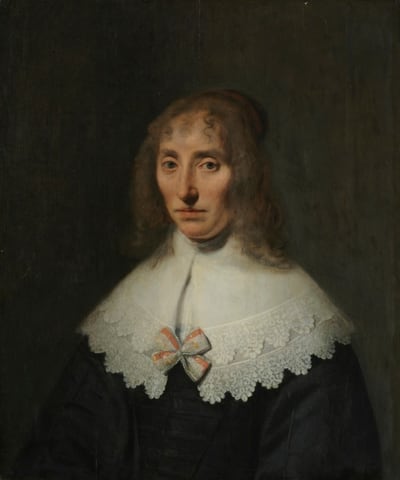
  2. Portrait of a Woman, by Govaert Flinck, 1646
    Portrait of a WomanGovaert Flinck, 1646Courtesy of the Cleveland Museum of Art
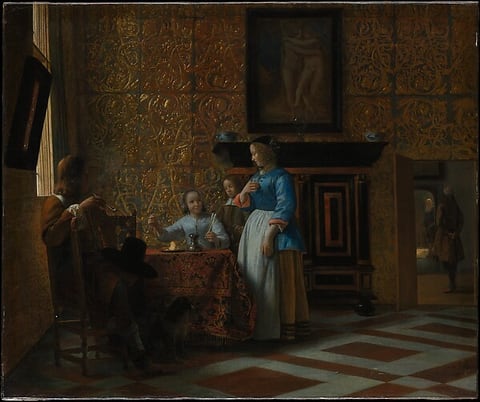
  3. Leisure Time in an Elegant Setting, by Pieter de Hooch, ca. 1663–65
    Leisure Time in an Elegant SettingPieter de Hooch, ca. 1663–65Courtesy of The Metropolitan Museum of Art