Floor plan

Artist galleriesWinslow Homer

Winslow Homer

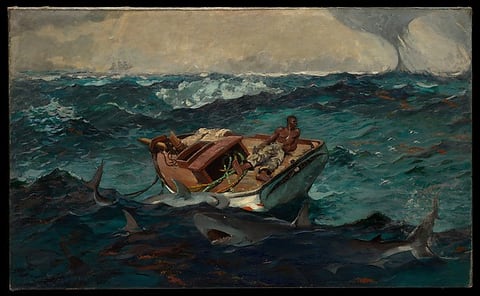
The Gulf Stream, by Winslow Homer, 1899; reworked by 1906
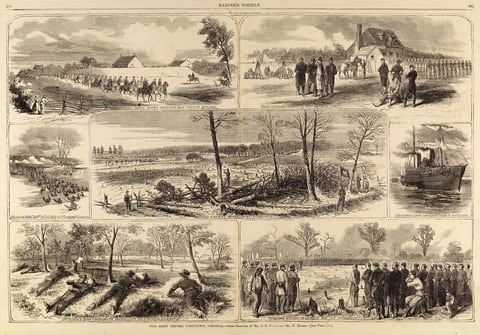
Our Army before Yorktown, Virginia, from Harper's Weekly, May 3, 1862, by Winslow Homer, 1862
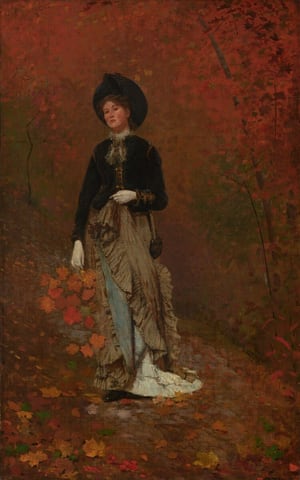
A woman with smooth, pale skin and wearing a hat, long dress, and gloves, stands holding a bunch of pumpkin-orange leaves against a background of trees painted with touches of rust orange and pine green in this vertical painting. The woman tips her head back slightly to look at us with dark eyes under arched eyebrows. Her cheeks are flushed and her coral-pink lips closed. Her round black hat perches on the back of her head and she has an inky black, long-sleeved, hip-length jacket with bronze trim at the shoulders, cuffs, and down the front. A gauzy bow is tied at her neck. Her left elbow, on our right, is bent and she holds up her tan-colored, ruffled skirt with a white-gloved hand. The raised skirt exposes sky-blue lining and white, ruffled flounces at her feet. Her right arm, on our left, hangs at her side and holds the handle of a basket. Deep marigold-orange leaves cascade out of the basket. One black shoe peeks out from under her long skirt. She stands on a hill carpeted with crimson-red, tawny-brown, golden yellow, and forest-green leaves. The space behind her is filled with touches and dabs of red, orange, brown, black, and tan.
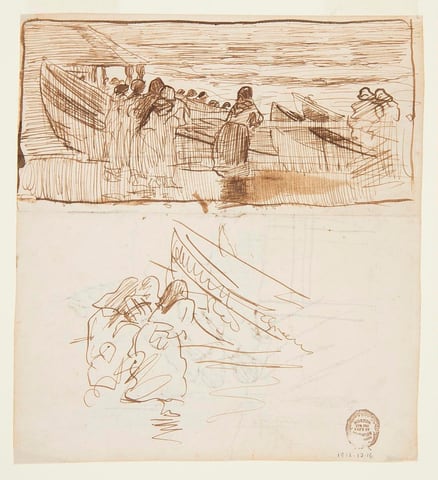
TWO STUDIES OF WOMEN STANDING BEHIND RAILING, LOOKING AT THE LAUNCHING OF DORIES, CULLERCOATS, ENGLAND
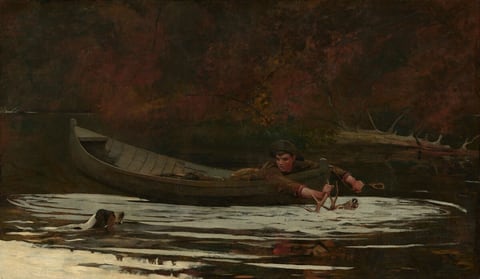
A young man with a peachy, ruddy complexion lies on his stomach in a wooden rowboat on a river, reaching forward to grasp the horn of a stag almost completely submerged in the rippling water with one hand. On the opposite riverbank, gold, rust, and scarlet-red trees span the width of this horizontal painting. The boy’s arms straddle the stern of the boat so one holds the antler with his right hand, closer to us, while the other clutches a rope with a loop at the end. He turns his face, mouth agape and cheeks flushed, over his right shoulder to look to our left, at a dog swimming toward the boat. The dog has white and caramel-brown markings, with dark brown ears. The boy wears earth-brown clothing and the front of his wide-brimmed hat is pushed up to reveal dark eyes and sable-brown bangs and brows. The stag and dog are between us and the boat, and are surrounded by thick brushstrokes of parchment white to create ripples in the forest-green water. Only the open muzzle, part of the eye, and the tips of the stag’s antlers are above the water’s surface. To our right, a bare, fallen tree lies along the far riverbank parallel to the boat. The boat and water fill the lower half of the scene and the autumn trees fill the upper half. The artist has signed and dated the painting in the lower right, “Winslow Homer 1892.”
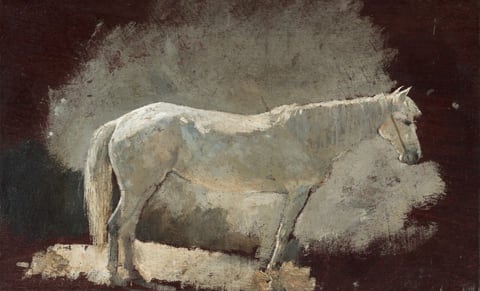
White Mare, by Winslow Homer, c. 1868
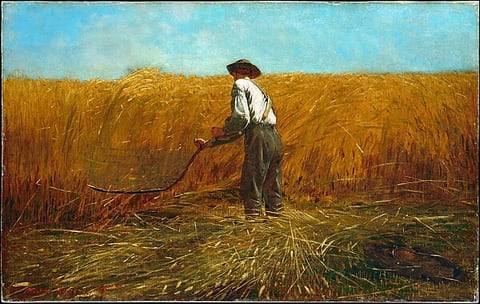
The Veteran in a New Field, by Winslow Homer, 1865

The works in this room are listed below.

Works in this room

Winslow Homer (American, 1836–1910). Every work of theirs in the collection, in today's hang.

Section 1, north wall

  1. The Gulf Stream, by Winslow Homer, 1899; reworked by 1906
    The Gulf StreamWinslow Homer, 1899; reworked by 1906Courtesy of The Metropolitan Museum of Art
  2. Our Army before Yorktown, Virginia, from Harper's Weekly, May 3, 1862, by Winslow Homer, 1862
    Our Army before Yorktown, Virginia, from Harper's Weekly, May 3, 1862Winslow Homer, 1862Courtesy of the Smithsonian American Art Museum
  3. A woman with smooth, pale skin and wearing a hat, long dress, and gloves, stands holding a bunch of pumpkin-orange leaves against a background of trees painted with touches of rust orange and pine green in this vertical painting. The woman tips her head back slightly to look at us with dark eyes under arched eyebrows. Her cheeks are flushed and her coral-pink lips closed. Her round black hat perches on the back of her head and she has an inky black, long-sleeved, hip-length jacket with bronze trim at the shoulders, cuffs, and down the front. A gauzy bow is tied at her neck. Her left elbow, on our right, is bent and she holds up her tan-colored, ruffled skirt with a white-gloved hand. The raised skirt exposes sky-blue lining and white, ruffled flounces at her feet. Her right arm, on our left, hangs at her side and holds the handle of a basket. Deep marigold-orange leaves cascade out of the basket. One black shoe peeks out from under her long skirt. She stands on a hill carpeted with crimson-red, tawny-brown, golden yellow, and forest-green leaves. The space behind her is filled with touches and dabs of red, orange, brown, black, and tan.
    AutumnWinslow Homer, 1877Courtesy National Gallery of Art, Washington
  4. TWO STUDIES OF WOMEN STANDING BEHIND RAILING, LOOKING AT THE LAUNCHING OF DORIES, CULLERCOATS, ENGLAND
    Two Studies of Women Standing behind Railing, Looking at the Launching of Dories, Cullercoats, EnglandWinslow Homer, 1881Courtesy of Cooper Hewitt, Smithsonian Design Museum

Section 1, south wall

  1. A young man with a peachy, ruddy complexion lies on his stomach in a wooden rowboat on a river, reaching forward to grasp the horn of a stag almost completely submerged in the rippling water with one hand. On the opposite riverbank, gold, rust, and scarlet-red trees span the width of this horizontal painting. The boy’s arms straddle the stern of the boat so one holds the antler with his right hand, closer to us, while the other clutches a rope with a loop at the end. He turns his face, mouth agape and cheeks flushed, over his right shoulder to look to our left, at a dog swimming toward the boat. The dog has white and caramel-brown markings, with dark brown ears. The boy wears earth-brown clothing and the front of his wide-brimmed hat is pushed up to reveal dark eyes and sable-brown bangs and brows. The stag and dog are between us and the boat, and are surrounded by thick brushstrokes of parchment white to create ripples in the forest-green water. Only the open muzzle, part of the eye, and the tips of the stag’s antlers are above the water’s surface. To our right, a bare, fallen tree lies along the far riverbank parallel to the boat. The boat and water fill the lower half of the scene and the autumn trees fill the upper half. The artist has signed and dated the painting in the lower right, “Winslow Homer 1892.”
    Hound and HunterWinslow Homer, 1892Courtesy National Gallery of Art, Washington
  2. White Mare, by Winslow Homer, c. 1868
    White MareWinslow Homer, c. 1868Courtesy of the Cleveland Museum of Art
  3. The Veteran in a New Field, by Winslow Homer, 1865
    The Veteran in a New FieldWinslow Homer, 1865Courtesy of The Metropolitan Museum of Art

Section 2, south wall
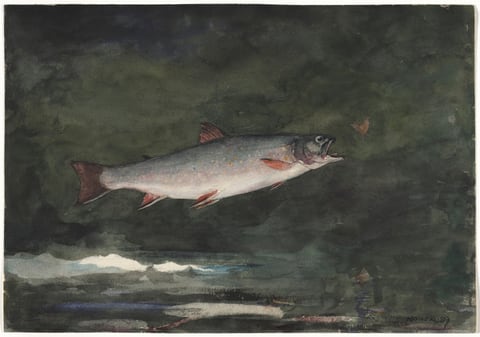
  1. Leaping Trout, by Winslow Homer, 1889
    Leaping TroutWinslow Homer, 1889Courtesy of the Cleveland Museum of Art
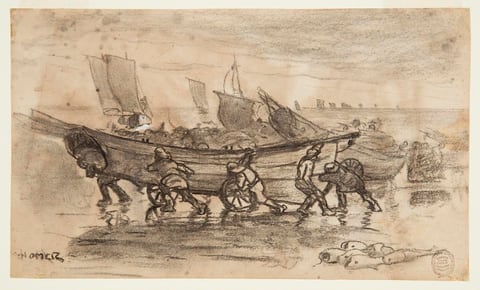
  2. FISHERMEN BEACHING A DORY, CULLERCOATS, ENGLAND
    Fishermen Beaching a Dory, Cullercoats, EnglandWinslow Homer, 1881Courtesy of Cooper Hewitt, Smithsonian Design Museum
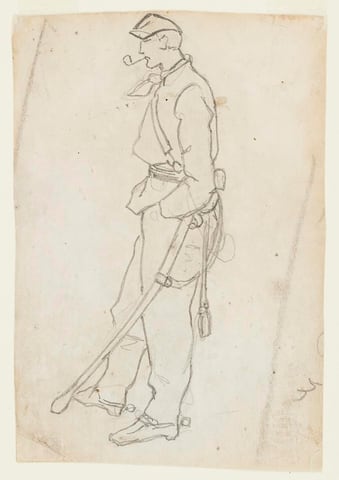
  3. SOLDIER WITH SWORD AND PIPE
    Soldier with Sword and PipeWinslow Homer, 1862Courtesy of Cooper Hewitt, Smithsonian Design Museum
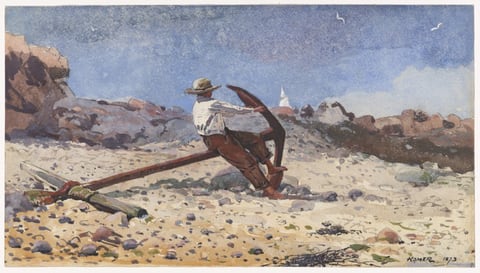
  4. Boy with Anchor, by Winslow Homer, 1873
    Boy with AnchorWinslow Homer, 1873Courtesy of the Cleveland Museum of Art

Section 2, north wall
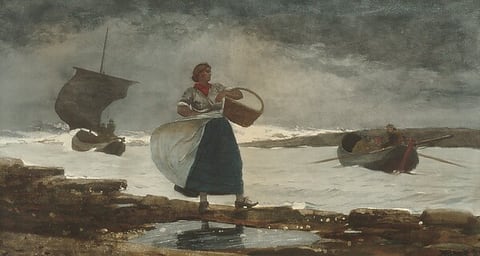
  1. Inside the Bar, by Winslow Homer, 1883
    Inside the BarWinslow Homer, 1883Courtesy of The Metropolitan Museum of Art
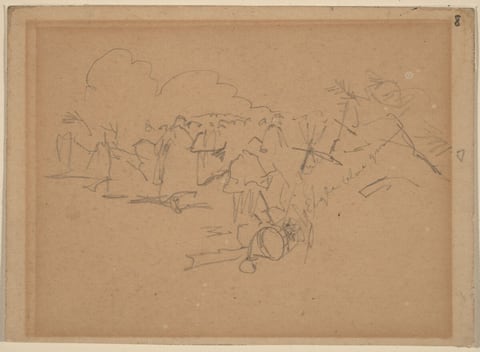
  2. The image displays curved and angular lines creating an abstract composition hinting at humanoid shapes and possible vegetation or trees. The lines suggest motion and activity, with shapes resembling drums and sticks scattered around. The overall impression is of a gathering or event, with figures depicted standing or moving, along with lines indicating movement or sound waves from musical instruments.
    End of the March [recto]Winslow Homer, 1862Courtesy National Gallery of Art, Washington
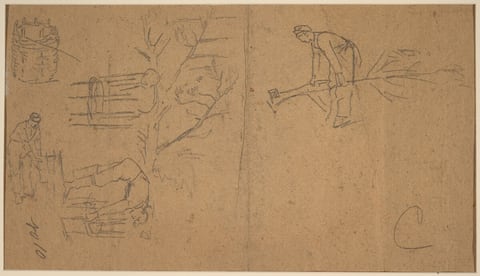
  3. This is a drawing of various sketches related to woodcutting or carpentry. The drawing features several pencil sketches on tan paper. On the left side, there are depictions of a barrel or basket, and beneath it, several outline sketches of figures engaged in activities involving woodwork. The right side of the drawing shows a figure bent over a large beam or branch. The sketches are simple, with minimal detail, capturing the basic form and movement of the figures and objects involved in woodwork-related activities.
    Soldiers felling sapling, and weaving saplings into baskets [verso]Winslow Homer, 1862Courtesy National Gallery of Art, Washington

Section 3, north wall
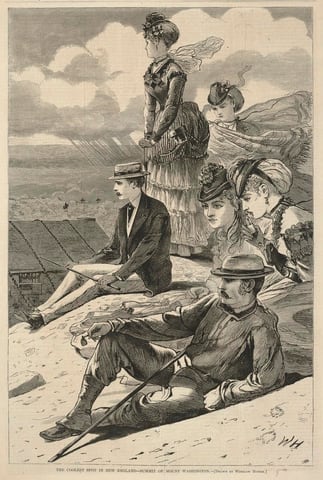
  1. The Coolest Spot in New England--Summit of Mount Washington, from Harper's Bazar, July 23, 1870, by Winslow Homer, 1870
    The Coolest Spot in New England--Summit of Mount Washington, from Harper's Bazar, July 23, 1870Winslow Homer, 1870Courtesy of the Smithsonian American Art Museum
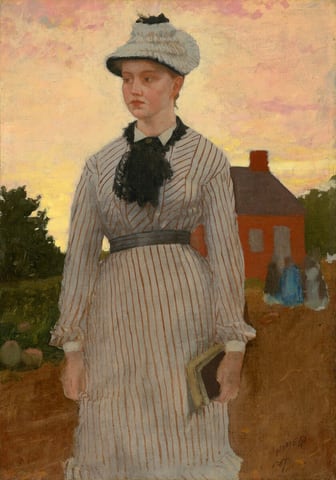
  2. Shown from the knees up, a pale-skinned woman stands close to us with a red schoolhouse in the distance under a sunset sky in this vertical painting. The woman’s body faces us, but she turns her head to look off to the left with light brown eyes. She has a short, straight nose, full pink lips, and a round face. Her blond hair is pulled up under a round white hat layered with ruffles, which lies like a pancake over the top of her head. Her white dress is vertically striped with thin rust-red lines and has a long-sleeved, tight-fitting bodice and a long skirt. A dark gray belt is cinched around her narrow waist, and she wears a black, lacy ruffle around her neck. The woman’s arms hang by her sides, and she holds two paperback-sized books in her left hand, to our right. An earth-brown lawn stretches back to the schoolhouse, which has crimson-red walls, a chimney, and a dark gray roof. Three forms painted with a few streaks of dark or light gray or topaz blue suggest people standing near the door of the schoolhouse. Trees and a grassy lawn beyond the building are loosely painted with blended strokes. The sky is shaded pale lemon yellow and light peach with touches of rose pink. The artist signed and dated the lower right corner, “HOMER 1873.”
    The Red School HouseWinslow Homer, 1873Courtesy National Gallery of Art, Washington