Floor plan

Style galleriesNeoclassicism

Neoclassicism

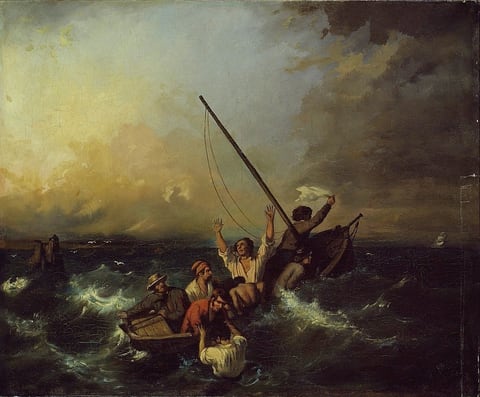
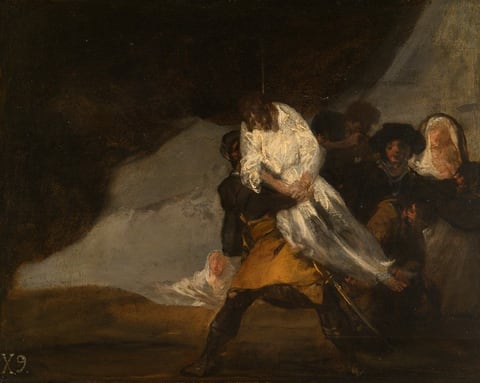
A work made of oil on canvas.
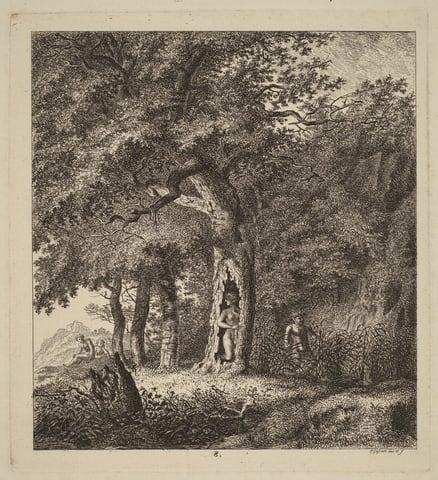
The image shows an etching of a forest scene with towering trees dominating the upper half. The horizon is not clearly visible due to dense foliage, but a line of trees and rocky outcrops in the distance provide a boundary. The fine lines and cross-hatching technique create detailed textures in the tree bark and foliage. The color palette is monochromatic, in shades of black and white emphasizing light and shadow. A large tree with a partially hollow trunk and figures scattered throughout the scene give a sense of scale and activity within the forest setting.
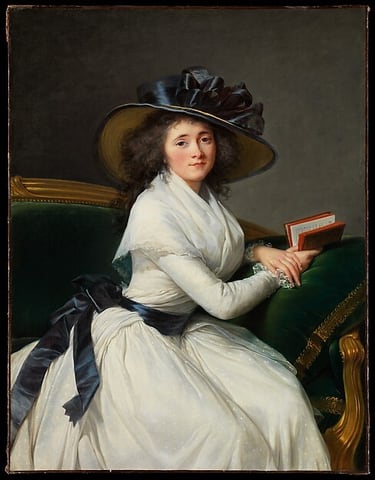
Comtesse de la Châtre (Marie Charlotte Louise Perrette Aglaé Bontemps, 1762–1848), by Elisabeth Louise Vigée Le Brun, 1789
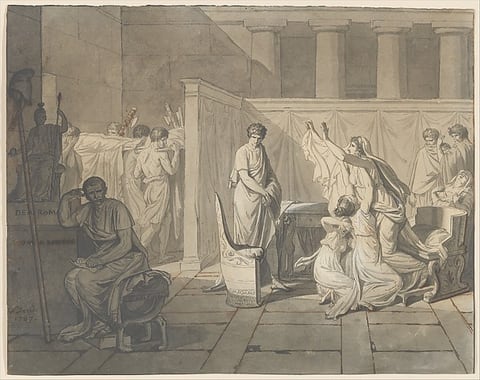
The Lictors Bringing Brutus the Bodies of his Sons, by Jacques-Louis David, 1787
A work made of oil on panel.
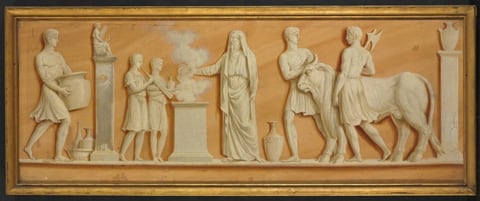
Overdoor Painting and Double-Leaf Doors, by Pierre Rousseau, 1790s
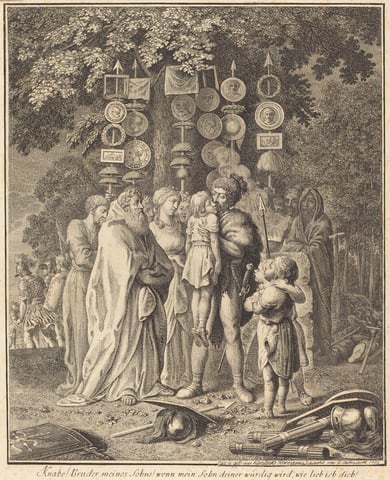
The image depicts a group of people in varying poses and outfits. A central figure, possibly a child, is being held up by a man. Those around them are positioned differently, some standing closely. The figures have detailed faces and wear garments resembling classical attire. Shields and banners decorated with symbols are present in the background. Armor and helmets are scattered on the ground. Trees and a group of people in the distance are part of the background.

The works in this room are listed below.

Works in this room

Europe turns back to Greece and Rome: clear line, calm figures and civic virtue.

First room, north wall

  1. A work made of oil on canvas.
    ShipwreckAfter Eugène Isabey, 19th centuryCourtesy of the Art Institute of Chicago
  2. The image shows an etching of a forest scene with towering trees dominating the upper half. The horizon is not clearly visible due to dense foliage, but a line of trees and rocky outcrops in the distance provide a boundary. The fine lines and cross-hatching technique create detailed textures in the tree bark and foliage. The color palette is monochromatic, in shades of black and white emphasizing light and shadow. A large tree with a partially hollow trunk and figures scattered throughout the scene give a sense of scale and activity within the forest setting.
    Wooded Landscape with a Nymph and a SatyrSalomon Gessner, 1764Courtesy National Gallery of Art, Washington
  3. Comtesse de la Châtre (Marie Charlotte Louise Perrette Aglaé Bontemps, 1762–1848), by Elisabeth Louise Vigée Le Brun, 1789
    Comtesse de la Châtre (Marie Charlotte Louise Perrette Aglaé Bontemps, 1762–1848)Elisabeth Louise Vigée Le Brun, 1789Courtesy of The Metropolitan Museum of Art
  4. The Lictors Bringing Brutus the Bodies of his Sons, by Jacques-Louis David, 1787
    The Lictors Bringing Brutus the Bodies of his SonsJacques-Louis David, 1787Courtesy of The Metropolitan Museum of Art

First room, south wall

  1. A work made of oil on panel.
    The Hanged MonkFrancisco Goya, c. 1810Courtesy of the Art Institute of Chicago
  2. Overdoor Painting and Double-Leaf Doors, by Pierre Rousseau, 1790s
    Overdoor Painting and Double-Leaf DoorsPierre Rousseau, 1790sCourtesy of the Cleveland Museum of Art
  3. The image depicts a group of people in varying poses and outfits. A central figure, possibly a child, is being held up by a man. Those around them are positioned differently, some standing closely. The figures have detailed faces and wear garments resembling classical attire. Shields and banners decorated with symbols are present in the background. Armor and helmets are scattered on the ground. Trees and a group of people in the distance are part of the background.
    Ancient TeutonsDaniel Nikolaus Chodowiecki, 1782Courtesy National Gallery of Art, Washington

Second room, south wall
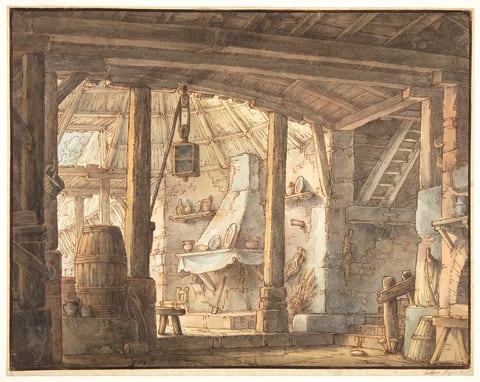
  1. RUSTIC INTERIOR: STAGE DESIGN FOR THE TEATRO DE' FELICINI, BOLOGNA
    Rustic Interior: Stage Design for the Teatro de' Felicini, BolognaAntonio Giuseppe Basoli, ca. 1810Courtesy of Cooper Hewitt, Smithsonian Design Museum
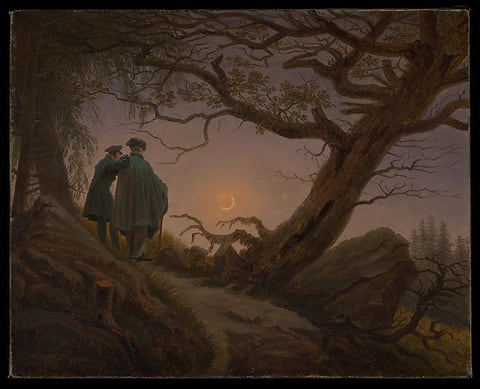
  2. Two Men Contemplating the Moon, by Caspar David Friedrich, ca. 1825–30
    Two Men Contemplating the MoonCaspar David Friedrich, ca. 1825–30Courtesy of The Metropolitan Museum of Art
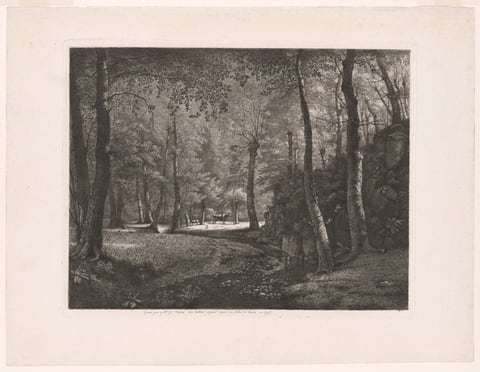
  3. A work made of etching with roulette in black on ivory wove paper.
    The Forest of RochecardonJean-Michel Grobon, 1800Courtesy of the Art Institute of Chicago
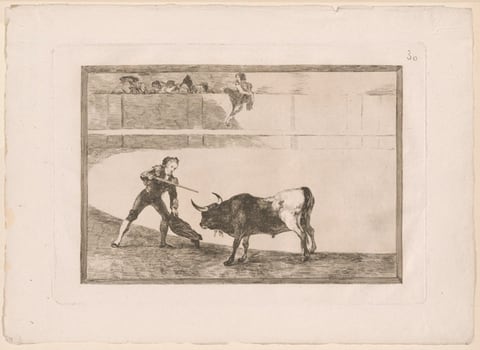
  4. A work made of etching, aquatint, drypoint and burin on ivory laid paper.
    Pedro Romero killing the halted bull, plate 30 from The Art of BullfightingFrancisco Goya, 1814/16, published 1816Courtesy of the Art Institute of Chicago

Second room, north wall
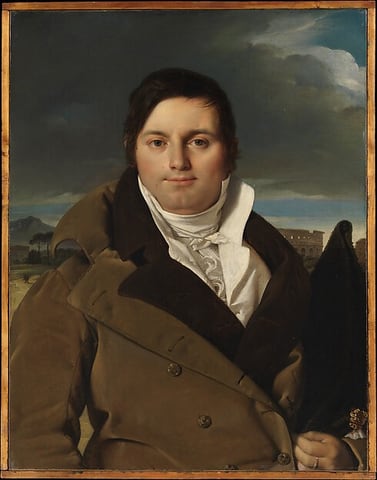
  1. Joseph-Antoine Moltedo (born 1775), by Jean Auguste Dominique Ingres, ca. 1810
    Joseph-Antoine Moltedo (born 1775)Jean Auguste Dominique Ingres, ca. 1810Courtesy of The Metropolitan Museum of Art
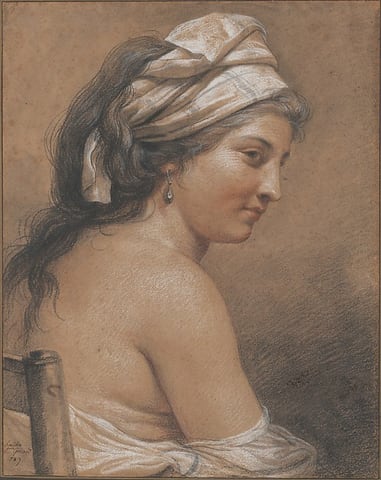
  2. Study of a Seated Woman Seen from Behind (Marie-Gabrielle Capet), by Adélaïde Labille-Guiard, 1789
    Study of a Seated Woman Seen from Behind (Marie-Gabrielle Capet)Adélaïde Labille-Guiard, 1789Courtesy of The Metropolitan Museum of Art
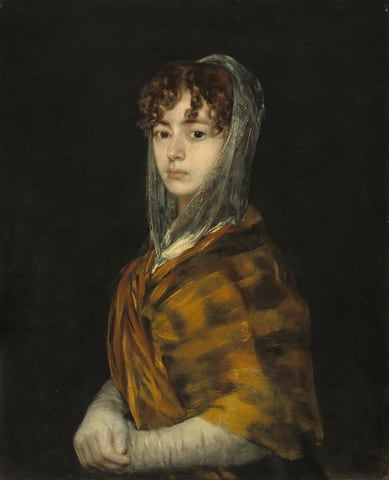
  3. Shown from the waist up in front of a black background, a young woman with pale white skin and curly brown hair looks directly out at us over her shoulder with her body angled to our left in this vertical portrait. She has dark brown eyes, a straight nose, smooth skin, and her pink lips are closed. Curls fall across her forehead but the rest of her hair is pulled up under a white lace scarf, called a mantilla. The mantilla is tucked under the wide orange and black shawl wrapped around her shoulders. She clasps her hands at her waist, and her hands and forearms are covered with long white gloves that disappear under the shawl.
    Señora Sabasa GarciaFrancisco Goya, c. 1806/1811Courtesy National Gallery of Art, Washington

Third room, north wall
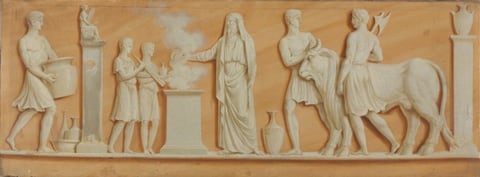
  1. Overdoor Painting, by Pierre Rousseau, 1790s
    Overdoor PaintingPierre Rousseau, 1790sCourtesy of the Cleveland Museum of Art
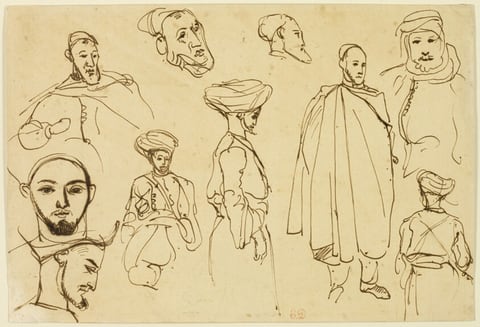
  2. A work made of pen and brown ink, with traces of graphite, on tan wove paper, laid down on cream wove paper.
    Sketches of Algerian MenEugène Delacroix, c. 1832Courtesy of the Art Institute of Chicago