Floor plan

Style galleriesGeorgian Britain

Georgian Britain

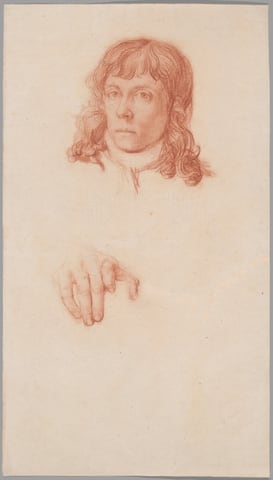
A work made of red chalk on cream laid paper.
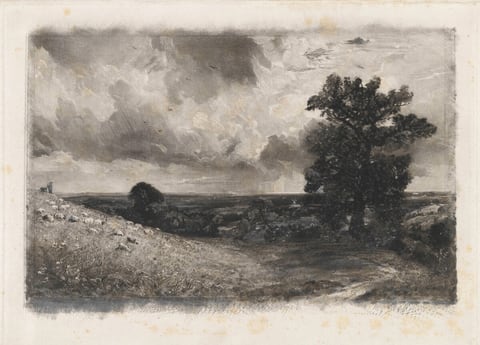
The image shows a landscape with a rolling hill in the foreground sloping downward. The horizon is high, providing a view over fields and sky. Sheep graze on the hill, tended by a person. A large, dark tree is on the right. Brushstrokes vary in the sky and land, with broad strokes for clouds and finer ones for grass and foliage. The color palette is mainly black, white, and shades of grey, highlighting light and shadow.
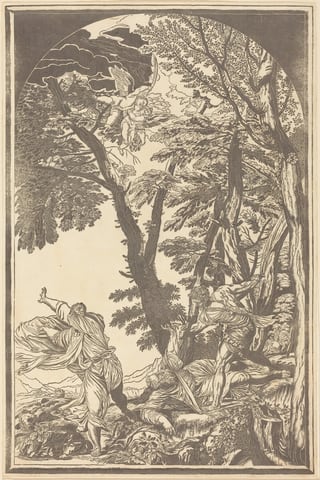
This drawing depicts multiple figures in a forest setting. An angelic figure hovers at the top with wings outstretched. The forest below is filled with intricately detailed trees. Figures on the ground are in dynamic poses, one showing surprise or fear, and another reaching upwards. The composition is detailed with flowing garments and textured foliage, evoking tension and animation.
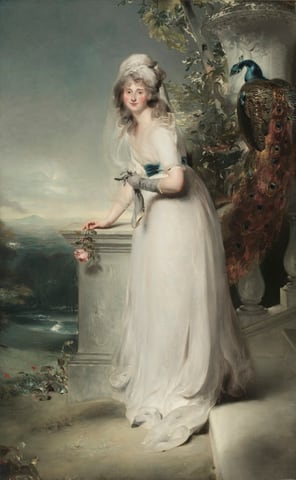
Portrait of Catherine Grey, Lady Manners, by Thomas Lawrence, 1794
A work made of varnished gouache, over black and red chalks, on cream laid paper, laid down on canvas, stretched on a wooden stretcher and varnished again.
Portrait of Charlotte and Sarah Carteret-Hardy, by Thomas Lawrence, 1801
Bray Church Yard, by John Varley, 1807

The works in this room are listed below.

Works in this room

Portraits, conversation pieces and watercolour landscapes from Hogarth to Constable.

Section 1, north wall

  1. A work made of red chalk on cream laid paper.
    Self-PortraitJohn Flaxman, c. 1779Courtesy of the Art Institute of Chicago
  2. The image shows a landscape with a rolling hill in the foreground sloping downward. The horizon is high, providing a view over fields and sky. Sheep graze on the hill, tended by a person. A large, dark tree is on the right. Brushstrokes vary in the sky and land, with broad strokes for clouds and finer ones for grass and foliage. The color palette is mainly black, white, and shades of grey, highlighting light and shadow.
    NoonDavid Lucas, 1830Courtesy National Gallery of Art, Washington
  3. This drawing depicts multiple figures in a forest setting. An angelic figure hovers at the top with wings outstretched. The forest below is filled with intricately detailed trees. Figures on the ground are in dynamic poses, one showing surprise or fear, and another reaching upwards. The composition is detailed with flowing garments and textured foliage, evoking tension and animation.
    The Death of Saint Peter MartyrJohn Baptist Jackson, 1739Courtesy National Gallery of Art, Washington
  4. Portrait of Catherine Grey, Lady Manners, by Thomas Lawrence, 1794
    Portrait of Catherine Grey, Lady MannersThomas Lawrence, 1794Courtesy of the Cleveland Museum of Art

Section 1, south wall

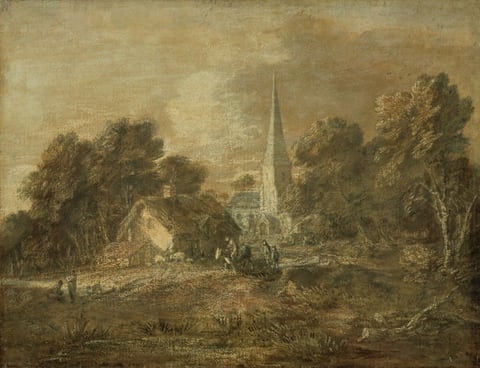
  1. A work made of varnished gouache, over black and red chalks, on cream laid paper, laid down on canvas, stretched on a wooden stretcher and varnished again.
    Wooded Landscape with Village SceneThomas Gainsborough, early 1770s (not later than 1772)Courtesy of the Art Institute of Chicago
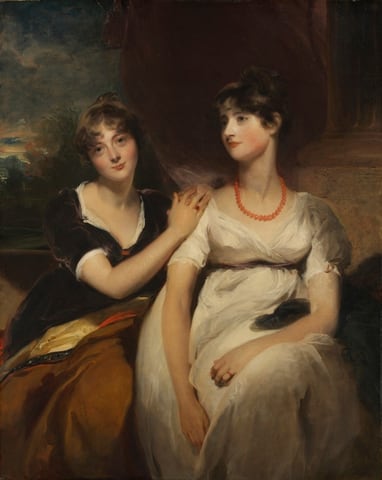
  2. Portrait of Charlotte and Sarah Carteret-Hardy, by Thomas Lawrence, 1801
    Portrait of Charlotte and Sarah Carteret-HardyThomas Lawrence, 1801Courtesy of the Cleveland Museum of Art
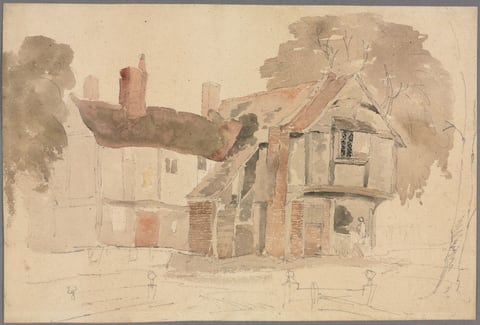
  3. Bray Church Yard, by John Varley, 1807
    Bray Church YardJohn Varley, 1807Courtesy of the Cleveland Museum of Art

Section 2, south wall
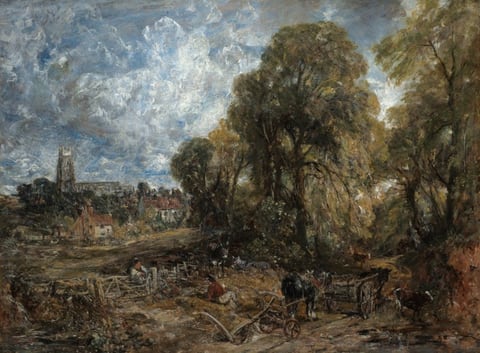
  1. Large English country landscape painting, farmers with horses, green trees.
    Stoke-by-NaylandJohn Constable, 1836Courtesy of the Art Institute of Chicago
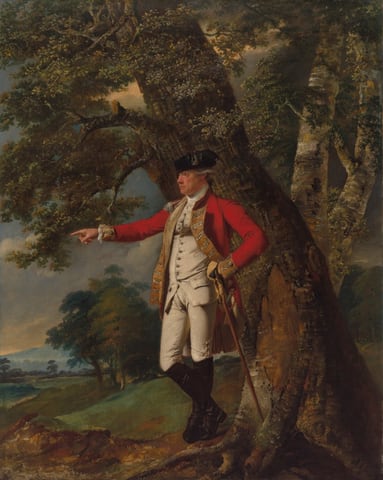
  2. Portrait of Colonel Charles Heathcote, by Joseph Wright of Derby, c. 1771–72
    Portrait of Colonel Charles HeathcoteJoseph Wright of Derby, c. 1771–72Courtesy of the Cleveland Museum of Art
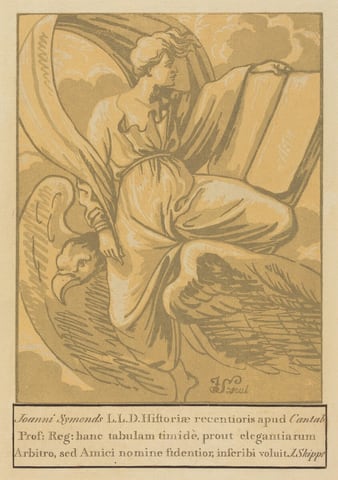
  3. This is a drawing of a winged figure seated on a bird. The image depicts a figure with flowing robes, wings outstretched, holding an open book in one hand. The figure appears to be looking off to the side, with a serene expression. The lower part of the image includes a bird upon which the figure is seated. The bird's head is turned slightly upwards, following the direction in which the figure is gazing. The image is rendered in a warm, monochromatic palette. In the lower section of the image, there is some text, likely Latin.
    Saint John the EvangelistJohn Skippe, 1771Courtesy National Gallery of Art, Washington

Section 2, north wall
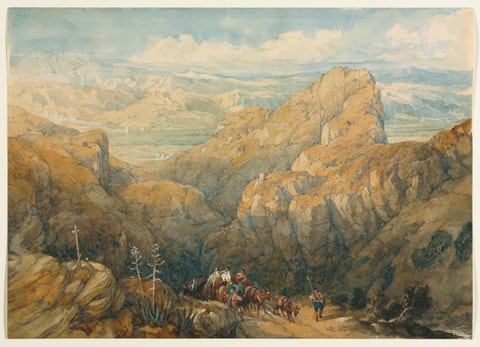
  1. Descent into the Plain of Granada, by David Roberts, 1834
    Descent into the Plain of GranadaDavid Roberts, 1834Courtesy of the Cleveland Museum of Art
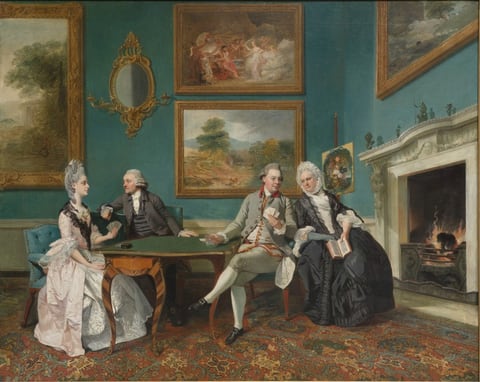
  2. The Dutton Family in the Drawing Room of Sherborne Park, Gloucestershire, by Johann Zoffany, c. 1772
    The Dutton Family in the Drawing Room of Sherborne Park, GloucestershireJohann Zoffany, c. 1772Courtesy of the Cleveland Museum of Art
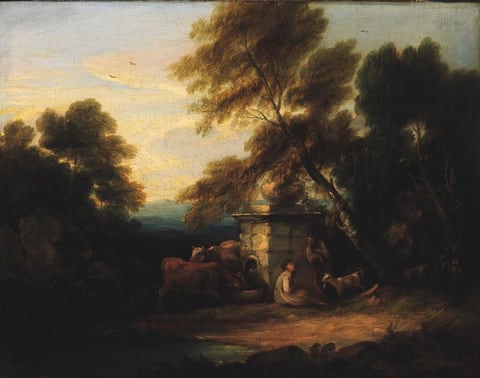
  3. Small Landscape, ca. 1750-1800
    Small LandscapeUnrecorded British maker, ca. 1750-1800Courtesy of the Smithsonian American Art Museum

Section 3, north wall
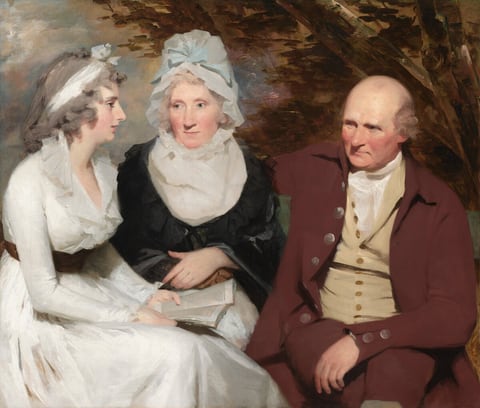
  1. John Johnstone, Betty Johnstone, and Miss Wedderburn, by Sir Henry Raeburn, c. 1790/1795
    John Johnstone, Betty Johnstone, and Miss WedderburnSir Henry Raeburn, c. 1790/1795Courtesy National Gallery of Art, Washington
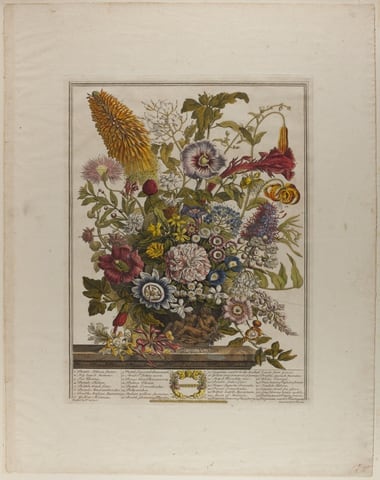
  2. A work made of engraving in black ink with opaque and translucent watercolor on cream laid paper.
    August, from Twelve Months of FlowersHenry Fletcher, n.d.Courtesy of the Art Institute of Chicago
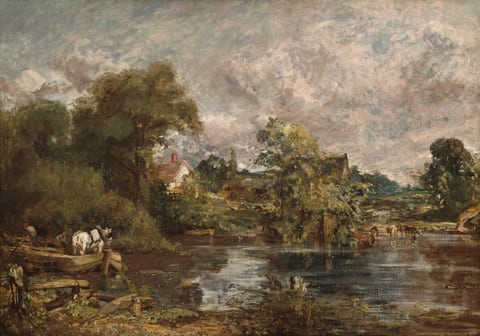
  3. From a grassy riverbank, we look across the placid surface of a river lined along the far bank with trees and farm animals in this horizontal landscape painting. The scene is painted loosely with brushstrokes visible throughout, so some details are difficult to make out. For the surface of the river, russet-brown and steel-gray paint skims lightly across the canvas and leaves some unpainted areas visible, creating the effect of light shimmering on the still water. On our left, a shallow wooden barge is propelled along the stream by two men in red caps with long poles. The boat carries a white horse wearing blinders and a harness. The riverbank beyond is lined with pale, sage-green grass tinged with gold, growing in front of a tangle of darker green trees and bushes. Across the water from us near the middle of the picture, a small rowboat sits in the shallows at the foot of a steep riverbank. Above, a white cottage with a reddish roof and chimney is tucked behind the trees, with a wooden rack full of hay next to it. Nearby, a plow and wheeled cart, highlighted with strokes of white, sit near more mounds of hay. Rocky fields reach into the distance. The vista is blocked to our right by another clump of trees and a rocky outcropping, rising from the stream, to our right of center. The steep, dark roof of a farmhouse is barely visible among the trees. Along the riverside to our right, a small group of cinnamon-brown and cream-white cows stand at water's edge. A rolling pasture stretches behind them to meet blue hills in the distance. Above, in the upper third of the painting, mottled white, pale rose, and gray clouds rolling across a steel-gray sky are reflected in the water below.
    The White HorseJohn Constable, 1818-1819Courtesy National Gallery of Art, Washington