Floor plan

Style galleriesThe French eighteenth century
The French eighteenth century
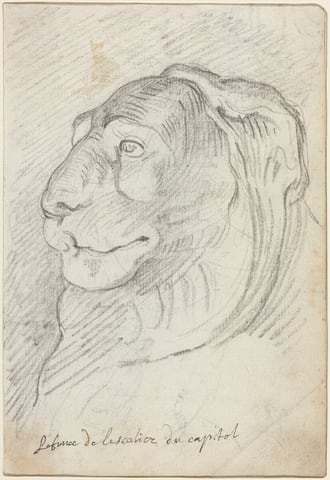
This is a detailed sketch of a lion's head, positioned to show its profile. The drawing features the lion's broad nose, rounded mouth, large eye, and flowing mane. The facial features are depicted with various curves and lines. The sketch is on textured paper with pencil shading creating variations in the background. Handwritten text at the bottom reads "Leone de l'Escalier du capitol."
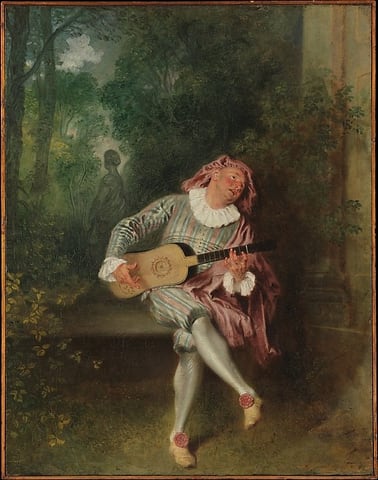
Mezzetin, by Antoine Watteau, ca. 1718–20
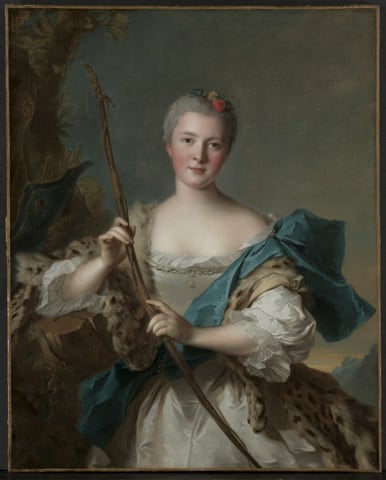
Portrait of a Woman as Diana, by Jean-Marc Nattier, 1752
A work made of oil on canvas.
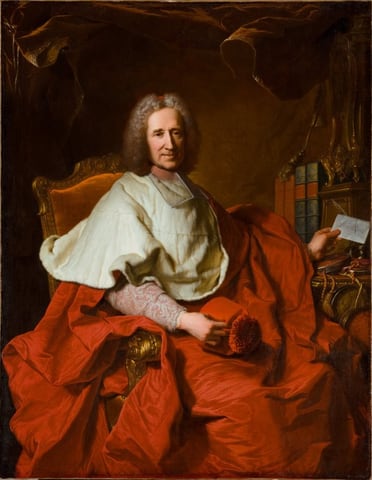
Portrait of Cardinal Guillaume Dubois, by Hyacinthe Rigaud, 1723
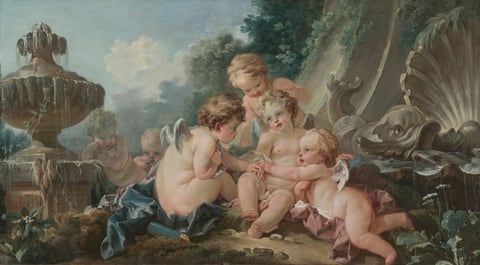
Cupids in Conspiracy, by François Boucher, 1740s
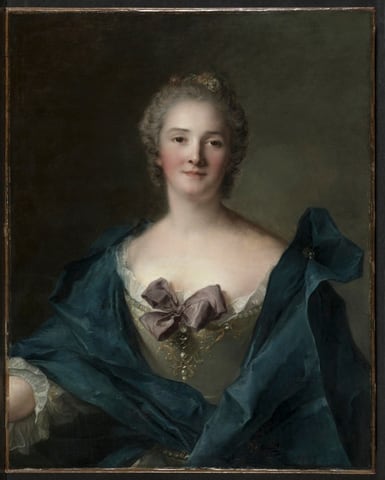
Portrait of a Woman, by Jean-Marc Nattier, c. 1748

The works in this room are listed below.

Works in this room

Fêtes, portraits and still lifes from the France of the Regency and Louis XV.

First room, north wall

  1. This is a detailed sketch of a lion's head, positioned to show its profile. The drawing features the lion's broad nose, rounded mouth, large eye, and flowing mane. The facial features are depicted with various curves and lines. The sketch is on textured paper with pencil shading creating variations in the background. Handwritten text at the bottom reads "Leone de l'Escalier du capitol."
    Lion's Head from the Capitoline StaircaseAugustin Pajou, 1752/1756Courtesy National Gallery of Art, Washington
  2. Mezzetin, by Antoine Watteau, ca. 1718–20
    MezzetinAntoine Watteau, ca. 1718–20Courtesy of The Metropolitan Museum of Art
  3. Portrait of a Woman as Diana, by Jean-Marc Nattier, 1752
    Portrait of a Woman as DianaJean-Marc Nattier, 1752Courtesy of the Cleveland Museum of Art
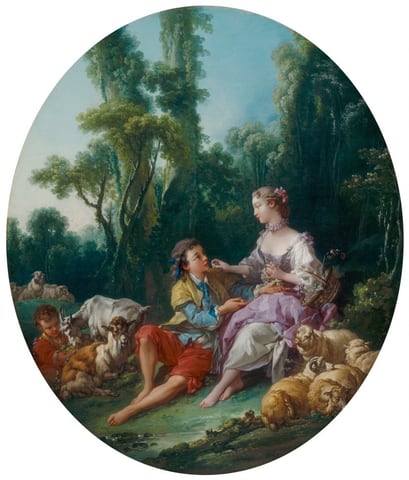
  4. A work made of oil on canvas.
    Are They Thinking about the Grape? (Pensent-ils au raisin?)François Boucher, 1747Courtesy of the Art Institute of Chicago

First room, south wall

  1. Portrait of Cardinal Guillaume Dubois, by Hyacinthe Rigaud, 1723
    Portrait of Cardinal Guillaume DuboisHyacinthe Rigaud, 1723Courtesy of the Cleveland Museum of Art
  2. Cupids in Conspiracy, by François Boucher, 1740s
    Cupids in ConspiracyFrançois Boucher, 1740sCourtesy of the Cleveland Museum of Art
  3. Portrait of a Woman, by Jean-Marc Nattier, c. 1748
    Portrait of a WomanJean-Marc Nattier, c. 1748Courtesy of the Cleveland Museum of Art

Second room, south wall
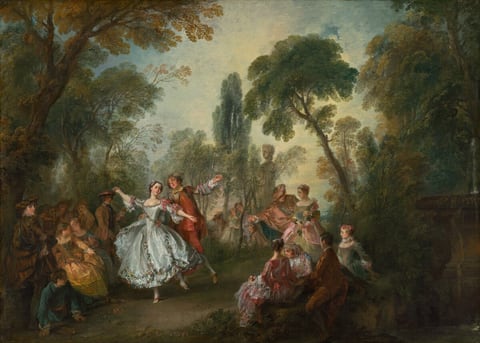
  1. Twenty-one men in long waistcoats and women in elegantly trimmed gowns gather and dance within a verdant landscape in this horizontal painting. The men wear jackets and breeches in ginger brown, pale pink, or spruce blue. The women’s gowns have full sleeves, tight-fitting bodices, and full skirts in shades of bronze, teal blue, butterscotch gold, or rich pink edged with ribbons and lace. Some of them wear floral wreaths or ribbons in their upswept hair. Groups gather around a woman and man who dance together to our left in the scene. Some in the group of onlookers to our left hold musical instruments, including a violin and a pipe. Another group is nestled among trees just beyond the dancers, at the center of the painting, and more sit and stand to our right. The dancing woman wears a gleaming, ice-blue gown with rows of flowers in muted pink, blue, and gold down the full skirt and around the bottom hem, which falls short of her thin ankles. More garlands cross her chest and shoulders, and flowers are tucked into her dark gray hair. She faces us with her head turned to our right as she looks off in that direction with dark eyes under curving brows. She has a delicate nose, rosy, round cheeks, and pink lips. She holds her arms spread wide with the thumb touching the index finger of each hand. The man with whom she dances wears a coral-red tunic and breeches with sleeves decorated with pale pink and blue ribbons. The brim of his brown hat is turned up. His body faces us but he turns his head to look at the woman, his lips parted. The man and woman each have one gracefully pointed foot raised. The dancers and groups are enclosed within a park-like setting with tall trees to either side, and a screen of trees across the back of the space. The trees have slender trunks and canopies in shades of pine, sage, and moss green. Near the back middle of the scene, a stone column topped by a human head wearing a wreath of laurel leaves rises above the central group. A fountain with a vertical jet of water is tucked into the shadows within a grove of trees along the right edge of the painting. The water falls into a pool in the lower right corner.
    La Camargo DancingNicolas Lancret, c. 1730Courtesy National Gallery of Art, Washington
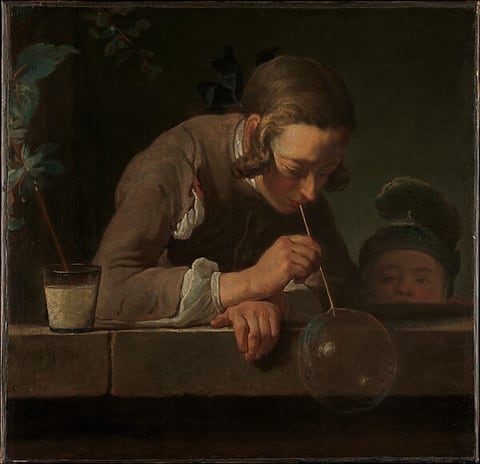
  2. Soap Bubbles, by Jean Siméon Chardin, ca. 1733–34
    Soap BubblesJean Siméon Chardin, ca. 1733–34Courtesy of The Metropolitan Museum of Art
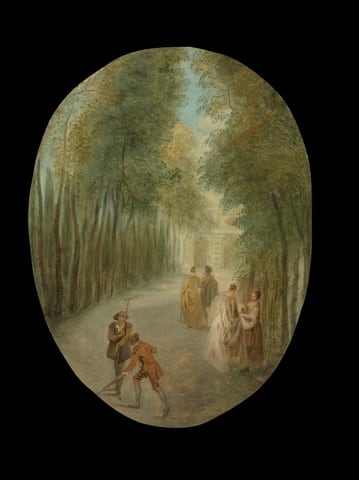
  3. Spring, by Jean-Baptiste Pater, c. 1720–36
    SpringJean-Baptiste Pater, c. 1720–36Courtesy of the Cleveland Museum of Art
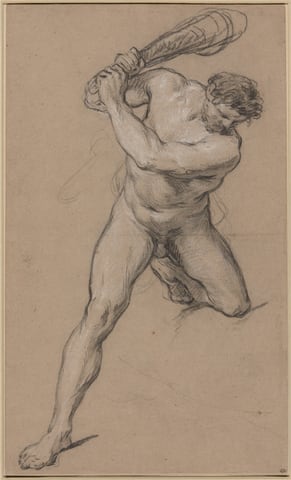
  4. A work made of black chalk, with white chalk, on buff laid paper, laid down on laid paper.
    Hercules Raising his Club: Study for “Hercules and Cacus”François Le Moyne, 1717Courtesy of the Art Institute of Chicago

Second room, north wall
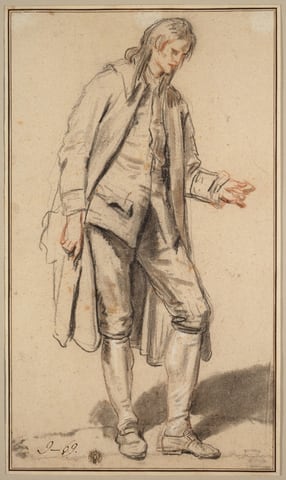
  1. A work made of black chalk, with stumping and black crayon, red and brown chalk, heightened with white chalk, on buff laid paper, laid down on cream laid paper.
    Study of a GroomJean Baptiste Greuze, c. 1760Courtesy of the Art Institute of Chicago
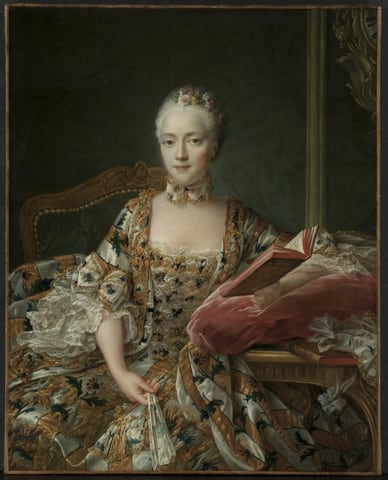
  2. Portrait of the Marquise d'Aguirandes, by François Hubert Drouais, 1759
    Portrait of the Marquise d'AguirandesFrançois Hubert Drouais, 1759Courtesy of the Cleveland Museum of Art
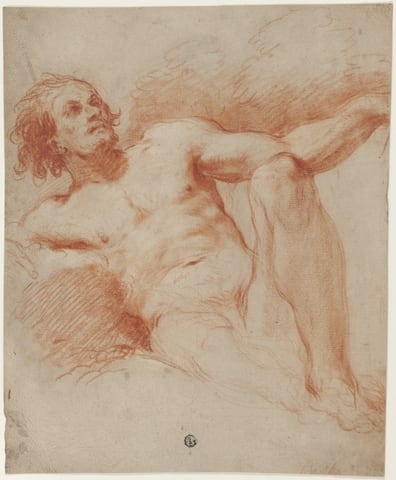
  3. A work made of red chalk, with stumping, on tan laid paper.
    Seated Male NudeFrançois Le Moyne, n.d.Courtesy of the Art Institute of Chicago

Third room, north wall
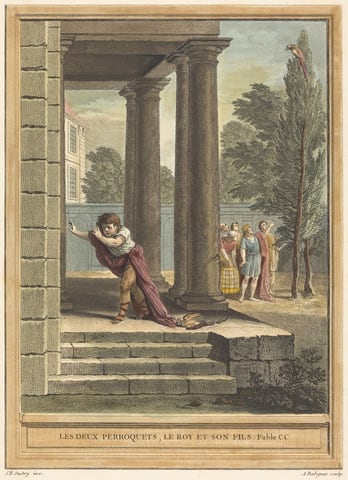
  1. This painting depicts a classical architectural scene with a bird and multiple individuals. It is done in the style of Jean-Baptiste Oudry. The image includes a large building with stone columns and stairs. A parrot is perched on a tree, catching attention with its colorful feathers. In the foreground, a person in classical clothing appears to be in motion. In the background, a group of people are gathered with varied expressions and gestures directed towards the person in the foreground. The architectural elements and foliage add depth and context to the scene.
    Les deux perroquets, le roi et son fils (Two Parrots, the King, and His Son)Antoine Radigues, published 1759Courtesy National Gallery of Art, Washington
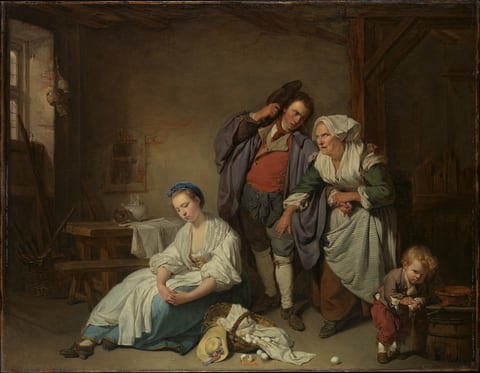
  2. Broken Eggs, by Jean Baptiste Greuze, 1756
    Broken EggsJean Baptiste Greuze, 1756Courtesy of The Metropolitan Museum of Art