Floor plan

East wing: The Nineteenth CenturyImpressionism

Impressionism

A work made of oil on canvas.
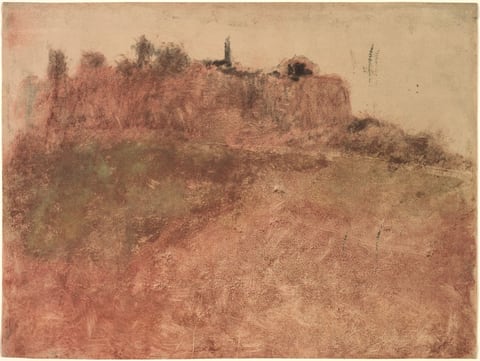
Estérel Village, by Edgar Degas, c. 1890
A work made of oil on canvas.
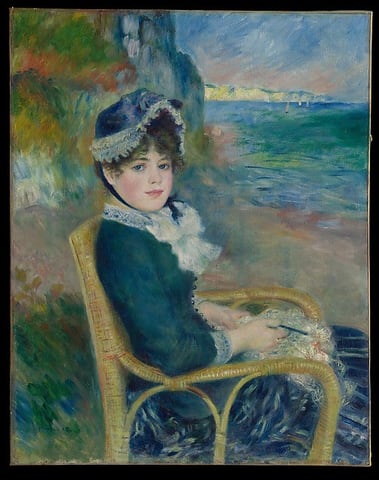
By the Seashore, by Pierre-Auguste Renoir, 1883
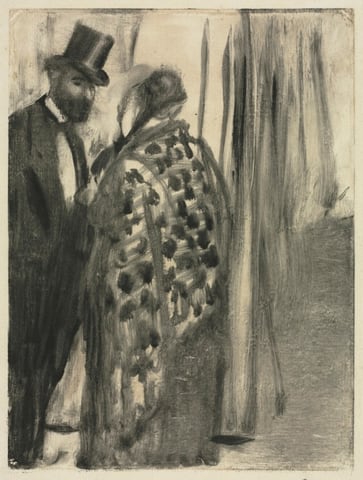
Conversation: Ludovic Halévy and Madame Cardinal (The Conversation) for "La Famille Cardinal" by Ludovic Halévy, by Edgar Degas, c. 1880–83

The works in this room are listed below.

Works in this room

Painters in 1870s Paris who worked quickly, often outdoors, to catch light as it changed.

First room, north wall

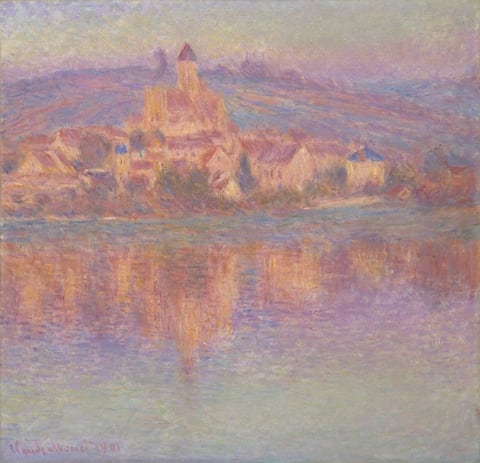
  1. A work made of oil on canvas.
    VétheuilClaude Monet, 1901Courtesy of the Art Institute of Chicago
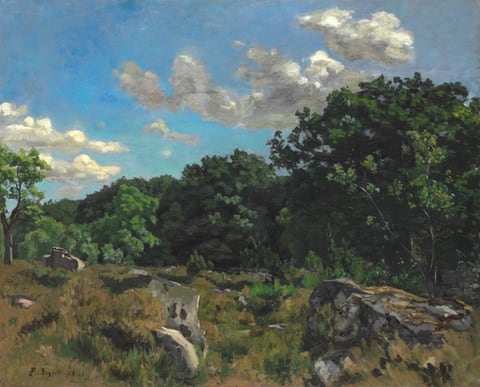
  2. A work made of oil on canvas.
    Landscape at ChaillyFrédéric Bazille, 1865Courtesy of the Art Institute of Chicago
  3. Estérel Village, by Edgar Degas, c. 1890
    Estérel VillageEdgar Degas, c. 1890Courtesy of the Cleveland Museum of Art

First room, south wall

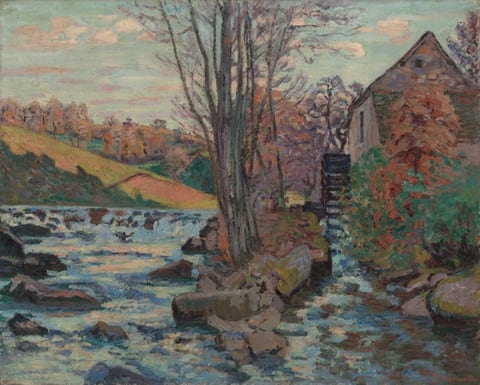
  1. A work made of oil on canvas.
    Mill of Pont MaupuitJean Baptiste Armand Guillaumin, c. 1900Courtesy of the Art Institute of Chicago
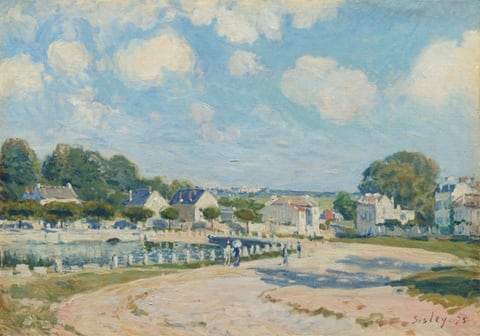
  2. A work made of oil on canvas.
    Watering Place at MarlyAlfred Sisley, 1875Courtesy of the Art Institute of Chicago
  3. By the Seashore, by Pierre-Auguste Renoir, 1883
    By the SeashorePierre-Auguste Renoir, 1883Courtesy of The Metropolitan Museum of Art
  4. Conversation: Ludovic Halévy and Madame Cardinal (The Conversation) for "La Famille Cardinal" by Ludovic Halévy, by Edgar Degas, c. 1880–83
    Conversation: Ludovic Halévy and Madame Cardinal (The Conversation) for "La Famille Cardinal" by Ludovic HalévyEdgar Degas, c. 1880–83Courtesy of the Cleveland Museum of Art

Second room, south wall
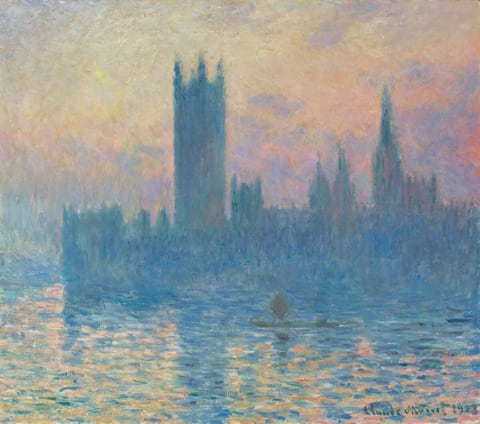
  1. A row of spire-like structures of different heights is silhouetted in azure blue against a soft pink, yellow, peach, and lavender-purple sunset and reflected in a rippling river in this nearly square landscape painting. Along the horizon, the buildings stretch from our right, almost fully across the canvas, and are painted with vertical brushstrokes in cool shades of blue. The sky behind the towers seems hazy with intermingling, pastel-colored clouds. The buildings are reflected in the river, which fills the bottom third of the painting. The surface of the water is painted with short, horizontal brushstrokes in azure blue for the buildings, and apricot, rose, and marigold orange for the sky’s reflection. A streak and smudge of olive-green paint on the water represents a person in a boat near the center of the painting. The artist signed and dated the work in the same olive color at the lower right: “Claude Monet 1903.”
    The Houses of Parliament, SunsetClaude Monet, 1903Courtesy National Gallery of Art, Washington
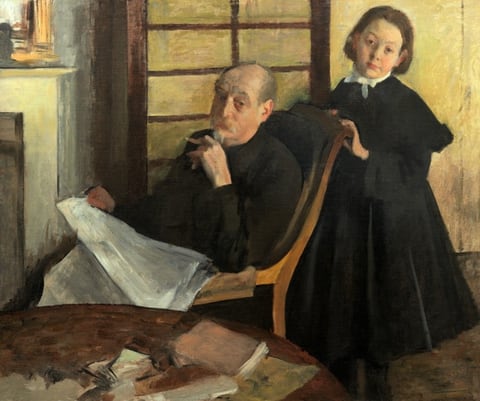
  2. Impressionist painting of seated man, girl with brown, black hues.
    Henri Degas and His Niece Lucie Degas (The Artist's Uncle and Cousin)Edgar Degas, 1875–76Courtesy of the Art Institute of Chicago
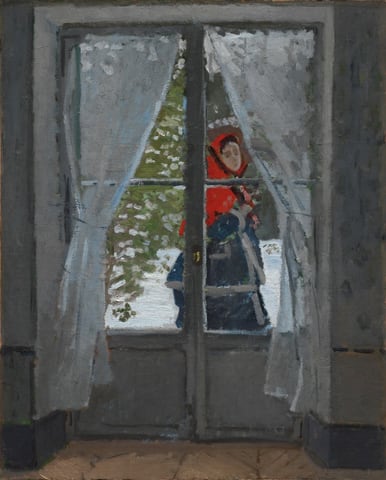
  3. The Red Kerchief, by Claude Monet, c. 1868–73
    The Red KerchiefClaude Monet, c. 1868–73Courtesy of the Cleveland Museum of Art

Second room, north wall
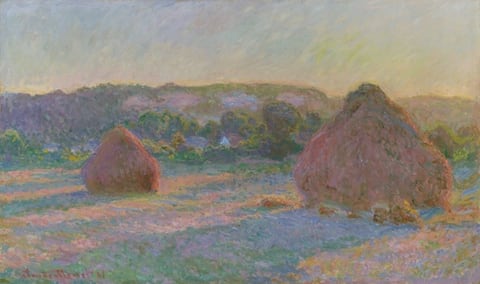
  1. Painting composed of short, dense brushstrokes depicts two domed stacks of wheat that cast long shadows on a field. The angled light indicates either a rising or setting sun.
    Stacks of Wheat (End of Summer)Claude Monet, 1890–91Courtesy of the Art Institute of Chicago
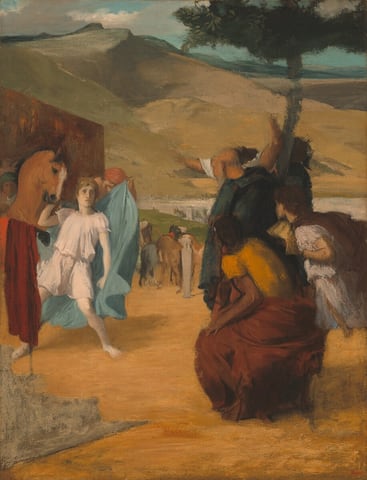
  2. Two groups of people face off in front of a hilly landscape in this loosely painted, vertical scene. On our left, a pale young man in a white tunic looks with eyes wide and lips parted at a group of three people on our right. The young man's right hand, on our left, is raised to stroke the head of a reddish-brown horse at his right shoulder. He stands with feet planted wide, knees bent, and he curls his left hand into a fist. Behind him, a man holds up a fluttering, light blue cape. A mottled red wall forms a backdrop to this scene on our left. The tight group gathered under a tree on our right stares back at the young man. The trio is made up of a balding, older man, a light-skinned boy also wearing a white tunic, and, closest to us, a brown-skinned woman wearing a marigold-orange shirt and a maroon-red skirt. Behind this group, a pair of pale raised arms suggests a fourth person, but the head is missing or has been painted over. The ground under the people is saffron orange. In the center of the picture, beyond the people, a group of horses stands near a green bank by a river, its surface reflecting white. The far bank is lined with white buildings. Tan and olive-green slopes rise from the opposite riverbank under a pale blue sky with cream-white clouds sweeping along the top edge of the composition. The artist signed his name in red paint in the lower right corner: “Degas.”
    Alexander and BucephalusEdgar Degas, 1861/1862Courtesy National Gallery of Art, Washington
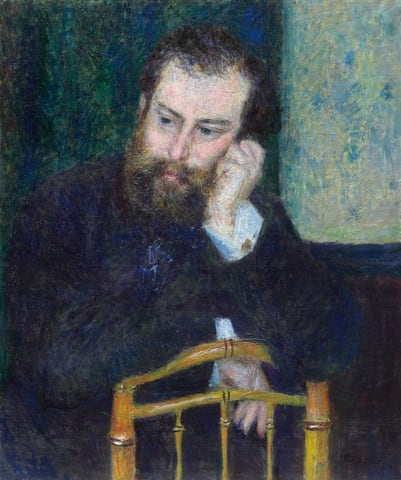
  3. A work made of oil on canvas.
    Alfred SisleyPierre-Auguste Renoir, 1876Courtesy of the Art Institute of Chicago

Third room, north wall
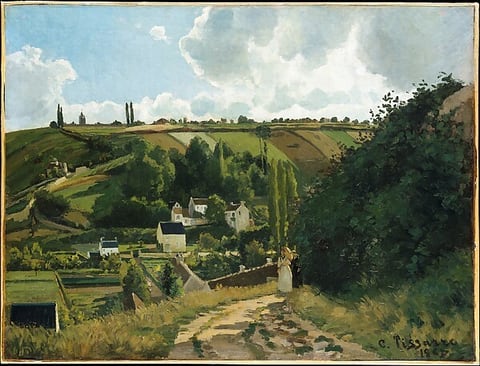
  1. Jalais Hill, Pontoise, by Camille Pissarro, 1867
    Jalais Hill, PontoiseCamille Pissarro, 1867Courtesy of The Metropolitan Museum of Art
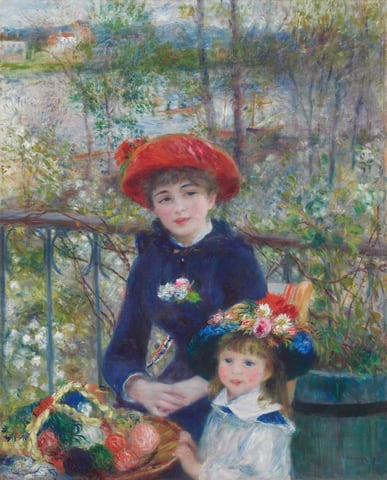
  2. Impressionist painting of two girls on balcony, bright flower hat, knitting basket.
    Two Sisters (On the Terrace)Pierre-Auguste Renoir, 1881Courtesy of the Art Institute of Chicago
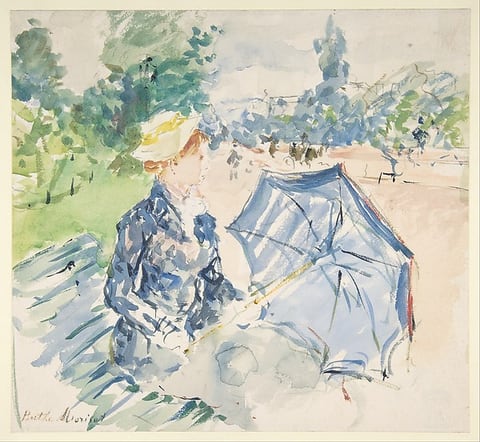
  3. A Woman Seated at a Bench on the Avenue du Bois, by Berthe Morisot, 1885
    A Woman Seated at a Bench on the Avenue du BoisBerthe Morisot, 1885Courtesy of The Metropolitan Museum of Art