Floor plan

Time and placeThe 19th century

The 19th century

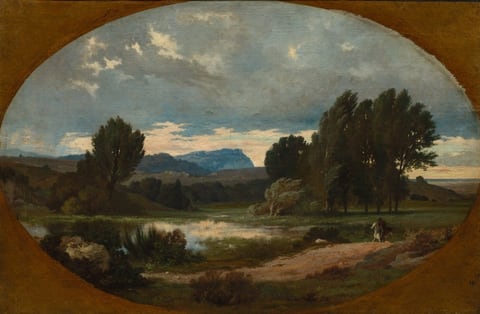
Landscape with Rider on White Horse, by Jean Achille Benouville, 1846
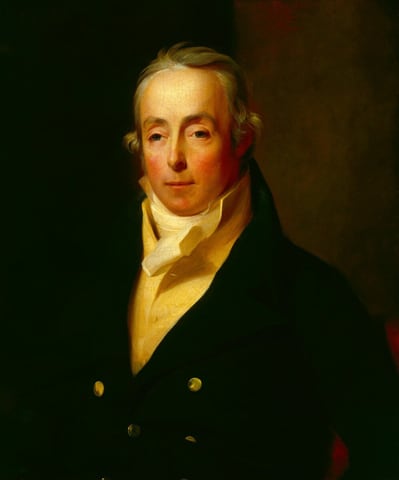
This painting is a portrait of a man from the waist up. He is facing us, with pale skin, thin lips, rosy cheeks, light green eyes, and gray hair styled into curls around his ears. He has a neutral expression. The man is wearing a dark coat with gold buttons on the front, with a pale-yellow shirt underneath and a white cravat around his neck. The background is a dark and indistinct brown color.
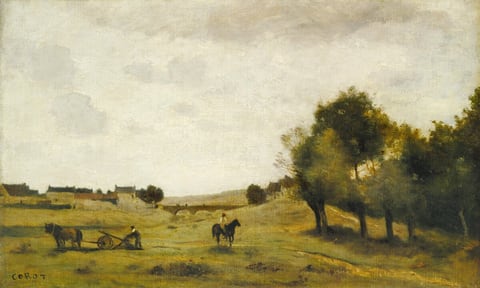
A person at the center of this loosely painted horizontal landscape rides a dark horse across a field as a man to the left works the field behind a horse-drawn plow. The field is carpeted with muted and gold-shaded green, and a grove of trees in the right third of the composition are painted in fern, olive, and dark green. A patch of darker green near us and to left of center is dotted with red and yellow to suggest flowers. The men and horses are small in relation to the composition. The people have brown skin and are painted with a few strokes in dark gray and muted green for the man behind the plow to the left and pale yellow and white and a red cap for the person on horseback. A band of houses with tan or light yellow walls and gray or terracotta red roofs line the far side of the field to the left, and an arched bridge crosses what appears to be a shallow, grassy ravine near the center. The horizon comes about a third of the way up this composition and a few smoke-gray clouds line the upper edge of the otherwise milk-white sky. The artist signed the lower left corner, “COROT.”
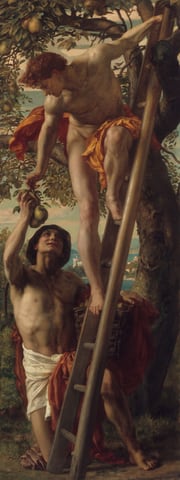
A work made of oil on canvas.
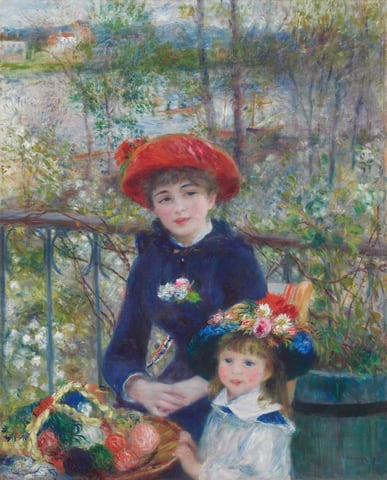
Impressionist painting of two girls on balcony, bright flower hat, knitting basket.
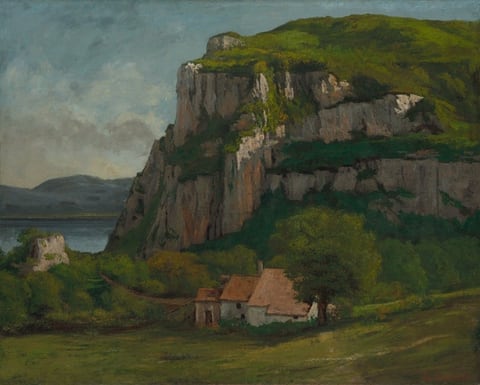
A work made of oil on canvas.
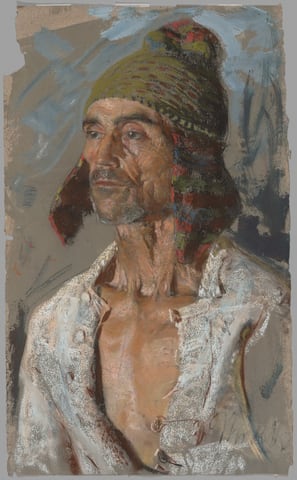
A work made of pastel, with wet brush (recto), and pastel (verso) on brown wove paper.
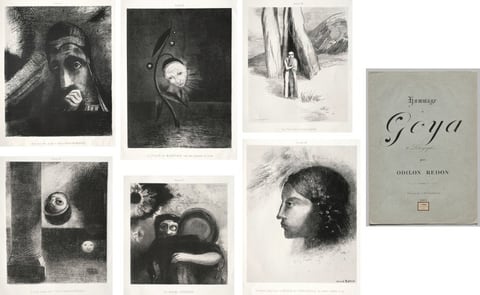
Homage to Goya, by Odilon Redon, 1885

The works in this room are listed below.

Works in this room

Works made in the 19th century, anywhere in the world.

Section 1, north wall

  1. Landscape with Rider on White Horse, by Jean Achille Benouville, 1846
    Landscape with Rider on White HorseJean Achille Benouville, 1846Courtesy of the Cleveland Museum of Art
  2. This painting is a portrait of a man from the waist up. He is facing us, with pale skin, thin lips, rosy cheeks, light green eyes, and gray hair styled into curls around his ears. He has a neutral expression. The man is wearing a dark coat with gold buttons on the front, with a pale-yellow shirt underneath and a white cravat around his neck. The background is a dark and indistinct brown color.
    Abraham KintzingThomas Sully, 1815Courtesy National Gallery of Art, Washington
  3. A person at the center of this loosely painted horizontal landscape rides a dark horse across a field as a man to the left works the field behind a horse-drawn plow. The field is carpeted with muted and gold-shaded green, and a grove of trees in the right third of the composition are painted in fern, olive, and dark green. A patch of darker green near us and to left of center is dotted with red and yellow to suggest flowers. The men and horses are small in relation to the composition. The people have brown skin and are painted with a few strokes in dark gray and muted green for the man behind the plow to the left and pale yellow and white and a red cap for the person on horseback. A band of houses with tan or light yellow walls and gray or terracotta red roofs line the far side of the field to the left, and an arched bridge crosses what appears to be a shallow, grassy ravine near the center. The horizon comes about a third of the way up this composition and a few smoke-gray clouds line the upper edge of the otherwise milk-white sky. The artist signed the lower left corner, “COROT.”
    View near EpernonJean Baptiste Camille Corot, 1850/1860Courtesy National Gallery of Art, Washington
  4. A work made of oil on canvas.
    The Golden AgeSir John Edward Poynter, 1875Courtesy of the Art Institute of Chicago

Section 1, south wall

  1. Impressionist painting of two girls on balcony, bright flower hat, knitting basket.
    Two Sisters (On the Terrace)Pierre-Auguste Renoir, 1881Courtesy of the Art Institute of Chicago
  2. A work made of oil on canvas.
    The Rock of HautepierreGustave Courbet, c. 1869Courtesy of the Art Institute of Chicago
  3. A work made of pastel, with wet brush (recto), and pastel (verso) on brown wove paper.
    A Shepherd (Study for “Il Voto”) (recto); Woman Holding a Baby (Study for “Il Voto”) (verso)Francesco Paolo Michetti, c. 1883Courtesy of the Art Institute of Chicago
  4. Homage to Goya, by Odilon Redon, 1885
    Homage to GoyaOdilon Redon, 1885Courtesy of the Cleveland Museum of Art

Section 2, south wall
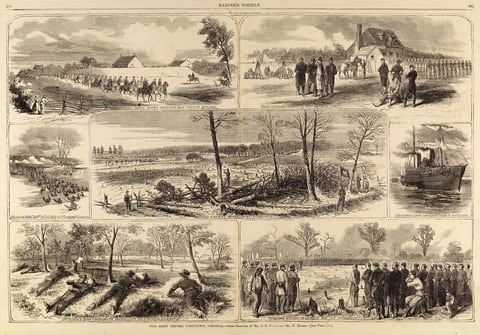
  1. Our Army before Yorktown, Virginia, from Harper's Weekly, May 3, 1862, by Winslow Homer, 1862
    Our Army before Yorktown, Virginia, from Harper's Weekly, May 3, 1862Winslow Homer, 1862Courtesy of the Smithsonian American Art Museum
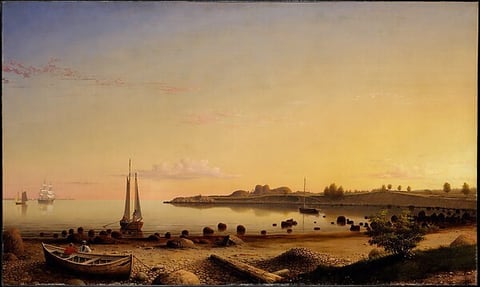
  2. Stage Fort across Gloucester Harbor, by Fitz Henry Lane, 1862
    Stage Fort across Gloucester HarborFitz Henry Lane, 1862Courtesy of The Metropolitan Museum of Art
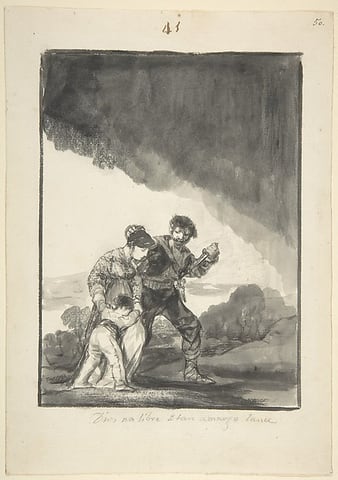
  3. God save us from such a bitter fate; a bandit threatening a woman and a child with a knife, page 41 from the "Black Border Album" (E), by Francisco Goya, ca. 1816–20
    God save us from such a bitter fate; a bandit threatening a woman and a child with a knife, page 41 from the "Black Border Album" (E)Francisco Goya, ca. 1816–20Courtesy of The Metropolitan Museum of Art
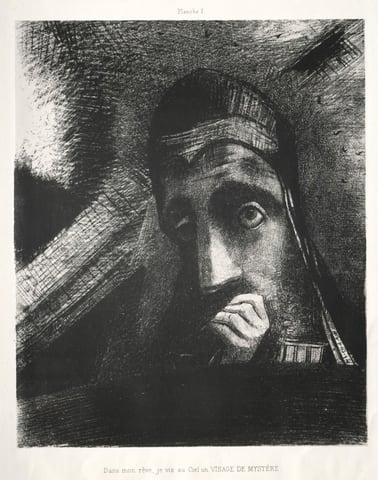
  4. In My Dream I Saw in the Sky a Face of Mystery, by Odilon Redon, 1885
    In My Dream I Saw in the Sky a Face of MysteryOdilon Redon, 1885Courtesy of the Cleveland Museum of Art

Section 2, north wall
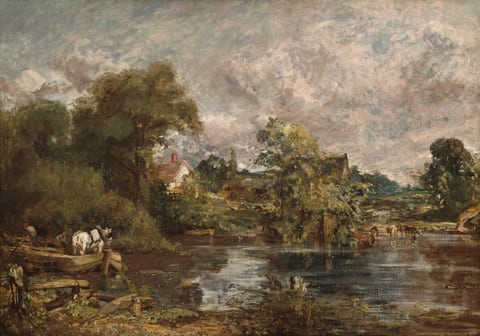
  1. From a grassy riverbank, we look across the placid surface of a river lined along the far bank with trees and farm animals in this horizontal landscape painting. The scene is painted loosely with brushstrokes visible throughout, so some details are difficult to make out. For the surface of the river, russet-brown and steel-gray paint skims lightly across the canvas and leaves some unpainted areas visible, creating the effect of light shimmering on the still water. On our left, a shallow wooden barge is propelled along the stream by two men in red caps with long poles. The boat carries a white horse wearing blinders and a harness. The riverbank beyond is lined with pale, sage-green grass tinged with gold, growing in front of a tangle of darker green trees and bushes. Across the water from us near the middle of the picture, a small rowboat sits in the shallows at the foot of a steep riverbank. Above, a white cottage with a reddish roof and chimney is tucked behind the trees, with a wooden rack full of hay next to it. Nearby, a plow and wheeled cart, highlighted with strokes of white, sit near more mounds of hay. Rocky fields reach into the distance. The vista is blocked to our right by another clump of trees and a rocky outcropping, rising from the stream, to our right of center. The steep, dark roof of a farmhouse is barely visible among the trees. Along the riverside to our right, a small group of cinnamon-brown and cream-white cows stand at water's edge. A rolling pasture stretches behind them to meet blue hills in the distance. Above, in the upper third of the painting, mottled white, pale rose, and gray clouds rolling across a steel-gray sky are reflected in the water below.
    The White HorseJohn Constable, 1818-1819Courtesy National Gallery of Art, Washington
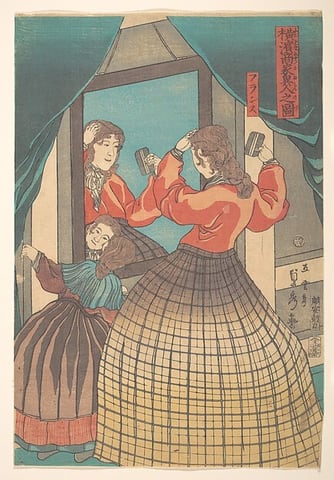
  2. French Woman and Girl, from the series Foreign Merchants in Yokohama (Yokohama shōka ijin no zu), by Utagawa (Gountei) Sadahide, 1st month, 1861
    French Woman and Girl, from the series Foreign Merchants in Yokohama (Yokohama shōka ijin no zu)Utagawa (Gountei) Sadahide, 1st month, 1861Courtesy of The Metropolitan Museum of Art
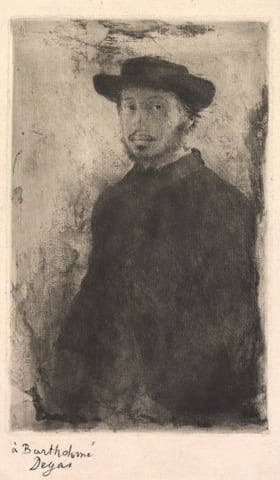
  3. Self-Portrait, by Edgar Degas, 1857
    Self-PortraitEdgar Degas, 1857Courtesy of the Cleveland Museum of Art
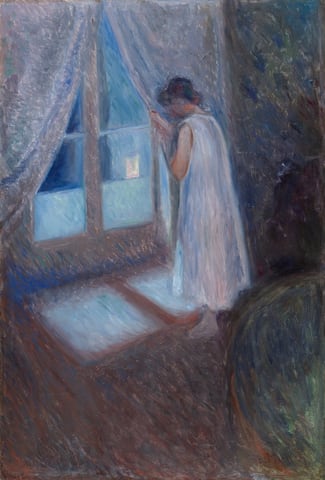
  4. Loosely painted scene of a brown-haired girl in her nightgown standing in a dark room, gazing out a window into a brighter night, her face unseen and her hand drawing back the pale curtain. Light blues and pink whites dominate the girl and the window, while deep browns, blues, and greens color the darkened portions of her room.
    The Girl by the WindowEdvard Munch, 1893Courtesy of the Art Institute of Chicago