Floor plan

Time and place19th-century France

19th-century France

A work made of oil on panel.
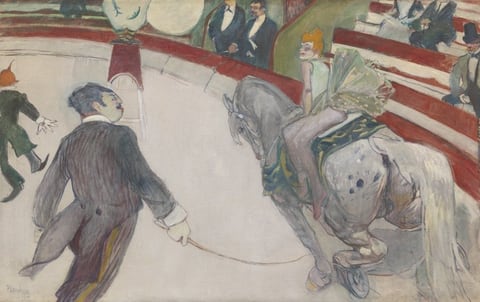
Painting of a performance inside a circus ring. A man wearing a suit holds a whip in his hand and looks towards a woman with red hair riding a gray horse and wearing a green dress. Audience members wearing suits and top hats watch from red and white benches on the side.
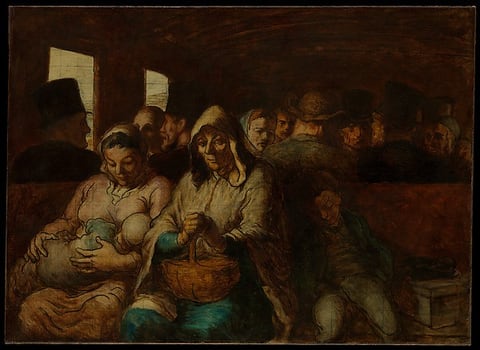
The Third-Class Carriage, by Honoré Daumier, 1864
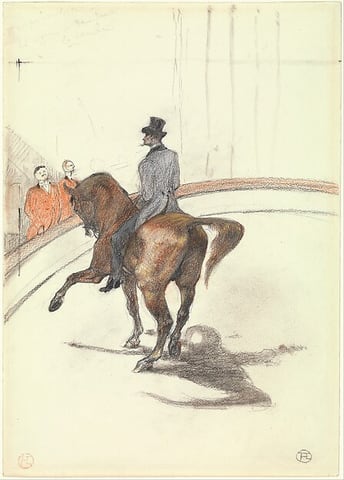
At the Circus: The Spanish Walk (Au Cirque: Le Pas espagnol), by Henri de Toulouse-Lautrec, 1899
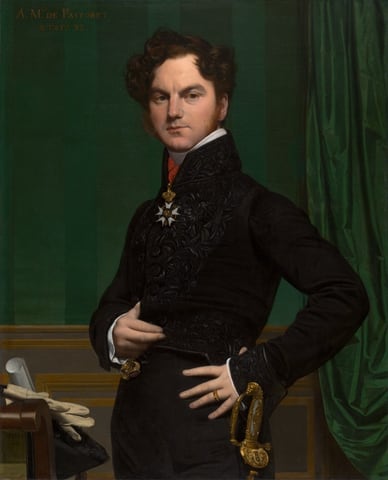
Portrait of white man dressed in all black with medallion and sword.
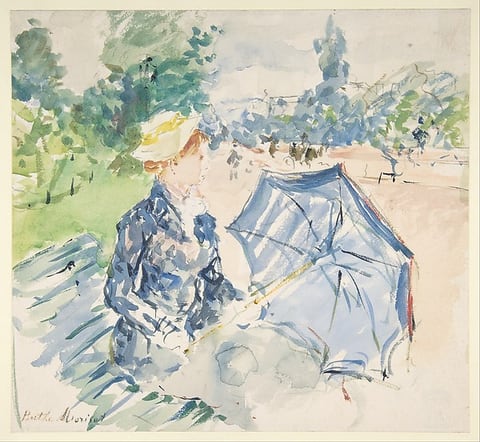
A Woman Seated at a Bench on the Avenue du Bois, by Berthe Morisot, 1885
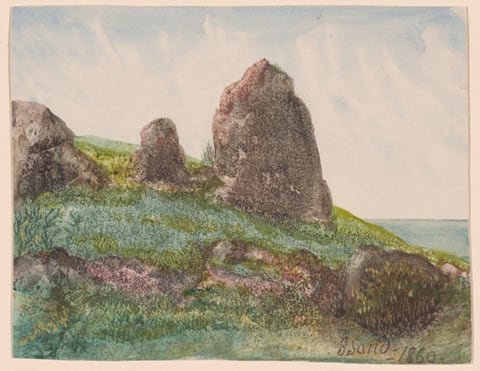
A work made of transparent and opaque watercolor on cream wove paper.

The works in this room are listed below.

Works in this room

Works made in France in the 19th century.

First room, north wall

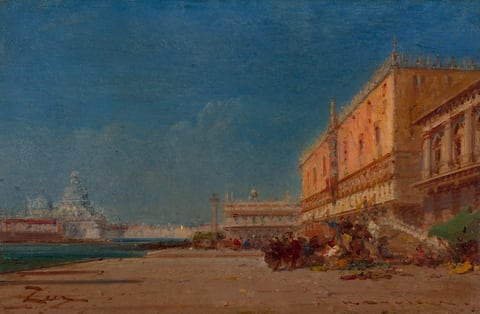
  1. A work made of oil on panel.
    Venice from the Riva looking toward the Piazzale San MarcoFélix Ziem, c. 1890Courtesy of the Art Institute of Chicago
  2. Painting of a performance inside a circus ring. A man wearing a suit holds a whip in his hand and looks towards a woman with red hair riding a gray horse and wearing a green dress. Audience members wearing suits and top hats watch from red and white benches on the side.
    Equestrienne (At the Cirque Fernando)Henri de Toulouse-Lautrec, 1887–88Courtesy of the Art Institute of Chicago
  3. The Third-Class Carriage, by Honoré Daumier, 1864
    The Third-Class CarriageHonoré Daumier, 1864Courtesy of The Metropolitan Museum of Art

First room, south wall

  1. At the Circus: The Spanish Walk (Au Cirque: Le Pas espagnol), by Henri de Toulouse-Lautrec, 1899
    At the Circus: The Spanish Walk (Au Cirque: Le Pas espagnol)Henri de Toulouse-Lautrec, 1899Courtesy of The Metropolitan Museum of Art
  2. Portrait of white man dressed in all black with medallion and sword.
    Amédée-David, the Comte de PastoretJean Auguste Dominique Ingres, 1823–26Courtesy of the Art Institute of Chicago
  3. A Woman Seated at a Bench on the Avenue du Bois, by Berthe Morisot, 1885
    A Woman Seated at a Bench on the Avenue du BoisBerthe Morisot, 1885Courtesy of The Metropolitan Museum of Art
  4. A work made of transparent and opaque watercolor on cream wove paper.
    Landscape with RocksGeorge Sand, c. 1868/76Courtesy of the Art Institute of Chicago

Second room, south wall
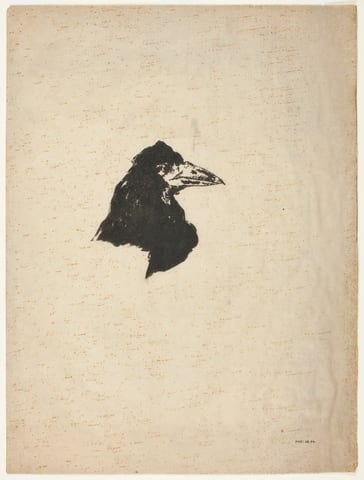
  1. A work made of transfer lithograph in black on tan simili-parchment paper.
    Head of a Raven in Profile, from The Raven (Le Corbeau)Édouard Manet, 1875Courtesy of the Art Institute of Chicago
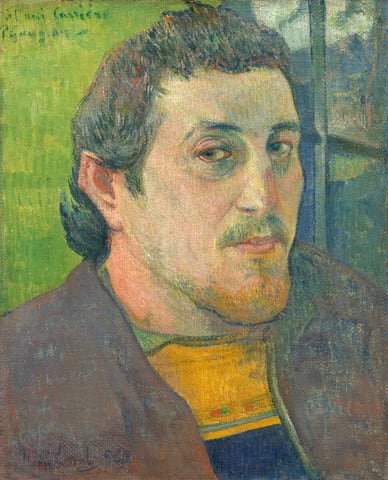
  2. Painted in muted lime green, plum purple, buttercup yellow, slate and royal blue, the head and shoulders of a man with peach-colored skin sitting in front of a window looks at us in this stylized, vertical portrait. His body and face are angled to our right but he looks at us from the corners of his eyes, which are grass-green with touches of yellow. One cobalt-blue eyebrow is cocked, and shading in denim blue, butter yellow, and fern green create hollows under both eyes. His flat nose has a broad bridge, and his pale pink lips are closed, the far corner pulled slightly up. His mustache is painted with visible strokes of forest green and his ginger-orange beard is trimmed along his prominent, jutting chin. His short, dark hair is brushed back from his temples and is painted with strokes of pine green, navy blue, and coral orange. His shirt has a wide, golden yellow stripe along the collar above indigo blue, under a grayish-violet purple jacket. The wall over his shoulder, in the upper left corner, is painted vivid lime green with long, vertical brushstrokes. The view through the window beyond his other shoulder is of vegetation and mountains. The portrait is painted with visible brushstrokes throughout, and is especially loose in the background, hair, and jacket. An inscription in dark green script in the upper left reads, “a l'ami Carriere PGauguin.” A second inscription in the lower left is written with dark brown paint: “l'ami Laval PGo.”
    Self-Portrait Dedicated to CarrièrePaul Gauguin, 1888 or 1889Courtesy National Gallery of Art, Washington
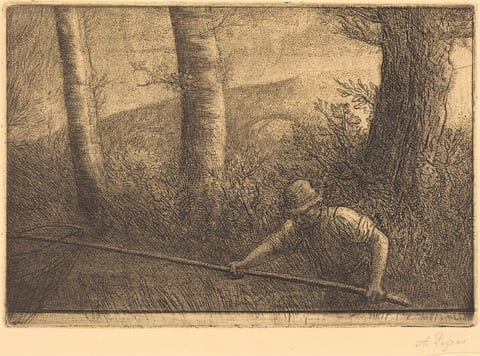
  3. The image shows a man in a forest using a long tool. Tall trees flank him on either side. The ground rises to a hill in the background. The artwork is detailed, with intricate lines showing leaves and foliage. The color scheme is monochromatic, dominated by shades of brown and beige, giving a rustic feel. The scene is filled with trees and foliage, with a distant hill visible.
    Fisherman with a Hoop-net (La peche a la truble)Alphonse LegrosCourtesy National Gallery of Art, Washington
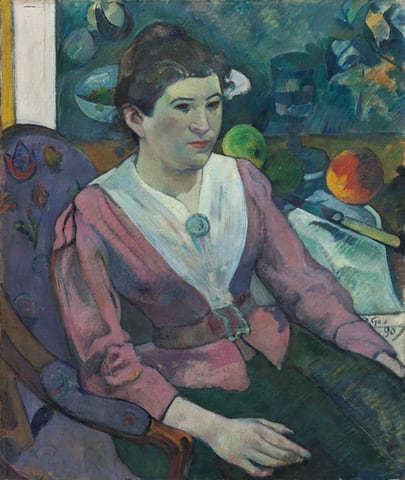
  4. A work made of oil on linen canvas.
    Woman in Front of a Still Life by CezannePaul Gauguin, 1890Courtesy of the Art Institute of Chicago

Second room, north wall
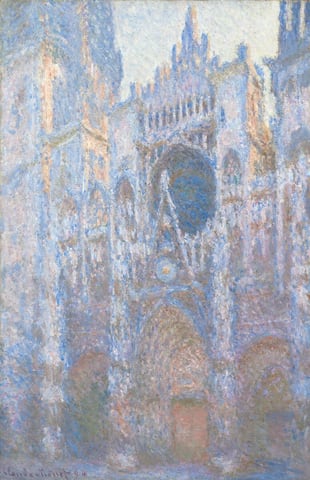
  1. We look up at the exterior of a church that soars the height of this vertical painting. The church is painted with visible dabs and strokes of azure blue, peach, lavender purple, and camel brown to create a blurred look, as if seeing a reflection in the rippling surface of a puddle. The church façade is angled to our left, away from us. The main door and its surround takes up the center of the composition, where a rectangular door is set within nested, pointed arches that lead up to a narrow, tall, triangular gable. The point of that gable overlaps the round, dark rose window, which is the same width as the portal surround below. Spires flank the central section and rise precipitously off the top edge of the painting. The sky above is painted with daubs of white and pale blue. The artist signed and dated the lower left, “Claude Monet 94.”
    Rouen Cathedral, West FaçadeClaude Monet, 1894Courtesy National Gallery of Art, Washington
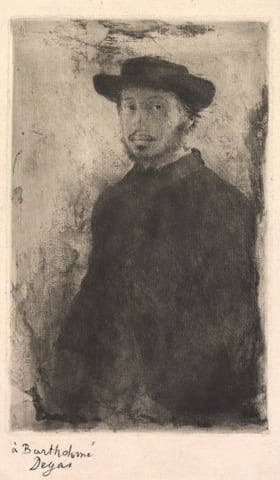
  2. Self-Portrait, by Edgar Degas, 1857
    Self-PortraitEdgar Degas, 1857Courtesy of the Cleveland Museum of Art
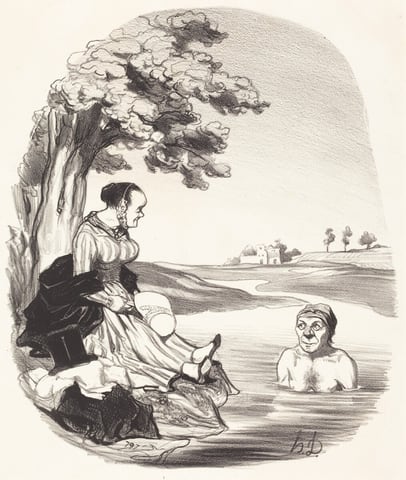
  3. The image shows a woman sitting beside a body of water, under a tree. She is wearing a long dress and holding a bonnet by her side. In the water, a person is visible from the shoulders up with short hair. The background includes a landscape with trees, water, and a distant structure that resembles a house or castle.
    L'Eau est délicieuse... je t'assure...Honoré Daumier, 1845Courtesy National Gallery of Art, Washington

Third room, north wall
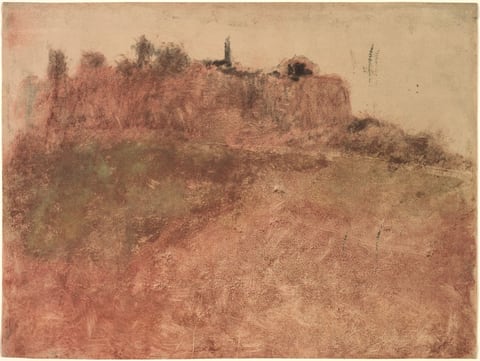
  1. Estérel Village, by Edgar Degas, c. 1890
    Estérel VillageEdgar Degas, c. 1890Courtesy of the Cleveland Museum of Art
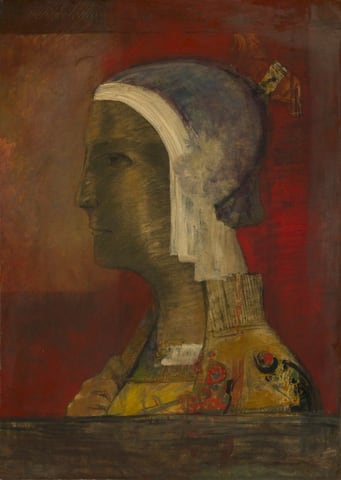
  2. Symbolic Head, by Odilon Redon, c. 1890
    Symbolic HeadOdilon Redon, c. 1890Courtesy of the Cleveland Museum of Art