Floor plan

Time and place19th-century France

19th-century France

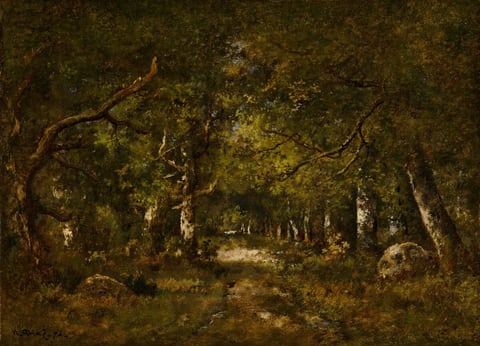
The painting depicts a forest floor under tall trees, with a grassy path leading into the distance. The sky is obscured by dense green foliage and tree limbs. Rocks and shrubs are visible on the ground, and the forest stretches into the distance. The trees are dark brown, with patches of white suggesting dappled light coming in through the branches above. The leaves and ground are mostly dark green, with some patches of brown, lighter green, and yellow.
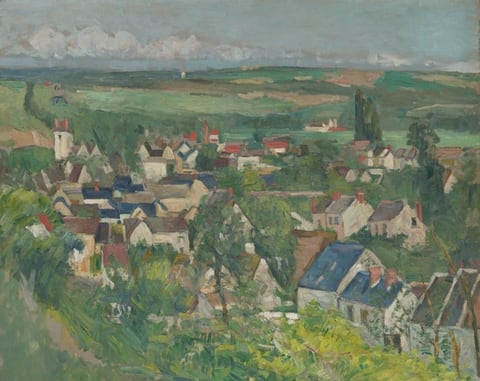
View of a village surrounded by hills, fields, and trees, shown from a vantage point above the scene. Subtly rolling hills recede into a bluish gray-ish sky punctuated by white clouds. Thick brushstrokes built up atop each other are visible throughout.
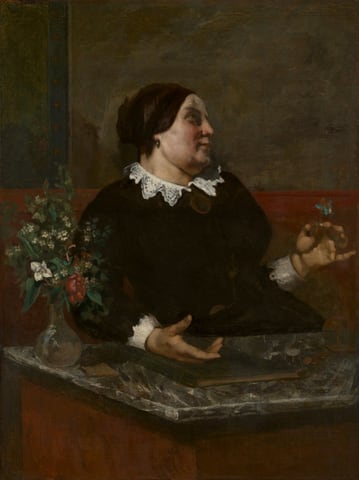
Dark portrait of older woman in black dress with lace collar, flowers.
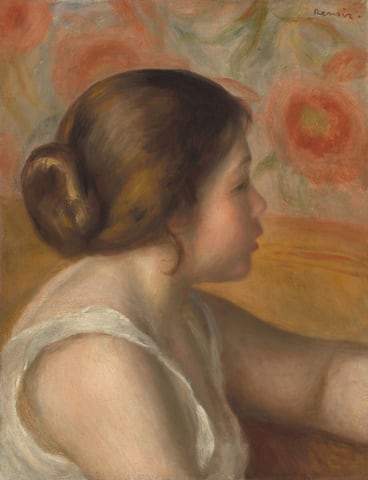
This painting shows a young woman's upper body from the torso up. She is seated and facing the right, with her face seen in profile and one arm bent in front of her, seeming to rest on a brown table or surface. She has pale skin, round, rosy cheeks, a small nose, and pink lips that are slightly parted. Her brown hair is styled into a smooth, glossy bun at the nape of her neck. She is wearing a white garment with thin straps over her shoulders. The background features a yellow section on the bottom half, and on the top half is a colorful, abstract pattern with large, soft, swirling forms in shades of orange and red on a blue-gray background with hints of green.
A work made of black and white chalk on blue wove paper.
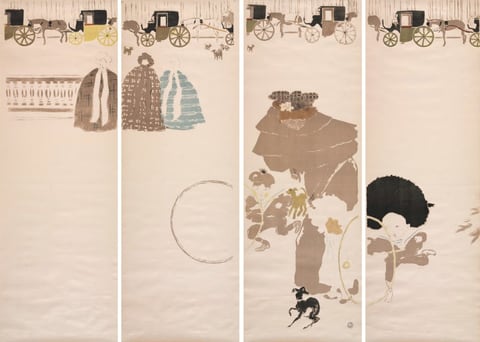
Nursemaids’ Promenade, Frieze of Carriages, by Pierre Bonnard, 1895
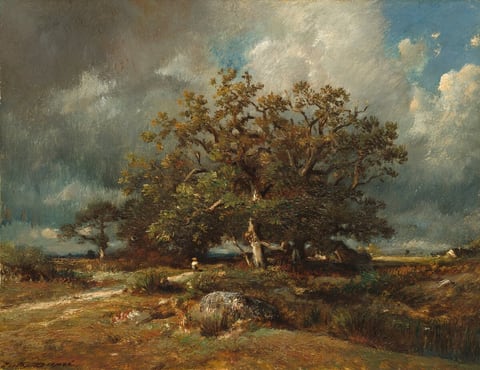
The painting depicts a landscape with a field, trees, and a dramatic cloudy sky. Grass, rocks, and a group of large trees are visible in the center of the composition. Below the trees, there is a small shape that could be a person looking up. Farther back, there are some small triangular structures that might be houses. The brushstrokes are expressive and not much detail is visible in the smaller shapes. The grass and foliage are painted in earthy tones of brown, orange, and green, while the sky is blue with areas of thick gray and white clouds.
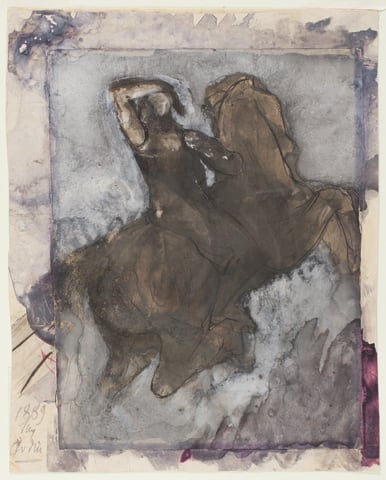
A work made of gouache, with pen and brown and black ink and traces of magenta ink (faded), over graphite (recto), and graphite (verso) on cream wove paper, tipped onto cream wove paper.

The works in this room are listed below.

Works in this room

Works made in France in the 19th century.

First room, north wall

  1. The painting depicts a forest floor under tall trees, with a grassy path leading into the distance. The sky is obscured by dense green foliage and tree limbs. Rocks and shrubs are visible on the ground, and the forest stretches into the distance. The trees are dark brown, with patches of white suggesting dappled light coming in through the branches above. The leaves and ground are mostly dark green, with some patches of brown, lighter green, and yellow.
    Forest SceneNarcisse Diaz de la Peña, 1874Courtesy National Gallery of Art, Washington
  2. View of a village surrounded by hills, fields, and trees, shown from a vantage point above the scene. Subtly rolling hills recede into a bluish gray-ish sky punctuated by white clouds. Thick brushstrokes built up atop each other are visible throughout.
    Auvers, Panoramic ViewPaul Cézanne, 1873–75Courtesy of the Art Institute of Chicago
  3. Dark portrait of older woman in black dress with lace collar, flowers.
    Mère GrégoireGustave Courbet, 1855, reworked 1857–59Courtesy of the Art Institute of Chicago
  4. This painting shows a young woman's upper body from the torso up. She is seated and facing the right, with her face seen in profile and one arm bent in front of her, seeming to rest on a brown table or surface. She has pale skin, round, rosy cheeks, a small nose, and pink lips that are slightly parted. Her brown hair is styled into a smooth, glossy bun at the nape of her neck. She is wearing a white garment with thin straps over her shoulders. The background features a yellow section on the bottom half, and on the top half is a colorful, abstract pattern with large, soft, swirling forms in shades of orange and red on a blue-gray background with hints of green.
    Head of a Young GirlPierre-Auguste Renoir, c. 1890Courtesy National Gallery of Art, Washington

First room, south wall

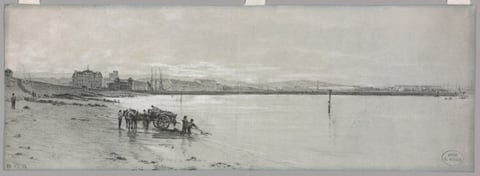
  1. A work made of black and white chalk on blue wove paper.
    SeasideCharles François Eustache, 1866Courtesy of the Art Institute of Chicago
  2. Nursemaids’ Promenade, Frieze of Carriages, by Pierre Bonnard, 1895
    Nursemaids’ Promenade, Frieze of CarriagesPierre Bonnard, 1895Courtesy of the Cleveland Museum of Art
  3. The painting depicts a landscape with a field, trees, and a dramatic cloudy sky. Grass, rocks, and a group of large trees are visible in the center of the composition. Below the trees, there is a small shape that could be a person looking up. Farther back, there are some small triangular structures that might be houses. The brushstrokes are expressive and not much detail is visible in the smaller shapes. The grass and foliage are painted in earthy tones of brown, orange, and green, while the sky is blue with areas of thick gray and white clouds.
    The Old OakJules Dupré, c. 1870Courtesy National Gallery of Art, Washington
  4. A work made of gouache, with pen and brown and black ink and traces of magenta ink (faded), over graphite (recto), and graphite (verso) on cream wove paper, tipped onto cream wove paper.
    Horseman (recto); Horse and Rider (verso)Auguste Rodin, 1889Courtesy of the Art Institute of Chicago

Second room, south wall
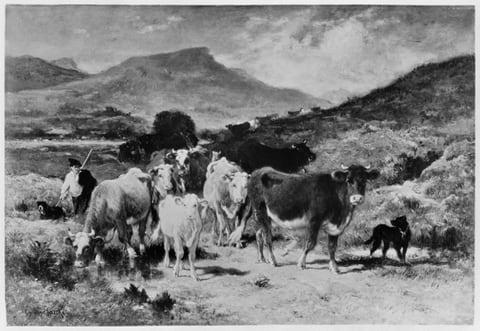
  1. A work made of oil on canvas.
    Descent of Cattle from the PyreneesEmile van Marcke de Lummen, c. 1880Courtesy of the Art Institute of Chicago
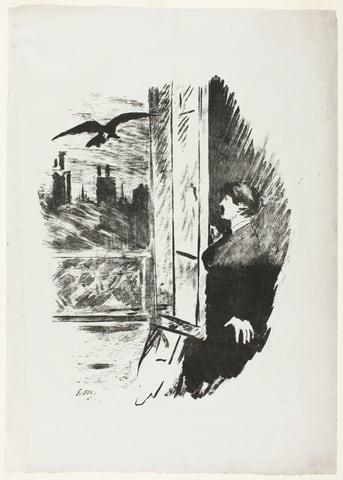
  2. A work made of transfer lithograph in black on gray china paper.
    At the window ("Open here I flung the shutter..."), from The Raven (Le Corbeau)Édouard Manet, 1875Courtesy of the Art Institute of Chicago
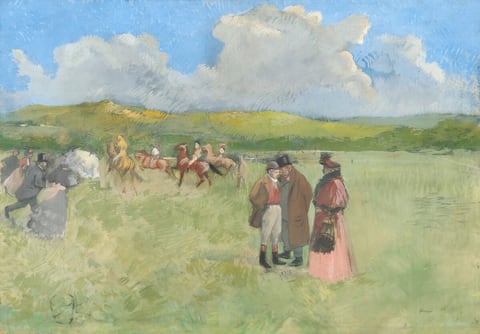
  3. This painting depicts a wide, grassy green field with distant green hills under a blue sky with fluffy white clouds. To the right of center, two men and one woman seem to be engaged in conversation. One man wears a dark suit with a long jacket over it and a top hat, and the other man wears a red shirt with tan breeches, tall black boots, a shorter brown coat, and a round hat. The woman wears a long pink dress with a ruffled black neckline and a large pink hat. Behind them, on the left, are four people riding horses, all headed towards the back left. On the far left, more men and women in dresses and suits seem to watch as the horses and riders race by, one woman holding a large white parasol. All of the people appear to have light skin, and their facial features are indistinct. The brushstrokes in the painting are loose and visible, and the landscape and sky are painted with short, overlapping lines going in different directions, giving the scene a hazy impression.
    The Race TrackJean Louis Forain, c. 1891Courtesy National Gallery of Art, Washington

Second room, north wall
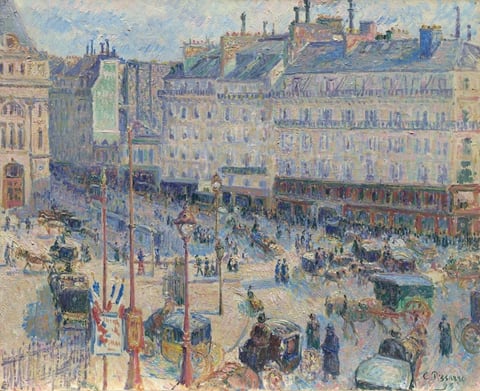
  1. A work made of oil on canvas.
    The Place du Havre, ParisCamille Pissarro, 1893Courtesy of the Art Institute of Chicago
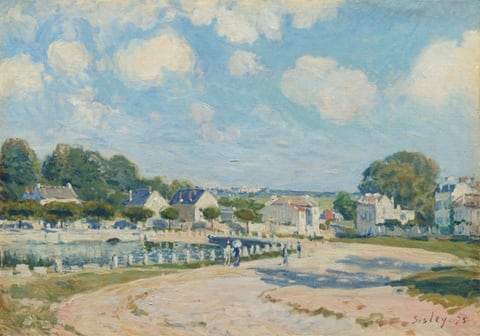
  2. A work made of oil on canvas.
    Watering Place at MarlyAlfred Sisley, 1875Courtesy of the Art Institute of Chicago
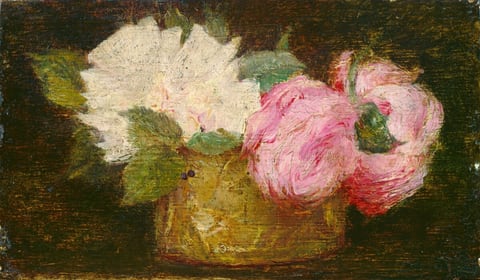
  3. Roses in a Vase, 1880/1900
    Roses in a VaseUnrecorded French maker, 1880/1900Courtesy National Gallery of Art, Washington

Third room, north wall
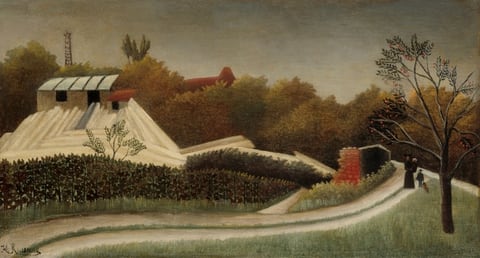
  1. A work made of oil on canvas.
    Sawmill, Outskirts of ParisHenri Rousseau, c. 1893/95Courtesy of the Art Institute of Chicago
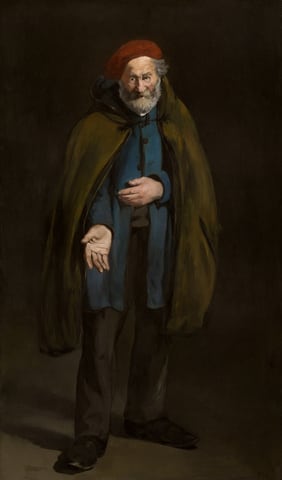
  2. A work made of oil on canvas.
    Beggar with a Duffle Coat (Philosopher)Édouard Manet, 1865–67Courtesy of the Art Institute of Chicago