Floor plan

Time and place17th-century Netherlands
17th-century Netherlands
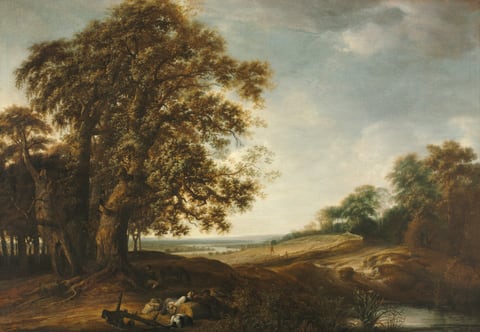
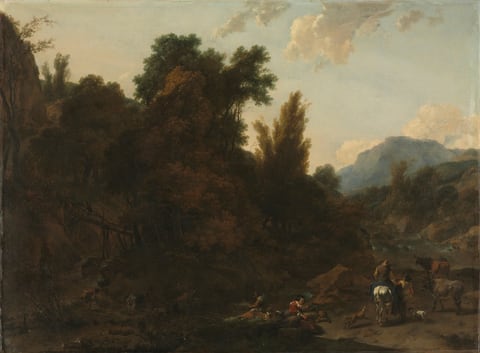
Rush Gatherers, by Nicolaes Berchem, 1657
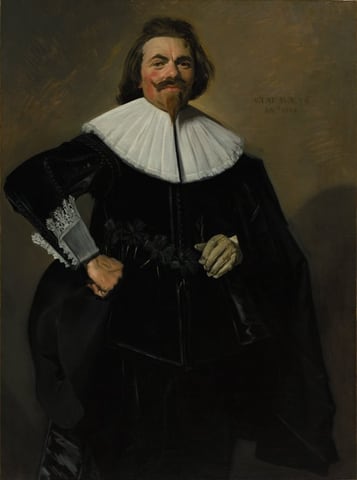
Portrait of Tieleman Roosterman, by Frans Hals, 1634
Sleeping Peasants near Fields (Parable of the Weeds), by Simon de Vlieger, 1650–53
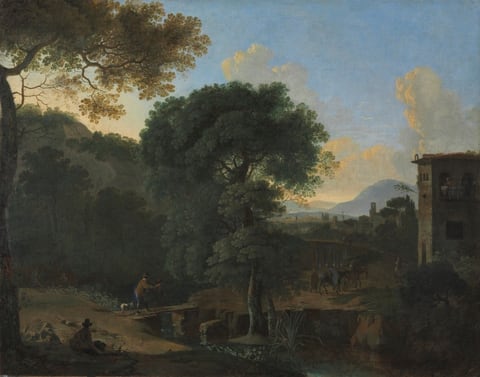
Landscape with Travelers, by Herman van Swanevelt, 1630s
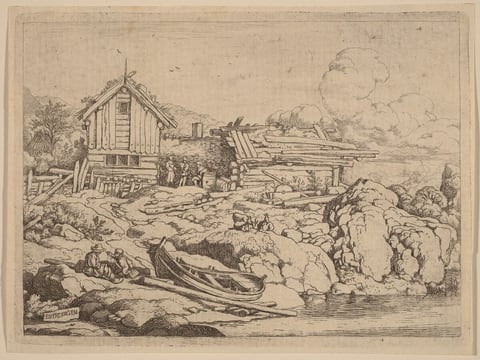
The image shows a landscape with figures near a body of water. There are buildings made of logs, people gathered near a structure, and trees in the background. The style is detailed with precise linework, shading, and hatching. The color palette is monochrome, emphasizing light and shadow.

The works in this room are listed below.

Works in this room

Works made in the Netherlands in the 17th century.

First room, north wall

  1. Rush Gatherers, by Nicolaes Berchem, 1657
    Rush GatherersNicolaes Berchem, 1657Courtesy of the Cleveland Museum of Art
  2. Portrait of Tieleman Roosterman, by Frans Hals, 1634
    Portrait of Tieleman RoostermanFrans Hals, 1634Courtesy of the Cleveland Museum of Art

First room, south wall

  1. Sleeping Peasants near Fields (Parable of the Weeds), by Simon de Vlieger, 1650–53
    Sleeping Peasants near Fields (Parable of the Weeds)Simon de Vlieger, 1650–53Courtesy of the Cleveland Museum of Art
  2. Landscape with Travelers, by Herman van Swanevelt, 1630s
    Landscape with TravelersHerman van Swanevelt, 1630sCourtesy of the Cleveland Museum of Art
  3. The image shows a landscape with figures near a body of water. There are buildings made of logs, people gathered near a structure, and trees in the background. The style is detailed with precise linework, shading, and hatching. The color palette is monochrome, emphasizing light and shadow.
    Boat at a River Bank with Three GoatsAllart van Everdingen, probably c. 1645/1656Courtesy National Gallery of Art, Washington

Second room, south wall
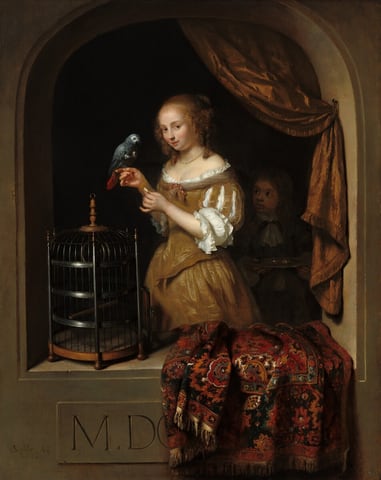
  1. Shown from about the knees up, a pale-skinned young woman stands within a stone niche, with a parrot perched on her finger as she gazes out at us in this vertical painting. The woman’s hands are raised to chest height, and she balances the spruce-blue parrot on the index finger of her far hand while her other hand holds an indistinct, white object. Her body is angled to our left, and she looks at us from the corner of her green eyes under faint brows. Her round face has a small nose, flushed cheeks, and her coral-red mouth curls up in a slight smile, her lips parted. Her honey-blond hair is gathered at the back of her head with curly tendrils framing her face and falling to her shoulders. She wears a golden-brown gown trimmed with a narrow ruffle of white fabric along the low neckline that reveals her décolletage. The bird faces the woman and lifts something, presumably a bit of food, up with one dark claw. The underside of its tail is crimson red. A light-skinned boy stands in deep shadow just to the right of the woman. He looks up at her and holds a silver tray in both hands. They stand within a light brown, arched, stone opening beyond a ledge, which comes up to about the woman’s knees. A carpet patterned with stylized flowers in ruby red, burnt orange, teal blue, white, and black is bunched up and draped over the parapet, to our right. A tall, iron-gray cage sits to our left. The rug partly covers an inscription on the front face of the niche that reads, “M. DO,” with the O cut off. A copper-colored, fringe-lined drapery hangs from the upper right of the arch and is fastened to the inner edge of the opening to create a swag. The woman is brightly lit from the upper left, and the space behind her and the boy is ink black. The artist signed and dated the lower left corner as if he had carved into the front face of the arch. It reads, “CNetscher .Ao. 16.66,” with the C and N overlapping to make a monogram.
    A Woman Feeding a Parrot, with a PageCaspar Netscher, 1666Courtesy National Gallery of Art, Washington
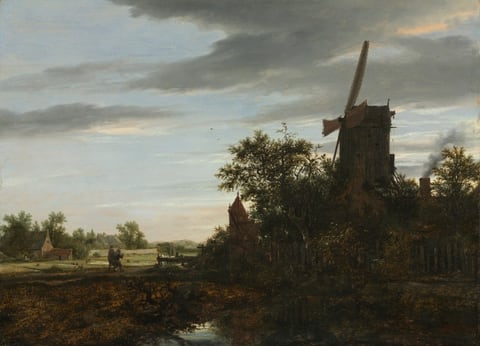
  2. Landscape with a Windmill, by Jacob van Ruisdael, 1646
    Landscape with a WindmillJacob van Ruisdael, 1646Courtesy of the Cleveland Museum of Art
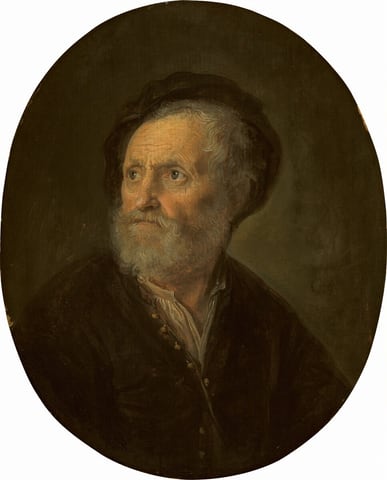
  3. Shown from the chest up, a light-skinned man with a wrinkled face and a silvery gray beard and hair gazes into the distance in this oval portrait painting. His chest is angled to our right but he turns his head to look off over his other shoulder, to our left. His slate-blue eyes are a little sunken and lined with wrinkles. Shading marks the hollows of the temple and cheek we can see. His thin lips are closed and framed by his curly mustache and beard. A dark, mahogany-brown cap is pushed back on his head, and his brown jacket has gold-colored buttons down the front. The collar of a cream-colored shirt shows through at the neckline. The background is dark olive green. The artist signed the work near the man’s shoulder, to our right: “GDOV.”
    Bust of a Bearded ManGerrit Dou, c. 1642/1645Courtesy National Gallery of Art, Washington
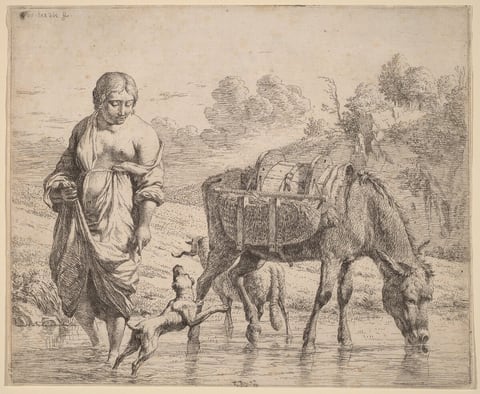
  4. The image shows a woman standing close to us, slightly turned to the side, looking down, with a hand supporting her draped attire and the other grasping a stick. Next to her, a donkey drinks from a shallow stream, carrying a large wicker basket with barrels inside. A dog is splashing in the water beside them. The horizon is low, meeting a rise of land with trees and shrubs, leading the eye to a distant pathway where a couple of small figures can be seen. The sky above has sketchily rendered clouds. The style involves fine, detailed linework, characteristic of etching, emphasizing textures such as the fur of the donkey and the folds of the fabric. The color palette is monochromatic, relying on various intensities of ink and line density to render shadows and highlights.
    Woman Crossing a StreamKarel Dujardin, 1662Courtesy National Gallery of Art, Washington

Second room, north wall
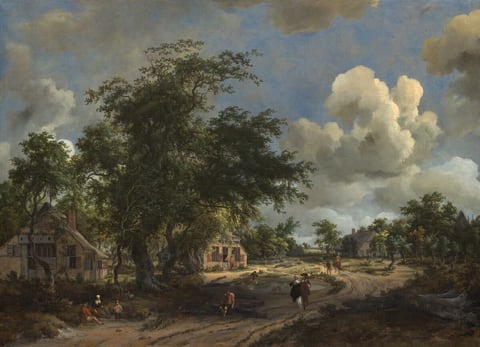
  1. Several people sit, stand, or stroll along a dirt road that winds from the lower left corner of this horizontal landscape painting into the distance, past trees and cottages under a vivid blue sky. The horizon line comes about a third of the way up the canvas, and the cloud studded, azure-blue sky fills the space above. Sunlight filtered through puffy white and steel-gray clouds illuminates the scene from the upper right, creating patches of light and shadow throughout. The road meanders through the center of the composition and is lined with dark and sage-green shrubs, scrubby growth, and gnarled, crooked trees. Closest to us and to our left, two tan cottages are tucked into deep shade created by a grove of several tall trees. The cottages have steeply pitched roofs and windows flanked by gray or brick-red shutters. Three people sit and stand near the path outside the closest building. A short distance to our right, a man sitting on a fallen log carries walking stick and a bundle on his back. His body faces us but his head is turned to our right to gaze toward the man and woman about to stroll past him, headed in our direction. The woman wears a black dress over a white skirt, and a white head covering and shawl. The man wears a brimmed hat with a red decoration, a brown coat with gold buttons down the front and a wide white collar, and heeled shoes. Beyond them, the road curves to our left around a small pond in front of the second cottage. Two people crouch to set a toy sailboat afloat by the edge of the pond, and a brown dog sniffs the ground nearby. Two more people stand talking at the doorway to the second cottage and another dog leaps up at the half-door. Further along the road, the light becomes stronger, illuminating a horse, rider, and another person walking alongside the horse. The road continues to curve around a butter-yellow cottage nestled in a grove of trees on the right. A sunny field is visible in the far distance.
    A View on a High RoadMeindert Hobbema, 1665Courtesy National Gallery of Art, Washington
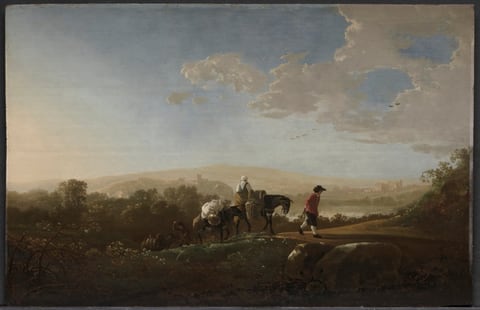
  2. Travelers in Hilly Countryside, by Aelbert Cuyp, c. 1650
    Travelers in Hilly CountrysideAelbert Cuyp, c. 1650Courtesy of the Cleveland Museum of Art
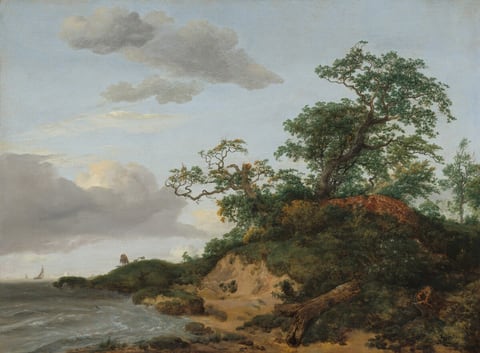
  3. Water laps at a curving shoreline in front of a steep sandy dune carpeted in grass, shrubs, and trees in this horizontal landscape painting. The dune takes up the lower right quadrant of the composition. A few broken tree trunks are overgrown with vines and plants across the top and down the sloping side of the dune facing us. A red brick wall cuts through the vegetation up the side of the dune and disappears into the shrubbery at the top. The twisting branches and canopies of three large trees reach into the upper right quadrant of the composition. The vegetation stops abruptly along the sheer edge of the dune where it faces the water. The land curves like a backward capital letter C so it almost reaches the left edge of the painting along the horizon, which comes a quarter of the way up the composition. A cow and three more animals, perhaps sheep or more cows, graze or lie on a grassy mound in the distance, and sailboats line the horizon in the deep distance. White ripples swirl in the steel-blue water. The artist signed and dated the lower center, “J Ruisdael . 1648.”
    Dunes by the SeaJacob van Ruisdael, 1648Courtesy National Gallery of Art, Washington

Third room, north wall
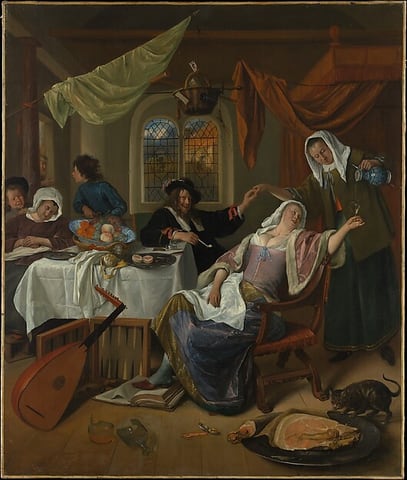
  1. The Dissolute Household, by Jan Steen, ca. 1663–64
    The Dissolute HouseholdJan Steen, ca. 1663–64Courtesy of The Metropolitan Museum of Art
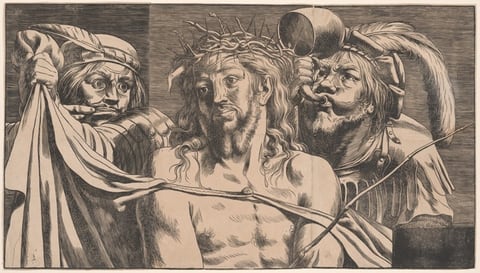
  2. A work made of woodcut on three joined sheets of ivory laid paper.
    The Mocking of ChristWerner van den Valckert, c. 1620Courtesy of the Art Institute of Chicago

Third room, south wall
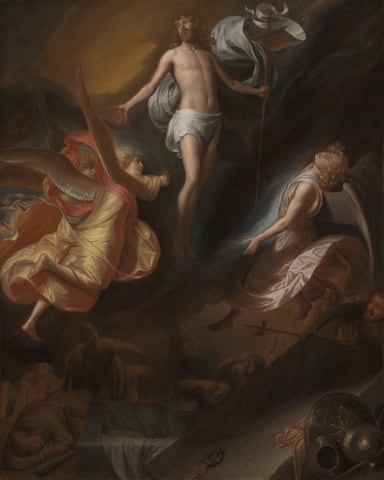
  1. A work made of oil on canvas.
    Resurrection of ChristSamuel van Hoogstraten, c. 1665Courtesy of the Art Institute of Chicago
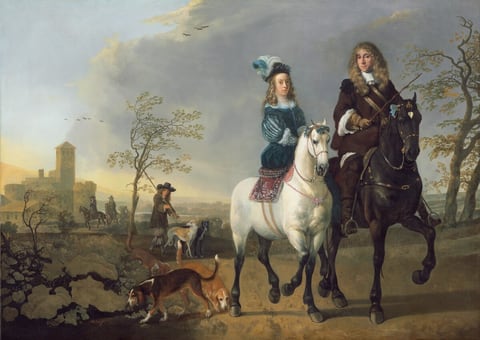
  2. An elegantly dressed man and woman ride horses toward us and to our right in a landscape with low, rolling hills, stone buildings, and trees in this horizontal painting. The two horses and riders take up the right half of the composition. Both people have pale skin and look at us. The woman has a high forehead, a straight nose, a round face, and curly blond hair falling to her shoulders. She wears a sapphire-blue dress with slashed sleeves to reveal a white garment beneath. Her hat is adorned with blue and white feathers, and she wears a string of pearls around her neck. The legs of her white horse darken to black below the knees, and the bridle is tied with blue bows near the horse’s ears. The sidesaddle sits on a woven, rug-like blanket. Next to her, to our right, the man rides a larger chestnut-brown horse with a white triangle between its eyes. The man looks at us out of the corners of his dark eyes under gathered brows. He has a long, straight nose and is cleanshaven, though a hint of a five o’clock shadow slightly darkens his cleft chin. His light brown hair falls in curls down past his shoulders, and he wears a dark brown coat with voluminous white fabric rippling out above tan-colored gloves. He holds a riding crop in his right hand, on our left, resting against his hip. Near the white horse’s feet, to our left, a dark brown dog with a white nose sniffs at a plant. Behind it, another reddish-brown dog sniffs the ground near the horse’s back hoof. A third dog stands beyond, partially obscured by bushes and plants growing in the lower left corner of the canvas. A man wearing a tall black, wide-brimmed hat and carrying a long staff leads two slender dogs resembling grayhounds on leashes along the path, a little behind the riders. Two more elegantly dressed men ride horses toward us father back on the path. Sand-colored stone buildings, hazy in the distance, are clustered around a squared tower, possibly a bell tower, to our left. The land dips gently to the horizon line in the deep distance. The riders are silhouetted against a swirling slate-blue cloud that fills most of the sky in the top two-thirds of the painting. The sky clears to pale blue to our left and then warms to golden yellow along the horizon, beyond the buildings. The artist signed the painting near the lower left corner: “A. Cuijp.”
    Lady and Gentleman on HorsebackAelbert Cuyp, c. 1655, reworked 1660/1665Courtesy National Gallery of Art, Washington