Floor plan

Style galleriesNeoclassicism

Neoclassicism

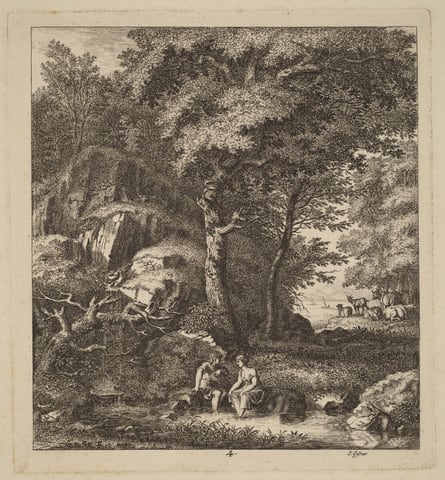
The image depicts a forest scene with large trees dominating the right side, two figures seated by a stream, rocky formations on the left, grazing animals in the distance, and a monochrome color palette of brown and espresso tones.
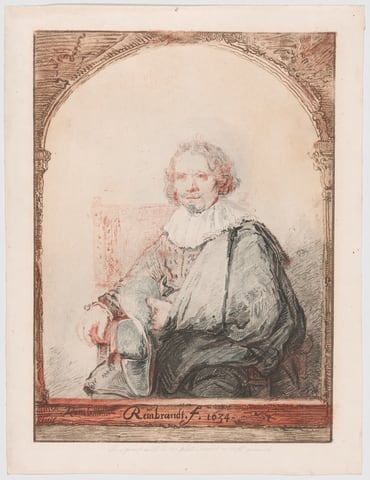
A work made of soft ground etching from two plates, with roulette, on paper.
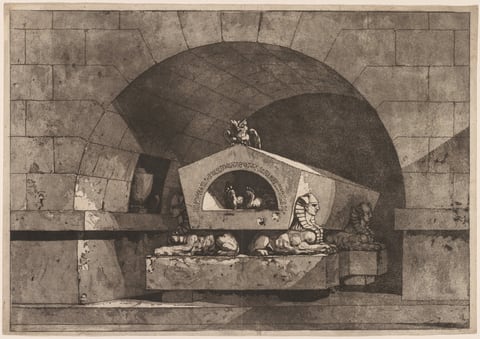
Tomb with Sphinxes and an Owl, by Louis Jean Desprez, c. 1779–84
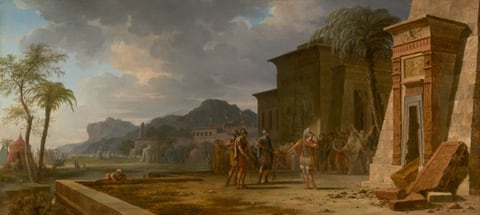
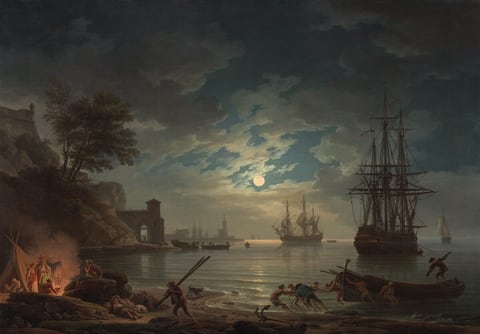
A work made of oil on canvas.
Moonlight falls across several masted ships near a rocky shoreline in this horizontal painting. The sky fills the top three-quarters of the picture. A veil of slate-gray clouds is lit to pearl white around the crisp, full moon at the center of the composition. Patches of denim-blue sky are seen through breaks in the blanket of clouds. Moonlight reflects down the center of rippling, silvery-gray water that laps against a beach close to us, along the bottom edge of the painting. A tent is set up in the lower left corner of the composition. There, two women and one man stand looking at a glowing fire next to the tent. One woman holds a basket on her head, the other tucks a flat basket under one arm. The man stands between the two women, and a fourth man crouches near the fire, his back to us. In the opening of the tent, another woman kneels over a large bowl as she looks at the fire. A fifth person, a man, gazes at the fire as he sits smoking a long-stemmed pipe on a boulder. At the foot of the boulders, a man lies back against some bundles, one arm thrown up over his head. A dog curls up next to his hip. Not far from the sleeping man and in the center of the foreground, a man carries several long wooden objects, possibly oars, over one shoulder while a dog beyond him barks at the lapping surf. The beach curves like a C away from us, along the left. At the point of the curve in the middle distance, a structure like a city wall and gate jut out to the water’s edge. More buildings atop steep cliffs rise vertically beyond the gate. The shoreline curves into the distance again, and more buildings, including a lighthouse, and masted ships there are smoke-gray silhouettes. Near the lower right corner of the painting, four men pull on ropes tied around the prow of a small wooden boat while three others push it toward the land. Another man stands in the far end. A short distance beyond that boat is a tall wooden ship with three masts and rigging outlined against the night sky. Windows along the decks of that boat’s wide stern, angled toward us, glow with golden light. Beyond it and a bit to our left, another ship, smaller in scale, sails away from us. Several more ships move back to the horizon until we only see strokes of white and gray to indicate their unfurled sails.
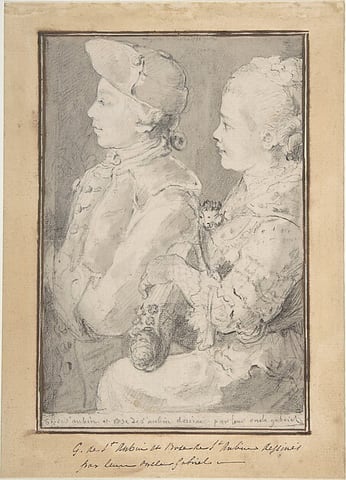
Germain-Augustin and Rose de Saint-Aubin, Drawn by Their Uncle, by Gabriel de Saint-Aubin, 1766
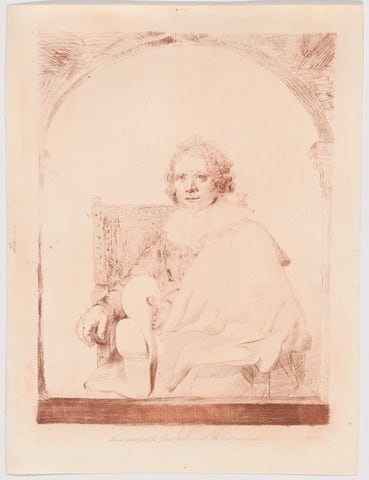
A work made of soft ground etching, with roulette, printed in red on white wove paper.
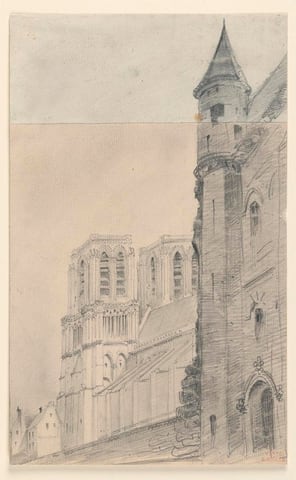
CATHEDRAL OF NOTRE DAME IN PARIS

The works in this room are listed below.

Works in this room

Europe turns back to Greece and Rome: clear line, calm figures and civic virtue.

First room, north wall

  1. The image depicts a forest scene with large trees dominating the right side, two figures seated by a stream, rocky formations on the left, grazing animals in the distance, and a monochrome color palette of brown and espresso tones.
    A Shepherd and a Young Woman With Their Feet in a BrookSalomon Gessner, 1764Courtesy National Gallery of Art, Washington
  2. A work made of soft ground etching from two plates, with roulette, on paper.
    Portrait of a Man in an Armchair, from Collection d'imitations de Dessins d'après les Principaux Maîtres Hollandais et FlamandsChristian Josi, 1826Courtesy of the Art Institute of Chicago
  3. Tomb with Sphinxes and an Owl, by Louis Jean Desprez, c. 1779–84
    Tomb with Sphinxes and an OwlLouis Jean Desprez, c. 1779–84Courtesy of the Cleveland Museum of Art
  4. A work made of oil on canvas.
    Alexander at the Tomb of Cyrus the GreatPierre Henri de Valenciennes, 1796Courtesy of the Art Institute of Chicago

First room, south wall

  1. Moonlight falls across several masted ships near a rocky shoreline in this horizontal painting. The sky fills the top three-quarters of the picture. A veil of slate-gray clouds is lit to pearl white around the crisp, full moon at the center of the composition. Patches of denim-blue sky are seen through breaks in the blanket of clouds. Moonlight reflects down the center of rippling, silvery-gray water that laps against a beach close to us, along the bottom edge of the painting. A tent is set up in the lower left corner of the composition. There, two women and one man stand looking at a glowing fire next to the tent. One woman holds a basket on her head, the other tucks a flat basket under one arm. The man stands between the two women, and a fourth man crouches near the fire, his back to us. In the opening of the tent, another woman kneels over a large bowl as she looks at the fire. A fifth person, a man, gazes at the fire as he sits smoking a long-stemmed pipe on a boulder. At the foot of the boulders, a man lies back against some bundles, one arm thrown up over his head. A dog curls up next to his hip. Not far from the sleeping man and in the center of the foreground, a man carries several long wooden objects, possibly oars, over one shoulder while a dog beyond him barks at the lapping surf. The beach curves like a C away from us, along the left. At the point of the curve in the middle distance, a structure like a city wall and gate jut out to the water’s edge. More buildings atop steep cliffs rise vertically beyond the gate. The shoreline curves into the distance again, and more buildings, including a lighthouse, and masted ships there are smoke-gray silhouettes. Near the lower right corner of the painting, four men pull on ropes tied around the prow of a small wooden boat while three others push it toward the land. Another man stands in the far end. A short distance beyond that boat is a tall wooden ship with three masts and rigging outlined against the night sky. Windows along the decks of that boat’s wide stern, angled toward us, glow with golden light. Beyond it and a bit to our left, another ship, smaller in scale, sails away from us. Several more ships move back to the horizon until we only see strokes of white and gray to indicate their unfurled sails.
    MoonlightClaude-Joseph Vernet, 1772Courtesy National Gallery of Art, Washington
  2. Germain-Augustin and Rose de Saint-Aubin, Drawn by Their Uncle, by Gabriel de Saint-Aubin, 1766
    Germain-Augustin and Rose de Saint-Aubin, Drawn by Their UncleGabriel de Saint-Aubin, 1766Courtesy of The Metropolitan Museum of Art
  3. A work made of soft ground etching, with roulette, printed in red on white wove paper.
    Portrait of a Man in an Armchair, from Collection d'imitations de Dessins d'après les Principaux Maîtres Hollandais et FlamandsChristian Josi, 1826Courtesy of the Art Institute of Chicago
  4. CATHEDRAL OF NOTRE DAME IN PARIS
    Cathedral of Notre Dame in ParisCharles Nicolas Ransonnette, 1825–1840Courtesy of Cooper Hewitt, Smithsonian Design Museum

Second room, south wall
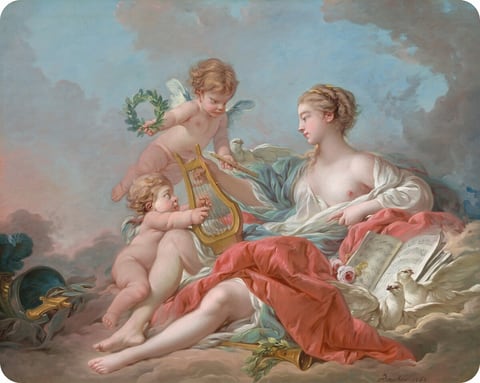
  1. A woman wearing flowing, pastel-colored robes and two, winged, child-like putti gather on a bank of clouds among musical instruments and sheet music in this horizontal painting. The people all have pale, pink-tinged skin. The woman sits to our right of center, facing our left in profile. She has straight nose, a rounded chin, and her small, pink lips are closed. Her ash-blond hair is pulled back under a yellow band. A voluminous white robe falls away over her left shoulder, to our right, to reveal a firm breast and small pink nipple. Sky-blue drapery wraps over her far arm, and deep rose-pink cloth falls across her lap and onto the clouds around her. Her legs extend to our left, her toes pointed. She leans back on her left elbow, closer to us, and points with that index finger to a lyre she props against her knee with her other hand. One chubby, nude putto reaches forward to strum the strings. The other putto hovers above, holding a ring of laurel leaves up in one hand and a flute in the other. Both putti have chubby limbs and torsos, blond curls lifted as if in a breeze, and short, ice-blue wings. Both look at the woman. In the lower left corner, a helmet with a topaz-blue feather and the gold hilt of a sword sit near the woman’s feet. Beneath the woman’s lower leg, at the bottom center of the painting, is a gold horn encircled by another wreath of laurel leaves. Two white doves with wings spread support an open book of sheet music and two pink roses tucked under the woman’s bent elbow. Fog-gray clouds billow up both sides of the scene against a pale blue sky. The clouds on which the trio gathers are parchment brown shaded with mauve pink. The outer corners of the image are white, indicating that the corners of the canvas were rounded. The artist signed and dated the painting in the lower right corner, “F Boucher 1764.”
    Allegory of MusicFrançois Boucher, 1764Courtesy National Gallery of Art, Washington
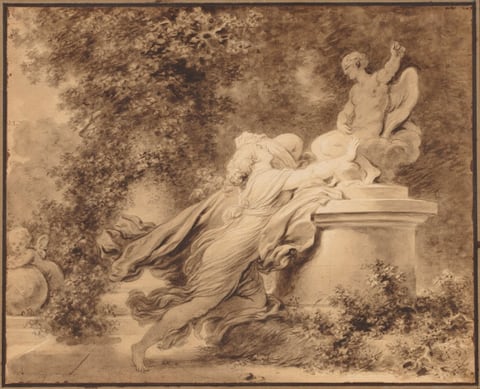
  2. Invocation to Love, by Jean Honoré Fragonard, c. 1781
    Invocation to LoveJean Honoré Fragonard, c. 1781Courtesy of the Cleveland Museum of Art
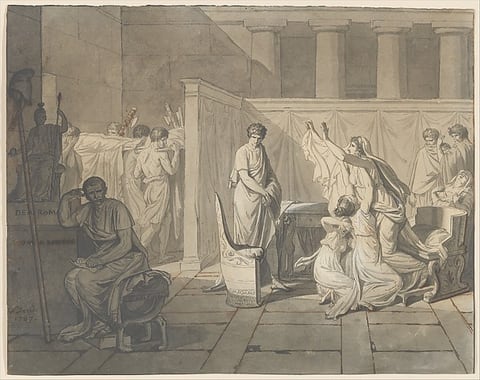
  3. The Lictors Bringing Brutus the Bodies of his Sons, by Jacques-Louis David, 1787
    The Lictors Bringing Brutus the Bodies of his SonsJacques-Louis David, 1787Courtesy of The Metropolitan Museum of Art

Second room, north wall
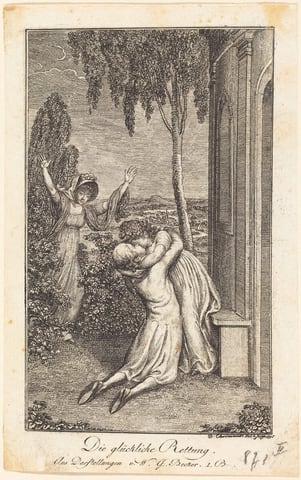
  1. The image shows three figures. Two of them are embracing in the foreground, kneeling on the ground and facing each other in a kiss. The person on the left has curly hair and appears to be wearing a coat-like garment, while the person on the right has long hair tied back and is dressed in a long robe. The third figure emerges from the bushes in the background, with shoulder-length hair, wearing a dress with a sash and a light shawl or scarf over their head. The setting includes tall trees, shrubs, and a structure with columns and arches on the right side, suggesting a garden or courtyard. Rolling hills and cloudy skies are in the distant background.
    The Fortunate RescueDaniel Nikolaus Chodowiecki, 1791Courtesy National Gallery of Art, Washington
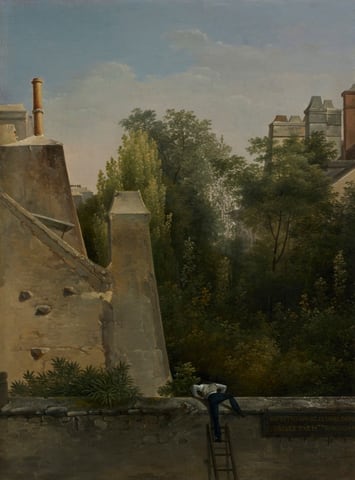
  2. The Curious One, by Antoine Pierre Mongin, 1823
    The Curious OneAntoine Pierre Mongin, 1823Courtesy of the Cleveland Museum of Art
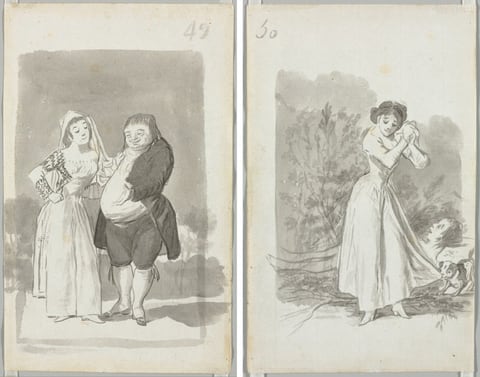
  3. Young Woman (possibly a Sex Worker) with a Man (recto); Young Woman Wringing Her Hands over a Man's Naked Body (verso), by Francisco Goya, 1796–97
    Young Woman (possibly a Sex Worker) with a Man (recto); Young Woman Wringing Her Hands over a Man's Naked Body (verso)Francisco Goya, 1796–97Courtesy of the Cleveland Museum of Art

Third room, north wall
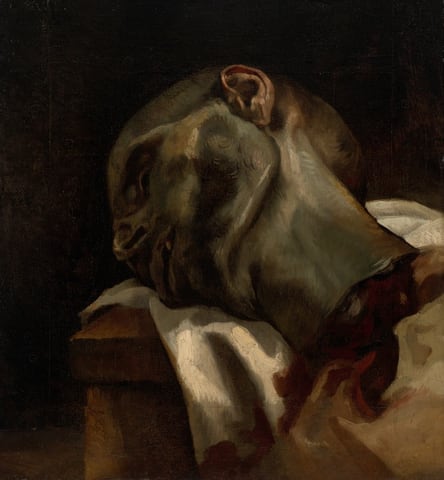
  1. A work made of oil on panel.
    Head of a Guillotined ManJean Louis André Théodore Géricault, 1818–19Courtesy of the Art Institute of Chicago
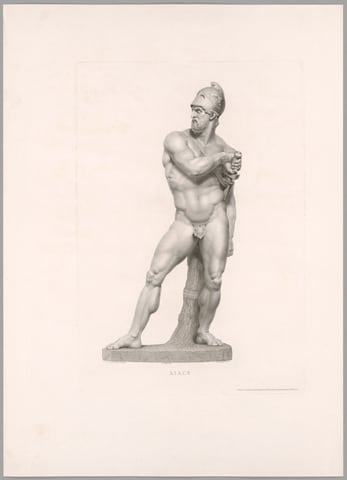
  2. A work made of engraving and etching in black on ivory wove paper.
    Ajax, Front View, from Oeuvre de CanovaAntonio Canova, 1817Courtesy of the Art Institute of Chicago