Floor plan

Style galleriesNeoclassicism

Neoclassicism

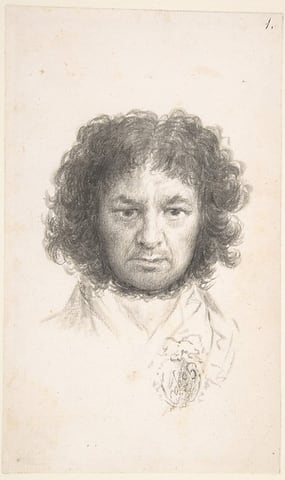
Self-Portrait, by Francisco Goya, ca. 1796
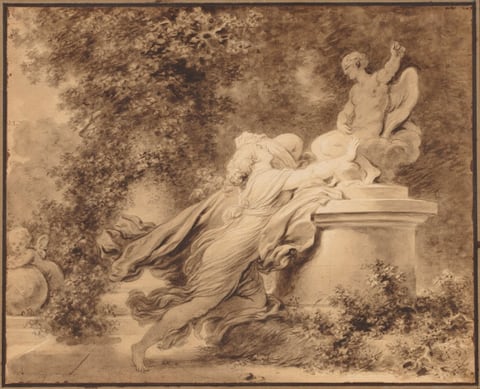
Invocation to Love, by Jean Honoré Fragonard, c. 1781
A work made of oil on canvas.
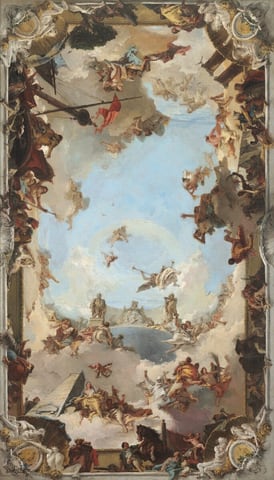
We look up through an opening surrounded by a stone ledge, with clusters of people and clouds swirling into a blue sky up and away from us in this vertical, rectangular painting. From a distance, the scene looks like a complete illusion but up close, the people, clouds, and architecture are sketchily painted. The ledge running around the opening has a gold, oval medallion at each corner. Appearing to be carved from white stone, two bearded men with long hair recline against each medallion, flanking them to each side in front of large shells that curve up over the people and frames them. A few architectural structures extend up into the sky, including a pointed obelisk in the lower left corner, a pair of columns at the upper right, and what seems to be the mast of a ship at the top left. Most of the people have pale skin but some have more tan complexions, and a few, including those wearing feather headdresses near the upper left corner, have brown skin. The people wear windswept robes of pale, butter yellow, robin’s egg blue, rose pink, and ivory. The eye may drawn to a few vignettes, such as the man holding a rearing, chestnut-brown horse on the illusionistic ledge near the lower right, a nun wearing a white robe and holding a cross above him in the clouds, and, farthest away, a crowned person sitting on a throne.
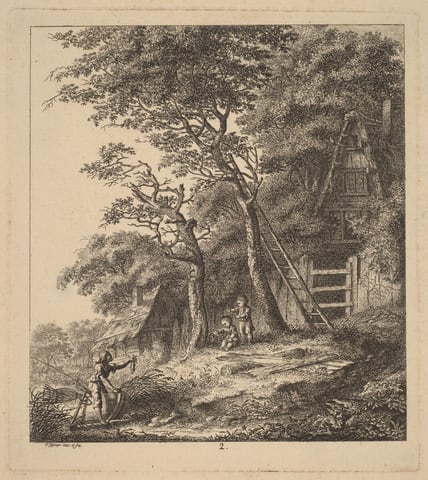
The image shows a rustic scene with a house, trees, and a figure washing near a stream. Two children stand in the middle distance next to a ladder. In the background are two thatched houses among trees. The drawing style is detailed with fine lines and cross-hatching, creating texture. The color palette is monochromatic in shades of black and gray, emphasizing light and shadow.
A work made of oil and ink on paper, laid down on canvas.
THE VIRGIN WITH THE CHILD

The works in this room are listed below.

Works in this room

Europe turns back to Greece and Rome: clear line, calm figures and civic virtue.

First room, north wall

  1. Self-Portrait, by Francisco Goya, ca. 1796
    Self-PortraitFrancisco Goya, ca. 1796Courtesy of The Metropolitan Museum of Art
  2. Invocation to Love, by Jean Honoré Fragonard, c. 1781
    Invocation to LoveJean Honoré Fragonard, c. 1781Courtesy of the Cleveland Museum of Art
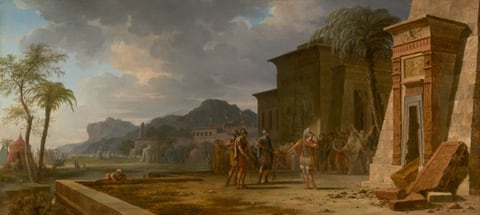
  3. A work made of oil on canvas.
    Alexander at the Tomb of Cyrus the GreatPierre Henri de Valenciennes, 1796Courtesy of the Art Institute of Chicago

First room, south wall

  1. We look up through an opening surrounded by a stone ledge, with clusters of people and clouds swirling into a blue sky up and away from us in this vertical, rectangular painting. From a distance, the scene looks like a complete illusion but up close, the people, clouds, and architecture are sketchily painted. The ledge running around the opening has a gold, oval medallion at each corner. Appearing to be carved from white stone, two bearded men with long hair recline against each medallion, flanking them to each side in front of large shells that curve up over the people and frames them. A few architectural structures extend up into the sky, including a pointed obelisk in the lower left corner, a pair of columns at the upper right, and what seems to be the mast of a ship at the top left. Most of the people have pale skin but some have more tan complexions, and a few, including those wearing feather headdresses near the upper left corner, have brown skin. The people wear windswept robes of pale, butter yellow, robin’s egg blue, rose pink, and ivory. The eye may drawn to a few vignettes, such as the man holding a rearing, chestnut-brown horse on the illusionistic ledge near the lower right, a nun wearing a white robe and holding a cross above him in the clouds, and, farthest away, a crowned person sitting on a throne.
    Wealth and Benefits of the Spanish Monarchy under Charles IIIGiovanni Battista Tiepolo, 1762Courtesy National Gallery of Art, Washington
  2. The image shows a rustic scene with a house, trees, and a figure washing near a stream. Two children stand in the middle distance next to a ladder. In the background are two thatched houses among trees. The drawing style is detailed with fine lines and cross-hatching, creating texture. The color palette is monochromatic in shades of black and gray, emphasizing light and shadow.
    A Fisherman and Two Children in a Landscape with Thatched CottagesSalomon Gessner, 1764Courtesy National Gallery of Art, Washington
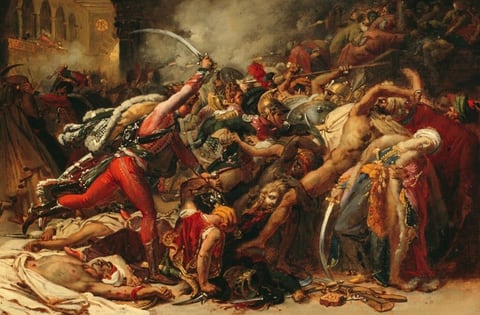
  3. A work made of oil and ink on paper, laid down on canvas.
    Sketch for The Revolt of CairoAnne-Louis Girodet de Roussy-Trioson, c. 1810Courtesy of the Art Institute of Chicago
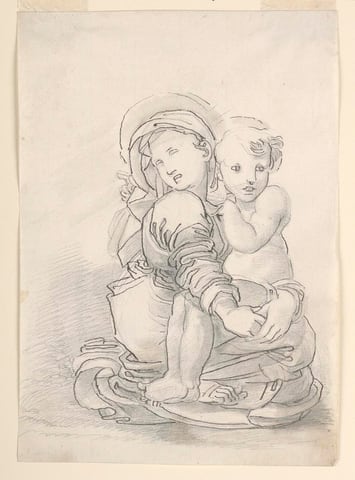
  4. THE VIRGIN WITH THE CHILD
    The Virgin with the ChildFortunato Duranti, 1820–1850Courtesy of Cooper Hewitt, Smithsonian Design Museum

Second room, south wall
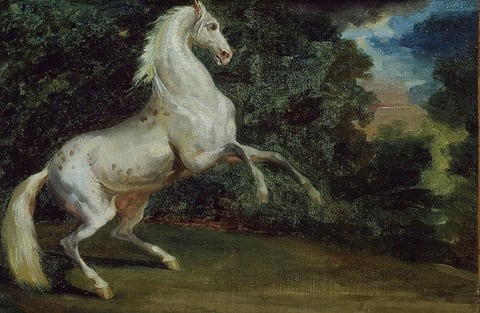
  1. A work made of oil on canvas.
    Prancing HorseFollower of Jean Louis André Théodore Géricault, 1808–12Courtesy of the Art Institute of Chicago
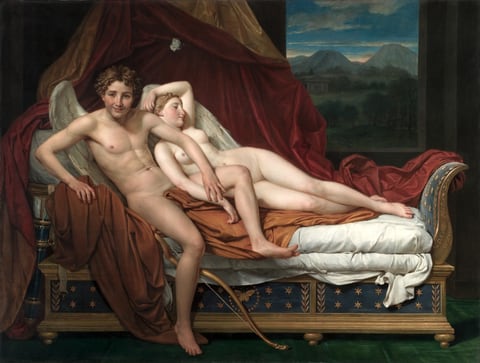
  2. Cupid and Psyche, by Jacques-Louis David, 1817
    Cupid and PsycheJacques-Louis David, 1817Courtesy of the Cleveland Museum of Art
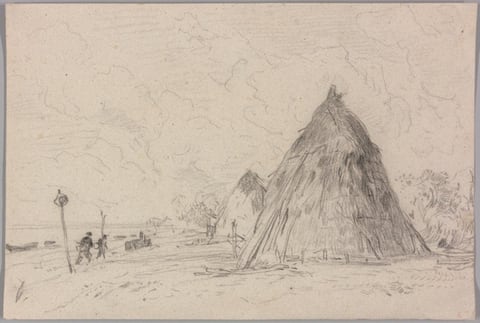
  3. A work made of conté crayon on gray-blue wove paper.
    Landscape with HaystacksConstant Troyon, n.d.Courtesy of the Art Institute of Chicago

Second room, north wall
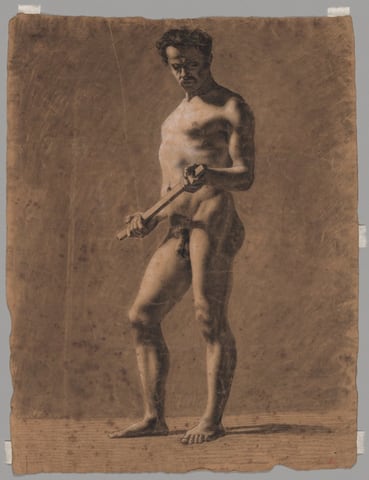
  1. A work made of black chalk and charcoal with stumping, heightened with white chalk (recto), and black chalk and charcoal with stumping (verso), on dark tan laid paper.
    Standing Academic Male Nude (recto); Sketch of Upper Arm (verso)Eugène Delacroix, 1816Courtesy of the Art Institute of Chicago
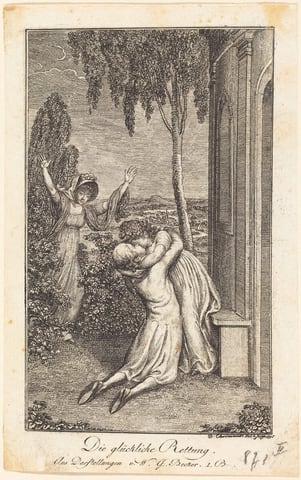
  2. The image shows three figures. Two of them are embracing in the foreground, kneeling on the ground and facing each other in a kiss. The person on the left has curly hair and appears to be wearing a coat-like garment, while the person on the right has long hair tied back and is dressed in a long robe. The third figure emerges from the bushes in the background, with shoulder-length hair, wearing a dress with a sash and a light shawl or scarf over their head. The setting includes tall trees, shrubs, and a structure with columns and arches on the right side, suggesting a garden or courtyard. Rolling hills and cloudy skies are in the distant background.
    The Fortunate RescueDaniel Nikolaus Chodowiecki, 1791Courtesy National Gallery of Art, Washington
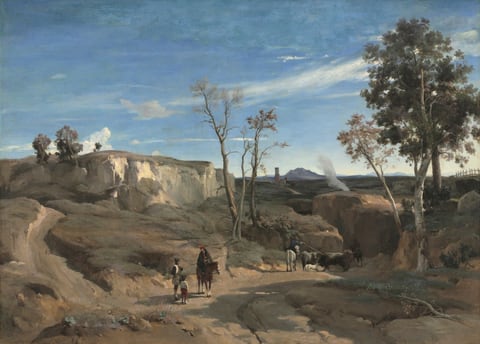
  3. La Cervara, the Roman Campagna, by Jean Baptiste Camille Corot, c. 1830–31
    La Cervara, the Roman CampagnaJean Baptiste Camille Corot, c. 1830–31Courtesy of the Cleveland Museum of Art

Third room, north wall
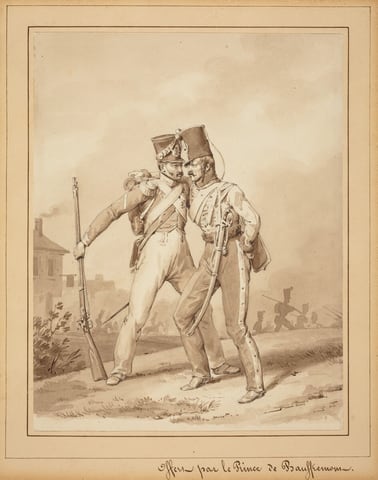
  1. The image features two men in military uniform engaging closely with each other. Both are shown from head to toe. The man on the left stands with his left leg forward, holding a rifle, and has his right arm around the shoulder of the other man. The man on the right has his right leg slightly bent, supporting his weight, and is holding a sword in his left hand. Each man has distinctive facial features. Both wear tall, elaborate military hats and detailed uniforms. The man on the left displays a strap over his shoulder, while the man on the right has intricate decorations on his jacket and trousers. In the background, there are a few more soldiers and part of a building to the left. The setting is monochromatic.
    Two GrenadiersVictor AdamCourtesy National Gallery of Art, Washington
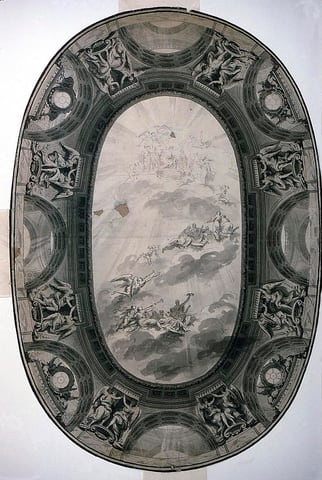
  2. PROJECT FOR THE PAINTED DECORATION OF THE CEILING OF A HALL (PAINTED OVAL CEILING)
    Project for the Painted Decoration of the Ceiling of a Hall (Painted Oval Ceiling)Jean Baptiste Marie Pierre, 1761Courtesy of Cooper Hewitt, Smithsonian Design Museum
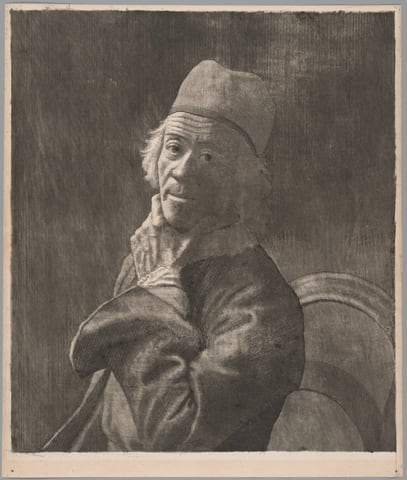
  3. A work made of etching, roulette, and mezzotint in black on cream laid paper.
    The Large Self-PortraitJean Etienne Liotard, 1778/81Courtesy of the Art Institute of Chicago