Floor plan

Style galleriesImpressionism

Impressionism

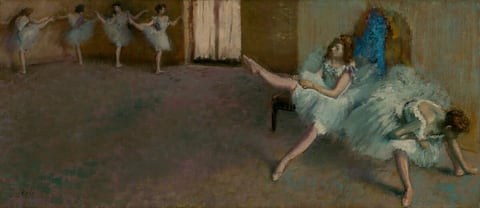
In a dance studio, two ballerinas wearing knee-length tutus and ballet slippers sit on a bench and stretch to our right while four more pose at the back of the space, to our left, in this long, horizontal painting. The scene and dancers are loosely painted so many features are indistinct. All the women have light skin and dark brown hair. Each pale, robins’ egg-blue costume has a low-cut, tightly fitting, sleeveless bodice and a full skirt. Dabs of off white, teal, and blue suggest flowers lining the deep U of the neckline at the front and down the back of each bodice. Closest to us and nearly brushing the edges of the lower right corner of the canvas, one dancer sits on the end of a wooden bench and leans down between her legs, her feet widely planted. She rests her torso on an elbow folded onto one knee as she reaches for her left foot, farther from us, with her other hand. Her hair is pulled up and her face, looking downward, is deep in shadow. Sitting behind her on the bench, to our left, a second dancer lifts her right leg, toe pointing, as she pulls on her pale pink tights. Her other leg stretches straight, pointed toe brushing the floor, in front of her. This woman’s hair hangs loose around her shoulders. The pair is brightly lit from a source to our right, and an arched area of electric blue and mustard yellow behind them is difficult to interpret. The floor, which takes up about two-thirds of the composition, is painted with dabs of teal blue, pale fuchsia pink, and caramel brown. It leads us back to the upper left corner of the painting where four more four ballerinas stand in a line. The pair to our left stands with their backs to us, facing the wall with their right legs raised to shoulder height, toes pointed. The pair to our right faces us. They also stand with their right legs raised, creating a wide angle with their standing legs. All four ballerinas bend their arms gently at the elbow, and some tip their heads toward the raised legs. The rightmost dancer is illuminated by a pair of French doors at the back corner, at the top center of the painting. The wall behind the bench is streaked with mint green over honey brown, and the wall at the back of the room is leather brown. The visible, soft brushstrokes give the image a blurred, ethereal appearance in the dimmed studio. The artist signed the painting in the lower left corner, “Degas.”
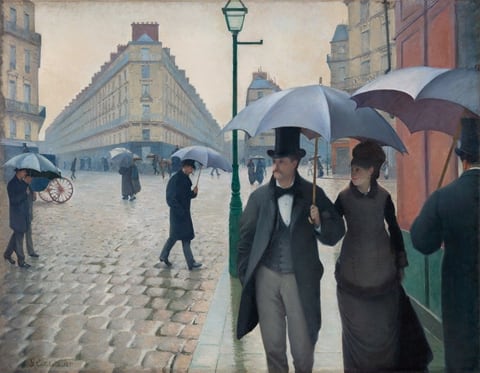
Life-size painting of an urban scene in Paris. A man in a top hat holding an umbrella and a woman in a long fashionable dark dress walk arm in arm toward the viewer as other city dwellers with umbrellas walk in various directions across cobblestone roads and sidewalks.
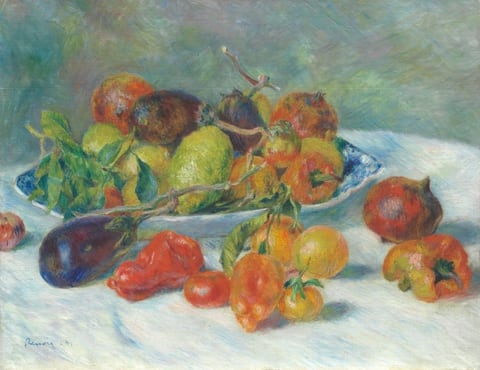
A work made of oil on canvas.
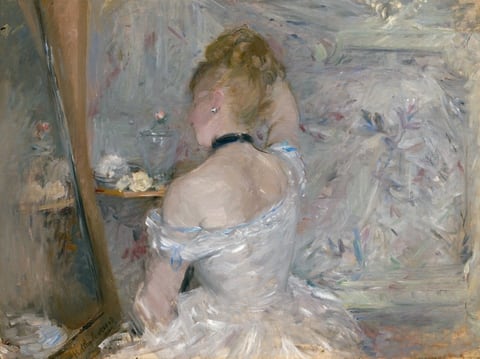
Painted portrait dominated by loose, large brushstrokes of a woman, seen from the back, wearing a gauzy white off-the-shoulder dress and black choker, blond hair swept up, examining herself in a mirror at left. The background is a feathered swirl suggesting floral pattern in cool pale tones of gray, purple, pink, and blue.
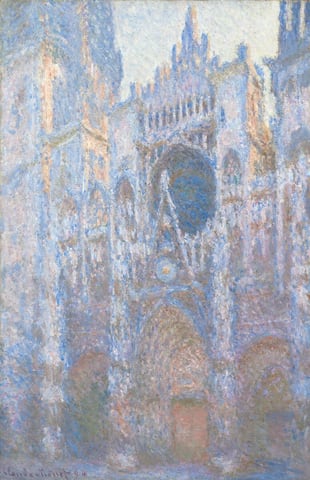
We look up at the exterior of a church that soars the height of this vertical painting. The church is painted with visible dabs and strokes of azure blue, peach, lavender purple, and camel brown to create a blurred look, as if seeing a reflection in the rippling surface of a puddle. The church façade is angled to our left, away from us. The main door and its surround takes up the center of the composition, where a rectangular door is set within nested, pointed arches that lead up to a narrow, tall, triangular gable. The point of that gable overlaps the round, dark rose window, which is the same width as the portal surround below. Spires flank the central section and rise precipitously off the top edge of the painting. The sky above is painted with daubs of white and pale blue. The artist signed and dated the lower left, “Claude Monet 94.”
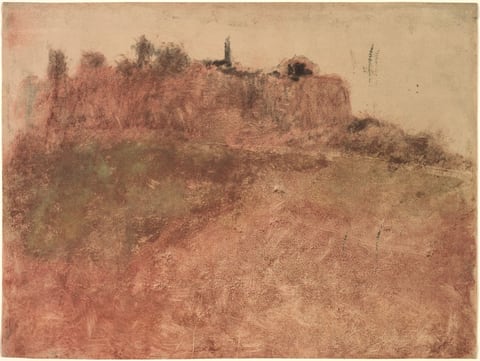
Estérel Village, by Edgar Degas, c. 1890

The works in this room are listed below.

Works in this room

Painters in 1870s Paris who worked quickly, often outdoors, to catch light as it changed.

Section 1, north wall

  1. In a dance studio, two ballerinas wearing knee-length tutus and ballet slippers sit on a bench and stretch to our right while four more pose at the back of the space, to our left, in this long, horizontal painting. The scene and dancers are loosely painted so many features are indistinct. All the women have light skin and dark brown hair. Each pale, robins’ egg-blue costume has a low-cut, tightly fitting, sleeveless bodice and a full skirt. Dabs of off white, teal, and blue suggest flowers lining the deep U of the neckline at the front and down the back of each bodice. Closest to us and nearly brushing the edges of the lower right corner of the canvas, one dancer sits on the end of a wooden bench and leans down between her legs, her feet widely planted. She rests her torso on an elbow folded onto one knee as she reaches for her left foot, farther from us, with her other hand. Her hair is pulled up and her face, looking downward, is deep in shadow. Sitting behind her on the bench, to our left, a second dancer lifts her right leg, toe pointing, as she pulls on her pale pink tights. Her other leg stretches straight, pointed toe brushing the floor, in front of her. This woman’s hair hangs loose around her shoulders. The pair is brightly lit from a source to our right, and an arched area of electric blue and mustard yellow behind them is difficult to interpret. The floor, which takes up about two-thirds of the composition, is painted with dabs of teal blue, pale fuchsia pink, and caramel brown. It leads us back to the upper left corner of the painting where four more four ballerinas stand in a line. The pair to our left stands with their backs to us, facing the wall with their right legs raised to shoulder height, toes pointed. The pair to our right faces us. They also stand with their right legs raised, creating a wide angle with their standing legs. All four ballerinas bend their arms gently at the elbow, and some tip their heads toward the raised legs. The rightmost dancer is illuminated by a pair of French doors at the back corner, at the top center of the painting. The wall behind the bench is streaked with mint green over honey brown, and the wall at the back of the room is leather brown. The visible, soft brushstrokes give the image a blurred, ethereal appearance in the dimmed studio. The artist signed the painting in the lower left corner, “Degas.”
    Before the BalletEdgar Degas, 1890/1892Courtesy National Gallery of Art, Washington
  2. Life-size painting of an urban scene in Paris. A man in a top hat holding an umbrella and a woman in a long fashionable dark dress walk arm in arm toward the viewer as other city dwellers with umbrellas walk in various directions across cobblestone roads and sidewalks.
    Paris Street; Rainy DayGustave Caillebotte, 1877Courtesy of the Art Institute of Chicago

Section 1, south wall

  1. A work made of oil on canvas.
    Fruits of the MidiPierre-Auguste Renoir, 1881Courtesy of the Art Institute of Chicago
  2. Painted portrait dominated by loose, large brushstrokes of a woman, seen from the back, wearing a gauzy white off-the-shoulder dress and black choker, blond hair swept up, examining herself in a mirror at left. The background is a feathered swirl suggesting floral pattern in cool pale tones of gray, purple, pink, and blue.
    Woman at Her ToiletteBerthe Morisot, 1875–80Courtesy of the Art Institute of Chicago
  3. We look up at the exterior of a church that soars the height of this vertical painting. The church is painted with visible dabs and strokes of azure blue, peach, lavender purple, and camel brown to create a blurred look, as if seeing a reflection in the rippling surface of a puddle. The church façade is angled to our left, away from us. The main door and its surround takes up the center of the composition, where a rectangular door is set within nested, pointed arches that lead up to a narrow, tall, triangular gable. The point of that gable overlaps the round, dark rose window, which is the same width as the portal surround below. Spires flank the central section and rise precipitously off the top edge of the painting. The sky above is painted with daubs of white and pale blue. The artist signed and dated the lower left, “Claude Monet 94.”
    Rouen Cathedral, West FaçadeClaude Monet, 1894Courtesy National Gallery of Art, Washington
  4. Estérel Village, by Edgar Degas, c. 1890
    Estérel VillageEdgar Degas, c. 1890Courtesy of the Cleveland Museum of Art

Section 2, south wall
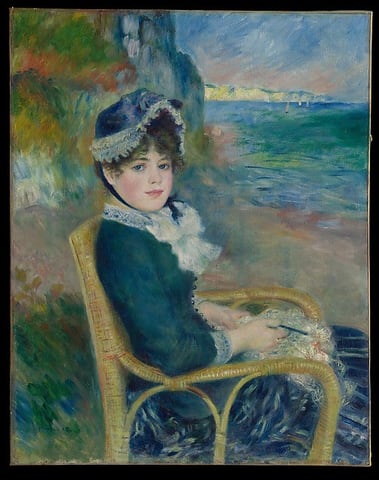
  1. By the Seashore, by Pierre-Auguste Renoir, 1883
    By the SeashorePierre-Auguste Renoir, 1883Courtesy of The Metropolitan Museum of Art
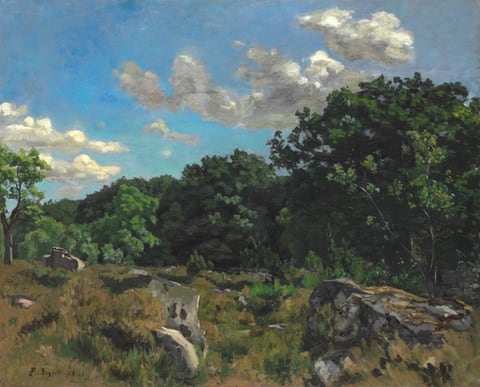
  2. A work made of oil on canvas.
    Landscape at ChaillyFrédéric Bazille, 1865Courtesy of the Art Institute of Chicago
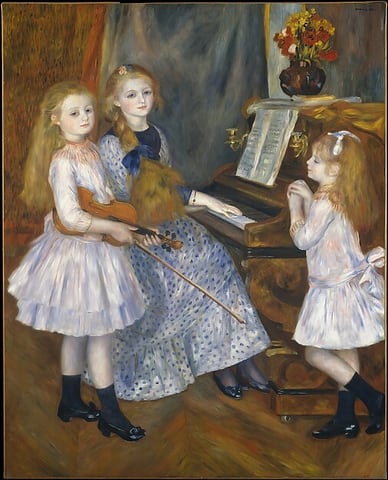
  3. The Daughters of Catulle Mendès, Huguette (1871–1964), Claudine (1876–1937), and Helyonne (1879–1955), by Pierre-Auguste Renoir, 1888
    The Daughters of Catulle Mendès, Huguette (1871–1964), Claudine (1876–1937), and Helyonne (1879–1955)Pierre-Auguste Renoir, 1888Courtesy of The Metropolitan Museum of Art

Section 2, north wall
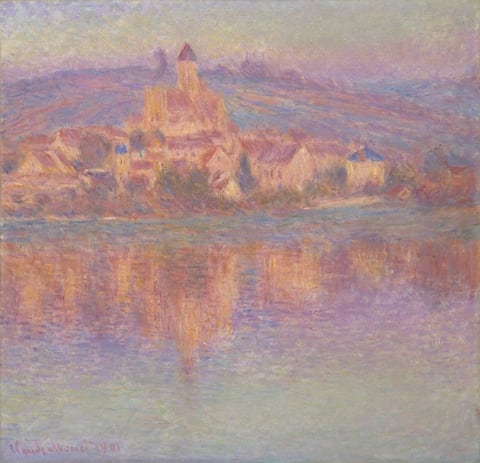
  1. A work made of oil on canvas.
    VétheuilClaude Monet, 1901Courtesy of the Art Institute of Chicago
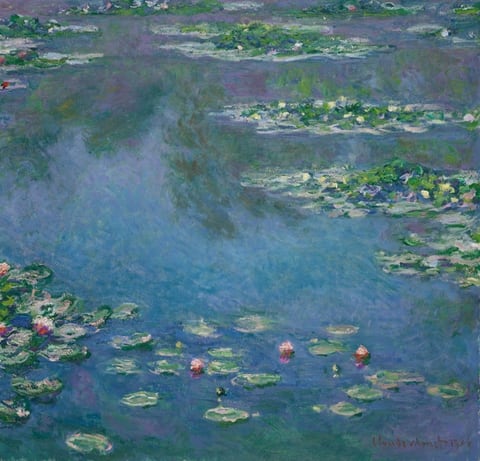
  2. Painting of a pond seen up close spotted with thickly painted pink and white water lilies and a shadow across the top third of the picture.
    Water LiliesClaude Monet, 1906Courtesy of the Art Institute of Chicago
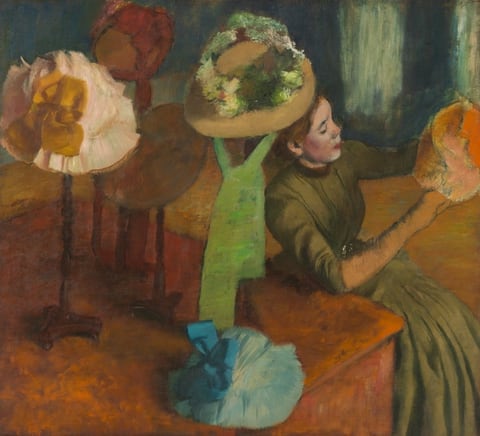
  3. Impressionist painting of woman wearing green dress trying on hats.
    The Millinery ShopEdgar Degas, 1879-86Courtesy of the Art Institute of Chicago

Section 3, north wall
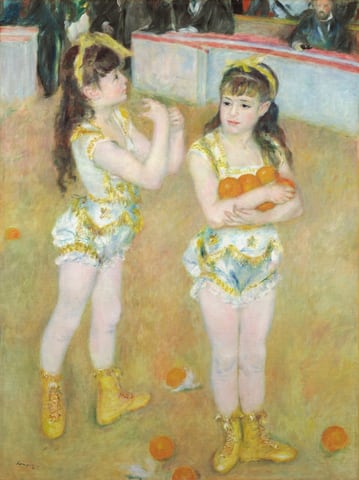
  1. Two girls in acrobatic uniforms stand in an arena, one holds oranges.
    Acrobats at the Cirque Fernando (Francisca and Angelina Wartenberg)Pierre-Auguste Renoir, 1879Courtesy of the Art Institute of Chicago
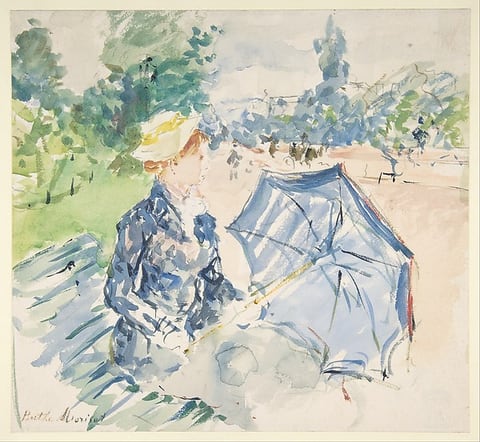
  2. A Woman Seated at a Bench on the Avenue du Bois, by Berthe Morisot, 1885
    A Woman Seated at a Bench on the Avenue du BoisBerthe Morisot, 1885Courtesy of The Metropolitan Museum of Art
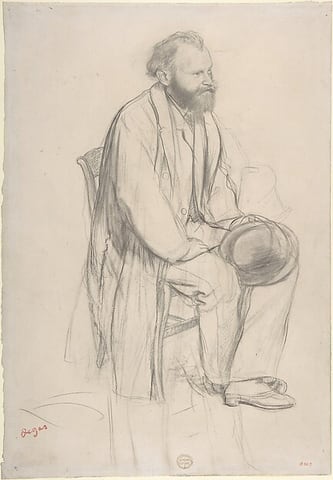
  3. Édouard Manet, Seated, Holding His Hat, by Edgar Degas, ca. 1868
    Édouard Manet, Seated, Holding His HatEdgar Degas, ca. 1868Courtesy of The Metropolitan Museum of Art
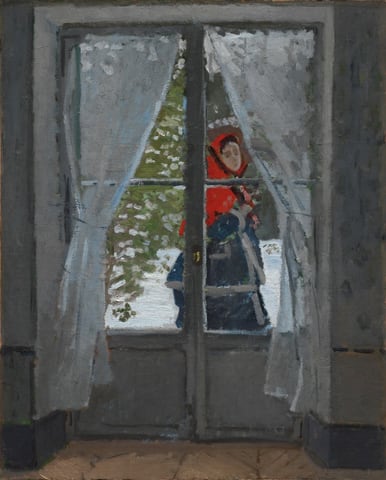
  4. The Red Kerchief, by Claude Monet, c. 1868–73
    The Red KerchiefClaude Monet, c. 1868–73Courtesy of the Cleveland Museum of Art