Floor plan

Style galleriesGeorgian Britain

Georgian Britain

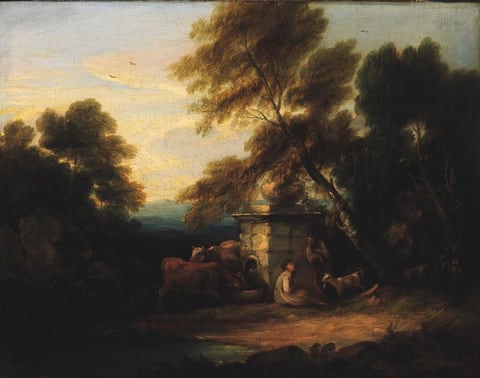
Small Landscape, ca. 1750-1800
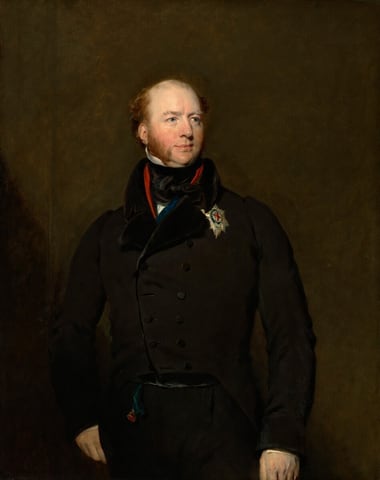
The image displays a man in a portrait from the waist up, in a three-quarter view. He is facing slightly to the right and looking into the distance with a calm expression. The man has fair skin, light reddish-brown hair, sideburns, a defined nose, and a slightly upturned chin. He is wearing a black double-breasted coat with a high collar, a dark waistcoat, a white shirt, and a medal on his chest with an insignia and ribbon. The background is plain and deep brown.
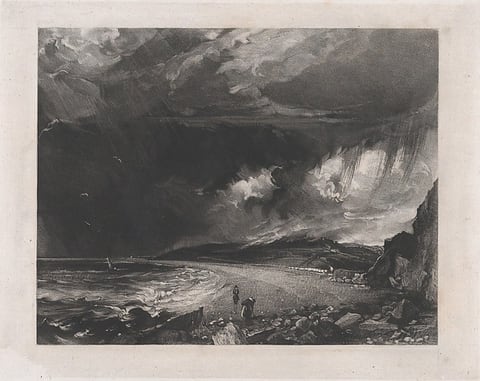
Weymouth Bay, by David Lucas, 1830
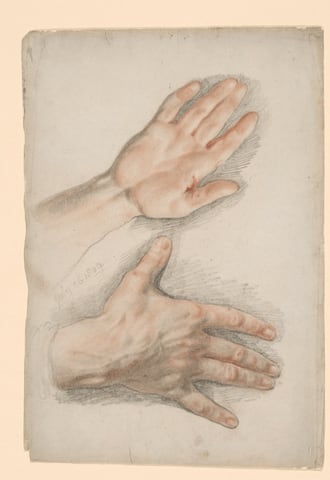
A work made of red and black chalk on gray wove paper.
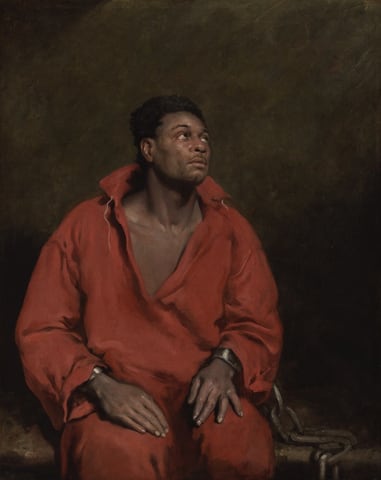
Painting of a dark-skinned man seated and wearing a red open-necked tunic. He looks up to the right. His wrists are shackled and a large chain rests at his right, running down the bench he sits upon.
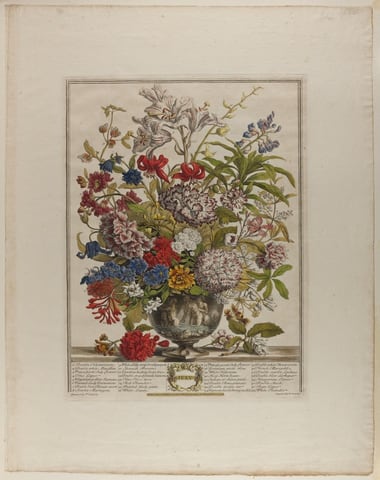
A work made of engraving in black ink with opaque and translucent watercolor on cream laid paper.
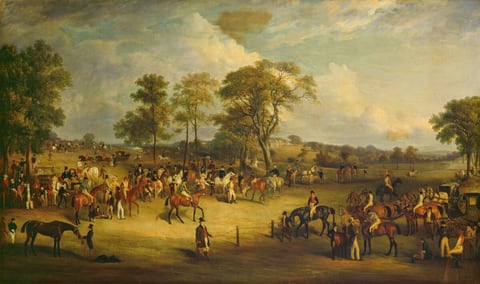
The painting depicts an equestrian scene with people and horses in a green landscape. There are several people on horseback, and others standing by horses. Some people are also sitting in horse-drawn carriages. The horses are in a variety of colors, and the people wear formal clothing like suit jackets, top hats, vests, or colorful dresses. People fill the middle of the scene and the green hills that rise to the left, while a wide path is marked off on the right, bordered by fences. There are some tall trees around the area, with people gathering below them. In the distance, a large white building with columns and blue roofs can be seen. There is also a white tent partially behind a hill on the left. The sky above is blue and filled with white and gray clouds.

The works in this room are listed below.

Works in this room

Portraits, conversation pieces and watercolour landscapes from Hogarth to Constable.

Section 1, north wall

  1. Small Landscape, ca. 1750-1800
    Small LandscapeUnrecorded British maker, ca. 1750-1800Courtesy of the Smithsonian American Art Museum
  2. The image displays a man in a portrait from the waist up, in a three-quarter view. He is facing slightly to the right and looking into the distance with a calm expression. The man has fair skin, light reddish-brown hair, sideburns, a defined nose, and a slightly upturned chin. He is wearing a black double-breasted coat with a high collar, a dark waistcoat, a white shirt, and a medal on his chest with an insignia and ribbon. The background is plain and deep brown.
    Francis Charles Seymour-Conway, 3rd Marquess of HertfordThomas Lawrence, c. 1822/1823Courtesy National Gallery of Art, Washington
  3. Weymouth Bay, by David Lucas, 1830
    Weymouth BayDavid Lucas, 1830Courtesy of The Metropolitan Museum of Art
  4. A work made of red and black chalk on gray wove paper.
    Two Studies of a Right HandThomas Lawrence, July 26, 1800Courtesy of the Art Institute of Chicago

Section 1, south wall

  1. Painting of a dark-skinned man seated and wearing a red open-necked tunic. He looks up to the right. His wrists are shackled and a large chain rests at his right, running down the bench he sits upon.
    The Captive Slave (Ira Aldridge)John Philip Simpson, 1827Courtesy of the Art Institute of Chicago
  2. A work made of engraving in black ink with opaque and translucent watercolor on cream laid paper.
    July, from Twelve Months of FlowersHenry Fletcher, n.d.Courtesy of the Art Institute of Chicago
  3. The painting depicts an equestrian scene with people and horses in a green landscape. There are several people on horseback, and others standing by horses. Some people are also sitting in horse-drawn carriages. The horses are in a variety of colors, and the people wear formal clothing like suit jackets, top hats, vests, or colorful dresses. People fill the middle of the scene and the green hills that rise to the left, while a wide path is marked off on the right, bordered by fences. There are some tall trees around the area, with people gathering below them. In the distance, a large white building with columns and blue roofs can be seen. There is also a white tent partially behind a hill on the left. The sky above is blue and filled with white and gray clouds.
    Heaton Park RacesJohn Ferneley, 1829Courtesy National Gallery of Art, Washington

Section 2, south wall
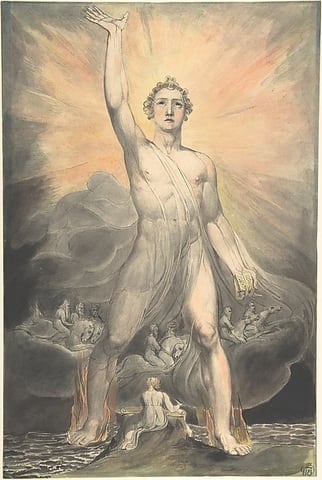
  1. Angel of the Revelation (Book of Revelation, chapter 10), by William Blake, ca. 1803–5
    Angel of the Revelation (Book of Revelation, chapter 10)William Blake, ca. 1803–5Courtesy of The Metropolitan Museum of Art
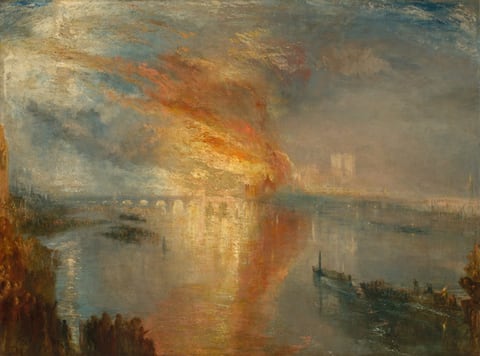
  2. The Burning of the Houses of Lords and Commons, 16 October 1834, by Joseph Mallord William Turner, 1835
    The Burning of the Houses of Lords and Commons, 16 October 1834Joseph Mallord William Turner, 1835Courtesy of the Cleveland Museum of Art
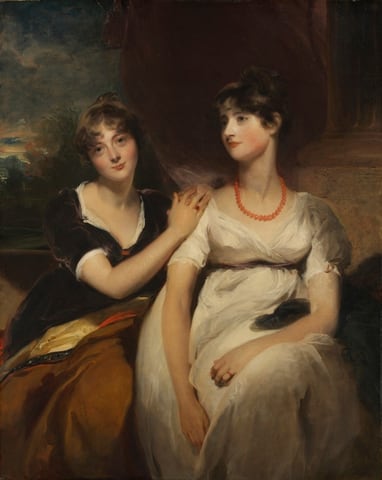
  3. Portrait of Charlotte and Sarah Carteret-Hardy, by Thomas Lawrence, 1801
    Portrait of Charlotte and Sarah Carteret-HardyThomas Lawrence, 1801Courtesy of the Cleveland Museum of Art
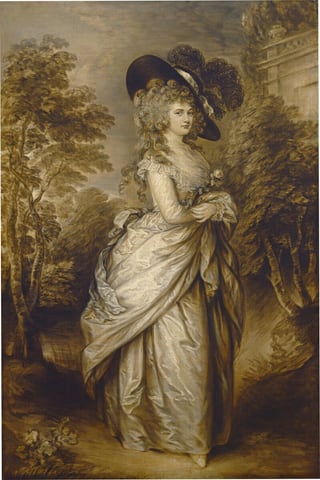
  4. This painting is a full-length portrait of a woman with her body facing the right and her head turned toward us. She has light skin, curly gray hair, arched eyebrows, and a small mouth in a neutral expression. She wears an elegant light-colored dress with a large bow on the back and a large, dark, feathered hat, and she has a flower tucked in her arms, which also gather up some of her skirts. The background shows tall trees, with the edge of a wall visible in the upper-right corner. The color scheme of the painting is mostly olive-green, and everything has a green tint.
    Georgiana, Duchess of DevonshireGainsborough Dupont, c. 1787/1796Courtesy National Gallery of Art, Washington

Section 2, north wall
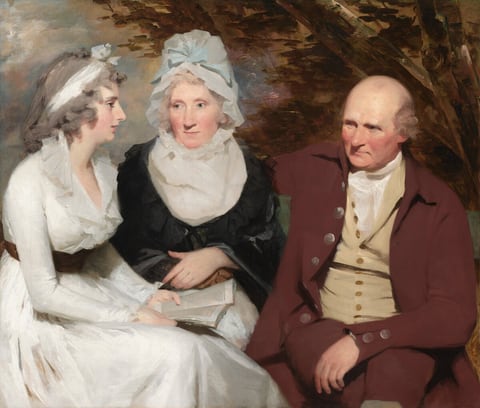
  1. John Johnstone, Betty Johnstone, and Miss Wedderburn, by Sir Henry Raeburn, c. 1790/1795
    John Johnstone, Betty Johnstone, and Miss WedderburnSir Henry Raeburn, c. 1790/1795Courtesy National Gallery of Art, Washington
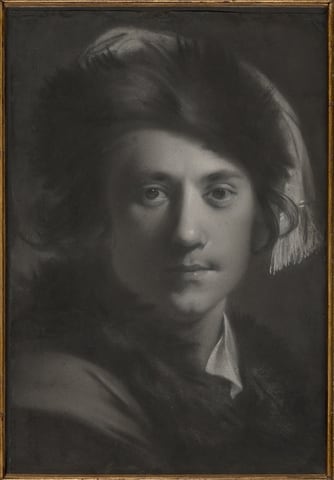
  2. Black, gray pastel portrait of man in a fur hat.
    Self-Portrait in a Fur CapJoseph Wright of Derby, 1765/68Courtesy of the Art Institute of Chicago
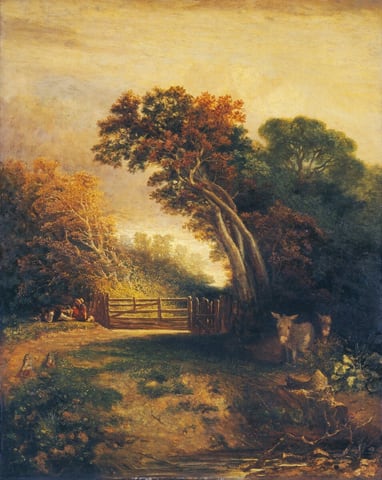
  3. This painting shows a serene pastoral scene with trees, a wooden gate, and foliage extending towards the horizon. Closest to us, there is a low riverbank with some tree branches in the water. Up a grassy dirt hill, two donkeys are visible off to the right, partially hidden by vegetation. On the left, a dirt path leads to the wooden gate. To the left of the gate, two people sit on the grass with a wicker basket between them. The tall trees that rise in the background have leaves in shades of green, yellow, and dark orange. The sky above the scene is yellow with some hints of light blue, and golden light shines down on the landscape.
    Landscape with Picnickers and Donkeys by a GateJoseph Paul, c. 1830-1880Courtesy National Gallery of Art, Washington

Section 3, north wall
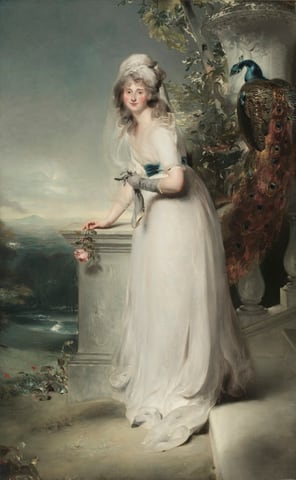
  1. Portrait of Catherine Grey, Lady Manners, by Thomas Lawrence, 1794
    Portrait of Catherine Grey, Lady MannersThomas Lawrence, 1794Courtesy of the Cleveland Museum of Art
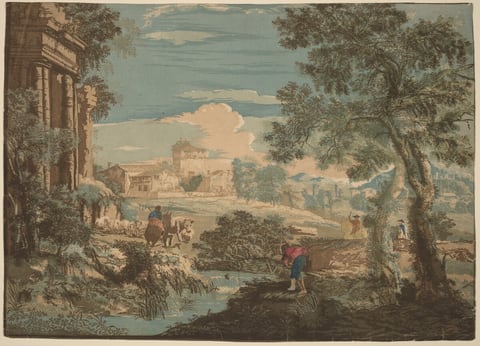
  2. The image shows a landscape scene from an elevated viewpoint. There are large columns of a classical ruin and a leafy tree on the left. On the right, there is a spreading tree with intricate leaves. In the background, there is a pastoral landscape with figures and animals. A shepherd and a cow are guiding a flock of sheep, and buildings can be seen in the distance. The horizon divides the image into sky and earth. The brushstrokes are detailed, capturing textures effectively. The color palette consists of earthy tones with touches of brighter colors on the figures' clothing.
    Heroic Landscape with Fisherman, Cows, and HorsemenJohn Baptist Jackson, 1744Courtesy National Gallery of Art, Washington