Floor plan

Style galleriesThe American Gilded Age
The American Gilded Age
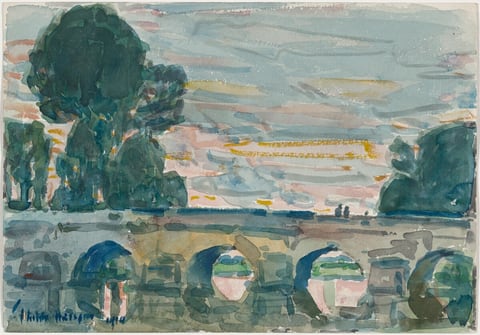
The Bridge at Grez [recto], by Childe Hassam, 1904
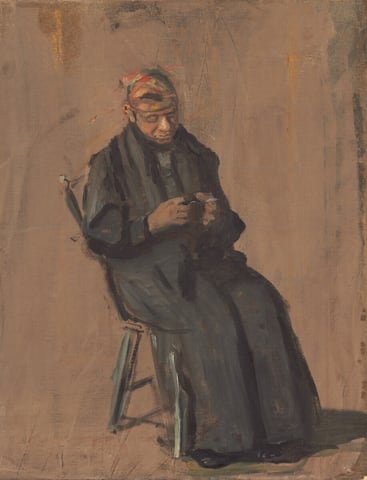
This painting shows a person seated on a stool or chair, wearing a long, dark-blue robe or gown. They are slightly turned toward the right, looking downward at something they hold in their hands, and their head is covered with a cloth or cap. The background is textured with earthy tones, mostly tan with some patches of yellow ochre and gray.
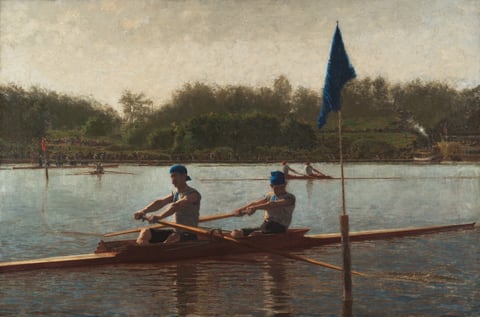
The Biglin Brothers Turning the Stake, by Thomas Eakins, 1873
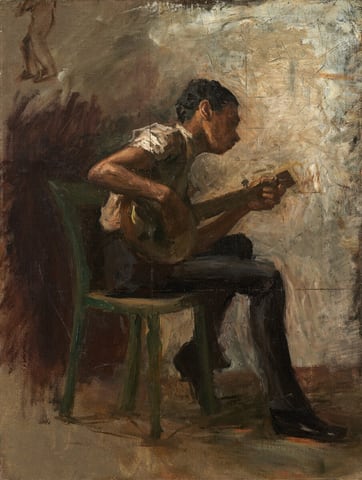
A young, gangly, brown-skinned boy sits on a green chair and leans over the banjo he plays in this loosely painted, vertical composition. His body faces our right in profile, and his head leans to his left and away from us. Light comes from our left to highlight his ear and the side of his chin, but throws his profile into shadow against the lighter background. The boy has short black hair and wears a white shirt with the sleeves rolled up, black pants, and black shoes. The floor is loosely painted with streaks of earth brown, taupe, and dark moss green. The wall behind the boy is painted with visible strokes of parchment brown, peachy tan, pearl white, and fog gray. The space to our left of the boy is dark brown, and an outline of a standing person is sketched in the top left corner. A grid is overlaid across the boy’s body and the chair.
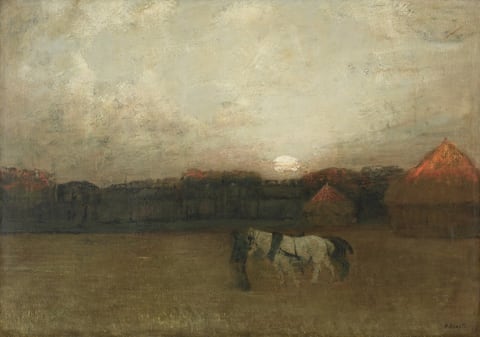
The Stubble Field, by Henry Golden Dearth, c. 1909
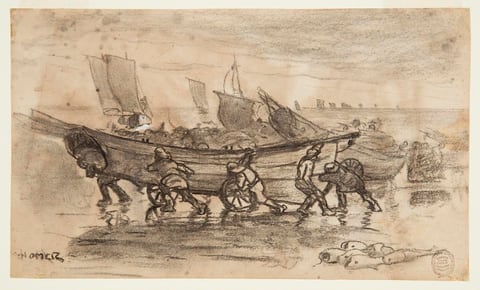
FISHERMEN BEACHING A DORY, CULLERCOATS, ENGLAND
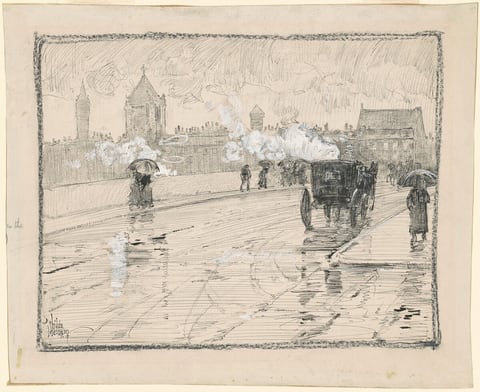
The image shows a street scene from an elevated viewpoint. A horse-drawn carriage is seen moving on a wet road, reflecting light. Pedestrians with umbrellas populate the avenue. The road is visibly marked with rainwater. The skyline displays detailed architectural features like church spires and towers. The painting is done in fine, linear brushstrokes highlighting movement and atmosphere. The grayscale palette emphasizes the rainy urban setting. Wisps of steam or smoke are visible. The intricate line work and shading depict a textured, busy street under an overcast sky.
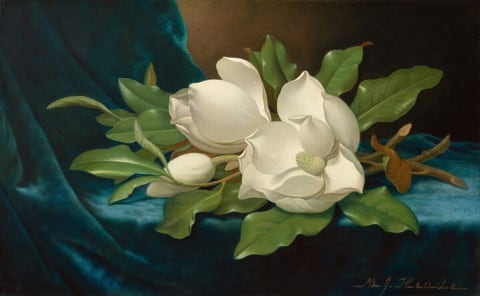
Twigs of a magnolia tree with light green, glossy leaves and three cream-white blossoms lie on a sapphire-blue cloth in this horizontal still life painting. Brightly lit from our left, the blossoms and leaves nearly fill the composition, and the cut ends lie on the fabric to our right. The blue fabric cascades from the upper left and across the table or ledge. The three flowers are in various stages of bloom. The tightest bud is to our left, overlapped by a stem and the tender, unfurling leaves of a branch. The blossom next to it, at the center, is starting to open. The petals of the third blossom, to our right, splay open around the flower’s oval-shaped stamen. Light glints off the waxy leaves surrounding the flowers. The tawny-brown underside of one leaf is visible where it turns over, near the cut ends of the branches. Light shimmering on the fabric darkens from bright blue to our right, to deep royal blue in the shadows to the upper left, suggesting the fabric is velvet. The background is streaked with tan and pine green behind the fabric, and becomes nearly black in the shadows of the upper right corner and along the bottom edge. The artist signed the lower right corner, "MJ. Heade."

The works in this room are listed below.

Works in this room

Painting and design in the United States from the Civil War to 1910.

First room, north wall

  1. The Bridge at Grez [recto], by Childe Hassam, 1904
    The Bridge at Grez [recto]Childe Hassam, 1904Courtesy National Gallery of Art, Washington
  2. This painting shows a person seated on a stool or chair, wearing a long, dark-blue robe or gown. They are slightly turned toward the right, looking downward at something they hold in their hands, and their head is covered with a cloth or cap. The background is textured with earthy tones, mostly tan with some patches of yellow ochre and gray.
    The ChaperoneThomas Eakins, c. 1908Courtesy National Gallery of Art, Washington
  3. The Biglin Brothers Turning the Stake, by Thomas Eakins, 1873
    The Biglin Brothers Turning the StakeThomas Eakins, 1873Courtesy of the Cleveland Museum of Art
  4. A young, gangly, brown-skinned boy sits on a green chair and leans over the banjo he plays in this loosely painted, vertical composition. His body faces our right in profile, and his head leans to his left and away from us. Light comes from our left to highlight his ear and the side of his chin, but throws his profile into shadow against the lighter background. The boy has short black hair and wears a white shirt with the sleeves rolled up, black pants, and black shoes. The floor is loosely painted with streaks of earth brown, taupe, and dark moss green. The wall behind the boy is painted with visible strokes of parchment brown, peachy tan, pearl white, and fog gray. The space to our left of the boy is dark brown, and an outline of a standing person is sketched in the top left corner. A grid is overlaid across the boy’s body and the chair.
    Study for "The Dancing Lesson": The Banjo PlayerThomas Eakins, probably 1877Courtesy National Gallery of Art, Washington

First room, south wall

  1. The Stubble Field, by Henry Golden Dearth, c. 1909
    The Stubble FieldHenry Golden Dearth, c. 1909Courtesy of the Cleveland Museum of Art
  2. FISHERMEN BEACHING A DORY, CULLERCOATS, ENGLAND
    Fishermen Beaching a Dory, Cullercoats, EnglandWinslow Homer, 1881Courtesy of Cooper Hewitt, Smithsonian Design Museum
  3. The image shows a street scene from an elevated viewpoint. A horse-drawn carriage is seen moving on a wet road, reflecting light. Pedestrians with umbrellas populate the avenue. The road is visibly marked with rainwater. The skyline displays detailed architectural features like church spires and towers. The painting is done in fine, linear brushstrokes highlighting movement and atmosphere. The grayscale palette emphasizes the rainy urban setting. Wisps of steam or smoke are visible. The intricate line work and shading depict a textured, busy street under an overcast sky.
    Rainy Day, BostonChilde Hassam, 1886Courtesy National Gallery of Art, Washington
  4. Twigs of a magnolia tree with light green, glossy leaves and three cream-white blossoms lie on a sapphire-blue cloth in this horizontal still life painting. Brightly lit from our left, the blossoms and leaves nearly fill the composition, and the cut ends lie on the fabric to our right. The blue fabric cascades from the upper left and across the table or ledge. The three flowers are in various stages of bloom. The tightest bud is to our left, overlapped by a stem and the tender, unfurling leaves of a branch. The blossom next to it, at the center, is starting to open. The petals of the third blossom, to our right, splay open around the flower’s oval-shaped stamen. Light glints off the waxy leaves surrounding the flowers. The tawny-brown underside of one leaf is visible where it turns over, near the cut ends of the branches. Light shimmering on the fabric darkens from bright blue to our right, to deep royal blue in the shadows to the upper left, suggesting the fabric is velvet. The background is streaked with tan and pine green behind the fabric, and becomes nearly black in the shadows of the upper right corner and along the bottom edge. The artist signed the lower right corner, "MJ. Heade."
    Giant Magnolias on a Blue Velvet ClothMartin Johnson Heade, c. 1890Courtesy National Gallery of Art, Washington

Second room, south wall
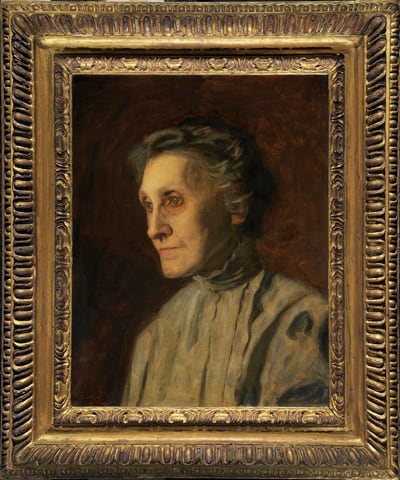
  1. Thomas Eakins
    Portrait of Mrs. Helen Mac Knight (Portrait of a Mother)Thomas Eakins, (c. 1903)Courtesy of the Hirshhorn Museum and Sculpture Garden, Smithsonian Institution
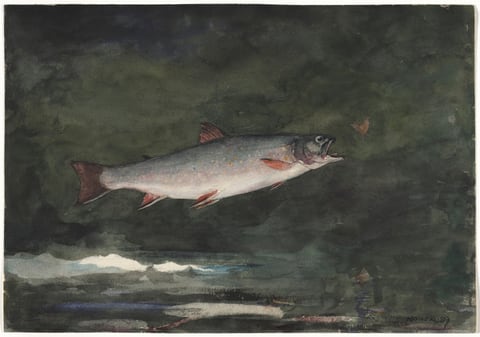
  2. Leaping Trout, by Winslow Homer, 1889
    Leaping TroutWinslow Homer, 1889Courtesy of the Cleveland Museum of Art
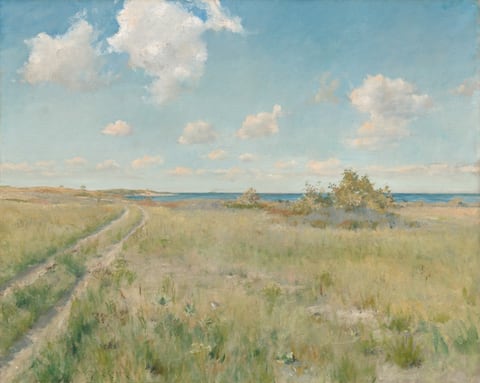
  3. The Old Road to the Sea, by William Merritt Chase, c. 1893
    The Old Road to the SeaWilliam Merritt Chase, c. 1893Courtesy of the Cleveland Museum of Art

Second room, north wall
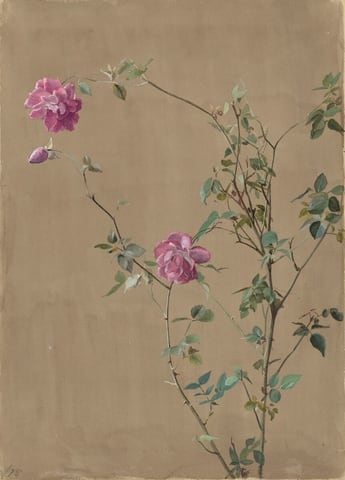
  1. This detailed painting shows two pink roses and a pink bud on a long, thin green stem with green leaves and small green thorns. The tall stem rises near the right edge of the painting, with some thin branches reaching out to either side. The largest rose is positioned near the top left corner of the painting, with the small bud right below it. The other large flower is right around the center of the painting. The background is a flat beige color.
    Pink RosesFidelia Bridges, 1875Courtesy National Gallery of Art, Washington
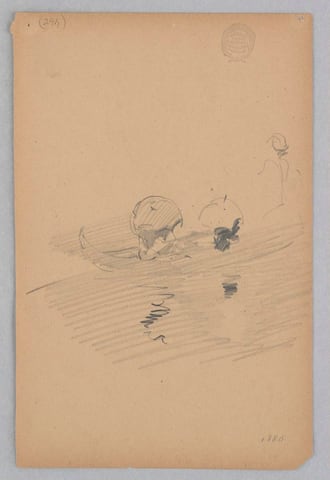
  2. VIEW OF VENICE, ITALY
    View of Venice, ItalyRobert Frederick Blum, 1880Courtesy of Cooper Hewitt, Smithsonian Design Museum
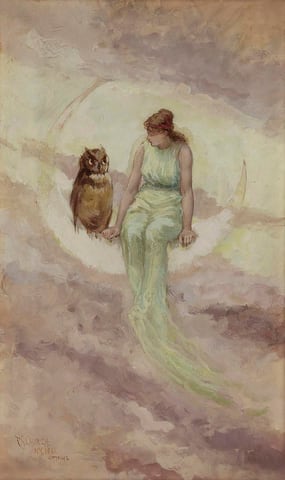
  3. The Witch's Daughter, by Frederick Stuart Church, 1881
    The Witch's DaughterFrederick Stuart Church, 1881Courtesy of the Smithsonian American Art Museum

Third room, north wall
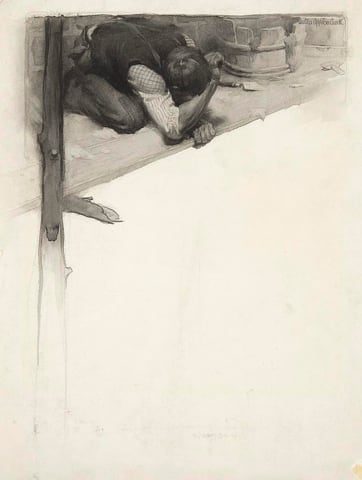
  1. VIGNETTE: MAN CROUCHING ON A SCAFFOLDING
    Vignette: Man Crouching on a ScaffoldingWalter Appleton Clark, 1899Courtesy of Cooper Hewitt, Smithsonian Design Museum
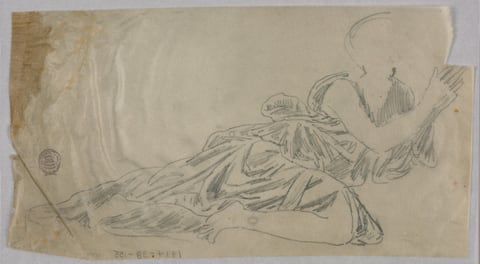
  2. DRAPERY STUDY
    Drapery StudyFrancis Augustus Lathrop, ca. 1895Courtesy of Cooper Hewitt, Smithsonian Design Museum