Floor plan

South wing: ThemesGardens and Botanicals
Gardens and Botanicals
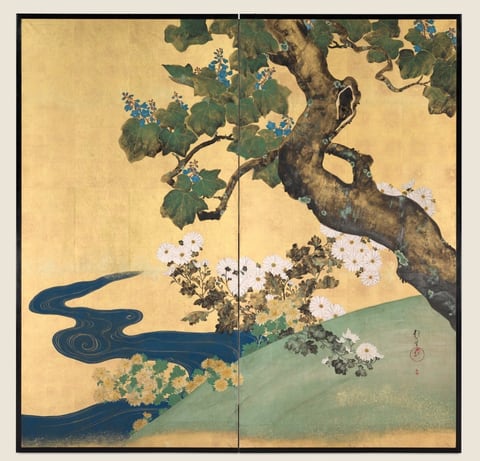
Paulownias and Chrysanthemums, by Sakai Hōitsu, early 1800s
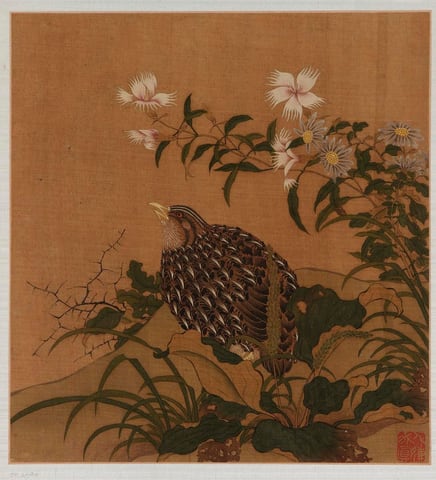
Album leaf
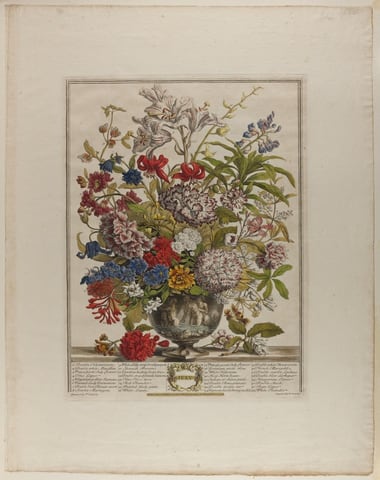
A work made of engraving in black ink with opaque and translucent watercolor on cream laid paper.
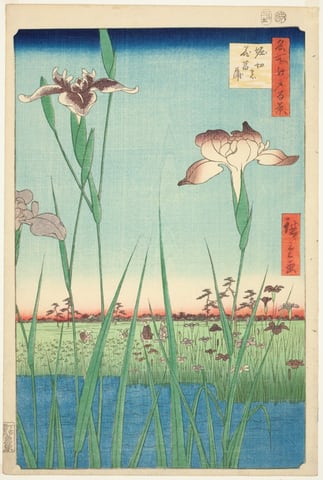
A work made of color woodblock print; oban.
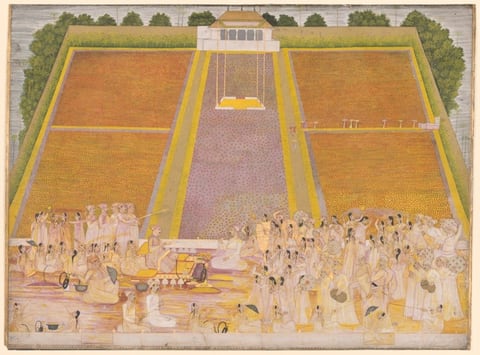
A work made of opaque watercolor and gold on paper.
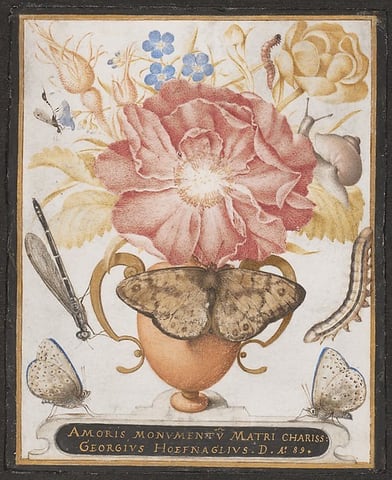
Still Life with Flowers, a Snail and Insects, by Joris Hoefnagel, 1589
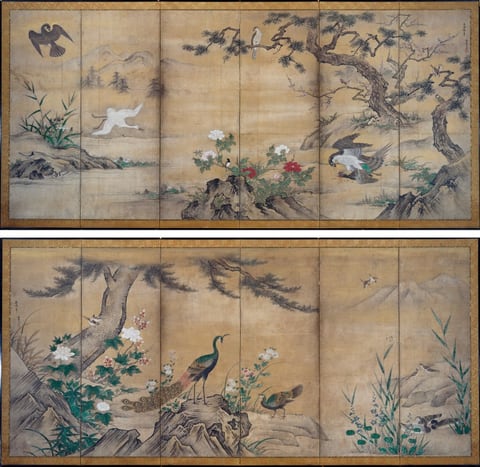
Birds and Flowers, by Kano Mitsunobu, late 1500s

The works in this room are listed below.

Works in this room

Flowers were studied before they were painted for pleasure, and the two impulses run together here: the botanist's careful plate, the gardener's border, the still life cut from a summer morning. Most of these works were made to record a plant exactly; many ended up as much admired for their colour.

First room, north wall

  1. Paulownias and Chrysanthemums, by Sakai Hōitsu, early 1800s
    Paulownias and ChrysanthemumsSakai Hōitsu, early 1800sCourtesy of the Cleveland Museum of Art
  2. Album leaf
    Quail and flowersZhao Boju, 18th centuryCourtesy of the National Museum of Asian Art, Smithsonian Institution
  3. A work made of engraving in black ink with opaque and translucent watercolor on cream laid paper.
    July, from Twelve Months of FlowersHenry Fletcher, n.d.Courtesy of the Art Institute of Chicago
  4. A work made of color woodblock print; oban.
    Irises at Horikiri (Horikiri no hanashobu), from the series "One Hundred Famous Views of Edo (Meisho Edo hyakkei)"Utagawa Hiroshige, 1857Courtesy of the Art Institute of Chicago

First room, south wall

  1. A work made of opaque watercolor and gold on paper.
    Holi Festival in a Walled Garden with CelebrantsUnrecorded Indian maker, c. 1764Courtesy of the Art Institute of Chicago
  2. Still Life with Flowers, a Snail and Insects, by Joris Hoefnagel, 1589
    Still Life with Flowers, a Snail and InsectsJoris Hoefnagel, 1589Courtesy of The Metropolitan Museum of Art
  3. Birds and Flowers, by Kano Mitsunobu, late 1500s
    Birds and FlowersKano Mitsunobu, late 1500sCourtesy of the Cleveland Museum of Art

Second room, south wall
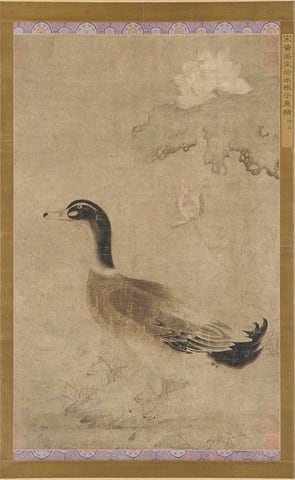
  1. Hanging scroll
    Drake and lotus flowersHuang Jucai, 1279-1368Courtesy of the National Museum of Asian Art, Smithsonian Institution
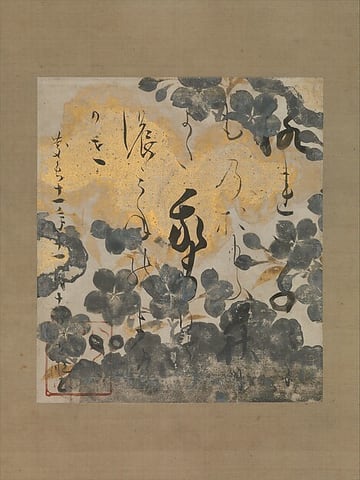
  2. Poem by Kamo no Chōmei with Underpainting of Cherry Blossoms, by Hon'ami Kōetsu, 1606
    Poem by Kamo no Chōmei with Underpainting of Cherry BlossomsHon'ami Kōetsu, 1606Courtesy of The Metropolitan Museum of Art
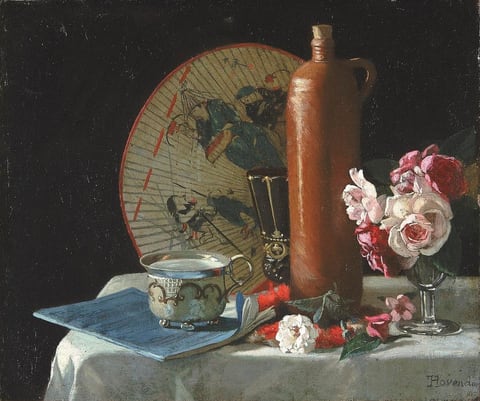
  3. Still Life with Fan and Roses, by Thomas Hovenden, 1874
    Still Life with Fan and RosesThomas Hovenden, 1874Courtesy of the Smithsonian American Art Museum
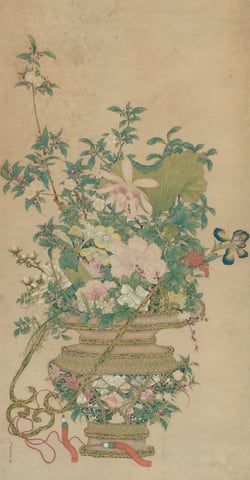
  4. A vertical painting of a bundle of many types of flowers set in a vase-like vessel. The bottom of this vessel contains netted rope through which many blossoms can be seen. A plethora of blooms and leaves extend upward from the top of the vessel.
    Flowers of the Four SeasonsUnrecorded Chinese maker, Qing dynasty (1644–1911), 18th/19th centuryCourtesy of the Art Institute of Chicago

Second room, north wall
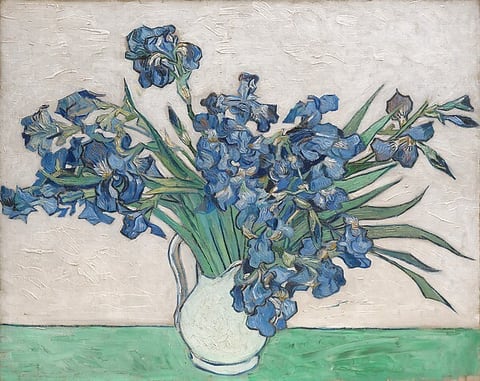
  1. Irises, by Vincent van Gogh, 1890
    IrisesVincent van Gogh, 1890Courtesy of The Metropolitan Museum of Art
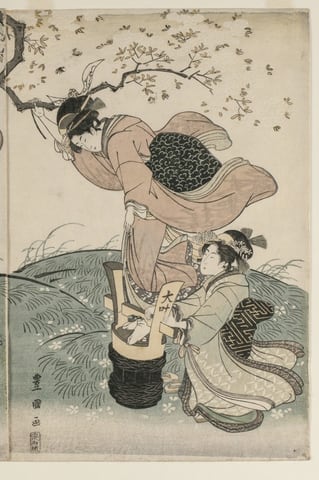
  2. Cherry Blossoms in the Wind, by Utagawa Toyokuni, late 1790s
    Cherry Blossoms in the WindUtagawa Toyokuni, late 1790sCourtesy of the Cleveland Museum of Art
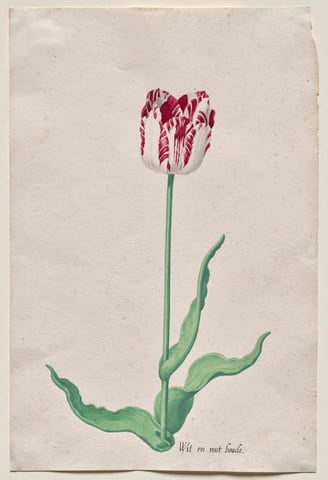
  3. Study of a Tulip (Wit en root boode), by Pieter Holsteyn II, c. 1645
    Study of a Tulip (Wit en root boode)Pieter Holsteyn II, c. 1645Courtesy of the Cleveland Museum of Art

Third room, north wall
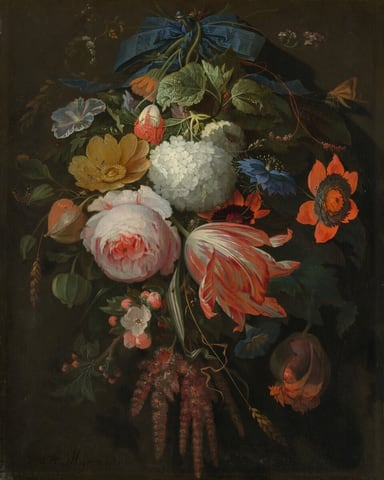
  1. A bouquet of flowers against a dark brown background hangs from a sapphire-blue bow to fill this vertical still life painting. The three largest blooms make a pyramid at the center. A pale pink, flat-leaved carnation is to the lower right of this trio. A red and white striped tulip with flame-shaped petals is next to it, to our right, and a white viburnum bloom, which is made of dozens of smaller clusters, is above. A tan-colored spider builds a web at the center of these three blossoms. Using the face of a clock to work around this trio, we find a spotted bug on a smaller viburnum and some frosty green leaves at noon. A muted orange moth rests on a stalk nearby. Down the right side, the layered vivid blue petals of a love-in-the-mist explode like a starburst. Two coral-red peonies, a mostly closed peony, a topaz-blue morning glory, and the fuzzy fingers of amaranth bring us to six o’clock. Up the left side are delicate pink crab apple blossoms, a spray of Chinese lanterns, a yellow rose with ants crawling across its splayed petals, a striped morning glory, and a few blue, orange, and red buds. A caterpillar rears up on a Chinese lantern bud and a ladybug sits on a leaf nearby. A few stalks of wheat are scattered throughout. Stems weave through the blue ribbon at the top, which is tied around a protruding nail. The artist signed the lower left corner, “AB Mignon f,” with the AB conjoined in a monogram.
    A Hanging Bouquet of FlowersAbraham Mignon, probably 1665/1670Courtesy National Gallery of Art, Washington
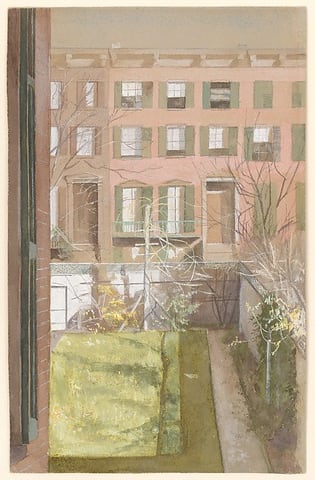
  2. Garden View, Brooklyn, by Fidelia Bridges, ca. 1867
    Garden View, BrooklynFidelia Bridges, ca. 1867Courtesy of The Metropolitan Museum of Art