Floor plan

Time and placeSpain

Spain

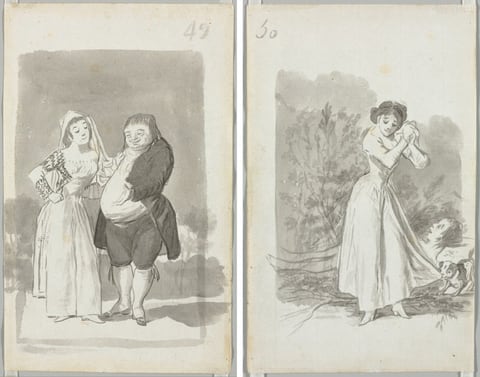
Young Woman (possibly a Sex Worker) with a Man (recto); Young Woman Wringing Her Hands over a Man's Naked Body (verso), by Francisco Goya, 1796–97
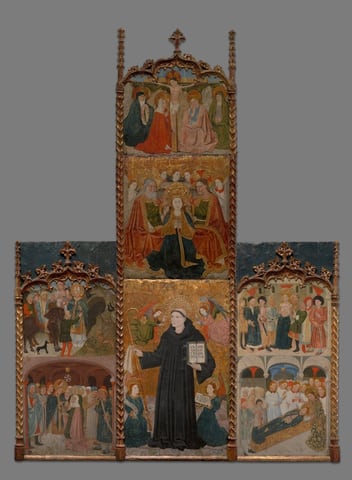
A work made of tempera on panel.
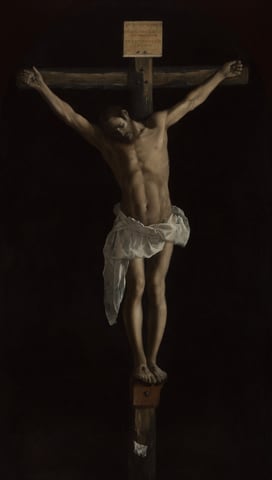
A work made of oil on canvas.
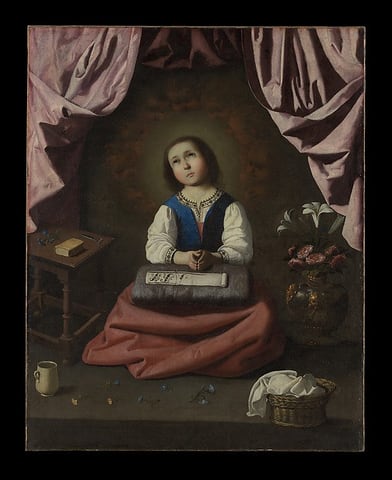
The Young Virgin, by Francisco de Zurbarán, ca. 1632–33
A work made of oil on canvas.
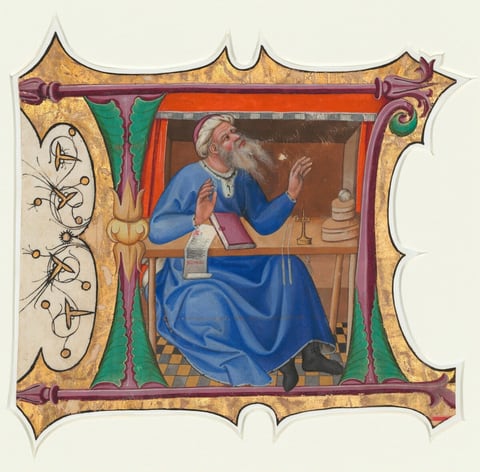
The image shows an elderly man seated at a table. He is turned slightly to the side, with his right hand raised as if in conversation. The man has a long, white beard and fair complexion, wearing a blue robe with white trim. He wears a white cap and holds a pink book in his left hand. A scroll of paper hangs off the table, which also holds a globe, balance scale, and round objects. The background has a wooden panel, and the scene is framed by an ornate border with gold, green, and purple colors, typical of medieval manuscripts.

The works in this room are listed below.

Works in this room

Works made in Spain, from every century in the collection.

Section 1, north wall

  1. Young Woman (possibly a Sex Worker) with a Man (recto); Young Woman Wringing Her Hands over a Man's Naked Body (verso), by Francisco Goya, 1796–97
    Young Woman (possibly a Sex Worker) with a Man (recto); Young Woman Wringing Her Hands over a Man's Naked Body (verso)Francisco Goya, 1796–97Courtesy of the Cleveland Museum of Art
  2. A work made of tempera on panel.
    Retable of Saints Athanasius, Blaise, and AgathaMaster of Riglos, c. 1440–c. 1445Courtesy of the Art Institute of Chicago
  3. A work made of oil on canvas.
    The CrucifixionFrancisco de Zurbarán, 1627Courtesy of the Art Institute of Chicago

Section 1, south wall

  1. The Young Virgin, by Francisco de Zurbarán, ca. 1632–33
    The Young VirginFrancisco de Zurbarán, ca. 1632–33Courtesy of The Metropolitan Museum of Art
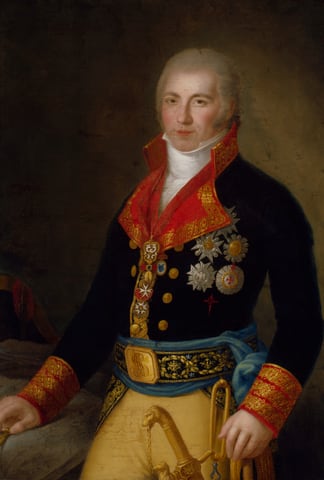
  2. A work made of oil on canvas.
    Manuel GodoyAgustin Esteve y Marqués, 1800–8Courtesy of the Art Institute of Chicago
  3. The image shows an elderly man seated at a table. He is turned slightly to the side, with his right hand raised as if in conversation. The man has a long, white beard and fair complexion, wearing a blue robe with white trim. He wears a white cap and holds a pink book in his left hand. A scroll of paper hangs off the table, which also holds a globe, balance scale, and round objects. The background has a wooden panel, and the scene is framed by an ornate border with gold, green, and purple colors, typical of medieval manuscripts.
    Initial L with Old Testament ProphetMaster of the Cypresses, 1430sCourtesy National Gallery of Art, Washington

Section 2, south wall
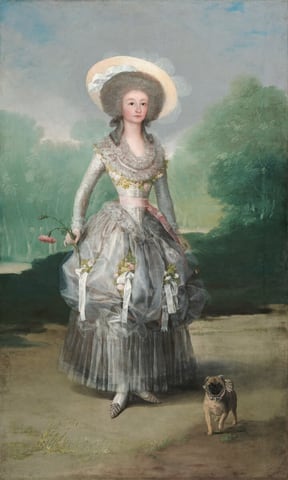
  1. A woman with pale skin, wearing a silvery-gray dress adorned with white ribbons and light pink roses, stands looking out at us with a small, pug dog by her feet in this vertical portrait painting. The woman’s body is angled slightly to our right but she looks at us with dark eyes under faint, arched brows. Her nose is rounded, her cheeks smooth and flushed, and her pale pink lips are closed. Her face is framed in a cloud of nickel-gray hair, and tendrils curl down over her shoulders. She wears a wide-brimmed straw hat with a white ribbon set on the back of her head and slightly off to one side. The bodice of her dress has a low, curving neck. This area is loosely painted to create the impression of layers of lace. A band of intertwined pale pink roses and delicate green leaves borders the outer edge of the lace. The dress has long, tight sleeves with lace at the cuffs and the notably narrow waist is tied with a blush-pink ribbon. The full, silver skirt is picked up to create a row of puffs, like the top of a muffin, around her knees. Bunches of pink roses and white ribbons are nestled into the puffs, and below, the skirt falls in long, vertical pleats to her ankles. She wears white stockings and pointed, petal-pink shoes. In her left arm, on our right, she holds a closed fan loosely at her side, almost lost behind the skirt. She holds a pink carnation with a full bloom and a bud on a long, curving stem in her other hand, by her hip. A caramel-brown pug with a black face, wearing a pink collar lined with three bells, stands facing us with one front paw lifted, to our right of the woman's feet. The landscape is painted in tones of mint and sage green for grass beneath trees enclosing the space the woman stands in, sand brown for the ground, and icy blue for the sky above.
    The Marquesa de PontejosFrancisco Goya, c. 1786Courtesy National Gallery of Art, Washington
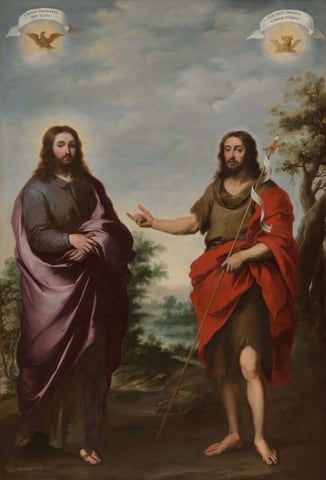
  2. A work made of oil on canvas.
    Ecce Agnus DeiBartolomé Esteban Murillo, c. 1655Courtesy of the Art Institute of Chicago
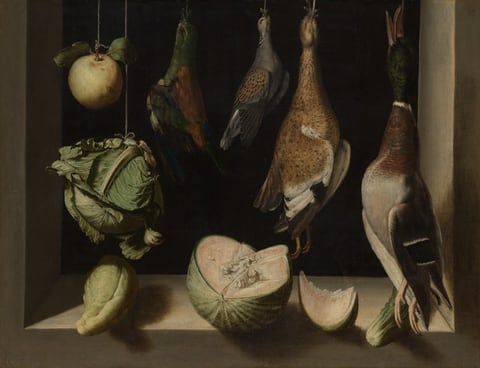
  3. Still life painting of dead waterfowl and vegetables in windowsill.
    Still Life with Game FowlJuan Sánchez Cotán, c. 1600–3Courtesy of the Art Institute of Chicago

Section 2, north wall
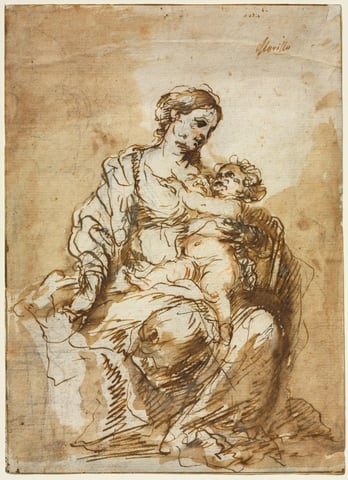
  1. Madonna Nursing the Christ Child, by Bartolomé Esteban Murillo, c. 1670–72
    Madonna Nursing the Christ ChildBartolomé Esteban Murillo, c. 1670–72Courtesy of the Cleveland Museum of Art
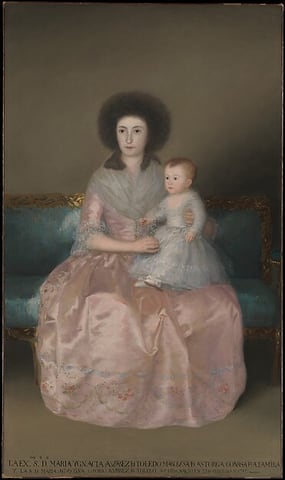
  2. Condesa de Altamira and Her Daughter, María Agustina, by Francisco Goya, 1787–88
    Condesa de Altamira and Her Daughter, María AgustinaFrancisco Goya, 1787–88Courtesy of The Metropolitan Museum of Art
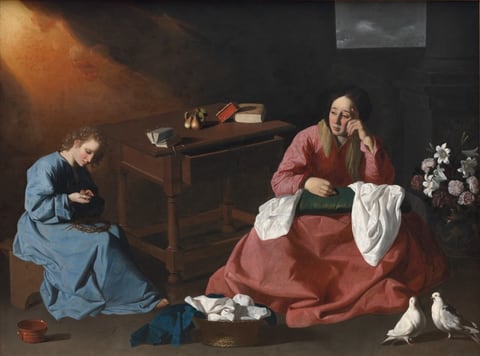
  3. Christ and the Virgin in the House at Nazareth, by Francisco de Zurbarán, c. 1640
    Christ and the Virgin in the House at NazarethFrancisco de Zurbarán, c. 1640Courtesy of the Cleveland Museum of Art

Section 3, north wall
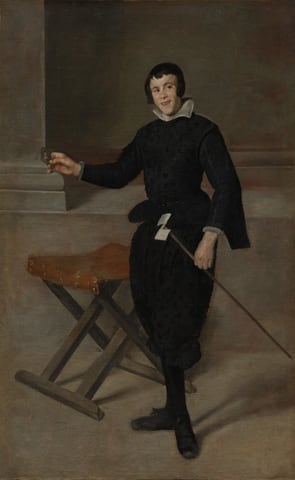
  1. Portrait of the Jester Calabazas, by Diego Velázquez, c. 1631–32
    Portrait of the Jester CalabazasDiego Velázquez, c. 1631–32Courtesy of the Cleveland Museum of Art
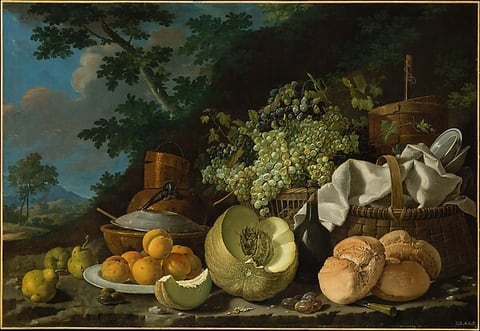
  2. The Afternoon Meal (La Merienda), by Luis Meléndez, ca. 1772
    The Afternoon Meal (La Merienda)Luis Meléndez, ca. 1772Courtesy of The Metropolitan Museum of Art

Section 3, south wall
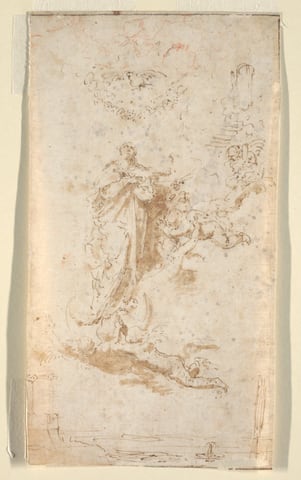
  1. THE IMMACULATE CONCEPTION
    The Immaculate ConceptionJusepe de Ribera (called Lo Spagnoletto), ca. 1640Courtesy of Cooper Hewitt, Smithsonian Design Museum
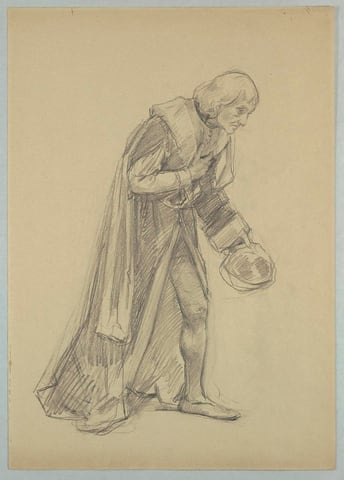
  2. STUDY OF A BOWING MAN (CHRISTOPHER COLUMBUS)
    Study of a Bowing Man (Christopher Columbus)Raimundo de MadrazoCourtesy of Cooper Hewitt, Smithsonian Design Museum