Floor plan

Time and placeFrance

France

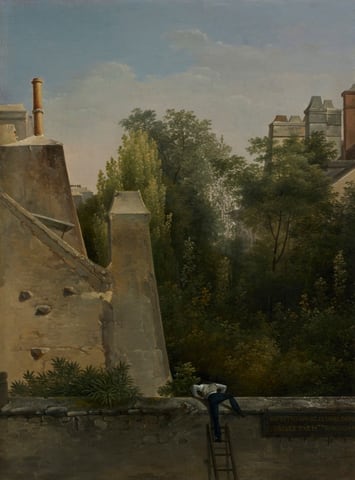
The Curious One, by Antoine Pierre Mongin, 1823
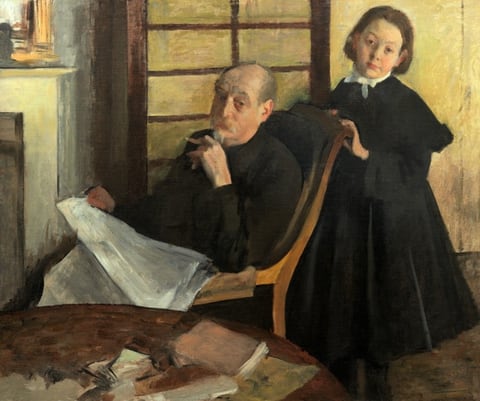
Impressionist painting of seated man, girl with brown, black hues.
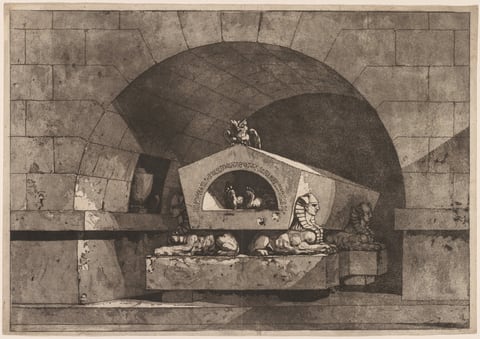
Tomb with Sphinxes and an Owl, by Louis Jean Desprez, c. 1779–84
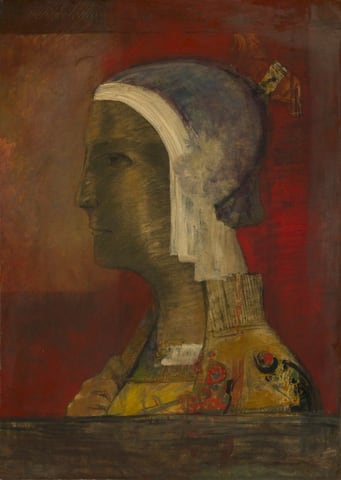
Symbolic Head, by Odilon Redon, c. 1890
A work made of graphite and pen and black ink, with touches of opaque, white watercolor on cream laid paper.
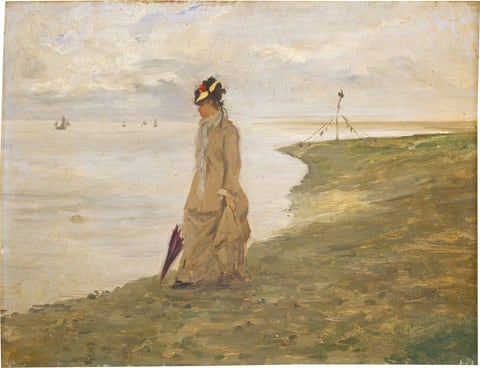
This painting shows a woman in a tan dress and a tan hat with red flowers, walking on a grassy shoreline, holding a dark purple umbrella. The woman is positioned in the center of the painting, and she faces the left, standing at the edge of the water, looking downward. She has light skin and dark hair put up under her hat. The horizon is high in the painting, where the blue-gray sky and water meet. Small ships are visible in the distance, floating on the horizon. On the right side of the painting, the yellow and green ground curves, sloping slightly downward to meet the water. The painting has loose, visible brushstrokes.
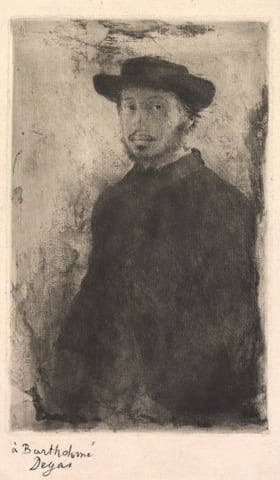
Self-Portrait, by Edgar Degas, 1857
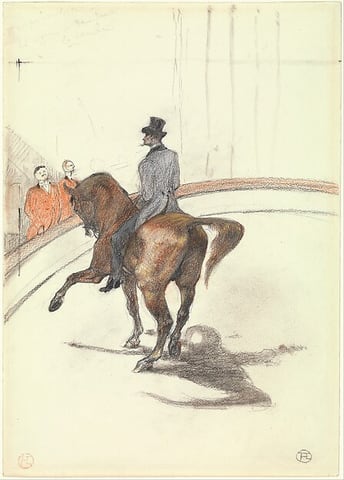
At the Circus: The Spanish Walk (Au Cirque: Le Pas espagnol), by Henri de Toulouse-Lautrec, 1899

The works in this room are listed below.

Works in this room

Works made in France, from every century in the collection.

First room, north wall

  1. The Curious One, by Antoine Pierre Mongin, 1823
    The Curious OneAntoine Pierre Mongin, 1823Courtesy of the Cleveland Museum of Art
  2. Impressionist painting of seated man, girl with brown, black hues.
    Henri Degas and His Niece Lucie Degas (The Artist's Uncle and Cousin)Edgar Degas, 1875–76Courtesy of the Art Institute of Chicago
  3. Tomb with Sphinxes and an Owl, by Louis Jean Desprez, c. 1779–84
    Tomb with Sphinxes and an OwlLouis Jean Desprez, c. 1779–84Courtesy of the Cleveland Museum of Art
  4. Symbolic Head, by Odilon Redon, c. 1890
    Symbolic HeadOdilon Redon, c. 1890Courtesy of the Cleveland Museum of Art

First room, south wall

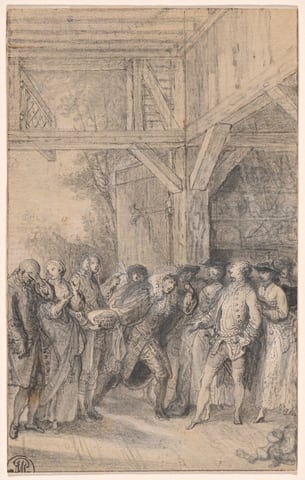
  1. A work made of graphite and pen and black ink, with touches of opaque, white watercolor on cream laid paper.
    Farmer Requesting Permission to Marry a Nobleman's DaughterGabriel de Saint-Aubin, 1761Courtesy of the Art Institute of Chicago
  2. This painting shows a woman in a tan dress and a tan hat with red flowers, walking on a grassy shoreline, holding a dark purple umbrella. The woman is positioned in the center of the painting, and she faces the left, standing at the edge of the water, looking downward. She has light skin and dark hair put up under her hat. The horizon is high in the painting, where the blue-gray sky and water meet. Small ships are visible in the distance, floating on the horizon. On the right side of the painting, the yellow and green ground curves, sloping slightly downward to meet the water. The painting has loose, visible brushstrokes.
    Woman by the SeasideUnrecorded French maker, 19th centuryCourtesy National Gallery of Art, Washington
  3. Self-Portrait, by Edgar Degas, 1857
    Self-PortraitEdgar Degas, 1857Courtesy of the Cleveland Museum of Art
  4. At the Circus: The Spanish Walk (Au Cirque: Le Pas espagnol), by Henri de Toulouse-Lautrec, 1899
    At the Circus: The Spanish Walk (Au Cirque: Le Pas espagnol)Henri de Toulouse-Lautrec, 1899Courtesy of The Metropolitan Museum of Art

Second room, south wall
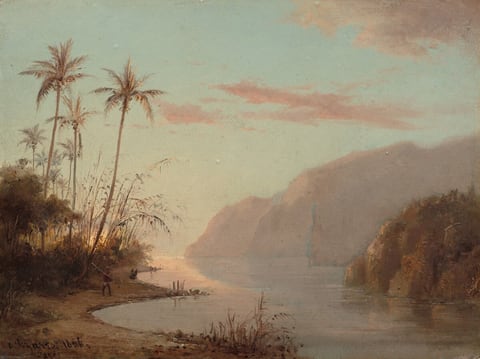
  1. A wide creek winds between a tree-lined bank to our left and hazy mountains to our right in this horizontal landscape painting. The riverbank curves deeply like a backward capital letter B. Marshy grasses grow in tufts, and palm and other trees grow in a grove to our left. One brown-skinned person wearing only a white cloth around the hips carries a long stick near the shoreline. Dabs of brown and muted dark pink suggest other people farther along the riverside. Tree-covered boulders jut into the creek from our right. A band of rocky, mountains are smoky mauve-pink across the rightmost two-thirds of the horizon, which comes a third of the way up the composition. The butter-yellow sun is low on the horizon to our right, peeking through the grove of palm trees. The light pours across the placid surface of the creek, creating a soft yellow streak next to the reflection of the mountain ridge. A few heather-pink clouds drift across the pale turquoise sky. The artist signed and dated the painting in the lower left corner, “C. Pizarro. 1856. Paris.”
    A Creek in St. Thomas (Virgin Islands)Camille Pissarro, 1856Courtesy National Gallery of Art, Washington
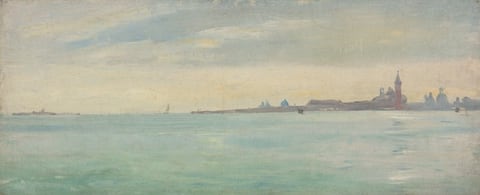
  2. A work made of oil on paper, mounted on canvas.
    Venice Seen from the Public GardenJean Jules Antoine Lecomte du Noüy, 1873Courtesy of the Art Institute of Chicago
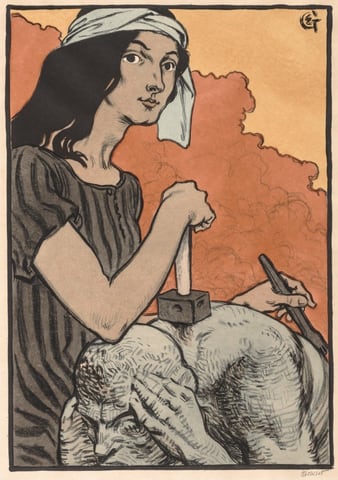
  3. Sculptress, by Eugène Grasset, 1897
    SculptressEugène Grasset, 1897Courtesy of the Cleveland Museum of Art
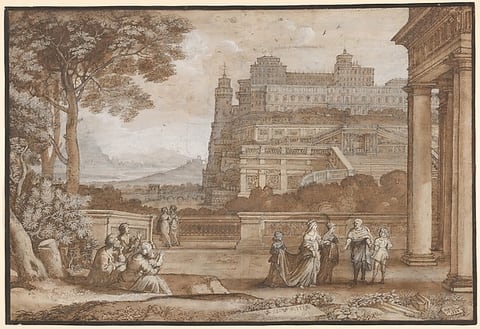
  4. Queen Esther Approaching the Palace of Ahasuerus, by Claude Lorrain (Claude Gellée), 1658
    Queen Esther Approaching the Palace of AhasuerusClaude Lorrain (Claude Gellée), 1658Courtesy of The Metropolitan Museum of Art

Second room, north wall
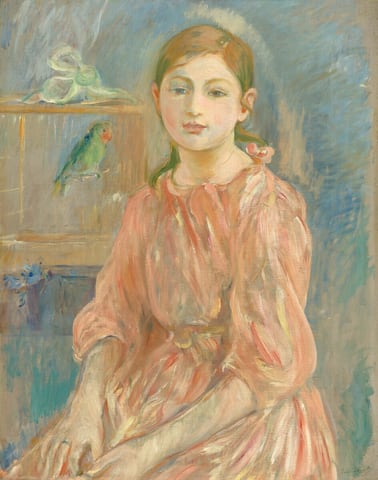
  1. Shown from the knees up, a young girl with pale skin, wearing a coral-peach dress, sits facing and looking at us in this loosely painted, vertical portrait. Her knees are angled slightly to our left, and her hands rest in her lap. She has a round face and smooth, lightly flushed cheeks. She has brown eyes under arched brows, a delicate, snub nose, and her rose-pink lips are closed. Her hair, which is painted with broad strokes of caramel brown and moss green, is parted on one side and pulled smoothly back, presumably tied behind her head. Tendrils fall over her shoulders. Her dress is gathered around her neck and tied with a bow at the back. The loose sleeves fall to just below her elbows, and the dress is belted around the waist. A curving swipe of canary-yellow paint could be a buckle at the front. The fabric of the dress is painted with long, visible strokes of shell and rose pink, butter yellow, and ivory white, and a few touches of sage green and periwinkle blue for shadows. She wears a ring on the middle finger of her right hand. The space around her is loosely painted with strokes of electric and cobalt blue, with unpainted canvas visible at some of the edges. To our left, over the girl's shoulder, a wooden bird cage holds an emerald-green parakeet. The bird is streaked with royal blue along its back, and the area around its hooked beak is apple red. The cage has a mint-green bow and ribbon along the top. The artist signed the painting in green on the lower right corner: “Berthe Morisot.”
    The Artist's Daughter with a ParakeetBerthe Morisot, 1890Courtesy National Gallery of Art, Washington
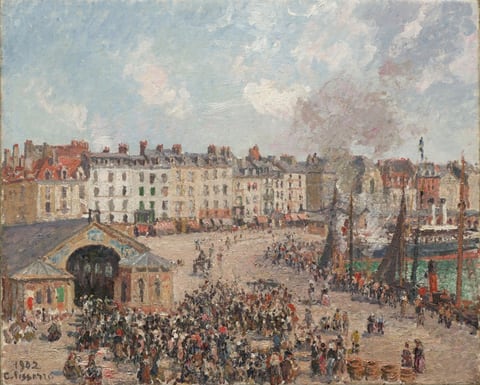
  2. Fishmarket, by Camille Pissarro, 1902
    FishmarketCamille Pissarro, 1902Courtesy of the Cleveland Museum of Art
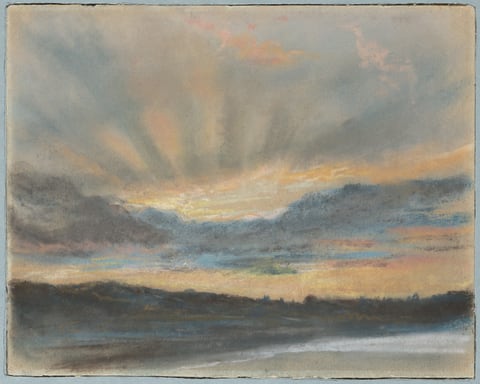
  3. Sunset, by Eugène Delacroix, ca. 1850
    SunsetEugène Delacroix, ca. 1850Courtesy of The Metropolitan Museum of Art
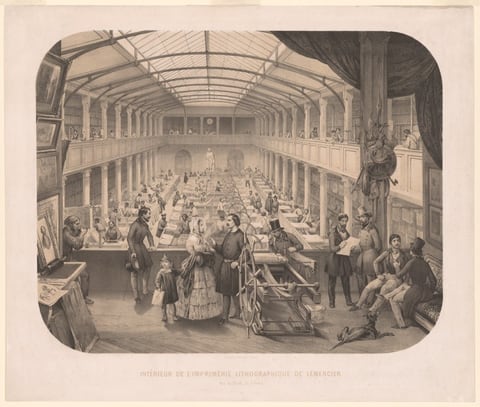
  4. A work made of lithograph from two stones on off-white wove paper.
    Interior of the Lemercier Lithographic Printing HouseCharles Villemin, n.d.Courtesy of the Art Institute of Chicago