Floor plan

Time and placeBritain

Britain

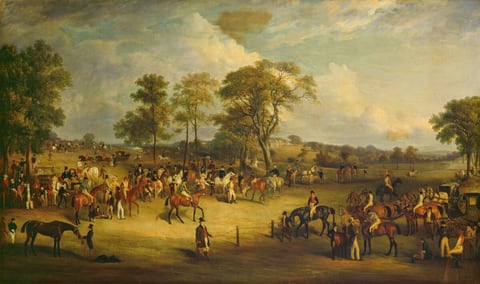
The painting depicts an equestrian scene with people and horses in a green landscape. There are several people on horseback, and others standing by horses. Some people are also sitting in horse-drawn carriages. The horses are in a variety of colors, and the people wear formal clothing like suit jackets, top hats, vests, or colorful dresses. People fill the middle of the scene and the green hills that rise to the left, while a wide path is marked off on the right, bordered by fences. There are some tall trees around the area, with people gathering below them. In the distance, a large white building with columns and blue roofs can be seen. There is also a white tent partially behind a hill on the left. The sky above is blue and filled with white and gray clouds.
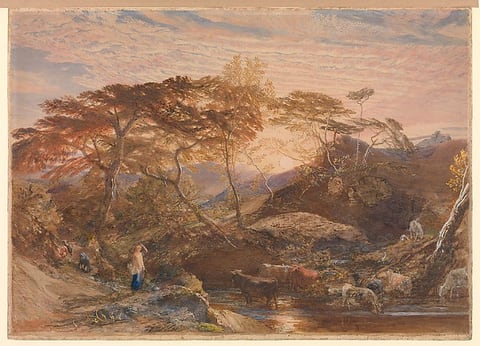
Sabrina, by Samuel Palmer, 1856
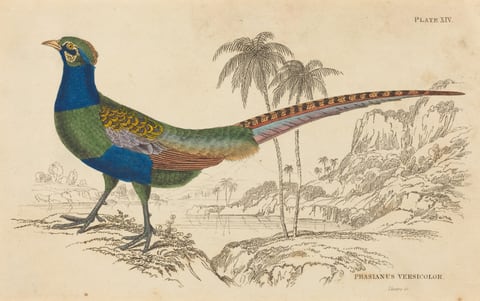
The image shows a pheasant with vivid green and blue plumage and intricate golden patterns on its wings. The bird has long, patterned tail feathers extended to the right. The background includes palm trees, rocky outcrops, and distant hills.
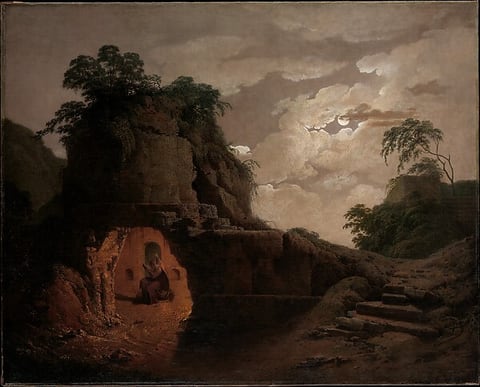
Virgil's Tomb by Moonlight, with Silius Italicus Declaiming, by Joseph Wright of Derby, 1779
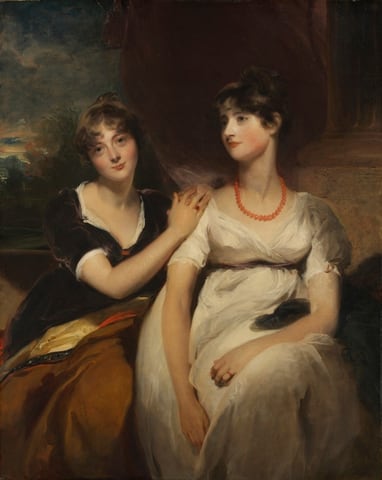
Portrait of Charlotte and Sarah Carteret-Hardy, by Thomas Lawrence, 1801
A work made of oil on canvas.

The works in this room are listed below.

Works in this room

Works made in Britain, from every century in the collection.

Section 1, north wall

  1. The painting depicts an equestrian scene with people and horses in a green landscape. There are several people on horseback, and others standing by horses. Some people are also sitting in horse-drawn carriages. The horses are in a variety of colors, and the people wear formal clothing like suit jackets, top hats, vests, or colorful dresses. People fill the middle of the scene and the green hills that rise to the left, while a wide path is marked off on the right, bordered by fences. There are some tall trees around the area, with people gathering below them. In the distance, a large white building with columns and blue roofs can be seen. There is also a white tent partially behind a hill on the left. The sky above is blue and filled with white and gray clouds.
    Heaton Park RacesJohn Ferneley, 1829Courtesy National Gallery of Art, Washington
  2. Sabrina, by Samuel Palmer, 1856
    SabrinaSamuel Palmer, 1856Courtesy of The Metropolitan Museum of Art
  3. The image shows a pheasant with vivid green and blue plumage and intricate golden patterns on its wings. The bird has long, patterned tail feathers extended to the right. The background includes palm trees, rocky outcrops, and distant hills.
    Phasianus VersicolorWilliam Home LizarsCourtesy National Gallery of Art, Washington

Section 1, south wall

  1. Virgil's Tomb by Moonlight, with Silius Italicus Declaiming, by Joseph Wright of Derby, 1779
    Virgil's Tomb by Moonlight, with Silius Italicus DeclaimingJoseph Wright of Derby, 1779Courtesy of The Metropolitan Museum of Art
  2. Portrait of Charlotte and Sarah Carteret-Hardy, by Thomas Lawrence, 1801
    Portrait of Charlotte and Sarah Carteret-HardyThomas Lawrence, 1801Courtesy of the Cleveland Museum of Art
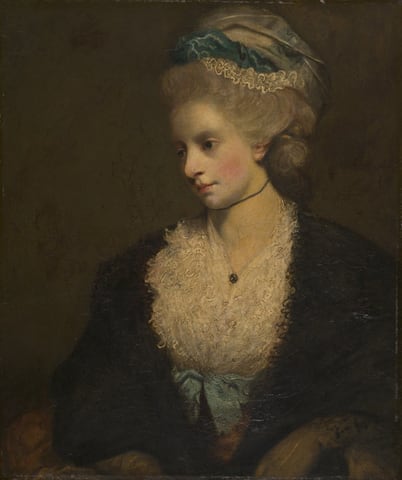
  3. A work made of oil on canvas.
    Theophilia GwatkinJoshua Reynolds, 1776–81Courtesy of the Art Institute of Chicago

Section 2, south wall
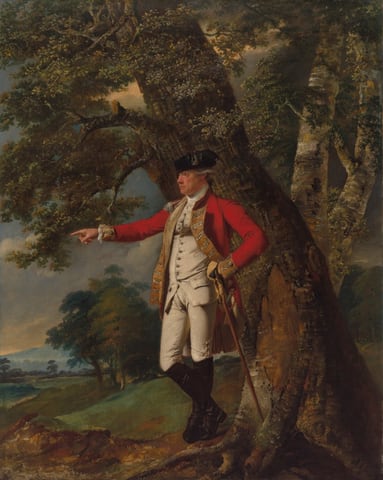
  1. Portrait of Colonel Charles Heathcote, by Joseph Wright of Derby, c. 1771–72
    Portrait of Colonel Charles HeathcoteJoseph Wright of Derby, c. 1771–72Courtesy of the Cleveland Museum of Art
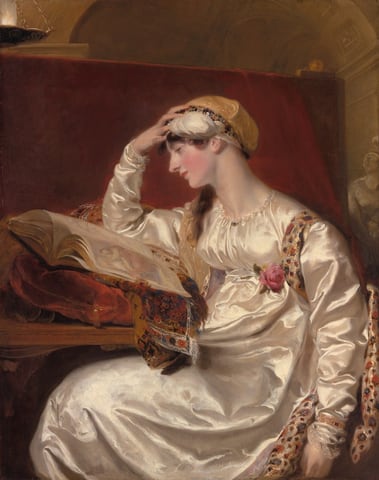
  2. A light-skinned woman in a long, shiny white dress sits at a desk reading a book. The book is propped on a large red pillow. Her head is propped in her hand.
    Isabella WolffThomas Lawrence, 1803–15Courtesy of the Art Institute of Chicago
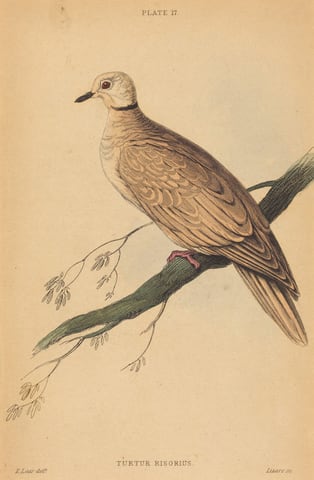
  3. This is a drawing of a bird perched on a branch. The bird is detailed and identified as "Turtur Risorius." It rests on a green textured branch against a plain background. The bird has a black ring around its neck, soft brown plumage with intricate feather patterns, and light pink legs. Its eye is prominent and outlined within its head design. The branch is minimalist with small buds and thin twigs.
    Turtur RisoriusWilliam Home LizarsCourtesy National Gallery of Art, Washington

Section 2, north wall
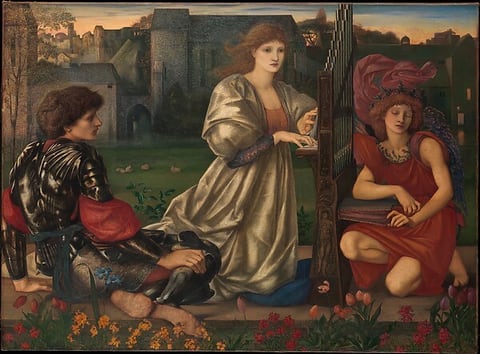
  1. The Love Song, by Sir Edward Burne-Jones, 1868–77
    The Love SongSir Edward Burne-Jones, 1868–77Courtesy of The Metropolitan Museum of Art
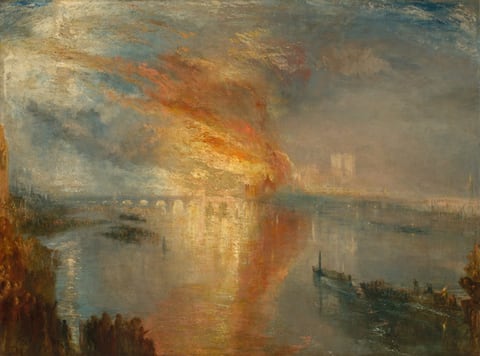
  2. The Burning of the Houses of Lords and Commons, 16 October 1834, by Joseph Mallord William Turner, 1835
    The Burning of the Houses of Lords and Commons, 16 October 1834Joseph Mallord William Turner, 1835Courtesy of the Cleveland Museum of Art
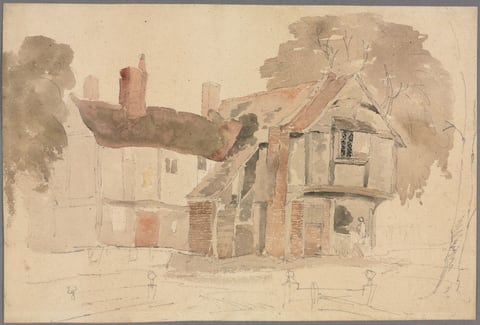
  3. Bray Church Yard, by John Varley, 1807
    Bray Church YardJohn Varley, 1807Courtesy of the Cleveland Museum of Art

Section 3, north wall
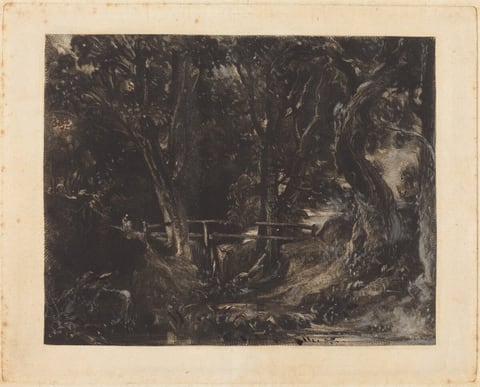
  1. The image shows a landscape scene with a frontal view of a dense forest. A wooden bridge spans across a narrow ravine or creek. The painting features vigorous and textural brushstrokes with dark tones creating a shadowy effect. The color palette includes deep blacks, dark browns, and occasional highlights of light filtering through the canopy. In the distance, lighter areas suggest a path leading further into the woods, surrounded by trees and undergrowth.
    A Dell at Helmingham Park, SuffolkDavid Lucas, 1830Courtesy National Gallery of Art, Washington
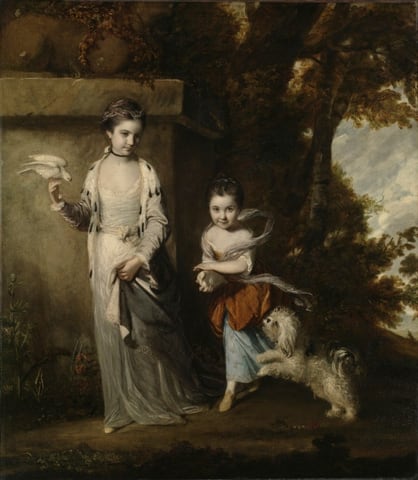
  2. Portrait of the Ladies Amabel and Mary Jemima Yorke, by Joshua Reynolds, c. 1761
    Portrait of the Ladies Amabel and Mary Jemima YorkeJoshua Reynolds, c. 1761Courtesy of the Cleveland Museum of Art
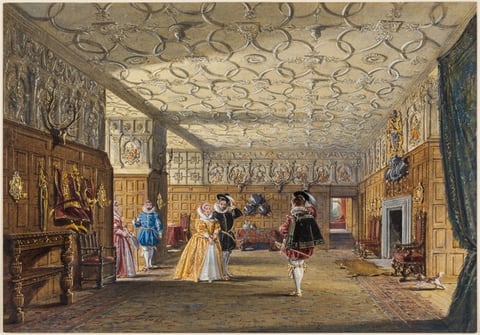
  3. A work made of watercolor and gouache, heightened with white gouache, over graphite selectively gum varnished on cream wove card.
    The Hall, Levens, WestmorelandJoseph Nash, n.d.Courtesy of the Art Institute of Chicago
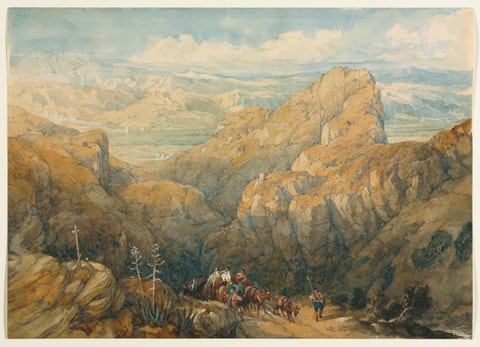
  4. Descent into the Plain of Granada, by David Roberts, 1834
    Descent into the Plain of GranadaDavid Roberts, 1834Courtesy of the Cleveland Museum of Art