Floor plan

Time and placeThe 19th century

The 19th century

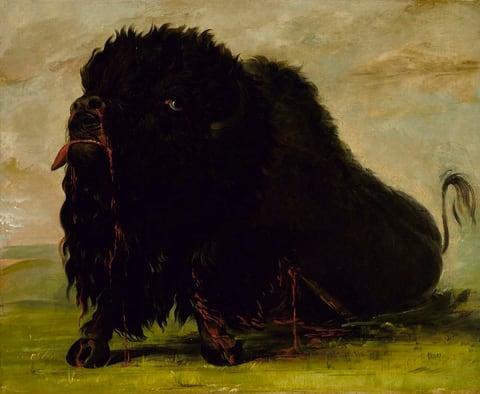
Dying Buffalo, Shot with an Arrow, by George Catlin, 1832-1833
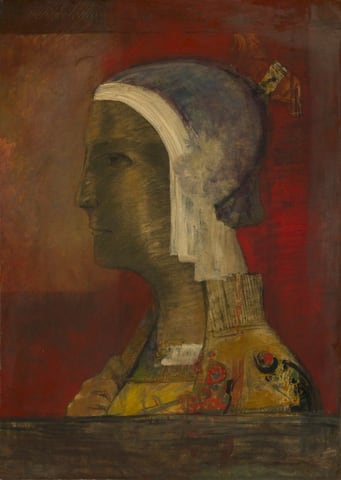
Symbolic Head, by Odilon Redon, c. 1890
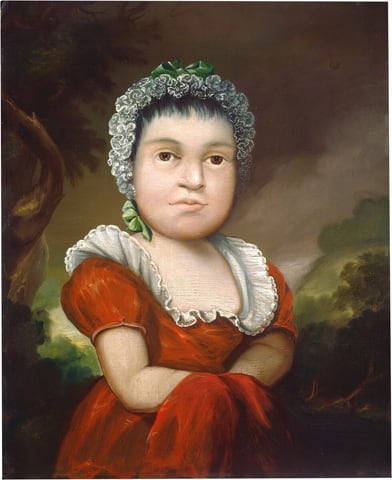
A pale-skinned child wearing a short-sleeved red dress and a white bonnet stands before a shadowy green forest under dark clouds in this vertical portrait painting. The child’s over-large head is out of scale with the rest of her body. She looks toward us with brown eyes in her wide, round-jawed face. She has a broad nose, and her pale lips are set in a line. Her lace bonnet lines her black hair like frothy seafoam and is tied with spring-green bows at the top and under her right ear, to our left. The low neckline of her crimson dress is lined with a wide white ruffle. Red fabric covers her hands, which are gathered in front of her waist. Gray clouds sweep over the hazy green forest in the background. A gnarled tree grows up the left side of the painting, framing the girl.
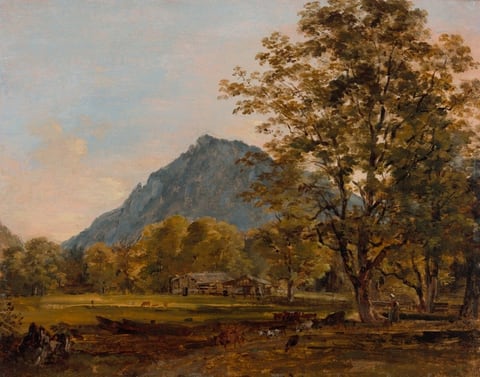
A work made of oil on paper, laid onto cardboard.
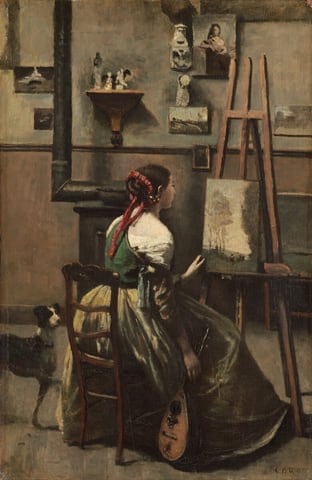
A young, pale-skinned woman sits with her back to us as she looks at a painting on an easel in a studio in this vertical painting. She sits in a ladder-back wood chair so her knees angle away from us, toward the back right corner of the studio. We look onto the side of her right cheek as she leans forward. Her brown hair is combed back and twisted into a bun wrapped with a raspberry-red ribbon that trails down her back. Touches of pearl white, pale pink, and silvery gray suggest flowers by the ear we can see. A cream-white chemise falls off the shoulder closer to us, under a grass-green bodice. She holds a mandolin down by her right side, which is closer to us, to nestle in the folds of her voluminous, olive-green skirt. She reaches forward with her other hand to touch the lower left corner of the painting resting on the easel. That vertically-oriented scene is loosely painted and shows a few people gathered in a landscape. A white and black dog stands with one front leg lifted to the left of the woman's chair, looking at her. The wall opposite us is parchment white over a strip of molding, like a high chair rail, and muted mauve pink below. An L-shaped pipe leads to an iron stove to our left of center. A narrow shelf tucked into the L of the pipe holds three hand-sized sculptures or casts. Small paintings and plaster casts hang around it on the wall above the molding. The artist signed the painting in the lower right: “COROT.”
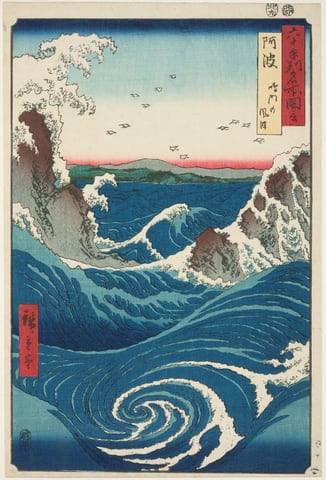
A work made of color woodblock print; ōban.
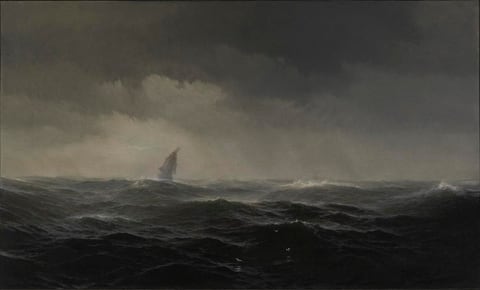
The Sea, by Edward Moran, 1870
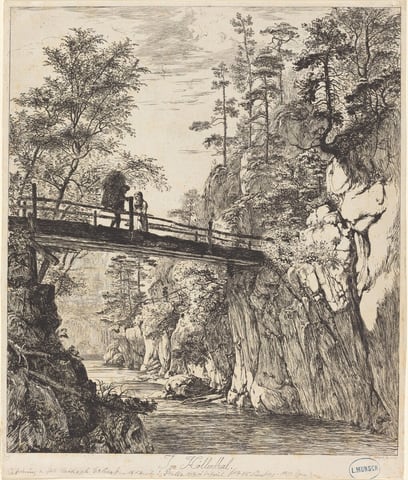
The image shows a landscape with a wooden bridge crossing over a river in a valley. The scenery includes cliffs, trees, and flowing water below. The artwork features fine, detailed brushstrokes depicting the texture of the cliffs, foliage, and water. The color scheme is monochromatic with various shades of gray and sepia tones. Two figures are seen on the bridge, contributing to the sense of scale and activity in the serene setting.

The works in this room are listed below.

Works in this room

Works made in the 19th century, anywhere in the world.

Section 1, north wall

  1. Dying Buffalo, Shot with an Arrow, by George Catlin, 1832-1833
    Dying Buffalo, Shot with an ArrowGeorge Catlin, 1832-1833Courtesy of the Smithsonian American Art Museum
  2. Symbolic Head, by Odilon Redon, c. 1890
    Symbolic HeadOdilon Redon, c. 1890Courtesy of the Cleveland Museum of Art
  3. A pale-skinned child wearing a short-sleeved red dress and a white bonnet stands before a shadowy green forest under dark clouds in this vertical portrait painting. The child’s over-large head is out of scale with the rest of her body. She looks toward us with brown eyes in her wide, round-jawed face. She has a broad nose, and her pale lips are set in a line. Her lace bonnet lines her black hair like frothy seafoam and is tied with spring-green bows at the top and under her right ear, to our left. The low neckline of her crimson dress is lined with a wide white ruffle. Red fabric covers her hands, which are gathered in front of her waist. Gray clouds sweep over the hazy green forest in the background. A gnarled tree grows up the left side of the painting, framing the girl.
    Portrait of a ChildEdward Hicks, c. 1840Courtesy National Gallery of Art, Washington
  4. A work made of oil on paper, laid onto cardboard.
    A Farmhouse in the Bavarian AlpsJohann Georg von Dillis, c. 1825Courtesy of the Art Institute of Chicago

Section 1, south wall

  1. A young, pale-skinned woman sits with her back to us as she looks at a painting on an easel in a studio in this vertical painting. She sits in a ladder-back wood chair so her knees angle away from us, toward the back right corner of the studio. We look onto the side of her right cheek as she leans forward. Her brown hair is combed back and twisted into a bun wrapped with a raspberry-red ribbon that trails down her back. Touches of pearl white, pale pink, and silvery gray suggest flowers by the ear we can see. A cream-white chemise falls off the shoulder closer to us, under a grass-green bodice. She holds a mandolin down by her right side, which is closer to us, to nestle in the folds of her voluminous, olive-green skirt. She reaches forward with her other hand to touch the lower left corner of the painting resting on the easel. That vertically-oriented scene is loosely painted and shows a few people gathered in a landscape. A white and black dog stands with one front leg lifted to the left of the woman's chair, looking at her. The wall opposite us is parchment white over a strip of molding, like a high chair rail, and muted mauve pink below. An L-shaped pipe leads to an iron stove to our left of center. A narrow shelf tucked into the L of the pipe holds three hand-sized sculptures or casts. Small paintings and plaster casts hang around it on the wall above the molding. The artist signed the painting in the lower right: “COROT.”
    Corot's Studio: Woman Seated Before an Easel, a Mandolin in her HandJean Baptiste Camille Corot, c. 1868Courtesy National Gallery of Art, Washington
  2. A work made of color woodblock print; ōban.
    Awa Province: Naruto Whirlpools (Awa, Naruto no fūha), from the series Famous Places in the Sixty-Odd Provinces (Rokujūyoshmeisho zue)Utagawa Hiroshige, 1855Courtesy of the Art Institute of Chicago
  3. The Sea, by Edward Moran, 1870
    The SeaEdward Moran, 1870Courtesy of the Smithsonian American Art Museum
  4. The image shows a landscape with a wooden bridge crossing over a river in a valley. The scenery includes cliffs, trees, and flowing water below. The artwork features fine, detailed brushstrokes depicting the texture of the cliffs, foliage, and water. The color scheme is monochromatic with various shades of gray and sepia tones. Two figures are seen on the bridge, contributing to the sense of scale and activity in the serene setting.
    Im Höllenthal (In the Höllen Valley)Johann Christoph Erhard, 1818Courtesy National Gallery of Art, Washington

Section 2, south wall
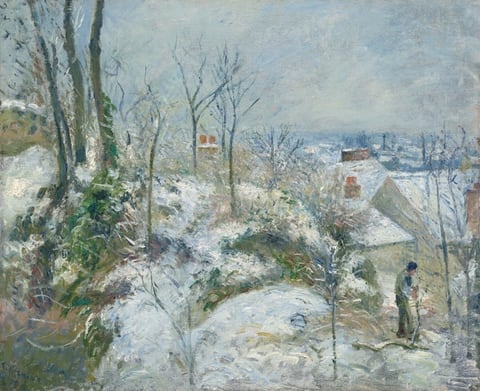
  1. A work made of oil on canvas.
    Rabbit Warren at Pontoise, SnowCamille Pissarro, 1879Courtesy of the Art Institute of Chicago
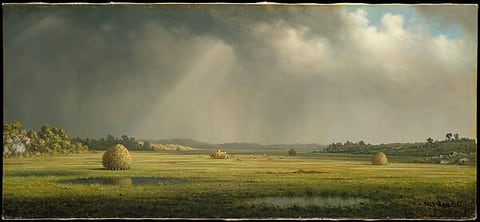
  2. Newburyport Meadows, by Martin Johnson Heade, ca. 1876–81
    Newburyport MeadowsMartin Johnson Heade, ca. 1876–81Courtesy of The Metropolitan Museum of Art
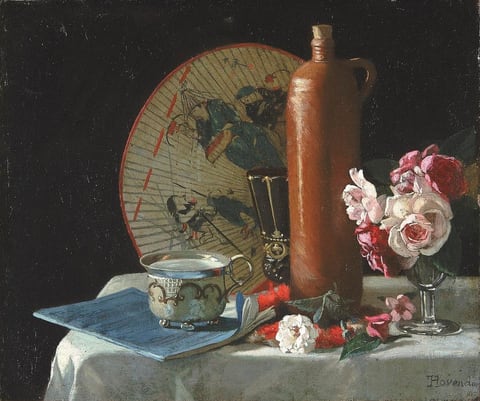
  3. Still Life with Fan and Roses, by Thomas Hovenden, 1874
    Still Life with Fan and RosesThomas Hovenden, 1874Courtesy of the Smithsonian American Art Museum
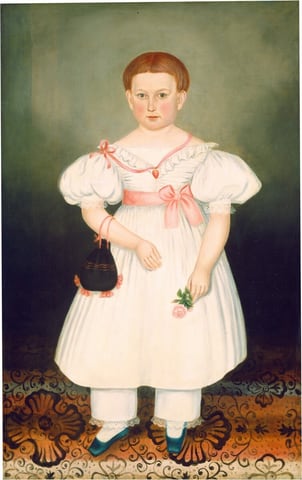
  4. The image shows a child standing upright, facing forward. They have fair skin, rounded cheeks, short reddish-brown hair, and are wearing a white dress with lace details and a pink ribbon, white pants with lace trim, blue shoes, a red necklace and a heart-shaped pendant. They hold a light pink rose in their left hand and a small black drawstring purse with red accents in their right hand. The background is a gradient from dark green to light green, with a floral-patterned carpet in black, brown, and red on the floor.
    Girl with Reticule and RoseJoseph Whiting Stock, c. 1840Courtesy National Gallery of Art, Washington

Section 2, north wall
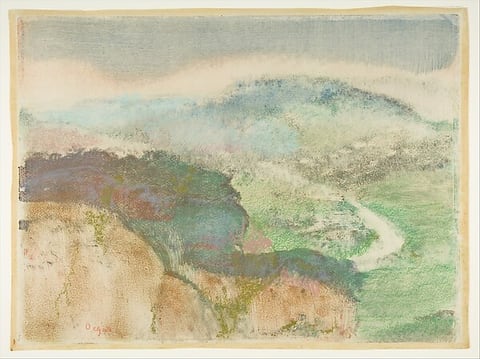
  1. Landscape, by Edgar Degas, 1892
    LandscapeEdgar Degas, 1892Courtesy of The Metropolitan Museum of Art
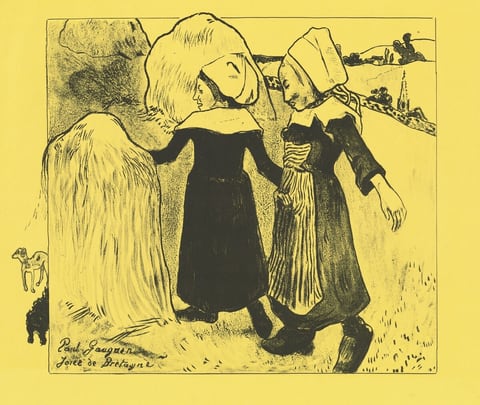
  2. The image shows two women walking arm in arm, both in traditional attire. One woman is facing away with a slight profile, while the other is seen from the side. Their faces are stylized and simplistic with covered hair. They wear long dresses with aprons and collars, and one has a striped apron. Haystacks and greenery surround them. Faint figures are in the background, as well as a spire-like structure. A dog is seen near the haystack, with simple lines suggesting a landscape.
    Pleasures of Brittany (Joies de Bretagne)Paul Gauguin, 1889Courtesy National Gallery of Art, Washington
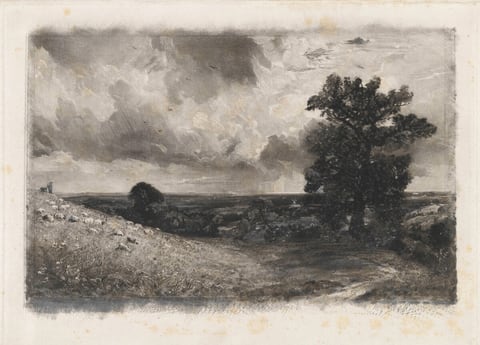
  3. The image shows a landscape with a rolling hill in the foreground sloping downward. The horizon is high, providing a view over fields and sky. Sheep graze on the hill, tended by a person. A large, dark tree is on the right. Brushstrokes vary in the sky and land, with broad strokes for clouds and finer ones for grass and foliage. The color palette is mainly black, white, and shades of grey, highlighting light and shadow.
    NoonDavid Lucas, 1830Courtesy National Gallery of Art, Washington
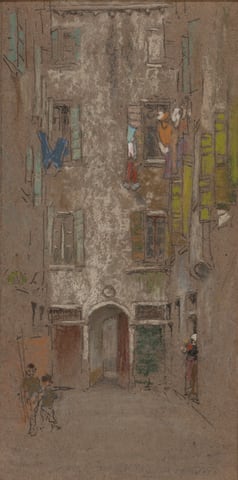
  4. A work made of pastel and black chalk on brown wove paper with fibrous inclusions.
    Corte del ParadisoJames McNeill Whistler, 1880Courtesy of the Art Institute of Chicago