Floor plan

Time and placeThe 19th century

The 19th century

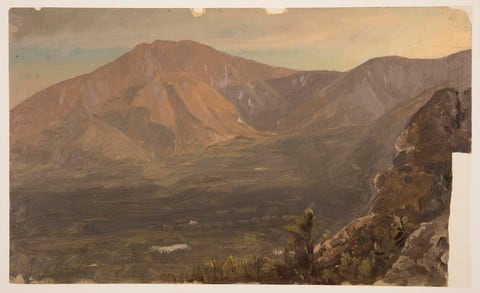
MT. KATAHDIN FROM SOUTH TURNER MOUNTAIN, MAINE
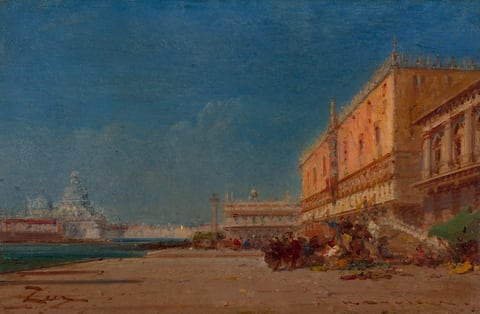
A work made of oil on panel.
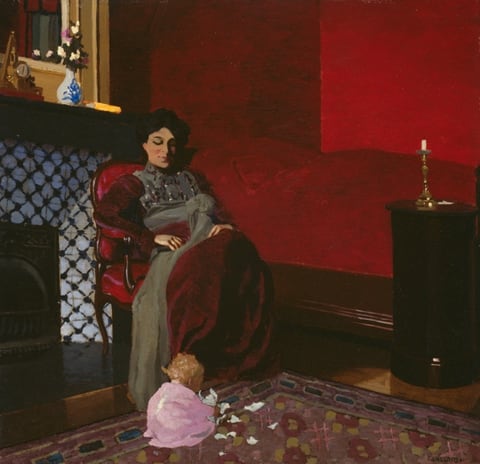
Painting of a stately woman seated on a red velvet chair in a blood-red room, a blue-white fireplace to her left. She glances down at the floor with a serene expression toward a tiny blond child—a baby—who sits on the floor tearing up paper, her pink-clad back facing the viewer.
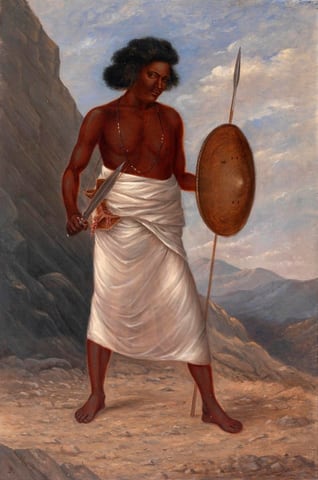
Somali Man, by Antonion Zeno Shindler, ca. 1893
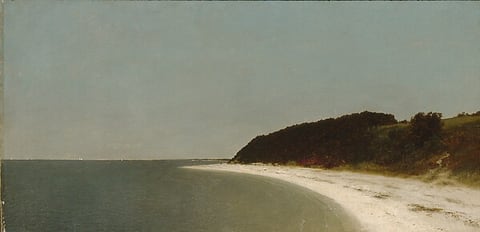
Eaton's Neck, Long Island, by John Frederick Kensett, 1872
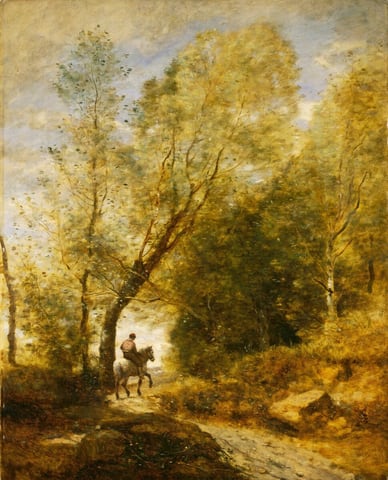
A person rides a horse away from us on a narrow dirt path curving through a forest dominated by golden yellow trees in this vertical landscape painting. A boulder about twice the width of the path is backlit where it sits just left of the lower center of the canvas. The path begins near the bottom right corner of the painting and curves back and to the right. The horse is white, and the rider wears dark brown pants and a hat, and a lighter brown shirt. Trees towering over the rider to either side of the curve nearly reach the top of the composition. The horizon comes less than a third of the way up the painting. Pearly white sky fills in the gap between the trees around the rider, and ivory-colored clouds frame an icy blue sky above. The scene is painted with textured and blended strokes, which gives the painting a soft look even though some of the brushstrokes are visible. The artist signed and dated the lower center of the canvas, though it is partially cut off: “COROT 1872.”
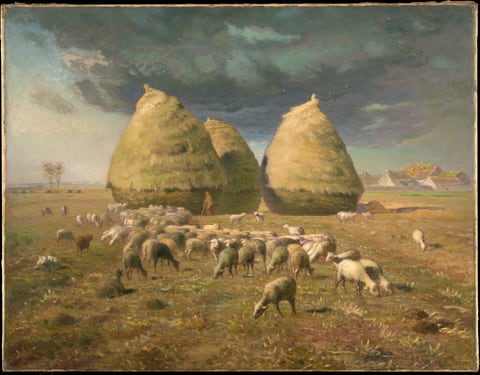
Haystacks: Autumn, by Jean-François Millet, ca. 1874
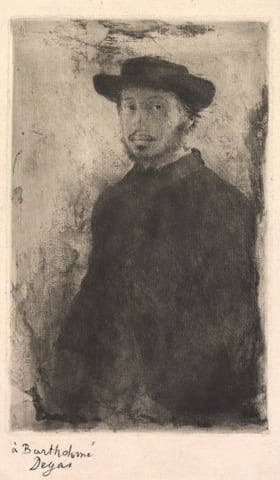
Self-Portrait, by Edgar Degas, 1857

The works in this room are listed below.

Works in this room

Works made in the 19th century, anywhere in the world.

Section 1, north wall

  1. MT. KATAHDIN FROM SOUTH TURNER MOUNTAIN, MAINE
    Mt. Katahdin from South Turner Mountain, MaineFrederic Edwin Church, 1877–78Courtesy of Cooper Hewitt, Smithsonian Design Museum
  2. A work made of oil on panel.
    Venice from the Riva looking toward the Piazzale San MarcoFélix Ziem, c. 1890Courtesy of the Art Institute of Chicago
  3. Painting of a stately woman seated on a red velvet chair in a blood-red room, a blue-white fireplace to her left. She glances down at the floor with a serene expression toward a tiny blond child—a baby—who sits on the floor tearing up paper, her pink-clad back facing the viewer.
    The Red Room, EtretatFélix Vallotton, 1899Courtesy of the Art Institute of Chicago
  4. Somali Man, by Antonion Zeno Shindler, ca. 1893
    Somali ManAntonion Zeno Shindler, ca. 1893Courtesy of the Smithsonian American Art Museum

Section 1, south wall

  1. Eaton's Neck, Long Island, by John Frederick Kensett, 1872
    Eaton's Neck, Long IslandJohn Frederick Kensett, 1872Courtesy of The Metropolitan Museum of Art
  2. A person rides a horse away from us on a narrow dirt path curving through a forest dominated by golden yellow trees in this vertical landscape painting. A boulder about twice the width of the path is backlit where it sits just left of the lower center of the canvas. The path begins near the bottom right corner of the painting and curves back and to the right. The horse is white, and the rider wears dark brown pants and a hat, and a lighter brown shirt. Trees towering over the rider to either side of the curve nearly reach the top of the composition. The horizon comes less than a third of the way up the painting. Pearly white sky fills in the gap between the trees around the rider, and ivory-colored clouds frame an icy blue sky above. The scene is painted with textured and blended strokes, which gives the painting a soft look even though some of the brushstrokes are visible. The artist signed and dated the lower center of the canvas, though it is partially cut off: “COROT 1872.”
    The Forest of CoubronJean Baptiste Camille Corot, 1872Courtesy National Gallery of Art, Washington
  3. Haystacks: Autumn, by Jean-François Millet, ca. 1874
    Haystacks: AutumnJean-François Millet, ca. 1874Courtesy of The Metropolitan Museum of Art
  4. Self-Portrait, by Edgar Degas, 1857
    Self-PortraitEdgar Degas, 1857Courtesy of the Cleveland Museum of Art

Section 2, south wall
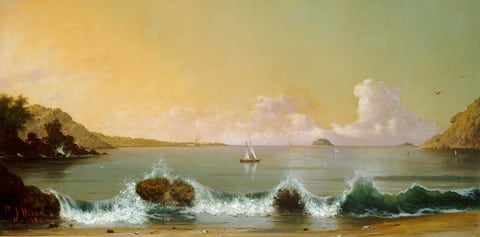
  1. Across a short stretch of sand in front of us, waves of bottle-green water break over two boulders on the shoreline, with sailboats in the water beyond, in this wide, horizontal painting. One boulder is at the left edge of the painting; the other is a short distance away, about a quarter of the way across. The water cascades down between those large rocks. Across the rest of the beach, the waves flare up to break toward us in white, foamy surf. The land curves back into view on both sides of the canvas with muted, sage-green hills and, to our left, dark green trees on more craggy boulders. A more distant finger of land to our left stretches nearly halfway across the horizon, which comes about halfway up the composition. Minuscule in scale there, smoke pours out of a chimney, which is surrounded by pale yellow buildings. A mound emerges from the horizon to our right of center. About ten sailboats float on the water. The closest one to us is near the center of the painting, and the tiny forms of people aboard can just barely be made out. The other boats become smaller as they move back to the horizon, and some are only a touch of white or gray on the canvas. White and pale lavender-purple clouds sweep up from the horizon into the sky, which glows butter yellow along the left edge. The sky cools to mint green in the upper right corner. Several white or brown birds fly across the sky or low over the water. The artist signed and dated the lower left, “M. J. Heade 1864.”
    Rio de Janeiro BayMartin Johnson Heade, 1864Courtesy National Gallery of Art, Washington
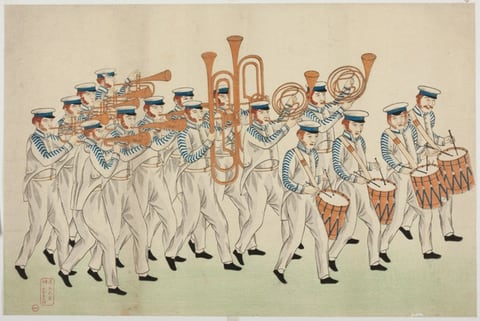
  2. A work made of color woodblock print.
    Procession of Russian Marching Band, from the Album of seven prints of Russian Army and Warship (Roshia seigi shashin kan), 1853Keiga, 1853Courtesy of the Art Institute of Chicago
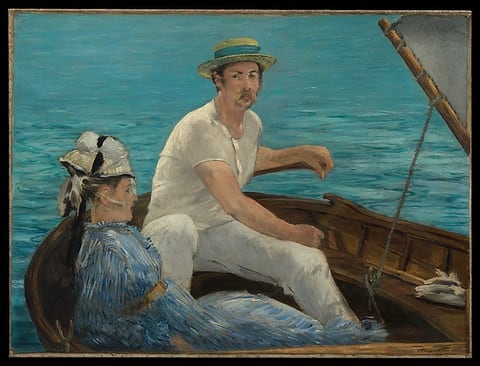
  3. Boating, by Édouard Manet, 1874
    BoatingÉdouard Manet, 1874Courtesy of The Metropolitan Museum of Art

Section 2, north wall
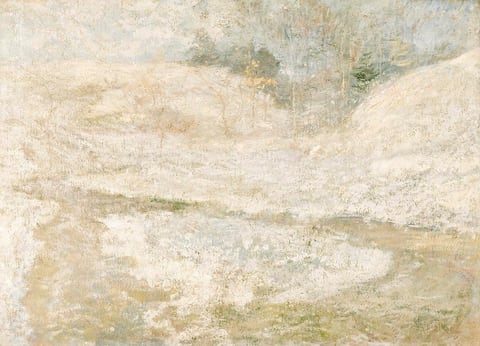
  1. The Brook, Greenwich, Connecticut, by John Henry Twachtman, ca. 1890-1900
    The Brook, Greenwich, ConnecticutJohn Henry Twachtman, ca. 1890-1900Courtesy of the Smithsonian American Art Museum
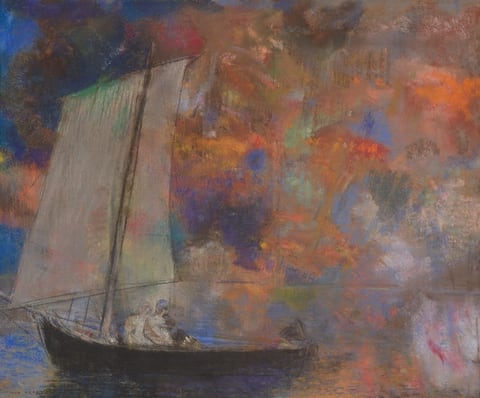
  2. Pastel drawing of two figures in a sailboat, bright multi-colored clouds.
    Flower CloudsOdilon Redon, c. 1903Courtesy of the Art Institute of Chicago
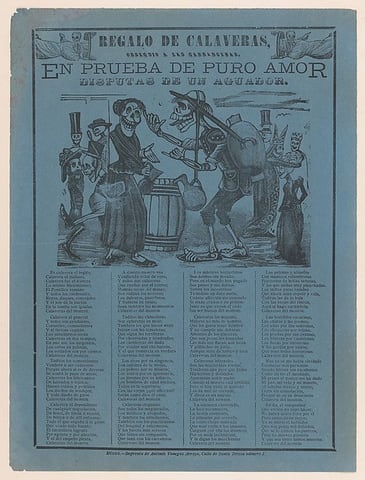
  3. In proof of true love, a watercarrier skeleton arguing with a woman (Posada); two skeleton angels in upper corners (Manilla), by José Guadalupe Posada, ca. 1890–96
    In proof of true love, a watercarrier skeleton arguing with a woman (Posada); two skeleton angels in upper corners (Manilla)José Guadalupe Posada, ca. 1890–96Courtesy of The Metropolitan Museum of Art

Section 3, north wall
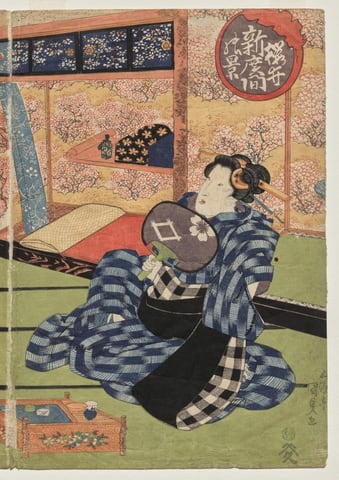
  1. A View of the Large New Room at Sakurai, by Utagawa Kunisada, early or mid 1830s
    A View of the Large New Room at SakuraiUtagawa Kunisada, early or mid 1830sCourtesy of the Cleveland Museum of Art
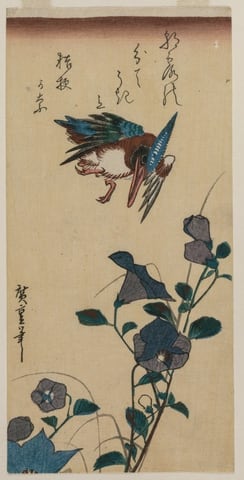
  2. Kingfisher and Chinese Bellflowers, by Utagawa Hiroshige, early or mid-1830s
    Kingfisher and Chinese BellflowersUtagawa Hiroshige, early or mid-1830sCourtesy of the Cleveland Museum of Art