Floor plan

Time and placeThe 19th century

The 19th century

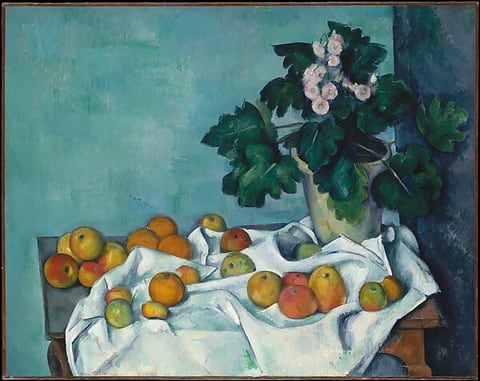
Still Life with Apples and a Pot of Primroses, by Paul Cézanne, ca. 1890
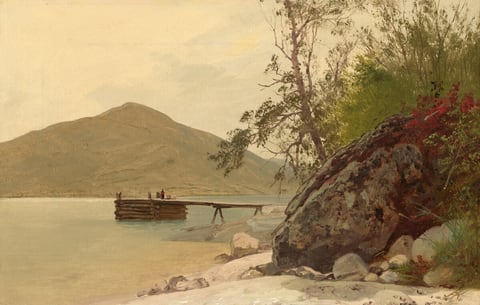
The painting depicts a tranquil lake scene with a low horizon line showing a pale green hill in the background under a pale, cloudy sky. Closer to us, on the right, there is a large, textured rock surrounded by greenery and red flowers. In the distance, a wooden dock extends into the lake on the left, and a person wearing red appears to sit or stand with their back to us.
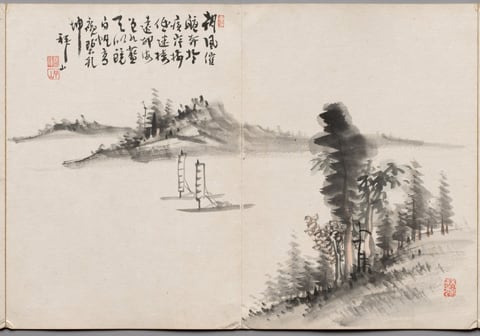
Painting Five from Album of Paintings by Haizan, by Yoshitsugu Haizan, late 1800s–early 1900s
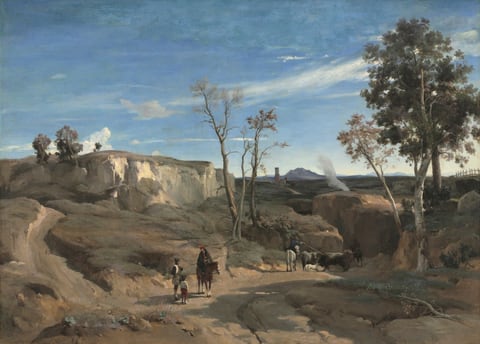
La Cervara, the Roman Campagna, by Jean Baptiste Camille Corot, c. 1830–31
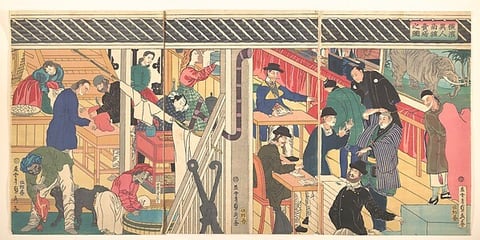
Foreign Business Establishment in Yokohama (Yokohama ijin shōkan uriba no zu), by Utagawa (Gountei) Sadahide, 9th month, 1861
A work made of oil on canvas.

The works in this room are listed below.

Works in this room

Works made in the 19th century, anywhere in the world.

Section 1, north wall

  1. Still Life with Apples and a Pot of Primroses, by Paul Cézanne, ca. 1890
    Still Life with Apples and a Pot of PrimrosesPaul Cézanne, ca. 1890Courtesy of The Metropolitan Museum of Art
  2. The painting depicts a tranquil lake scene with a low horizon line showing a pale green hill in the background under a pale, cloudy sky. Closer to us, on the right, there is a large, textured rock surrounded by greenery and red flowers. In the distance, a wooden dock extends into the lake on the left, and a person wearing red appears to sit or stand with their back to us.
    Landing at Sabbath Day PointJohn Frederick Kensett, c. 1853Courtesy National Gallery of Art, Washington
  3. Painting Five from Album of Paintings by Haizan, by Yoshitsugu Haizan, late 1800s–early 1900s
    Painting Five from Album of Paintings by HaizanYoshitsugu Haizan, late 1800s–early 1900sCourtesy of the Cleveland Museum of Art

Section 1, south wall

  1. La Cervara, the Roman Campagna, by Jean Baptiste Camille Corot, c. 1830–31
    La Cervara, the Roman CampagnaJean Baptiste Camille Corot, c. 1830–31Courtesy of the Cleveland Museum of Art
  2. Foreign Business Establishment in Yokohama (Yokohama ijin shōkan uriba no zu), by Utagawa (Gountei) Sadahide, 9th month, 1861
    Foreign Business Establishment in Yokohama (Yokohama ijin shōkan uriba no zu)Utagawa (Gountei) Sadahide, 9th month, 1861Courtesy of The Metropolitan Museum of Art
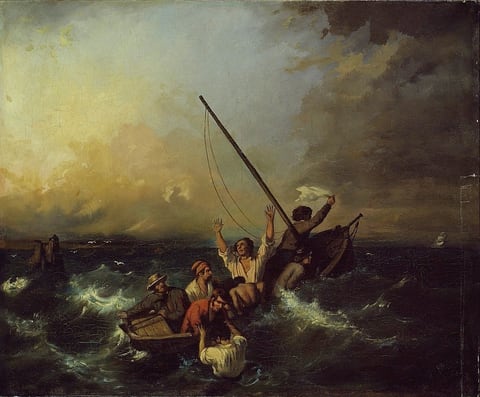
  3. A work made of oil on canvas.
    ShipwreckAfter Eugène Isabey, 19th centuryCourtesy of the Art Institute of Chicago

Section 2, south wall
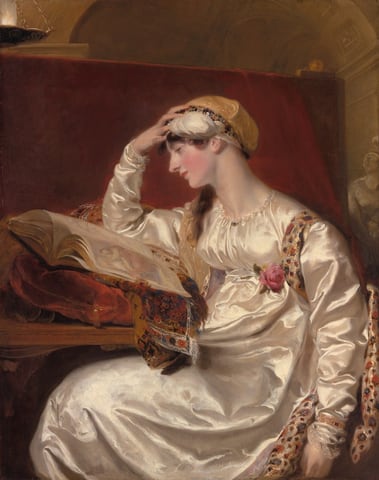
  1. A light-skinned woman in a long, shiny white dress sits at a desk reading a book. The book is propped on a large red pillow. Her head is propped in her hand.
    Isabella WolffThomas Lawrence, 1803–15Courtesy of the Art Institute of Chicago
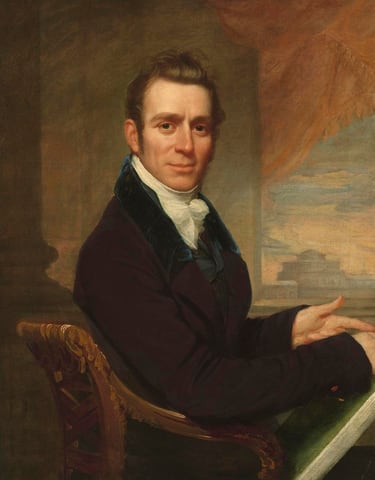
  2. Artist: John Wesley Jarvis, Sitter: Joseph Delaplaine, Current owner: National Portrait Gallery, Smithsonian Institution
    Joseph DelaplaineJohn Wesley Jarvis, January 1819Courtesy of the National Portrait Gallery, Smithsonian Institution
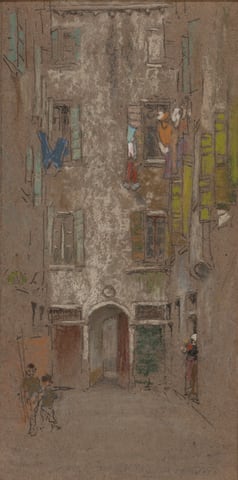
  3. A work made of pastel and black chalk on brown wove paper with fibrous inclusions.
    Corte del ParadisoJames McNeill Whistler, 1880Courtesy of the Art Institute of Chicago
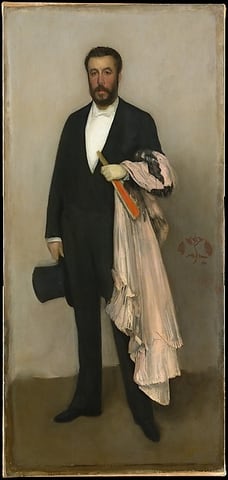
  4. Arrangement in Flesh Colour and Black: Portrait of Theodore Duret, by James McNeill Whistler, 1883
    Arrangement in Flesh Colour and Black: Portrait of Theodore DuretJames McNeill Whistler, 1883Courtesy of The Metropolitan Museum of Art

Section 2, north wall
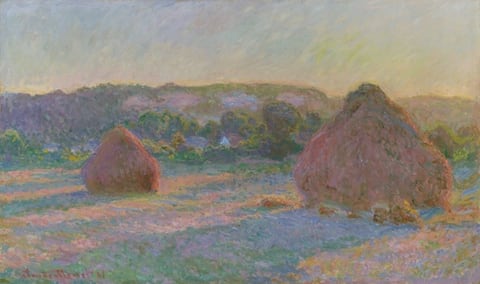
  1. Painting composed of short, dense brushstrokes depicts two domed stacks of wheat that cast long shadows on a field. The angled light indicates either a rising or setting sun.
    Stacks of Wheat (End of Summer)Claude Monet, 1890–91Courtesy of the Art Institute of Chicago
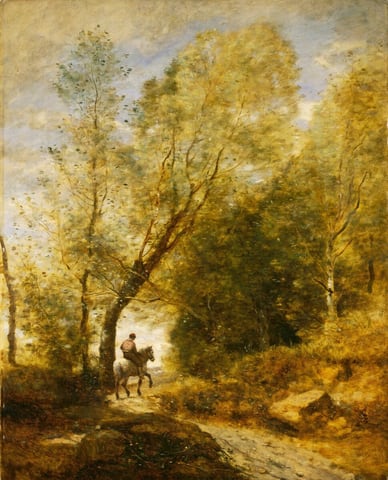
  2. A person rides a horse away from us on a narrow dirt path curving through a forest dominated by golden yellow trees in this vertical landscape painting. A boulder about twice the width of the path is backlit where it sits just left of the lower center of the canvas. The path begins near the bottom right corner of the painting and curves back and to the right. The horse is white, and the rider wears dark brown pants and a hat, and a lighter brown shirt. Trees towering over the rider to either side of the curve nearly reach the top of the composition. The horizon comes less than a third of the way up the painting. Pearly white sky fills in the gap between the trees around the rider, and ivory-colored clouds frame an icy blue sky above. The scene is painted with textured and blended strokes, which gives the painting a soft look even though some of the brushstrokes are visible. The artist signed and dated the lower center of the canvas, though it is partially cut off: “COROT 1872.”
    The Forest of CoubronJean Baptiste Camille Corot, 1872Courtesy National Gallery of Art, Washington
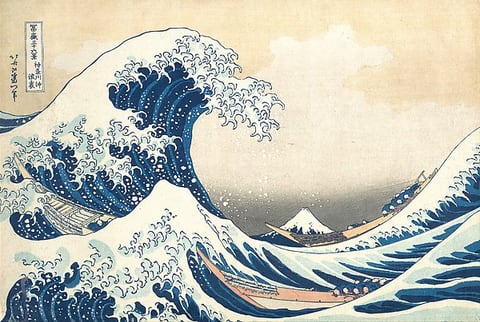
  3. Under the Wave off Kanagawa (Kanagawa oki nami ura), also known as The Great Wave, from the series Thirty-six Views of Mount Fuji (Fugaku sanjūrokkei), by Katsushika Hokusai, ca. 1830–32
    Under the Wave off Kanagawa (Kanagawa oki nami ura), also known as The Great Wave, from the series Thirty-six Views of Mount Fuji (Fugaku sanjūrokkei)Katsushika Hokusai, ca. 1830–32Courtesy of The Metropolitan Museum of Art
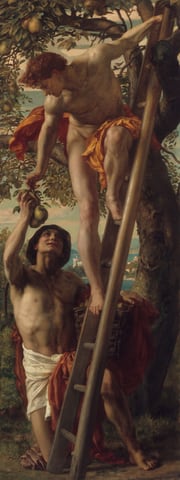
  4. A work made of oil on canvas.
    The Golden AgeSir John Edward Poynter, 1875Courtesy of the Art Institute of Chicago

Section 3, north wall
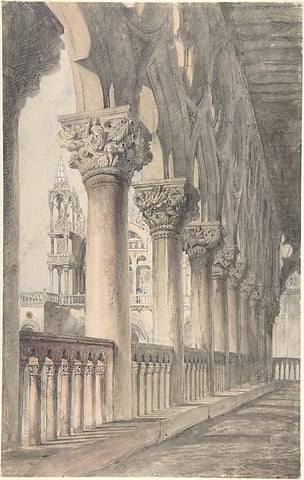
  1. Loggia of the Ducal Palace, Venice, by John Ruskin, 1849–50
    Loggia of the Ducal Palace, VeniceJohn Ruskin, 1849–50Courtesy of The Metropolitan Museum of Art
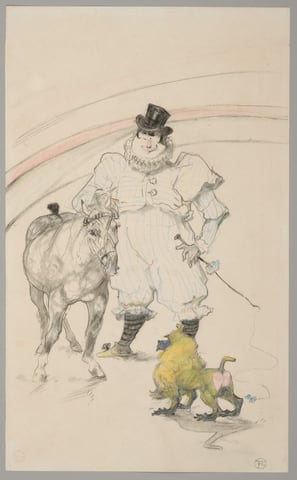
  2. A work made of pastel and graphite on cream wove paper.
    At the Circus: Trained Pony and BaboonHenri de Toulouse-Lautrec, 1899Courtesy of the Art Institute of Chicago