Floor plan

Time and place19th-century United States
19th-century United States
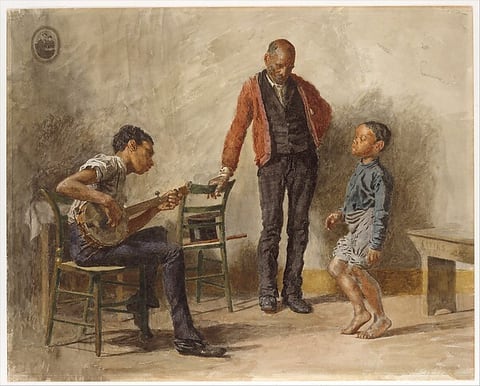
The Dancing Lesson, by Thomas Eakins, 1878
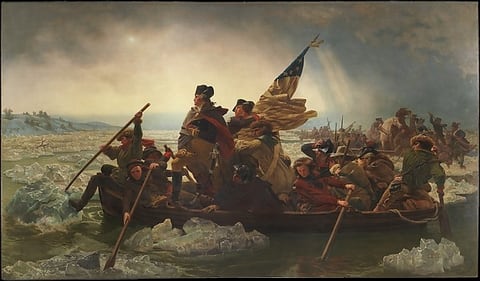
Washington Crossing the Delaware, by Emanuel Leutze, 1851
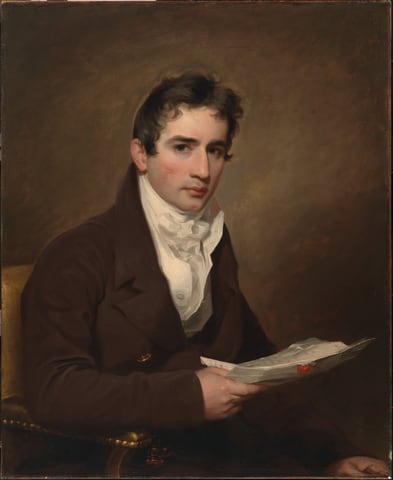
Artist: Thomas Sully, Sitter: John Sergeant, Current owner: National Portrait Gallery, Smithsonian Institution
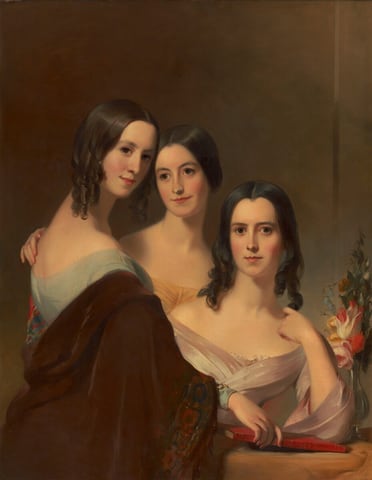
In this painting, three women are depicted standing and sitting closely together. The women have fair complexions and dark hair in ringlets, and they are smiling slightly. The woman on the left appears to be standing, and her body is turned to the right while her head is turned over her shoulder to face us. She wears a light blue dress with a brown shawl, and she is holding the edge of a red book that rests on a small table in the bottom right corner. The woman in the middle also appears to be standing, and she is wearing a golden-yellow off-the-shoulder garment. One of her hands is on the shoulder of the woman on the left. The woman on the right is seated at the small table, and she wears a pale pink off-the-shoulder dress. She looks directly out at us. The small table is covered in a golden cloth, and on the right is a vase of colorful flowers. The wall behind the woman is a blend of brown, tan, and pale blue tones.
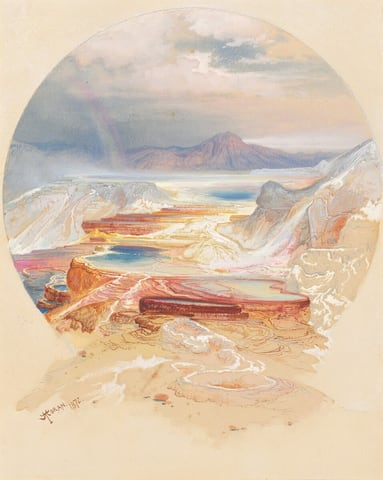
This painting shows a view looking out over a vast landscape. Most of the painting is circular, with a small part of the bottom bleeding out of the circle towards us. The top third of the circle shows a mountain range with a large purple peak in the distance. In front of the mountain is a faint rainbow. A body of water flows from in front of the mountain to the bottom of the painting, weaving in between shorter white peaks. Towards the bottom, the water appears to flow into small, layered pools of various bright colors including yellow, orange, red, pink, blue, and teal. The sky is a light blue-gray color. The background of the painting outside of the circle is plain paper.
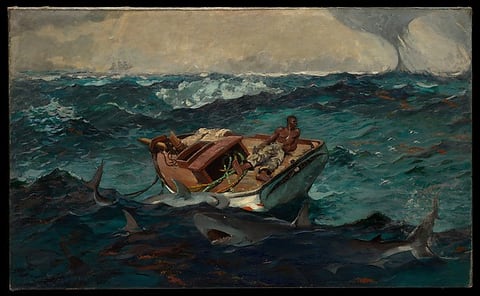
The Gulf Stream, by Winslow Homer, 1899; reworked by 1906

The works in this room are listed below.

Works in this room

Works made in the United States in the 19th century.

Section 1, north wall

  1. The Dancing Lesson, by Thomas Eakins, 1878
    The Dancing LessonThomas Eakins, 1878Courtesy of The Metropolitan Museum of Art
  2. Washington Crossing the Delaware, by Emanuel Leutze, 1851
    Washington Crossing the DelawareEmanuel Leutze, 1851Courtesy of The Metropolitan Museum of Art
  3. Artist: Thomas Sully, Sitter: John Sergeant, Current owner: National Portrait Gallery, Smithsonian Institution
    John SergeantThomas Sully, 1811Courtesy of the National Portrait Gallery, Smithsonian Institution

Section 1, south wall

  1. In this painting, three women are depicted standing and sitting closely together. The women have fair complexions and dark hair in ringlets, and they are smiling slightly. The woman on the left appears to be standing, and her body is turned to the right while her head is turned over her shoulder to face us. She wears a light blue dress with a brown shawl, and she is holding the edge of a red book that rests on a small table in the bottom right corner. The woman in the middle also appears to be standing, and she is wearing a golden-yellow off-the-shoulder garment. One of her hands is on the shoulder of the woman on the left. The woman on the right is seated at the small table, and she wears a pale pink off-the-shoulder dress. She looks directly out at us. The small table is covered in a golden cloth, and on the right is a vase of colorful flowers. The wall behind the woman is a blend of brown, tan, and pale blue tones.
    The Coleman SistersThomas Sully, 1844Courtesy National Gallery of Art, Washington
  2. This painting shows a view looking out over a vast landscape. Most of the painting is circular, with a small part of the bottom bleeding out of the circle towards us. The top third of the circle shows a mountain range with a large purple peak in the distance. In front of the mountain is a faint rainbow. A body of water flows from in front of the mountain to the bottom of the painting, weaving in between shorter white peaks. Towards the bottom, the water appears to flow into small, layered pools of various bright colors including yellow, orange, red, pink, blue, and teal. The sky is a light blue-gray color. The background of the painting outside of the circle is plain paper.
    Minerva Terrace, YellowstoneThomas Moran, 1872Courtesy National Gallery of Art, Washington
  3. The Gulf Stream, by Winslow Homer, 1899; reworked by 1906
    The Gulf StreamWinslow Homer, 1899; reworked by 1906Courtesy of The Metropolitan Museum of Art

Section 2, south wall
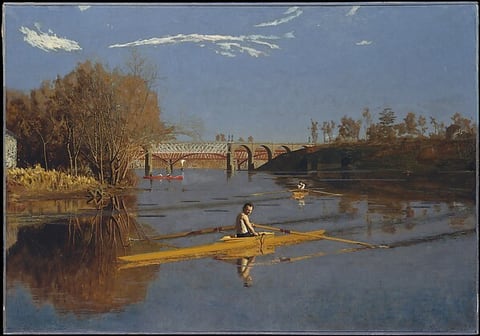
  1. The Champion Single Sculls (Max Schmitt in a Single Scull), by Thomas Eakins, 1871
    The Champion Single Sculls (Max Schmitt in a Single Scull)Thomas Eakins, 1871Courtesy of The Metropolitan Museum of Art
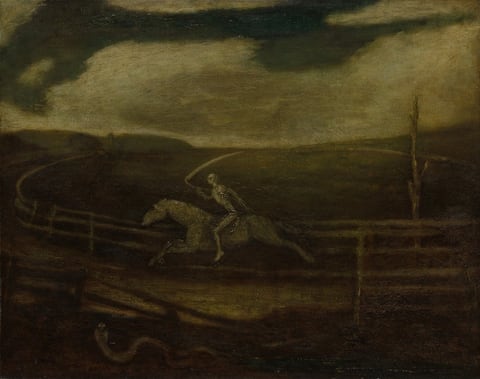
  2. The Race Track (Death on a Pale Horse), by Albert Pinkham Ryder, c. 1896–1908
    The Race Track (Death on a Pale Horse)Albert Pinkham Ryder, c. 1896–1908Courtesy of the Cleveland Museum of Art

Section 2, north wall
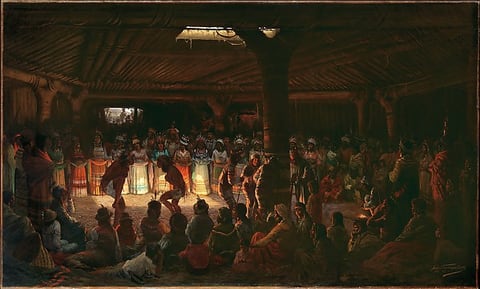
  1. Dance in a Subterranean Roundhouse at Clear Lake, California, by Jules Tavernier, 1878
    Dance in a Subterranean Roundhouse at Clear Lake, CaliforniaJules Tavernier, 1878Courtesy of The Metropolitan Museum of Art
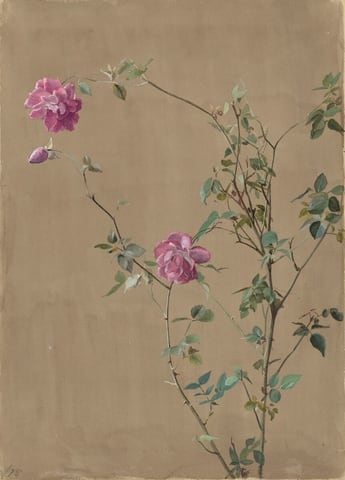
  2. This detailed painting shows two pink roses and a pink bud on a long, thin green stem with green leaves and small green thorns. The tall stem rises near the right edge of the painting, with some thin branches reaching out to either side. The largest rose is positioned near the top left corner of the painting, with the small bud right below it. The other large flower is right around the center of the painting. The background is a flat beige color.
    Pink RosesFidelia Bridges, 1875Courtesy National Gallery of Art, Washington
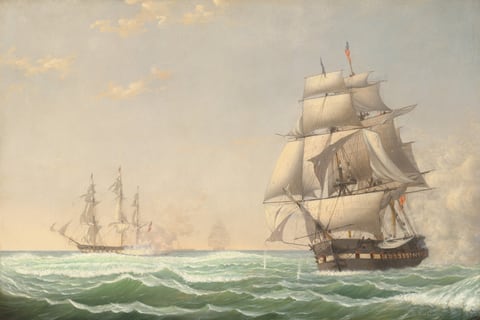
  3. This painting shows a maritime landscape with an expansive view of the ocean and sky. The horizon is positioned in the lower third of the composition, meeting a clear sky with soft, diffused clouds. Two ships appear to be engaged in a conflict on the green, wave-filled water. One large sailing ship with fully extended sails is near the bottom right corner of the painting. It has two tall masts and multiple white sails, and it flies the flag of the U.S.A in several places. The body of this ship is gray with a wide white stripe, and cannons stick out of small holes across the ship. Small people climb on ropes up into the sails, which are covered in small white and gray dots, perhaps indicating holes. Another ship is visible in the distance on the left side of the painting, and its cannons appear to be firing, with bursts of yellow flame and smoke drifting across the water. This ship flies several flags in shades of red, blue, and white. In the background, the faint gray silhouettes of other ships can be seen across the water. The ocean is depicted with smooth brushstrokes in shades of green and white, and the wide sky is a gradient, with light blue at the top and pale yellow towards the horizon. Faint white clouds drift in the top left corner of the painting.
    The United States Frigate "President" Engaging the British Squadron, 1815Fitz Henry Lane, 1850Courtesy National Gallery of Art, Washington

Section 3, north wall
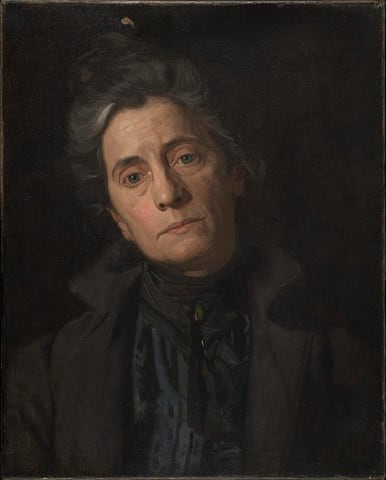
  1. Thomas Eakins
    Portrait of Mrs. Thomas EakinsThomas Eakins, (c. 1899)Courtesy of the Hirshhorn Museum and Sculpture Garden, Smithsonian Institution
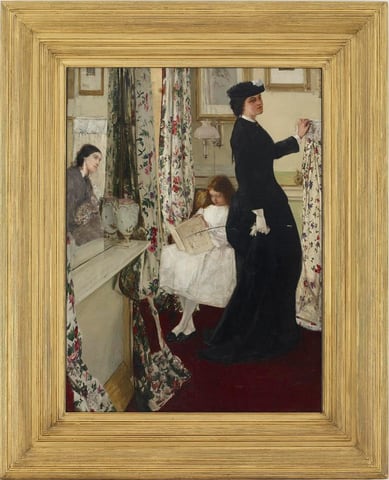
  2. Oil painting
    Harmony in Green and Rose: The Music RoomJames McNeill Whistler, 1860-1861Courtesy of the National Museum of Asian Art, Smithsonian Institution
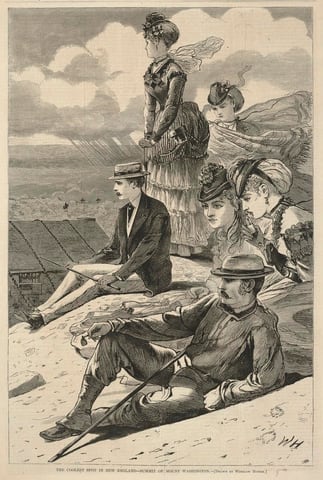
  3. The Coolest Spot in New England--Summit of Mount Washington, from Harper's Bazar, July 23, 1870, by Winslow Homer, 1870
    The Coolest Spot in New England--Summit of Mount Washington, from Harper's Bazar, July 23, 1870Winslow Homer, 1870Courtesy of the Smithsonian American Art Museum

Section 3, south wall
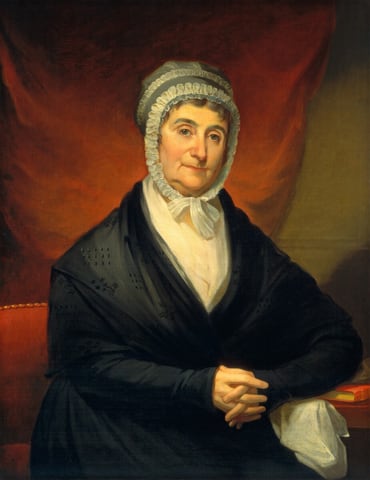
  1. The image shows the upper half of a seated woman facing forward. She has her hands clasped together in front of her. The woman appears calm with visible signs of age, including a few wrinkles on her face. She wears a white bonnet with a frilled edge tied under her chin, a dark shawl over a white high-collared blouse, and sits on a red chair with a gold trim. A red book and a handkerchief are on the surface next to her. The background transitions from deep red to brown tones.
    Ann Old Coleman (Mrs. Robert Coleman)Jacob Eichholtz, c. 1820Courtesy National Gallery of Art, Washington
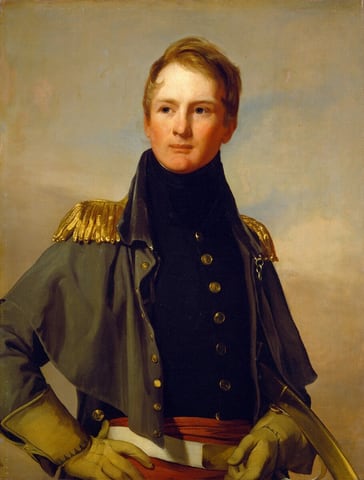
  2. Major Thomas Biddle, by Thomas Wilcocks Sully, 1832
    Major Thomas BiddleThomas Wilcocks Sully, 1832Courtesy National Gallery of Art, Washington