Floor plan

Time and place18th-century Italy

18th-century Italy

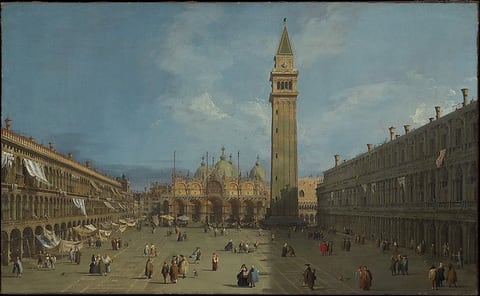
Piazza San Marco, by Canaletto, late 1720s
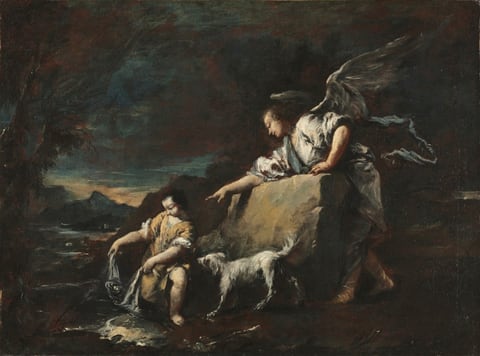
Tobias and the Angel, by Francesco Guardi, 1750s
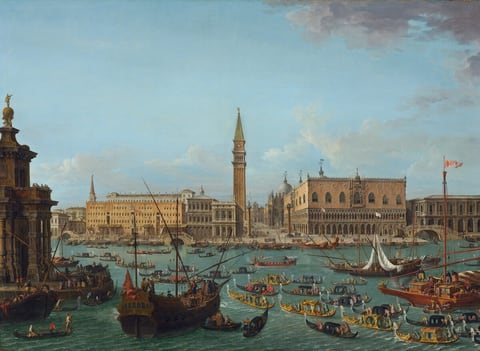
The painting depicts many large and small ships on blue-green water. Gondolas in shades of gold, black, red, and blue drift across the water, small people on them pushing long poles through the water. There are also large sailboats and long boats with several rowers. They create a colorful mix. On the left, a large brown building with columns is visible. Some of the boats pull up to it, and many people in colorful clothing are visible on the shore. Behind the water are more large buildings in shades of brown, cream, and tan, with even more people visible on the streets below them. There is a large tower in the center of the painting, and several blue domes are visible in the distance. The sky is light blue, with white and gray clouds drifting across it.
We look up through an opening surrounded by a stone ledge, with clusters of people and clouds swirling into a blue sky up and away from us in this vertical, rectangular painting. From a distance, the scene looks like a complete illusion but up close, the people, clouds, and architecture are sketchily painted. The ledge running around the opening has a gold, oval medallion at each corner. Appearing to be carved from white stone, two bearded men with long hair recline against each medallion, flanking them to each side in front of large shells that curve up over the people and frames them. A few architectural structures extend up into the sky, including a pointed obelisk in the lower left corner, a pair of columns at the upper right, and what seems to be the mast of a ship at the top left. Most of the people have pale skin but some have more tan complexions, and a few, including those wearing feather headdresses near the upper left corner, have brown skin. The people wear windswept robes of pale, butter yellow, robin’s egg blue, rose pink, and ivory. The eye may drawn to a few vignettes, such as the man holding a rearing, chestnut-brown horse on the illusionistic ledge near the lower right, a nun wearing a white robe and holding a cross above him in the clouds, and, farthest away, a crowned person sitting on a throne.

The works in this room are listed below.

Works in this room

Works made in Italy in the 18th century.

First room, north wall

  1. Piazza San Marco, by Canaletto, late 1720s
    Piazza San MarcoCanaletto, late 1720sCourtesy of The Metropolitan Museum of Art
  2. Tobias and the Angel, by Francesco Guardi, 1750s
    Tobias and the AngelFrancesco Guardi, 1750sCourtesy of the Cleveland Museum of Art

First room, south wall

  1. The painting depicts many large and small ships on blue-green water. Gondolas in shades of gold, black, red, and blue drift across the water, small people on them pushing long poles through the water. There are also large sailboats and long boats with several rowers. They create a colorful mix. On the left, a large brown building with columns is visible. Some of the boats pull up to it, and many people in colorful clothing are visible on the shore. Behind the water are more large buildings in shades of brown, cream, and tan, with even more people visible on the streets below them. There is a large tower in the center of the painting, and several blue domes are visible in the distance. The sky is light blue, with white and gray clouds drifting across it.
    Procession of Gondolas in the Bacino di San Marco, VeniceAntonio Joli, 1742 or afterCourtesy National Gallery of Art, Washington
  2. We look up through an opening surrounded by a stone ledge, with clusters of people and clouds swirling into a blue sky up and away from us in this vertical, rectangular painting. From a distance, the scene looks like a complete illusion but up close, the people, clouds, and architecture are sketchily painted. The ledge running around the opening has a gold, oval medallion at each corner. Appearing to be carved from white stone, two bearded men with long hair recline against each medallion, flanking them to each side in front of large shells that curve up over the people and frames them. A few architectural structures extend up into the sky, including a pointed obelisk in the lower left corner, a pair of columns at the upper right, and what seems to be the mast of a ship at the top left. Most of the people have pale skin but some have more tan complexions, and a few, including those wearing feather headdresses near the upper left corner, have brown skin. The people wear windswept robes of pale, butter yellow, robin’s egg blue, rose pink, and ivory. The eye may drawn to a few vignettes, such as the man holding a rearing, chestnut-brown horse on the illusionistic ledge near the lower right, a nun wearing a white robe and holding a cross above him in the clouds, and, farthest away, a crowned person sitting on a throne.
    Wealth and Benefits of the Spanish Monarchy under Charles IIIGiovanni Battista Tiepolo, 1762Courtesy National Gallery of Art, Washington

Second room, south wall
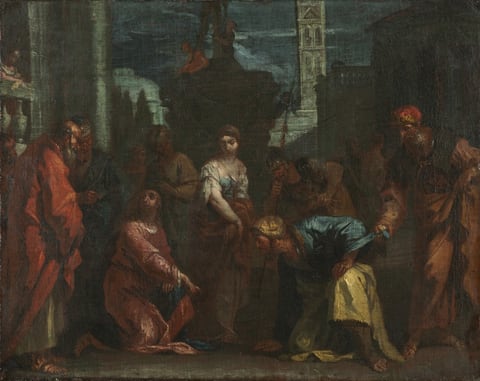
  1. Christ and the Woman Taken in Adultery, by Sebastiano Ricci, mid-1700s
    Christ and the Woman Taken in AdulterySebastiano Ricci, mid-1700sCourtesy of the Cleveland Museum of Art
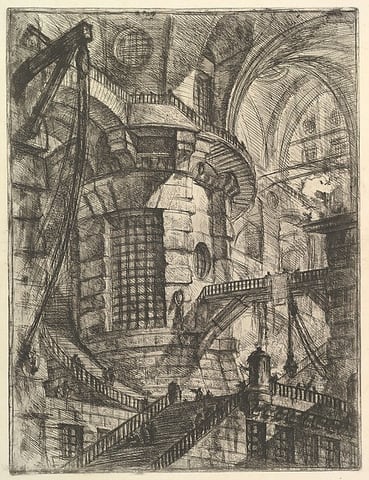
  2. The Round Tower, from "Carceri d'invenzione" (Imaginary Prisons), by Giovanni Battista Piranesi, ca. 1749–50
    The Round Tower, from "Carceri d'invenzione" (Imaginary Prisons)Giovanni Battista Piranesi, ca. 1749–50Courtesy of The Metropolitan Museum of Art
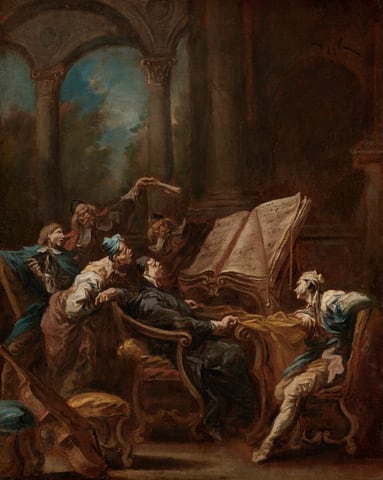
  3. This is a painting of a group engaged in a music session, all looking towards a large open music book in a grand, architectural setting. Behind the group are tall, ornate columns and an arched background that opens up to show a cloudy blue sky. Most of the people have open mouths as if they are singing, while one man in the back seems to be conducting, holding a up roll of paper. Some of the people in the group are seated in cushioned wooden chairs, and a yellowish cloth is draped over the surface that the large book rests on. There is a string instrument similar to a cello near the bottom left corner. The colors used are rich, earthy browns, yellows, and reds, with elements of blue and white clothing. All of the people have pale skin, and two have long white mustaches.
    The ChoristersAlessandro Magnasco, c. 1740/1745Courtesy National Gallery of Art, Washington
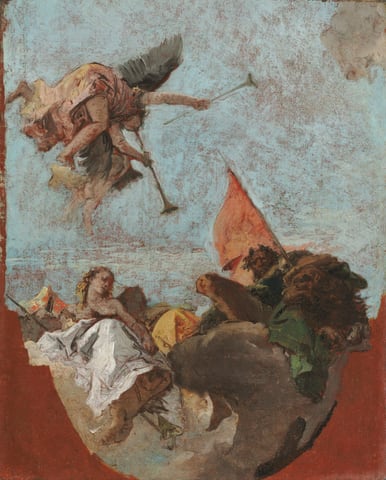
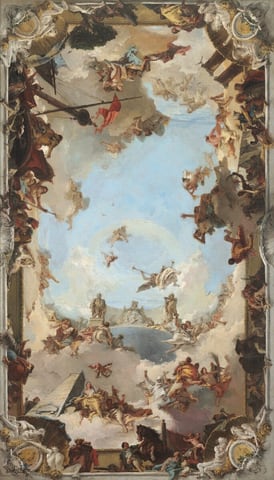
  4. Sketch for a Ceiling, by Giovanni Battista Tiepolo, 1750s
    Sketch for a CeilingGiovanni Battista Tiepolo, 1750sCourtesy of the Cleveland Museum of Art

Second room, north wall
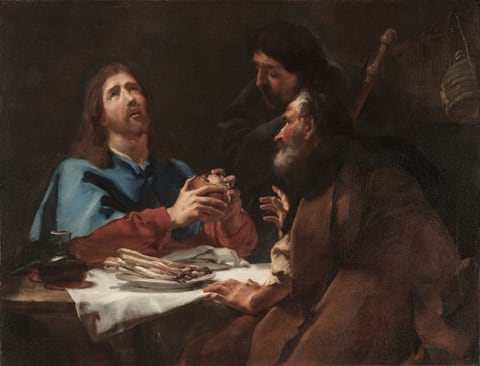
  1. The Supper at Emmaus, by Giovanni Battista Piazzetta, c. 1720
    The Supper at EmmausGiovanni Battista Piazzetta, c. 1720Courtesy of the Cleveland Museum of Art
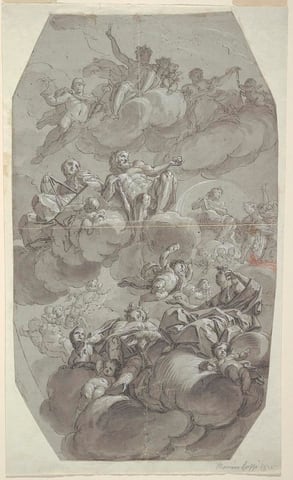
  2. STUDY FOR PAINTING, MOUNT OLYMPUS
    Study for Painting, Mount OlympusVito D'Anna, 1750–60Courtesy of Cooper Hewitt, Smithsonian Design Museum
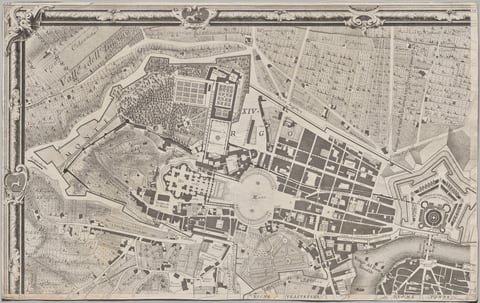
  3. Nuova pianta di Roma data in luce da Giambattista Nolli l’anno MDCCXLVII, known as La Pianta Grande di Roma, by Giovanni Battista Nolli, 1748
    Nuova pianta di Roma data in luce da Giambattista Nolli l’anno MDCCXLVII, known as La Pianta Grande di RomaGiovanni Battista Nolli, 1748Courtesy of the Cleveland Museum of Art

Third room, north wall
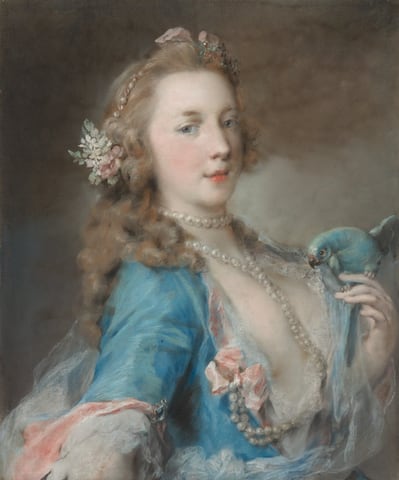
  1. A pastel drawing of woman in blue and pink dress with blue parrot.
    A Young Lady with a ParrotRosalba Carriera, c. 1730Courtesy of the Art Institute of Chicago
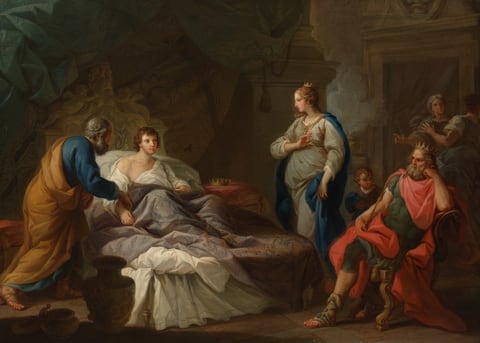
  2. A work made of oil on canvas.
    Antiochus Yearning for StratoniceStefano Pozzi, c. 1740Courtesy of the Art Institute of Chicago

Third room, south wall
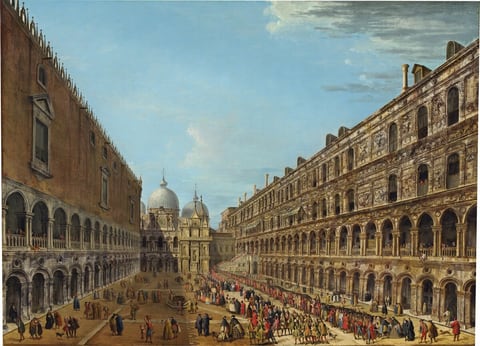
  1. This painting depicts a square seen from above, surrounded by elegant architectural structures. On the left side, there is a large building with a red-brown facade and arched white windows with columns. On the right, there is an ornate off-white structure with arches and detailed stonework. Both of these long buildings stretch from the sides of the painting towards the center, where they converge at a gray building with tall spires and large blue domes behind it. In the square there are countless people in colorful attire, wearing shades of pink, red, blue, green, yellow, black, and blue. There are men, women, and children, and those with visible faces all appear to have light skin. Some wear white masks with bird-like noses. On the right, there is a long line of people engaging in a procession or gathering. People also line the windows of the two buildings on either side of the square. The painting is incredibly detailed, capturing architectural elements and the bustling crowd. The color palette features earthy tones for the architecture and vibrant colors for the people, all set below a pale blue sky with a few white-and-gray clouds.
    Procession in the Courtyard of the Ducal Palace, VeniceAntonio Joli, 1742 or afterCourtesy National Gallery of Art, Washington
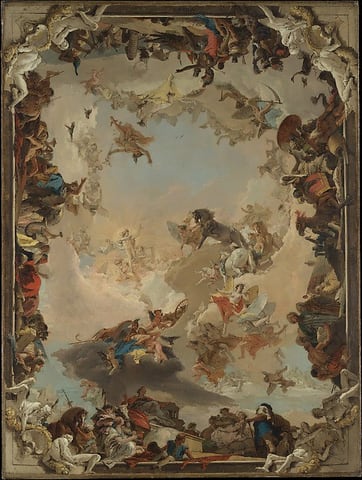
  2. Allegory of the Planets and Continents, by Giovanni Battista Tiepolo, 1752
    Allegory of the Planets and ContinentsGiovanni Battista Tiepolo, 1752Courtesy of The Metropolitan Museum of Art
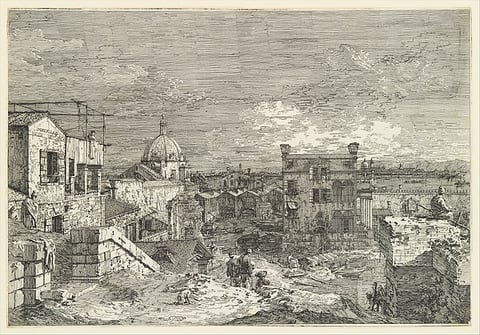
  3. Imaginary View of Venice, houses at left with figures on terraces, a domed church at center in the background, boats and boat-sheds below, and a seated man observing from a wall at right in the foreground, from "Views" (Vedute altre prese da i luoghi altre ideate da Antonio Canal), by Canaletto, 1741
    Imaginary View of Venice, houses at left with figures on terraces, a domed church at center in the background, boats and boat-sheds below, and a seated man observing from a wall at right in the foreground, from "Views" (Vedute altre prese da i luoghi altre ideate da Antonio Canal)Canaletto, 1741Courtesy of The Metropolitan Museum of Art