Floor plan

Time and place18th-century Italy

18th-century Italy

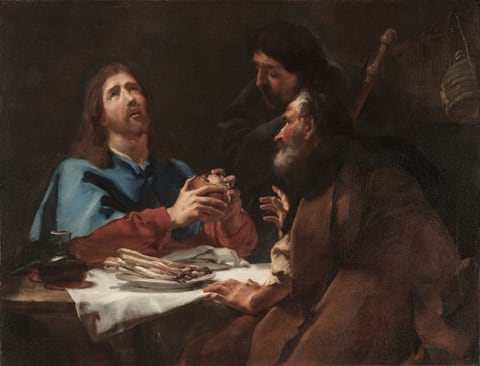
The Supper at Emmaus, by Giovanni Battista Piazzetta, c. 1720
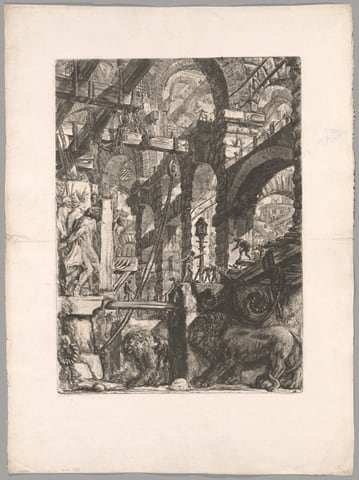
A work made of etching and engraving on heavy ivory laid paper.
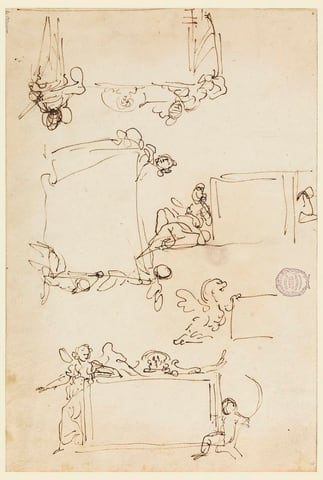
SKETCHES FOR A TABLET
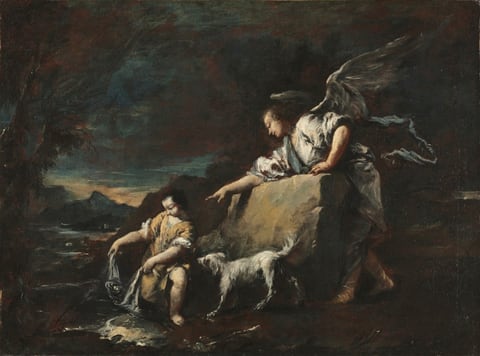
Tobias and the Angel, by Francesco Guardi, 1750s
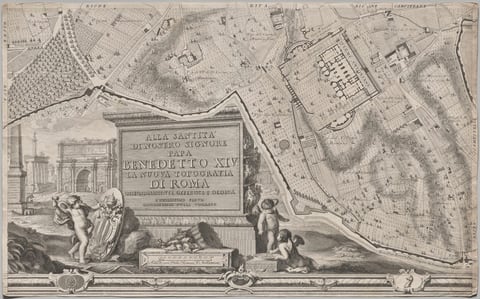
Nuova pianta di Roma data in luce da Giambattista Nolli l’anno MDCCXLVII, known as La Pianta Grande di Roma, by Giovanni Battista Nolli, 1748
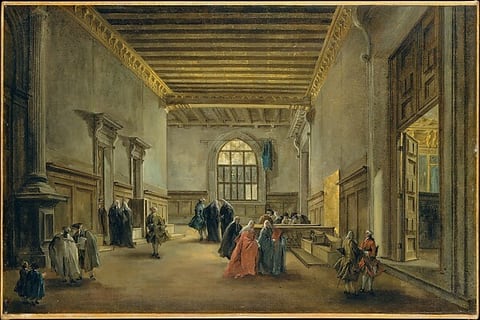
The Antechamber of the Sala del Maggior Consiglio, by Francesco Guardi, ca. 1765–68

The works in this room are listed below.

Works in this room

Works made in Italy in the 18th century.

First room, north wall

  1. The Supper at Emmaus, by Giovanni Battista Piazzetta, c. 1720
    The Supper at EmmausGiovanni Battista Piazzetta, c. 1720Courtesy of the Cleveland Museum of Art
  2. A work made of etching and engraving on heavy ivory laid paper.
    The Lion Bas-Reliefs, plate 5 from Imaginary PrisonsGiovanni Battista Piranesi, 1761Courtesy of the Art Institute of Chicago
  3. SKETCHES FOR A TABLET
    Sketches for a tabletCarlo Marchionni, ca. 1750Courtesy of Cooper Hewitt, Smithsonian Design Museum

First room, south wall

  1. Tobias and the Angel, by Francesco Guardi, 1750s
    Tobias and the AngelFrancesco Guardi, 1750sCourtesy of the Cleveland Museum of Art
  2. Nuova pianta di Roma data in luce da Giambattista Nolli l’anno MDCCXLVII, known as La Pianta Grande di Roma, by Giovanni Battista Nolli, 1748
    Nuova pianta di Roma data in luce da Giambattista Nolli l’anno MDCCXLVII, known as La Pianta Grande di RomaGiovanni Battista Nolli, 1748Courtesy of the Cleveland Museum of Art
  3. The Antechamber of the Sala del Maggior Consiglio, by Francesco Guardi, ca. 1765–68
    The Antechamber of the Sala del Maggior ConsiglioFrancesco Guardi, ca. 1765–68Courtesy of The Metropolitan Museum of Art

Second room, south wall
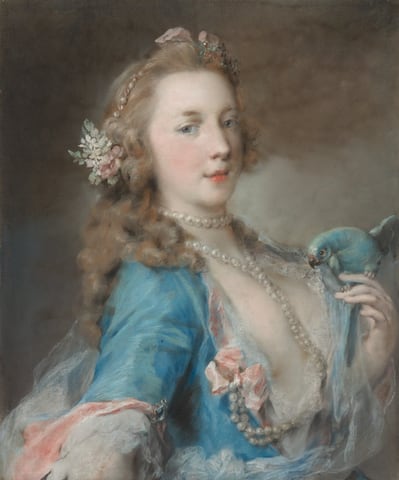
  1. A pastel drawing of woman in blue and pink dress with blue parrot.
    A Young Lady with a ParrotRosalba Carriera, c. 1730Courtesy of the Art Institute of Chicago
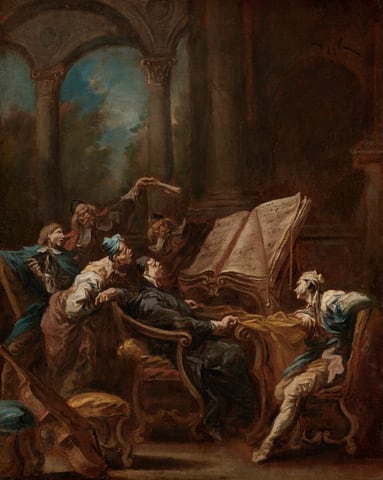
  2. This is a painting of a group engaged in a music session, all looking towards a large open music book in a grand, architectural setting. Behind the group are tall, ornate columns and an arched background that opens up to show a cloudy blue sky. Most of the people have open mouths as if they are singing, while one man in the back seems to be conducting, holding a up roll of paper. Some of the people in the group are seated in cushioned wooden chairs, and a yellowish cloth is draped over the surface that the large book rests on. There is a string instrument similar to a cello near the bottom left corner. The colors used are rich, earthy browns, yellows, and reds, with elements of blue and white clothing. All of the people have pale skin, and two have long white mustaches.
    The ChoristersAlessandro Magnasco, c. 1740/1745Courtesy National Gallery of Art, Washington
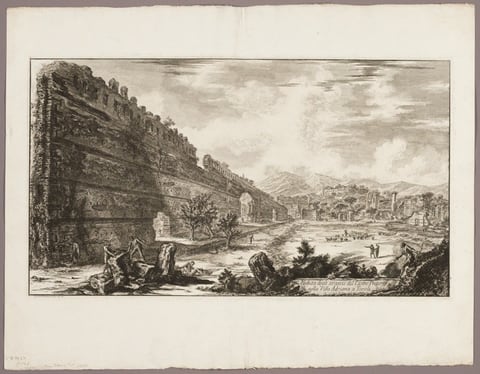
  3. A work made of etching on heavy ivory laid paper.
    View of the Remains of the Praetorian Fort [the Poecile], Hadrian's Villa, Tivoli, from Views of RomeGiovanni Battista Piranesi, 1770Courtesy of the Art Institute of Chicago

Second room, north wall
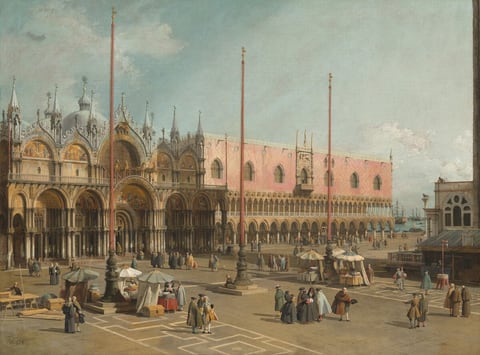
  1. Dozens of men with several women and a few children gather in pairs or small groups across a sun-drenched plaza in front of a domed church next to a long, pale pink building in this horizontal painting. The people’s faces and hands we can see have pale, peachy skin. The men wear hats and shin-length capes or jackets over stockings in tones of charcoal gray, olive green, butterscotch yellow, black, and brown. The women wear black capes covering their heads and long, full skirts. The ash-brown plaza has two zones where geometric patterns are picked out in a lighter, oatmeal brown. Three coral-red flagpoles are spaced along the center of the plaza parallel to the two buildings. Each flagpole rests on an olive-green base about a third of the height of the pole. Tables under open umbrellas clustered around the outer two flagpoles display piles of cloth, and a few people gather around the wares. The domed building extends into the scene from the left edge of the painting, and reaches about a third of the way across as it angles away from us. It has a central portal with nested arches, flanked to each side by a pair of slightly smaller, arched portals. Scenes against gold backgrounds appear in the archway of each of the five doors. There is a second level of arches above. The smaller arches to either side are decorated with more scenes of people against gold backgrounds. Four gold horses stand atop the central, lower arch, each with one front and one back hoof raised. The arch behind them is dim, the back side of a stained-glass window. The stone of the arches and front of the building are light brown. The upper arches are lined with pale, slate-gray spires and curling tracery. The three-story pink building sits close by to our right, extending into the distance on the same angle as the church, and as tall as its neighbor. The lowest level is a series of open, pointed arches. The second level is also a row of arches, but more closely spaced. People walk and stand under both covered walkways. The top half of the building has a carnation-pink façade with seven windows evenly spaced across its width. The central window is surrounded by carved stone ornament. Along the right edge of the painting and closer to us than the large buildings is the corner of a two-story building. The lower level is in shadow under a sloping awning, creating a merchant’s stall, and the second level has a rounded, arched window. One person stands at the front corner of the roof and looks down into the square. In the narrow gap between the row of buildings to our left and the smaller structure to our right is a winged lion atop a tall column. Beyond that is sparkling blue water with several masted ships and long, narrow gondolas. The sky above has thin white clouds against a pale blue sky. The artist signed the lower left, “A.C.F.”
    The Square of Saint Mark's, VeniceCanaletto, 1742/1744Courtesy National Gallery of Art, Washington
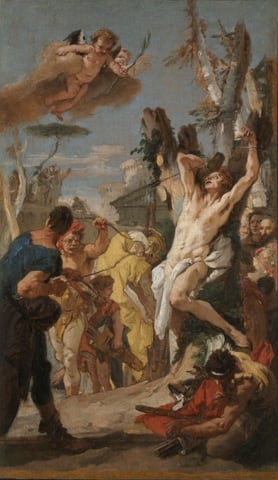
  2. Study for "The Martyrdom of Saint Sebastian" (for the Augustinian monastery at Diessen, Germany), by Giovanni Battista Tiepolo, 1739
    Study for "The Martyrdom of Saint Sebastian" (for the Augustinian monastery at Diessen, Germany)Giovanni Battista Tiepolo, 1739Courtesy of the Cleveland Museum of Art

Third room, north wall
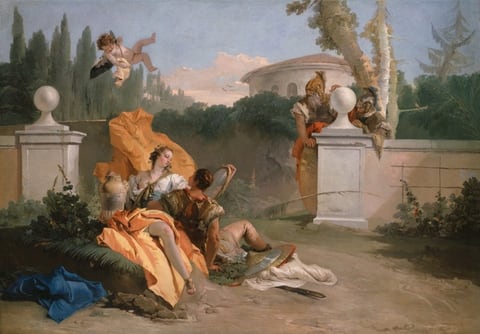
  1. A work made of oil on canvas.
    Rinaldo and Armida in Her GardenGiovanni Battista Tiepolo, c. 1742–45Courtesy of the Art Institute of Chicago
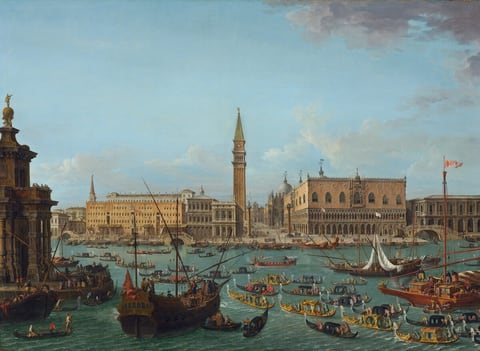
  2. The painting depicts many large and small ships on blue-green water. Gondolas in shades of gold, black, red, and blue drift across the water, small people on them pushing long poles through the water. There are also large sailboats and long boats with several rowers. They create a colorful mix. On the left, a large brown building with columns is visible. Some of the boats pull up to it, and many people in colorful clothing are visible on the shore. Behind the water are more large buildings in shades of brown, cream, and tan, with even more people visible on the streets below them. There is a large tower in the center of the painting, and several blue domes are visible in the distance. The sky is light blue, with white and gray clouds drifting across it.
    Procession of Gondolas in the Bacino di San Marco, VeniceAntonio Joli, 1742 or afterCourtesy National Gallery of Art, Washington

Third room, south wall
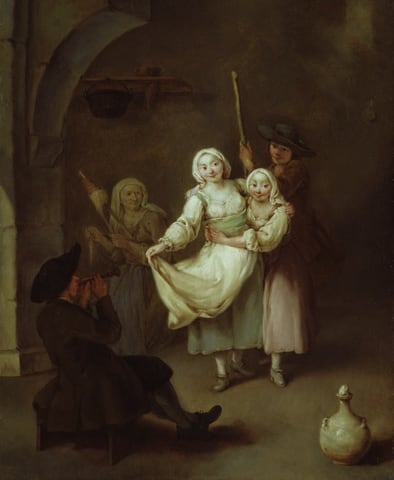
  1. A work made of oil on canvas.
    The DancePietro Longhi, c. 1750Courtesy of the Art Institute of Chicago
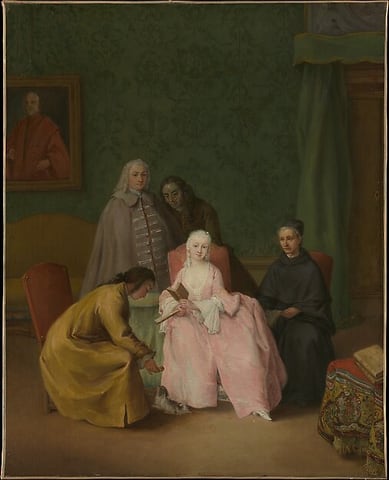
  2. The Visit, by Pietro Longhi, 1746
    The VisitPietro Longhi, 1746Courtesy of The Metropolitan Museum of Art
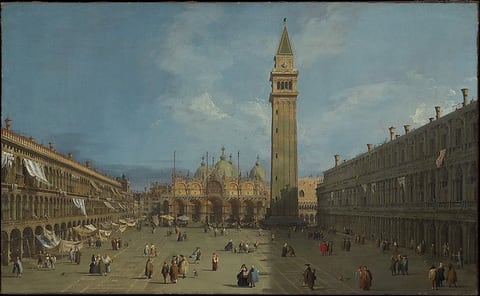
  3. Piazza San Marco, by Canaletto, late 1720s
    Piazza San MarcoCanaletto, late 1720sCourtesy of The Metropolitan Museum of Art