Floor plan

Time and place18th-century Italy

18th-century Italy

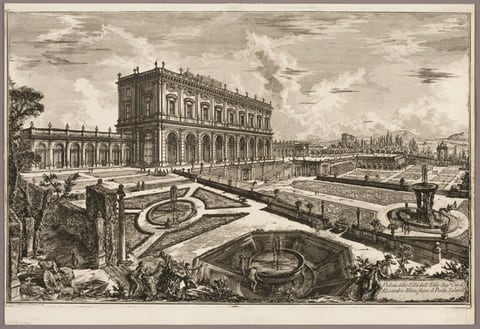
A work made of etching on ivory laid paper.
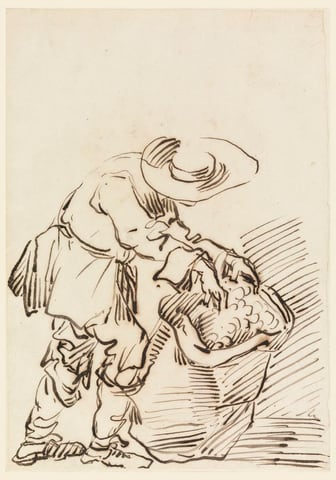
WORKING PEASANT
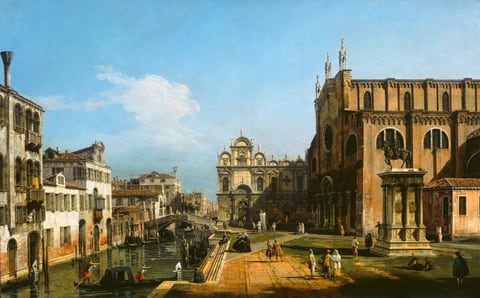
People walk, sit, or stand on a plaza along a canal lined on the far side with buildings in this horizontal landscape painting. The canal begins in the lower left corner and angles slightly right as it travels to the horizon, which comes about a third of the way up this composition. One, two, three, or four-story buildings line the canal to the left into the far distance. Arched doorways give direct access to the water, and one person leans out an upper-story window. The buildings are reflected in the gently rippling water, which is painted in shades of olive green. A stepped bridge crosses the canal in the near distance, and two gondoliers guide a long, narrow boat to a platform alongside the plaza in the bottom left corner of the composition. People walk or stand singly or in pairs on the plaza in the bottom right quadrant of the painting. The women wear dresses with long skirts and head coverings in shades of black, white, yellow, or pale pink. The men wear hats, jackets, capes, stockings, and slacks in shades of peanut brown, muted yellow, red, blue, or white. The people all appear to have pale, peachy skin. A statue of a man riding a horse rests on a towering platform in a grassy patch to our right. Beyond it is the blocky form of a red brick church. One man in a pair standing on the plaza gestures toward the entrance with a walking stick and others approach the central entrance. Sunlight streams across the scene from the upper right, throwing the church façade into shadow and casting a deep shadow across the face of another building that encloses the far side of the plaza. That second building has arched windows and doors, statues lining the roofline, and a winged lion over the entrance. A fat cloud trundles across a mostly empty vibrant blue sky above.
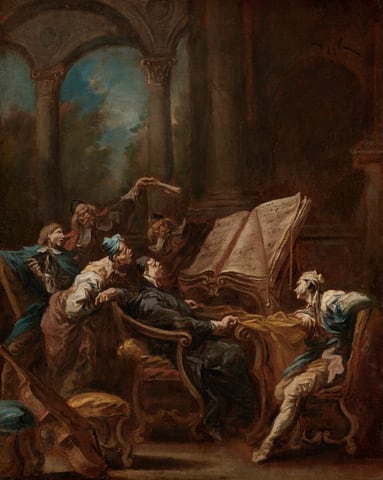
This is a painting of a group engaged in a music session, all looking towards a large open music book in a grand, architectural setting. Behind the group are tall, ornate columns and an arched background that opens up to show a cloudy blue sky. Most of the people have open mouths as if they are singing, while one man in the back seems to be conducting, holding a up roll of paper. Some of the people in the group are seated in cushioned wooden chairs, and a yellowish cloth is draped over the surface that the large book rests on. There is a string instrument similar to a cello near the bottom left corner. The colors used are rich, earthy browns, yellows, and reds, with elements of blue and white clothing. All of the people have pale skin, and two have long white mustaches.
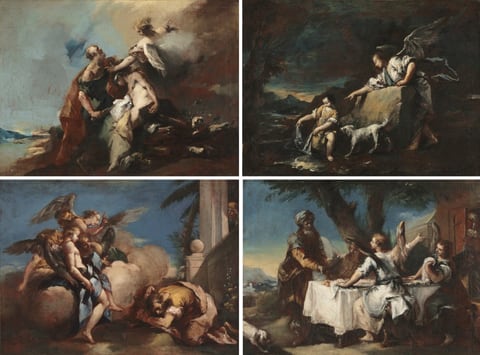
The Sacrifice of Isaac, Tobias and the Angel, The Angels Appearing to Abraham, Abraham Welcoming the Three Angels (painting series), by Francesco Guardi, 1750s
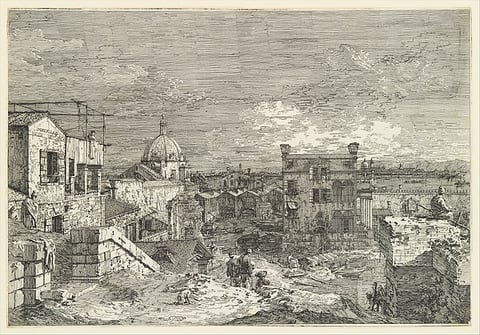
Imaginary View of Venice, houses at left with figures on terraces, a domed church at center in the background, boats and boat-sheds below, and a seated man observing from a wall at right in the foreground, from "Views" (Vedute altre prese da i luoghi altre ideate da Antonio Canal), by Canaletto, 1741

The works in this room are listed below.

Works in this room

Works made in Italy in the 18th century.

First room, north wall

  1. A work made of etching on ivory laid paper.
    View of the Villa of His Eminence Cardinal Alessandro Albani, outside Porta Salaria, from Views of RomeGiovanni Battista Piranesi, 1769, published 1800–07Courtesy of the Art Institute of Chicago
  2. WORKING PEASANT
    Working PeasantCarlo Marchionni, 1728–78Courtesy of Cooper Hewitt, Smithsonian Design Museum
  3. People walk, sit, or stand on a plaza along a canal lined on the far side with buildings in this horizontal landscape painting. The canal begins in the lower left corner and angles slightly right as it travels to the horizon, which comes about a third of the way up this composition. One, two, three, or four-story buildings line the canal to the left into the far distance. Arched doorways give direct access to the water, and one person leans out an upper-story window. The buildings are reflected in the gently rippling water, which is painted in shades of olive green. A stepped bridge crosses the canal in the near distance, and two gondoliers guide a long, narrow boat to a platform alongside the plaza in the bottom left corner of the composition. People walk or stand singly or in pairs on the plaza in the bottom right quadrant of the painting. The women wear dresses with long skirts and head coverings in shades of black, white, yellow, or pale pink. The men wear hats, jackets, capes, stockings, and slacks in shades of peanut brown, muted yellow, red, blue, or white. The people all appear to have pale, peachy skin. A statue of a man riding a horse rests on a towering platform in a grassy patch to our right. Beyond it is the blocky form of a red brick church. One man in a pair standing on the plaza gestures toward the entrance with a walking stick and others approach the central entrance. Sunlight streams across the scene from the upper right, throwing the church façade into shadow and casting a deep shadow across the face of another building that encloses the far side of the plaza. That second building has arched windows and doors, statues lining the roofline, and a winged lion over the entrance. A fat cloud trundles across a mostly empty vibrant blue sky above.
    The Campo di SS. Giovanni e Paolo, VeniceBernardo Bellotto, 1743/1747Courtesy National Gallery of Art, Washington

First room, south wall

  1. This is a painting of a group engaged in a music session, all looking towards a large open music book in a grand, architectural setting. Behind the group are tall, ornate columns and an arched background that opens up to show a cloudy blue sky. Most of the people have open mouths as if they are singing, while one man in the back seems to be conducting, holding a up roll of paper. Some of the people in the group are seated in cushioned wooden chairs, and a yellowish cloth is draped over the surface that the large book rests on. There is a string instrument similar to a cello near the bottom left corner. The colors used are rich, earthy browns, yellows, and reds, with elements of blue and white clothing. All of the people have pale skin, and two have long white mustaches.
    The ChoristersAlessandro Magnasco, c. 1740/1745Courtesy National Gallery of Art, Washington
  2. The Sacrifice of Isaac, Tobias and the Angel, The Angels Appearing to Abraham, Abraham Welcoming the Three Angels (painting series), by Francesco Guardi, 1750s
    The Sacrifice of Isaac, Tobias and the Angel, The Angels Appearing to Abraham, Abraham Welcoming the Three Angels (painting series)Francesco Guardi, 1750sCourtesy of the Cleveland Museum of Art
  3. Imaginary View of Venice, houses at left with figures on terraces, a domed church at center in the background, boats and boat-sheds below, and a seated man observing from a wall at right in the foreground, from "Views" (Vedute altre prese da i luoghi altre ideate da Antonio Canal), by Canaletto, 1741
    Imaginary View of Venice, houses at left with figures on terraces, a domed church at center in the background, boats and boat-sheds below, and a seated man observing from a wall at right in the foreground, from "Views" (Vedute altre prese da i luoghi altre ideate da Antonio Canal)Canaletto, 1741Courtesy of The Metropolitan Museum of Art

Second room, south wall
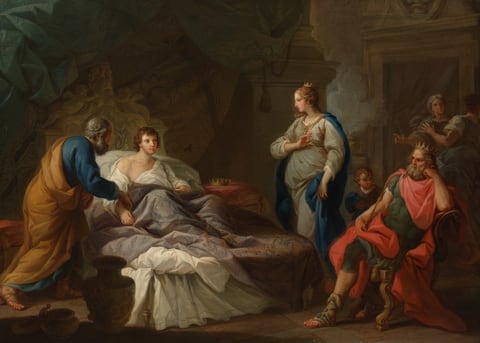
  1. A work made of oil on canvas.
    Antiochus Yearning for StratoniceStefano Pozzi, c. 1740Courtesy of the Art Institute of Chicago
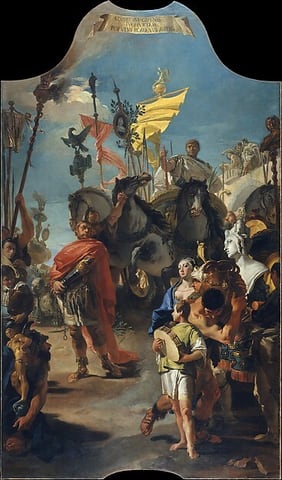
  2. The Triumph of Marius, by Giovanni Battista Tiepolo, 1729
    The Triumph of MariusGiovanni Battista Tiepolo, 1729Courtesy of The Metropolitan Museum of Art
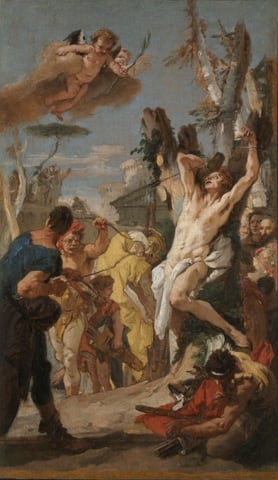
  3. Study for "The Martyrdom of Saint Sebastian" (for the Augustinian monastery at Diessen, Germany), by Giovanni Battista Tiepolo, 1739
    Study for "The Martyrdom of Saint Sebastian" (for the Augustinian monastery at Diessen, Germany)Giovanni Battista Tiepolo, 1739Courtesy of the Cleveland Museum of Art

Second room, north wall
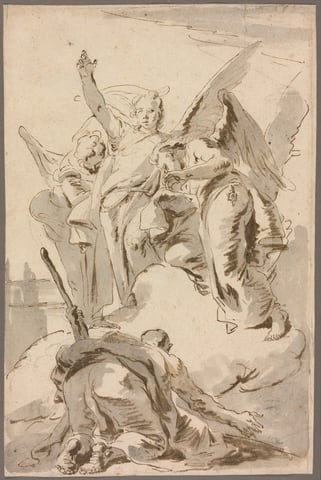
  1. A work made of pen and brown ink and brush and brown and gray wash, over black chalk, on ivory laid paper.
    Three Angels Appearing to AbrahamGiovanni Battista Tiepolo, c. 1726Courtesy of the Art Institute of Chicago
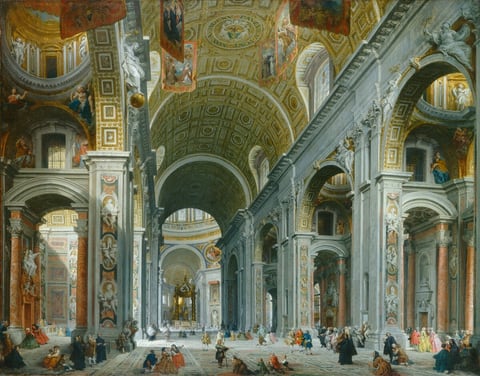
  2. The soaring, gilded vault of a central aisle of the inside of a church fills this horizontal painting. The ceiling of the nave curves up and away from us like a tunnel. It is lined with coffers, which have inset panels, decorated with gold. The light-filled nave angles down from the top center of the composition toward the lower left as it moves away from us. The white stone pillars supporting the barrel vault are intricately carved and decorated with pudgy, winged cherubs holding portraits of men, and aisles run parallel to the central nave to our left and right. In the side aisles, pink marble columns flank altars in chapels. At the far end of the church, the nave is interrupted where it opens into the light-filled crossing, before continuing beyond. Marking the space where the long hall of the church is intersected by a shorter arm to create a cross shape is a structure made of four twisting columns supporting a pointed canopy, all cast in bronze. Tiny men and women pray or gather in pairs and small groups along the nave. Some wear tattered clothing and others are elegantly dressed.
    Interior of Saint Peter's, RomeGiovanni Paolo Panini, c. 1754Courtesy National Gallery of Art, Washington
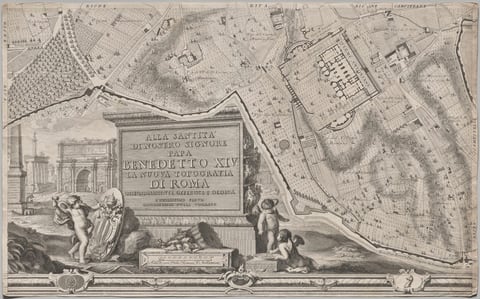
  3. Nuova pianta di Roma data in luce da Giambattista Nolli l’anno MDCCXLVII, known as La Pianta Grande di Roma, by Giovanni Battista Nolli, 1748
    Nuova pianta di Roma data in luce da Giambattista Nolli l’anno MDCCXLVII, known as La Pianta Grande di RomaGiovanni Battista Nolli, 1748Courtesy of the Cleveland Museum of Art

Third room, north wall
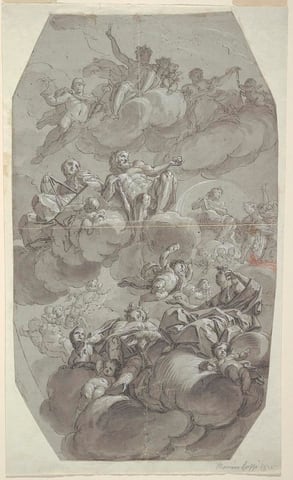
  1. STUDY FOR PAINTING, MOUNT OLYMPUS
    Study for Painting, Mount OlympusVito D'Anna, 1750–60Courtesy of Cooper Hewitt, Smithsonian Design Museum
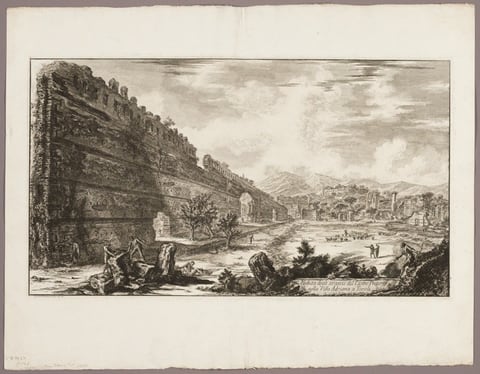
  2. A work made of etching on heavy ivory laid paper.
    View of the Remains of the Praetorian Fort [the Poecile], Hadrian's Villa, Tivoli, from Views of RomeGiovanni Battista Piranesi, 1770Courtesy of the Art Institute of Chicago
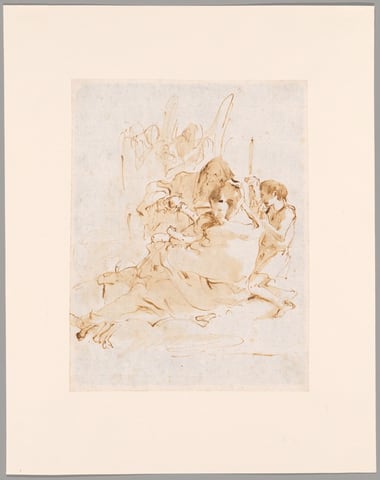
  3. A work made of pen and brown ink and brush and brown ink wash on ivory laid paper.
    Holy Family with St. John and Two AngelsGiovanni Battista Tiepolo, n.d.Courtesy of the Art Institute of Chicago
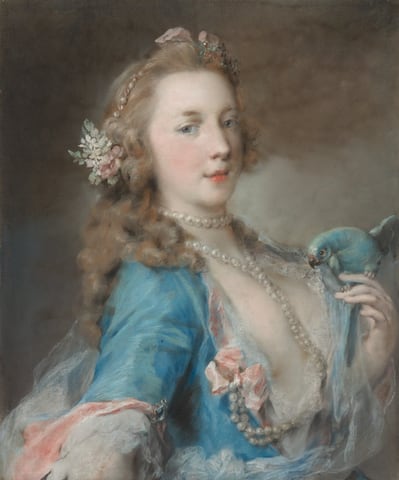
  4. A pastel drawing of woman in blue and pink dress with blue parrot.
    A Young Lady with a ParrotRosalba Carriera, c. 1730Courtesy of the Art Institute of Chicago