Floor plan

Time and placeThe 17th century

The 17th century

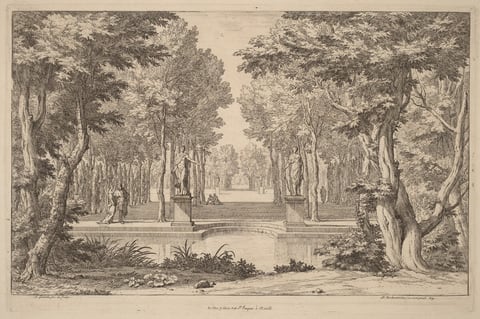
The image shows a formal garden or park with a symmetrical view. It is taken from a slightly elevated position, revealing the vast space beyond a foreground of foliage and low-growing plants. The horizon line is positioned near the midpoint, where a tree-lined pathway extends into the distance. Flanking the pathway are two statues on pedestals under leafy trees. The scene is detailed with intricate line work emphasizing textures and forms. The color palette is monochromatic in various shades of brown, creating a classic appearance. Paved steps and a bridge over a small body of water add to the ordered elegance of the garden.
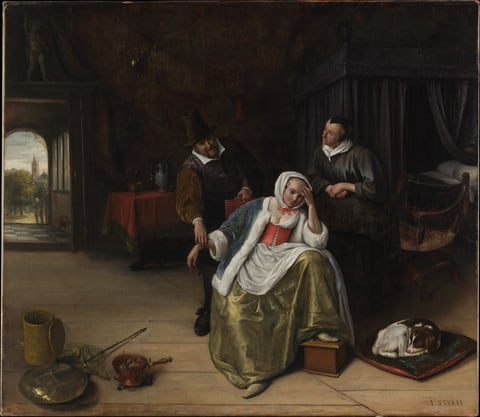
The Lovesick Maiden, by Jan Steen, ca. 1660
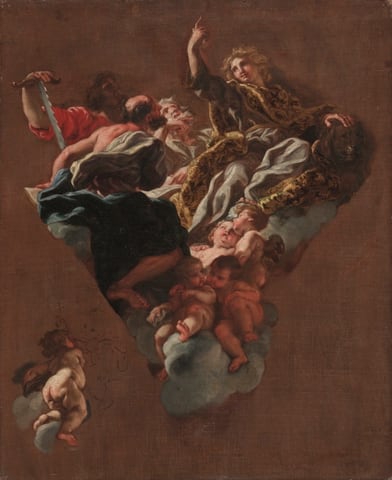
Sketch for "The Four Prophets of Israel" (for Il Gesù, Rome), by Giovanni Battista Gaulli, c. 1675–1677
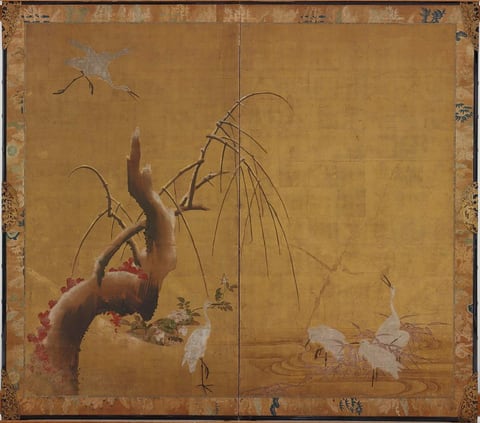
Screen (two-panel)
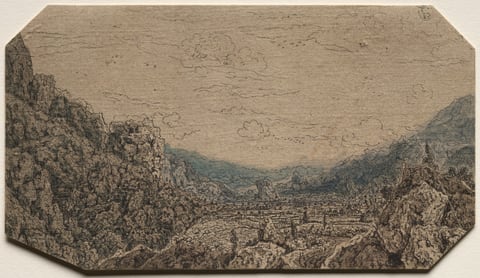
Enclosed Valley, by Hercules Seghers, c. 1623–30
A work made of pen and brown ink and brush and brown wash, with traces of black chalk and opaque white watercolor, on cream laid paper, laid down on cream laid paper.
Hanging scrolls (pair)

The works in this room are listed below.

Works in this room

Works made in the 17th century, anywhere in the world.

Section 1, north wall

  1. The image shows a formal garden or park with a symmetrical view. It is taken from a slightly elevated position, revealing the vast space beyond a foreground of foliage and low-growing plants. The horizon line is positioned near the midpoint, where a tree-lined pathway extends into the distance. Flanking the pathway are two statues on pedestals under leafy trees. The scene is detailed with intricate line work emphasizing textures and forms. The color palette is monochromatic in various shades of brown, creating a classic appearance. Paved steps and a bridge over a small body of water add to the ordered elegance of the garden.
    The Two StatuesAbraham Genoels IICourtesy National Gallery of Art, Washington
  2. The Lovesick Maiden, by Jan Steen, ca. 1660
    The Lovesick MaidenJan Steen, ca. 1660Courtesy of The Metropolitan Museum of Art
  3. Sketch for "The Four Prophets of Israel" (for Il Gesù, Rome), by Giovanni Battista Gaulli, c. 1675–1677
    Sketch for "The Four Prophets of Israel" (for Il Gesù, Rome)Giovanni Battista Gaulli, c. 1675–1677Courtesy of the Cleveland Museum of Art

Section 1, south wall

  1. Screen (two-panel)
    Herons and Old WIllowKano Sadanobu, 1615-1868Courtesy of the National Museum of Asian Art, Smithsonian Institution
  2. Enclosed Valley, by Hercules Seghers, c. 1623–30
    Enclosed ValleyHercules Seghers, c. 1623–30Courtesy of the Cleveland Museum of Art
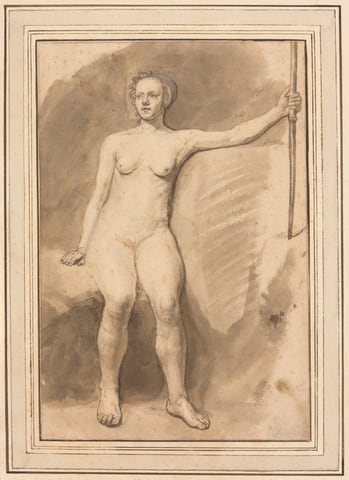
  3. A work made of pen and brown ink and brush and brown wash, with traces of black chalk and opaque white watercolor, on cream laid paper, laid down on cream laid paper.
    Seated Female NudeSamuel van Hoogstraten, 1647/78Courtesy of the Art Institute of Chicago
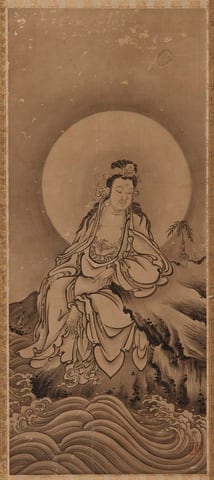
  4. Hanging scrolls (pair)
    KwannonUnrecorded Japanese maker, 1615-1868Courtesy of the National Museum of Asian Art, Smithsonian Institution

Section 2, south wall
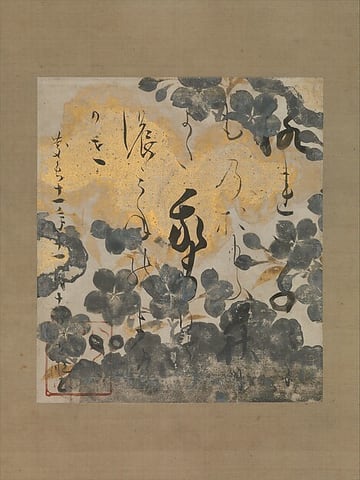
  1. Poem by Kamo no Chōmei with Underpainting of Cherry Blossoms, by Hon'ami Kōetsu, 1606
    Poem by Kamo no Chōmei with Underpainting of Cherry BlossomsHon'ami Kōetsu, 1606Courtesy of The Metropolitan Museum of Art
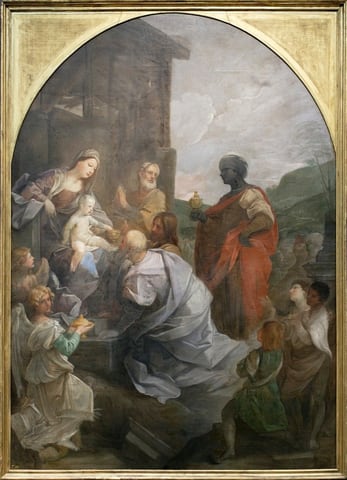
  2. Adoration of the Magi, by Guido Reni, 1642
    Adoration of the MagiGuido Reni, 1642Courtesy of the Cleveland Museum of Art
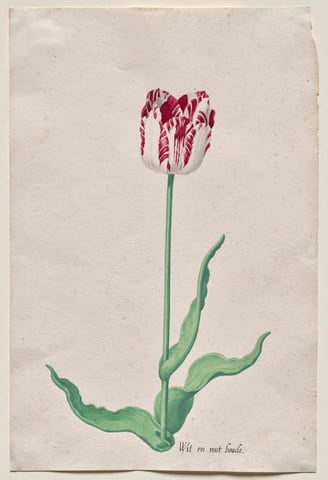
  3. Study of a Tulip (Wit en root boode), by Pieter Holsteyn II, c. 1645
    Study of a Tulip (Wit en root boode)Pieter Holsteyn II, c. 1645Courtesy of the Cleveland Museum of Art

Section 2, north wall
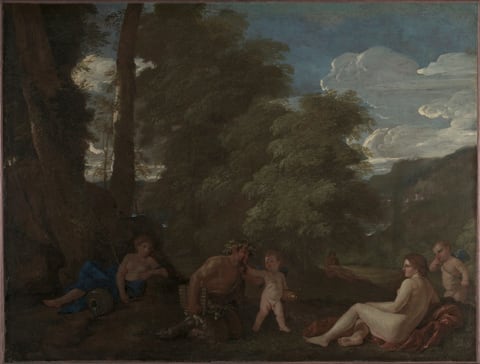
  1. Nymphs and a Satyr (Amor Vincit Omnia), by Nicolas Poussin, c. 1625–27
    Nymphs and a Satyr (Amor Vincit Omnia)Nicolas Poussin, c. 1625–27Courtesy of the Cleveland Museum of Art
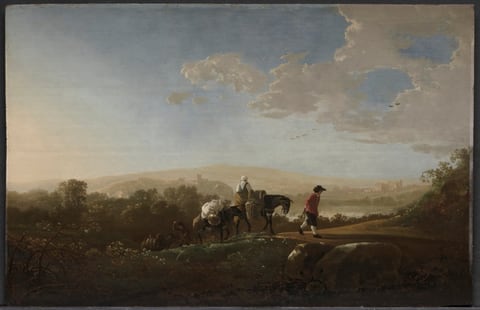
  2. Travelers in Hilly Countryside, by Aelbert Cuyp, c. 1650
    Travelers in Hilly CountrysideAelbert Cuyp, c. 1650Courtesy of the Cleveland Museum of Art
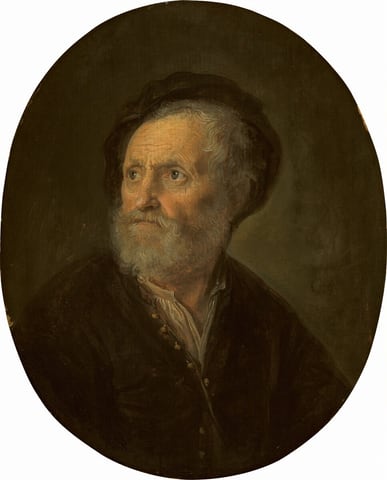
  3. Shown from the chest up, a light-skinned man with a wrinkled face and a silvery gray beard and hair gazes into the distance in this oval portrait painting. His chest is angled to our right but he turns his head to look off over his other shoulder, to our left. His slate-blue eyes are a little sunken and lined with wrinkles. Shading marks the hollows of the temple and cheek we can see. His thin lips are closed and framed by his curly mustache and beard. A dark, mahogany-brown cap is pushed back on his head, and his brown jacket has gold-colored buttons down the front. The collar of a cream-colored shirt shows through at the neckline. The background is dark olive green. The artist signed the work near the man’s shoulder, to our right: “GDOV.”
    Bust of a Bearded ManGerrit Dou, c. 1642/1645Courtesy National Gallery of Art, Washington
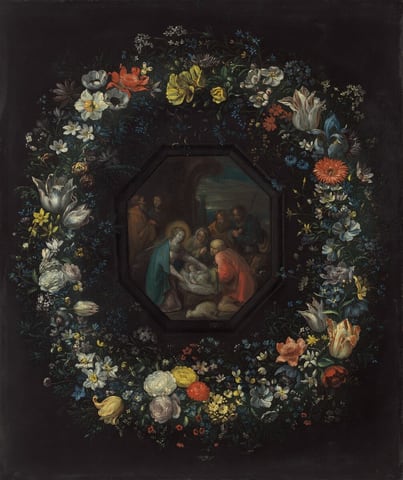
  4. A scene with seven men and women gathered around an infant is enclosed in an eight-sided, octagonal painted frame, which is surrounded by a wreath of flowers in this vertical painting. The painted black frame-within-a-frame resembles molding. The people in the scene have pale skin and wear robes in shades of teal blue, burnt orange, red, muted purple, or red. A woman reaching for the bed on which the child lies and the child have gold halos. Others crouch or bend toward the child, and one pair, to our left, turn toward each other, presumably talking. The nighttime-blue sky is streaked with nickel-gray clouds beyond a partially ruined stone arch. A lamb with all four feet tired together lies at the foot of the child’s bed. The wreath surrounding the painting-within-a-painting is dense with tulips, roses, daffodils, poppies, violets, and other flowers and greenery painted in shades of lemon and butter yellow, opal and pearl white, brick and coral red, and sky and slate blue against an inky-black background. One artist signed the painting-within-a-painting near the bottom left corner, “FF F.” The second artist who painted this signed his initials, “HDB”, on the bottom edge of the painted frame.
    Garland of Flowers with Adoration of the ShepherdsFrans Francken the Younger, c. 1625/1630Courtesy National Gallery of Art, Washington

Section 3, north wall
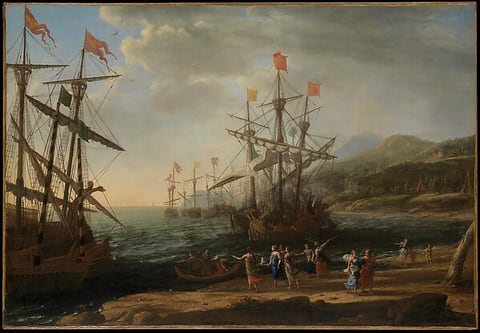
  1. The Trojan Women Setting Fire to Their Fleet, by Claude Lorrain (Claude Gellée), ca. 1643
    The Trojan Women Setting Fire to Their FleetClaude Lorrain (Claude Gellée), ca. 1643Courtesy of The Metropolitan Museum of Art
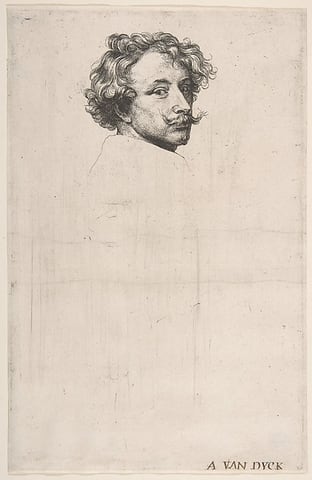
  2. Self-Portrait, from "The Iconography", by Anthony van Dyck, ca. 1640
    Self-Portrait, from "The Iconography"Anthony van Dyck, ca. 1640Courtesy of The Metropolitan Museum of Art