Floor plan

Time and placeThe 17th century

The 17th century

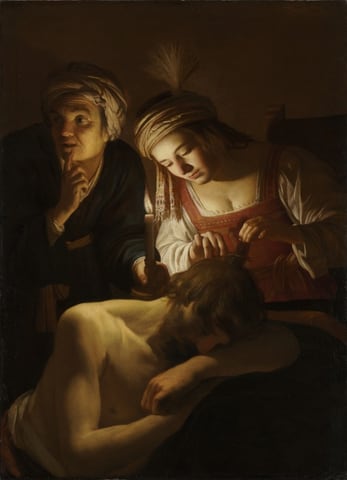
Samson and Delilah, by Gerrit van Honthorst, c. 1616
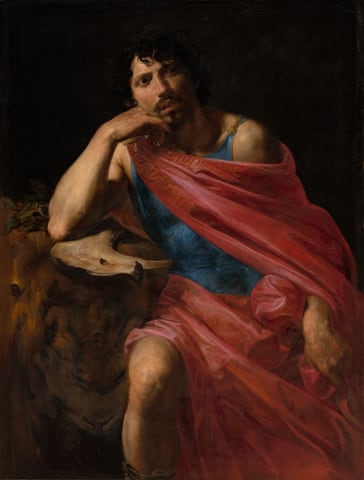
Samson, by Valentin de Boulogne, 1630–31
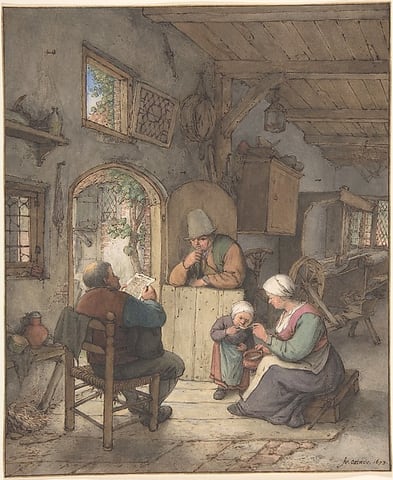
Reading the News at the Weavers' Cottage, by Adriaen van Ostade, 1673
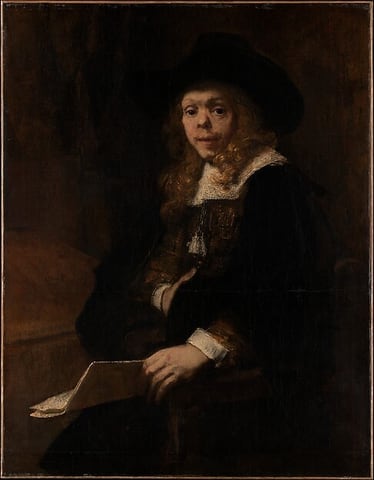
Portrait of Gerard de Lairesse, by Rembrandt van Rijn, 1665–67
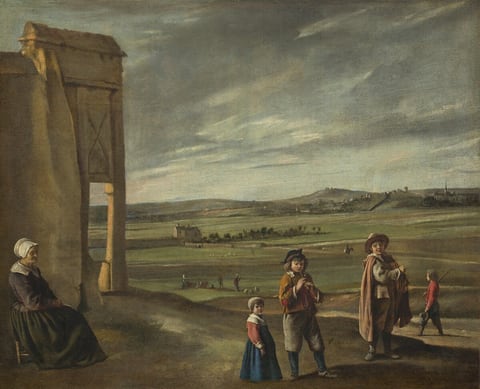
An elderly woman sits on a small stool and four children stand along the foreground of a landscape with rolling, olive-green fields leading back to low, slate-gray mountains in this nearly square painting. The horizon comes about halfway up the painting, and the sky above is filled with a sheet of steel-gray clouds that break to reveal patches of ice-blue sky. Closest to us and along the left edge of the painting, the woman sits near a structure with a fragment of wall and a column that could be made from tan-colored stone. The woman faces our right in profile and looks at or toward three children gathered on a low hill to our right. Her lined face is partially cast in shadow by her white bonnet, but her skin is yellowed where the light falls across the side closer to us. A wide, white collar lies over the shoulders of her muted, plum-purple jacket, which is tied with a narrow red belt. Her hands rest in the lap of her full, moss-green skirt that falls to her feet and covers most of the stool. To our right, two boys and a little girl stand on a low hill. They all stand with their bodies angled to our right, and all have pale skin and brown hair. To our left in the trio, the young girl wears a royal-blue dress with brick-red, long sleeves and a wide, white collar, cuffs, and cap. Next to her, a slightly older boy wearing gray knee-britches, a honey-orange jacket with a white collar, and a blue tricorn hat looks down and plays a thin pipe. His jacket is torn at the elbows, revealing a red shirt beneath. To our right, the oldest boy wears a brown cloak over a gray jacket, tan trousers, and a tan brimmed hat. He holds his right arm, closer to us, across his chest as he touches an instrument nestled in the crook of his other elbow. Another bareheaded boy wearing a red shirt and blue trousers walks beyond this trio, holding a short pole over one shoulder and a brimmed hat in his other hand. He walks to our left and looks to the horizon. More people with sheep, cows, and a person on horseback dot the rolling fields that stretch back to low hills. One house sits next to a line of trees to the left of center, in the middle distance, and more buildings, including a church spire, cluster on the horizon to our right.
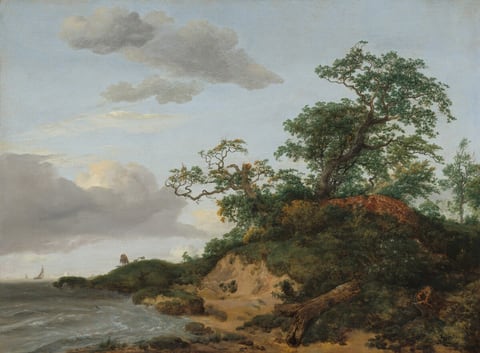
Water laps at a curving shoreline in front of a steep sandy dune carpeted in grass, shrubs, and trees in this horizontal landscape painting. The dune takes up the lower right quadrant of the composition. A few broken tree trunks are overgrown with vines and plants across the top and down the sloping side of the dune facing us. A red brick wall cuts through the vegetation up the side of the dune and disappears into the shrubbery at the top. The twisting branches and canopies of three large trees reach into the upper right quadrant of the composition. The vegetation stops abruptly along the sheer edge of the dune where it faces the water. The land curves like a backward capital letter C so it almost reaches the left edge of the painting along the horizon, which comes a quarter of the way up the composition. A cow and three more animals, perhaps sheep or more cows, graze or lie on a grassy mound in the distance, and sailboats line the horizon in the deep distance. White ripples swirl in the steel-blue water. The artist signed and dated the lower center, “J Ruisdael . 1648.”
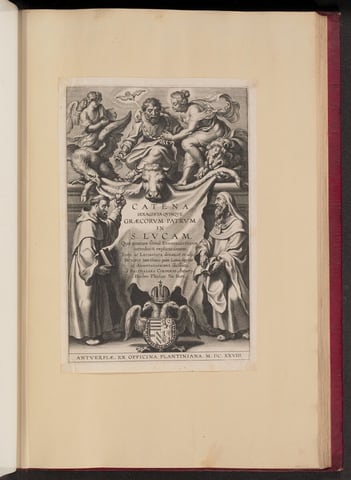
The image features a detailed black and white illustration with multiple human and animal figures in a symbolic arrangement. In the foreground, two full-body figures are depicted in long robes and sandals, positioned on either side of a large draped banner with text. One figure holds an open book. Above the banner are celestial figures in dynamic poses. To the left is a winged bull-like creature and a seated male figure with a beard, next to a female figure in classical attire. They are all surrounded by flowing fabric and a lion-like animal. In the lower center foreground, there is an emblem resembling a coat of arms with an eagle and a crowned shield. The background is textured, with no natural landscape or architecture present, allowing the figures to stand out. The illustration is framed by the margins of an open book.

The works in this room are listed below.

Works in this room

Works made in the 17th century, anywhere in the world.

Section 1, north wall

  1. Samson and Delilah, by Gerrit van Honthorst, c. 1616
    Samson and DelilahGerrit van Honthorst, c. 1616Courtesy of the Cleveland Museum of Art
  2. Samson, by Valentin de Boulogne, 1630–31
    SamsonValentin de Boulogne, 1630–31Courtesy of the Cleveland Museum of Art
  3. Reading the News at the Weavers' Cottage, by Adriaen van Ostade, 1673
    Reading the News at the Weavers' CottageAdriaen van Ostade, 1673Courtesy of The Metropolitan Museum of Art

Section 1, south wall

  1. Portrait of Gerard de Lairesse, by Rembrandt van Rijn, 1665–67
    Portrait of Gerard de LairesseRembrandt van Rijn, 1665–67Courtesy of The Metropolitan Museum of Art
  2. An elderly woman sits on a small stool and four children stand along the foreground of a landscape with rolling, olive-green fields leading back to low, slate-gray mountains in this nearly square painting. The horizon comes about halfway up the painting, and the sky above is filled with a sheet of steel-gray clouds that break to reveal patches of ice-blue sky. Closest to us and along the left edge of the painting, the woman sits near a structure with a fragment of wall and a column that could be made from tan-colored stone. The woman faces our right in profile and looks at or toward three children gathered on a low hill to our right. Her lined face is partially cast in shadow by her white bonnet, but her skin is yellowed where the light falls across the side closer to us. A wide, white collar lies over the shoulders of her muted, plum-purple jacket, which is tied with a narrow red belt. Her hands rest in the lap of her full, moss-green skirt that falls to her feet and covers most of the stool. To our right, two boys and a little girl stand on a low hill. They all stand with their bodies angled to our right, and all have pale skin and brown hair. To our left in the trio, the young girl wears a royal-blue dress with brick-red, long sleeves and a wide, white collar, cuffs, and cap. Next to her, a slightly older boy wearing gray knee-britches, a honey-orange jacket with a white collar, and a blue tricorn hat looks down and plays a thin pipe. His jacket is torn at the elbows, revealing a red shirt beneath. To our right, the oldest boy wears a brown cloak over a gray jacket, tan trousers, and a tan brimmed hat. He holds his right arm, closer to us, across his chest as he touches an instrument nestled in the crook of his other elbow. Another bareheaded boy wearing a red shirt and blue trousers walks beyond this trio, holding a short pole over one shoulder and a brimmed hat in his other hand. He walks to our left and looks to the horizon. More people with sheep, cows, and a person on horseback dot the rolling fields that stretch back to low hills. One house sits next to a line of trees to the left of center, in the middle distance, and more buildings, including a church spire, cluster on the horizon to our right.
    Landscape with PeasantsLouis Le Nain, c. 1640Courtesy National Gallery of Art, Washington
  3. Water laps at a curving shoreline in front of a steep sandy dune carpeted in grass, shrubs, and trees in this horizontal landscape painting. The dune takes up the lower right quadrant of the composition. A few broken tree trunks are overgrown with vines and plants across the top and down the sloping side of the dune facing us. A red brick wall cuts through the vegetation up the side of the dune and disappears into the shrubbery at the top. The twisting branches and canopies of three large trees reach into the upper right quadrant of the composition. The vegetation stops abruptly along the sheer edge of the dune where it faces the water. The land curves like a backward capital letter C so it almost reaches the left edge of the painting along the horizon, which comes a quarter of the way up the composition. A cow and three more animals, perhaps sheep or more cows, graze or lie on a grassy mound in the distance, and sailboats line the horizon in the deep distance. White ripples swirl in the steel-blue water. The artist signed and dated the lower center, “J Ruisdael . 1648.”
    Dunes by the SeaJacob van Ruisdael, 1648Courtesy National Gallery of Art, Washington
  4. The image features a detailed black and white illustration with multiple human and animal figures in a symbolic arrangement. In the foreground, two full-body figures are depicted in long robes and sandals, positioned on either side of a large draped banner with text. One figure holds an open book. Above the banner are celestial figures in dynamic poses. To the left is a winged bull-like creature and a seated male figure with a beard, next to a female figure in classical attire. They are all surrounded by flowing fabric and a lion-like animal. In the lower center foreground, there is an emblem resembling a coat of arms with an eagle and a crowned shield. The background is textured, with no natural landscape or architecture present, allowing the figures to stand out. The illustration is framed by the margins of an open book.
    Title Page for Balthasar Cordier, Catena Sexaginta Qvinqve Graecorvm Patrvm in S. Lvcam...Cornelis Galle I, 1628Courtesy National Gallery of Art, Washington

Section 2, south wall
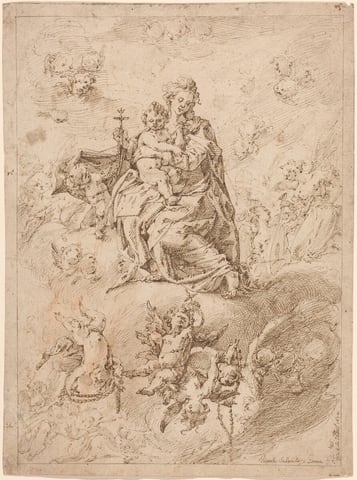
  1. The image depicts a woman seated with a child in her lap. The woman looks down at the child, who has curly hair. Both figures are intricately drawn in a detailed line drawing style. The woman wears a headdress and flowing garment, holding a cross-topped staff. The child clutches her arm. Surrounding them are cloud-like forms and cherubic figures with wings, some holding rosary beads. In the background, more clouds and angelic faces are sketched.
    The Madonna of the RosaryVicente Salvador Gómez, 1674Courtesy National Gallery of Art, Washington
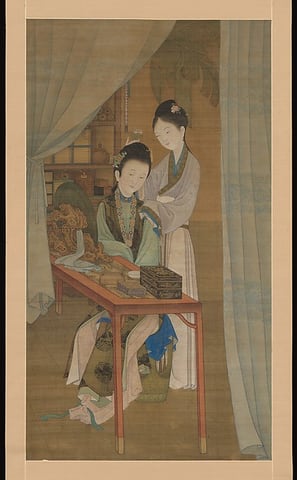
  2. Woman at her dressing table, by Leng Mei, early 18th century
    Woman at her dressing tableLeng Mei, early 18th centuryCourtesy of The Metropolitan Museum of Art
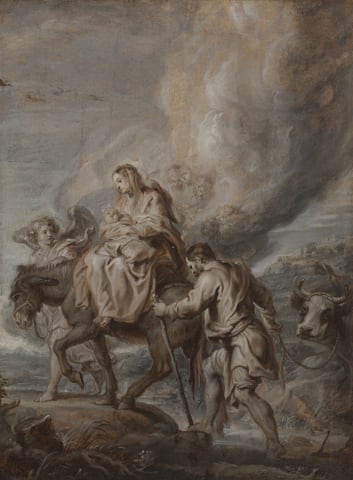
  3. A work made of oil on panel.
    The Flight into EgyptAbraham Jansz. van Diepenbeeck, c. 1650Courtesy of the Art Institute of Chicago
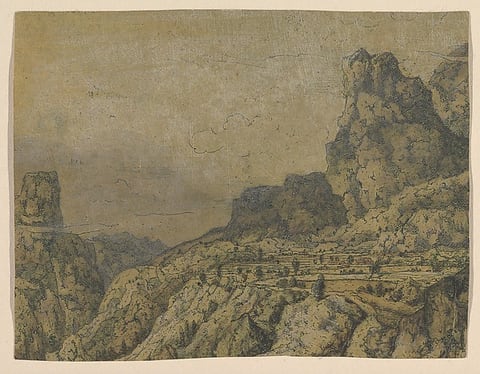
  4. Mountain Valley with a Plateau, by Hercules Segers, ca. 1625–30
    Mountain Valley with a PlateauHercules Segers, ca. 1625–30Courtesy of The Metropolitan Museum of Art

Section 2, north wall
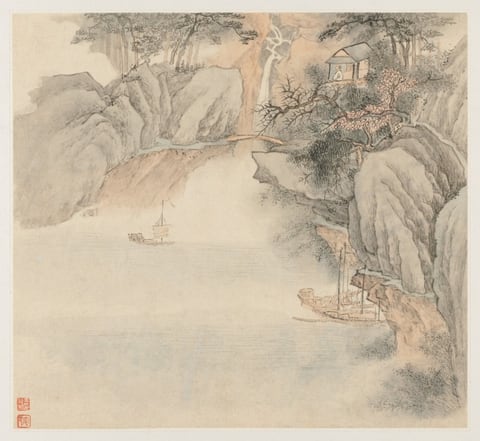
  1. Album of Landscapes: Leaf 4, by Wang Gai, 1677
    Album of Landscapes: Leaf 4Wang Gai, 1677Courtesy of the Cleveland Museum of Art
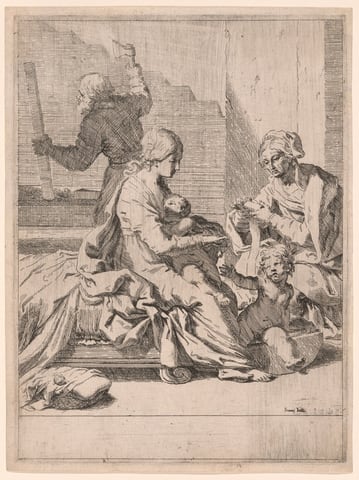
  2. A work made of etching in black on cream laid paper.
    Holy Family with Saint Elizabeth and Saint John the BaptistElisabetta Sirani, 1650/60Courtesy of the Art Institute of Chicago
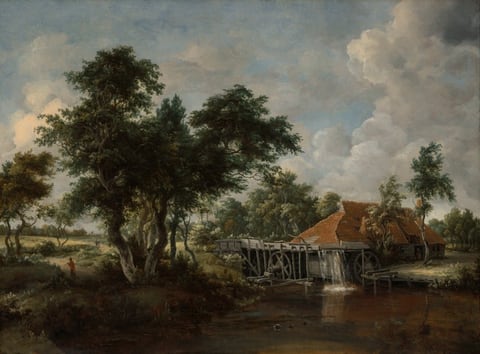
  3. Landscape painting featuring a wavy tree tree in the foreground and a watermill with a red roof adjacent to a river at right. Colors are subdued earth tones, the foliage a dark green and the river a muddy brown. Water flows through the mill wheel under a cloudy sky of gray and blue. Three individuals can be seen in the distance at left.
    The Watermill with the Great Red RoofMeindert Hobbema, c. 1665Courtesy of the Art Institute of Chicago

Section 3, north wall
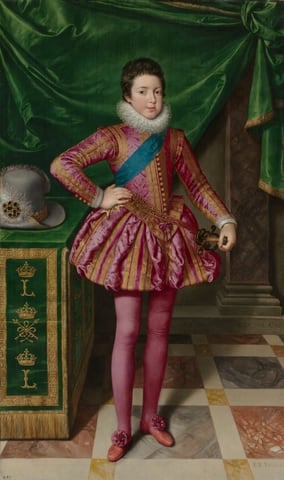
  1. Portrait of King Louis XIII of France, by Frans Pourbus, 1611
    Portrait of King Louis XIII of FranceFrans Pourbus, 1611Courtesy of the Cleveland Museum of Art
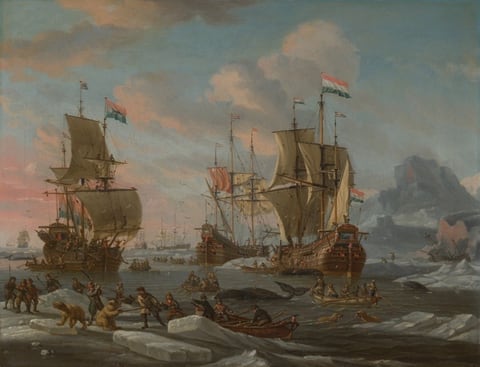
  2. A work made of oil on canvas.
    The Dutch Whaling FleetAbraham Storck, c. 1695Courtesy of the Art Institute of Chicago