Floor plan

Time and place17th-century Netherlands
17th-century Netherlands
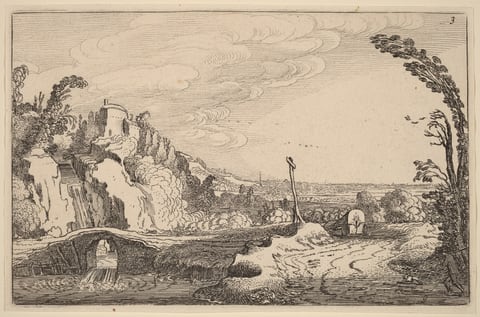
The image shows a pastoral scene in black and white with fine line work. A small bridge with a circular archway crosses a stream. A dirt path winds through the landscape flanked by grass and bushes. A rocky cliff ascends on the left with a tower-like structure partially obscured by vegetation. The horizon features a cloudy sky, with swirling lines indicating motion. In the distance, a tall, thin structure, possibly a spire or chimney, stands amid faint hills and trees. The scene conveys a serene atmosphere through hatching and cross-hatching techniques.
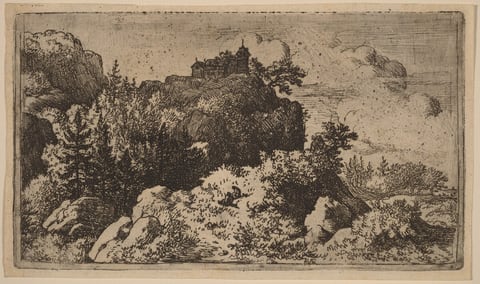
The image shows a slightly elevated perspective of a rugged landscape with dense vegetation and rock formations. The horizon is high in the upper third of the image, with a distant building or castle on a hill. The structure is silhouetted against the sky and partially obscured by foliage. Intricate line work and hatching create detailed textures and shading, especially in the trees and clouds. The color palette is monochromatic, using varying shades of brown and sepia to give the artwork an antiquated and rustic appearance.
A work made of oil on canvas.
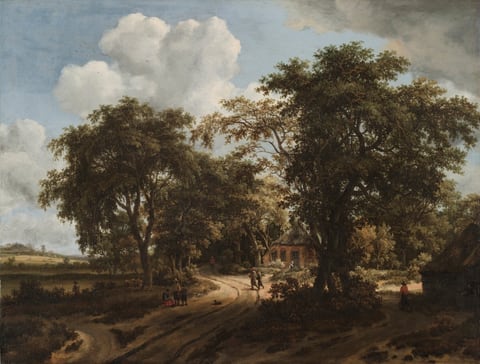
A Cottage in the Woods, by Meindert Hobbema, c. 1662
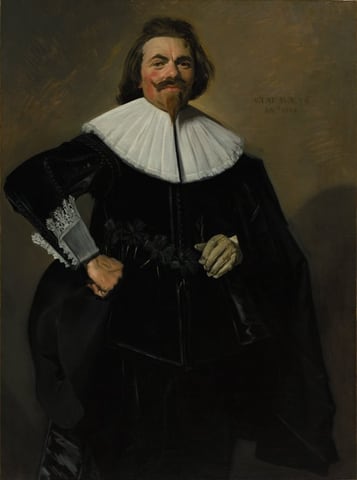
Portrait of Tieleman Roosterman, by Frans Hals, 1634
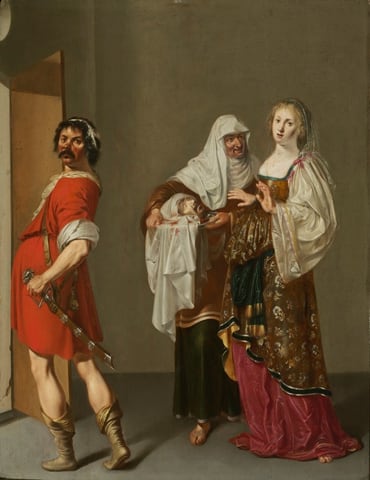
Salome with the Head of Saint John the Baptist, by Jacob Duck, mid-1600s

The works in this room are listed below.

Works in this room

Works made in the Netherlands in the 17th century.

First room, north wall

  1. The image shows a pastoral scene in black and white with fine line work. A small bridge with a circular archway crosses a stream. A dirt path winds through the landscape flanked by grass and bushes. A rocky cliff ascends on the left with a tower-like structure partially obscured by vegetation. The horizon features a cloudy sky, with swirling lines indicating motion. In the distance, a tall, thin structure, possibly a spire or chimney, stands amid faint hills and trees. The scene conveys a serene atmosphere through hatching and cross-hatching techniques.
    Cascade under a Stone BridgeJan van de Velde II, c. 1616Courtesy National Gallery of Art, Washington
  2. The image shows a slightly elevated perspective of a rugged landscape with dense vegetation and rock formations. The horizon is high in the upper third of the image, with a distant building or castle on a hill. The structure is silhouetted against the sky and partially obscured by foliage. Intricate line work and hatching create detailed textures and shading, especially in the trees and clouds. The color palette is monochromatic, using varying shades of brown and sepia to give the artwork an antiquated and rustic appearance.
    Firs in the DefileAllart van Everdingen, probably c. 1645/1656Courtesy National Gallery of Art, Washington
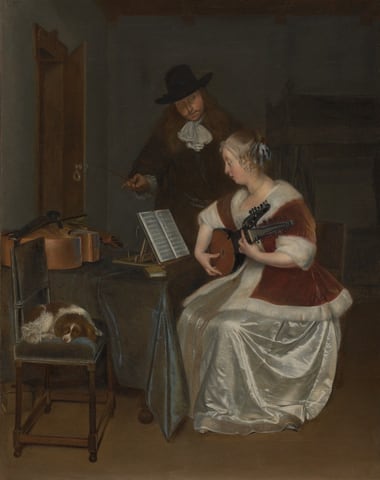
  3. A work made of oil on canvas.
    The Music LessonGerard ter Borch the Younger, c. 1670Courtesy of the Art Institute of Chicago

First room, south wall

  1. A Cottage in the Woods, by Meindert Hobbema, c. 1662
    A Cottage in the WoodsMeindert Hobbema, c. 1662Courtesy of the Cleveland Museum of Art
  2. Portrait of Tieleman Roosterman, by Frans Hals, 1634
    Portrait of Tieleman RoostermanFrans Hals, 1634Courtesy of the Cleveland Museum of Art
  3. Salome with the Head of Saint John the Baptist, by Jacob Duck, mid-1600s
    Salome with the Head of Saint John the BaptistJacob Duck, mid-1600sCourtesy of the Cleveland Museum of Art

Second room, south wall
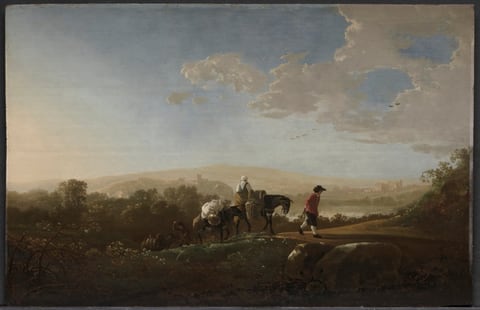
  1. Travelers in Hilly Countryside, by Aelbert Cuyp, c. 1650
    Travelers in Hilly CountrysideAelbert Cuyp, c. 1650Courtesy of the Cleveland Museum of Art
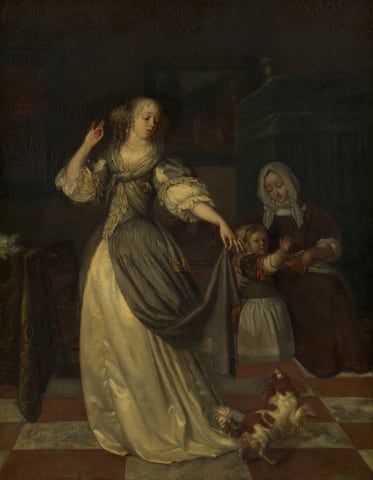
  2. A work made of oil on canvas.
    Lady Playing with a DogEglon van der Neer, c. 1670Courtesy of the Art Institute of Chicago
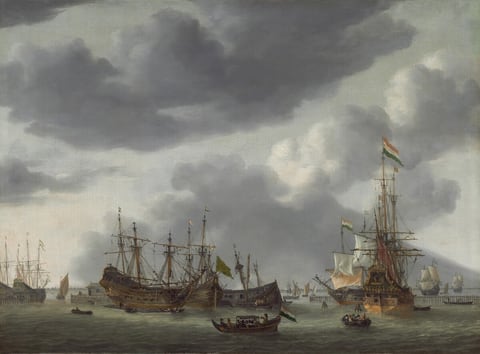
  3. A sage-green harbor teems with more than a dozen sailing ships and rowboats under a pale gray sky in this horizontal painting. The horizon comes about one-fifth of the way up the composition, and dark gray and white clouds tower above. Light filters onto the scene through the clouds from our left to fall across the ships while casting shadows on the water nearest us. Painted in tones of slate gray and warm brown, most of the ships closest to us have their sails furled so the masts and horizontal yard arms bristle against the sky. The larger ships have cannons poking out of square portholes. On our right, a war ship floats with its ornately carved and gilded stern facing us. A flag flying from the tallest of the three masts has red, white, and green stripes. The artist painted his name on that flag, “R. Zeeman.” The ship is tied to a buoy with a length of rope, and an empty rowboat is tethered to the right side of the ship. A similar ship but with the sails hanging loosely is tied to a buoy just beyond this one. A row of pickets, like a fence, extends into the water behind these two ships. To our left, a rowboat full of men has pulled up alongside a partially sunken ship, its masts tilting toward us. A few people stand on two more ships nearby. A black temporary dock floats next to the leftmost ship here. A person mixes something that smokes on the platform, and another person stands on a board lifted halfway up the ship’s side, presumably working on a repair. Two women in another rowboat next to the floating dock lean over the side, washing clothes. Another fence encloses the harbor to our left, and a hut in the middle of the harbor is surrounded by a similar structure. Two rowboats closer to us are filled with men wearing tall hats and black or brown coats, and women wearing black bonnets and white shawls. More sailing ships and rowboats move back or around beyond the harbor, out to sea. Visible cracks cover the surface of the painting.
    Amsterdam Harbor SceneReinier Nooms, called Zeeman, c. 1654/1655Courtesy National Gallery of Art, Washington
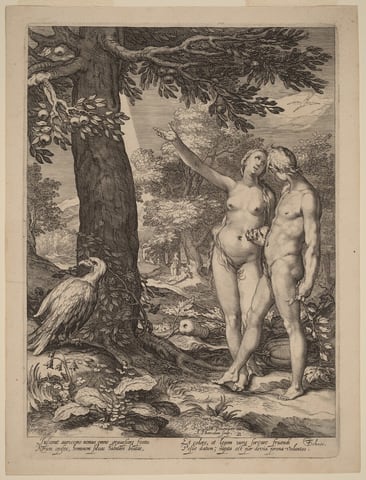
  4. This is a drawing of two nude figures standing beneath a fruit-bearing tree surrounded by elements of nature. The drawing depicts a scene in a lush outdoor setting, featuring intricately detailed branches and leaves of the large tree as well as an eagle-like bird perched nearby. In the background are additional trees extending into a forested area, and a winding path leading into the distance. The foreground includes various plants and the ground is littered with their leaves. The figures are positioned at the center, engaged in a gesture of pointing towards the fruit in the tree. The scene is rendered in fine details with attention to the texture and flow of the natural elements surrounding the figures.
    Adam and Eve before the Tree of KnowledgeJan Saenredam, 1604Courtesy National Gallery of Art, Washington

Second room, north wall
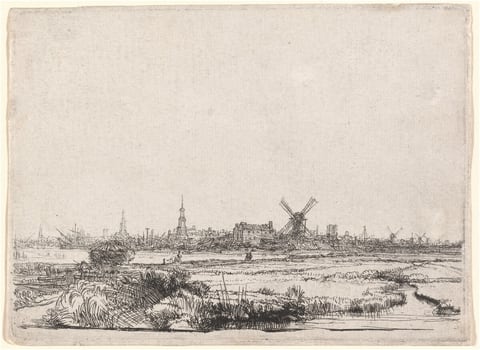
  1. View of Amsterdam from the Northwest, by Rembrandt van Rijn, c. 1640
    View of Amsterdam from the NorthwestRembrandt van Rijn, c. 1640Courtesy National Gallery of Art, Washington
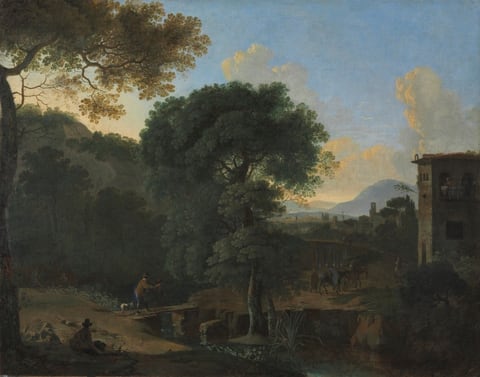
  2. Landscape with Travelers, by Herman van Swanevelt, 1630s
    Landscape with TravelersHerman van Swanevelt, 1630sCourtesy of the Cleveland Museum of Art
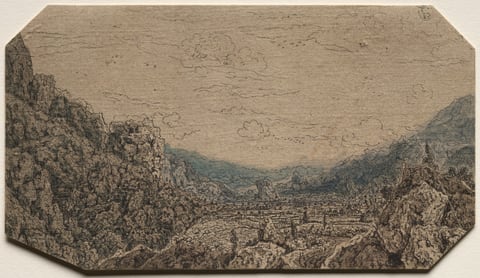
  3. Enclosed Valley, by Hercules Seghers, c. 1623–30
    Enclosed ValleyHercules Seghers, c. 1623–30Courtesy of the Cleveland Museum of Art
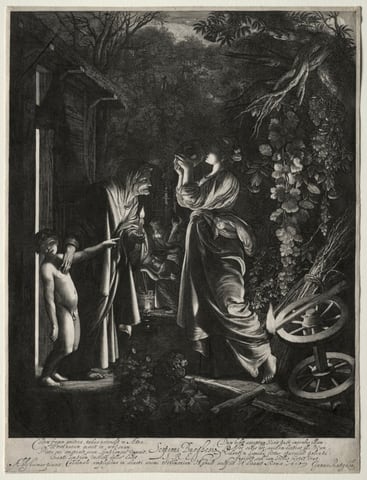
  4. The Mocking of Ceres, by Hendrik Goudt, 1610
    The Mocking of CeresHendrik Goudt, 1610Courtesy of the Cleveland Museum of Art

Third room, north wall
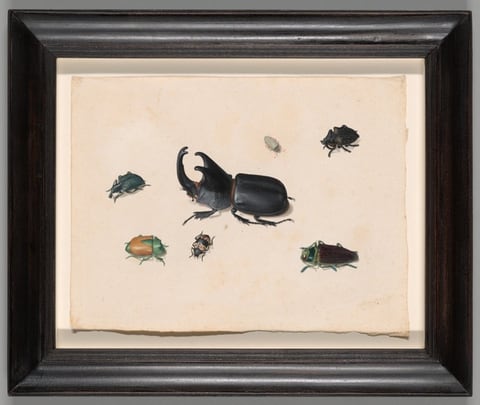
  1. A work made of watercolor and opaque watercolor on cream laid paper.
    Megasoma Elephas or Megaceras Jason and Six Other InsectsPieter Holsteyn, the younger, 1640/80Courtesy of the Art Institute of Chicago
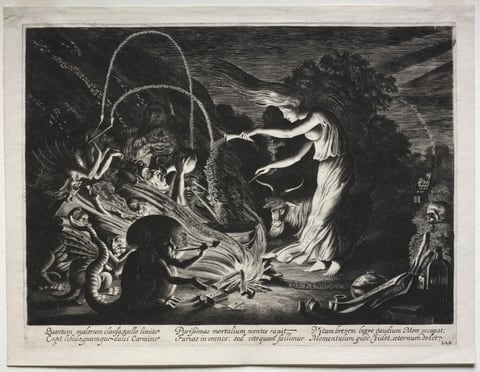
  2. The Witch (Night Piece), by Jan van de Velde II, 1626
    The Witch (Night Piece)Jan van de Velde II, 1626Courtesy of the Cleveland Museum of Art