Floor plan

Style galleriesPaintings of the 19th century
Paintings of the 19th century
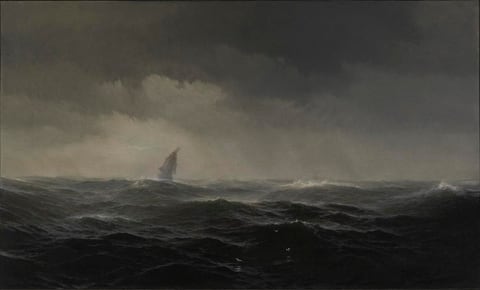
The Sea, by Edward Moran, 1870
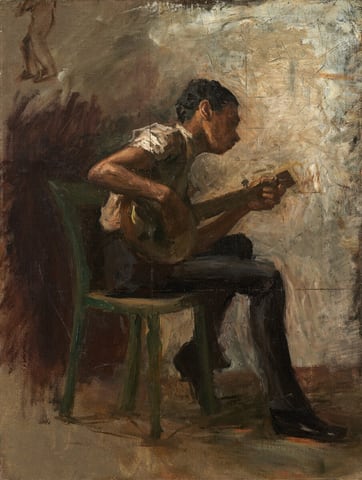
A young, gangly, brown-skinned boy sits on a green chair and leans over the banjo he plays in this loosely painted, vertical composition. His body faces our right in profile, and his head leans to his left and away from us. Light comes from our left to highlight his ear and the side of his chin, but throws his profile into shadow against the lighter background. The boy has short black hair and wears a white shirt with the sleeves rolled up, black pants, and black shoes. The floor is loosely painted with streaks of earth brown, taupe, and dark moss green. The wall behind the boy is painted with visible strokes of parchment brown, peachy tan, pearl white, and fog gray. The space to our left of the boy is dark brown, and an outline of a standing person is sketched in the top left corner. A grid is overlaid across the boy’s body and the chair.
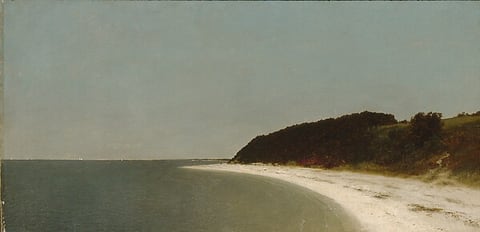
Eaton's Neck, Long Island, by John Frederick Kensett, 1872
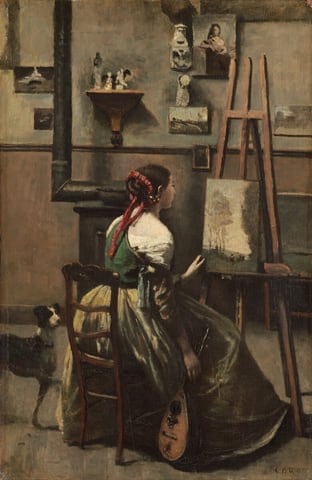
A young, pale-skinned woman sits with her back to us as she looks at a painting on an easel in a studio in this vertical painting. She sits in a ladder-back wood chair so her knees angle away from us, toward the back right corner of the studio. We look onto the side of her right cheek as she leans forward. Her brown hair is combed back and twisted into a bun wrapped with a raspberry-red ribbon that trails down her back. Touches of pearl white, pale pink, and silvery gray suggest flowers by the ear we can see. A cream-white chemise falls off the shoulder closer to us, under a grass-green bodice. She holds a mandolin down by her right side, which is closer to us, to nestle in the folds of her voluminous, olive-green skirt. She reaches forward with her other hand to touch the lower left corner of the painting resting on the easel. That vertically-oriented scene is loosely painted and shows a few people gathered in a landscape. A white and black dog stands with one front leg lifted to the left of the woman's chair, looking at her. The wall opposite us is parchment white over a strip of molding, like a high chair rail, and muted mauve pink below. An L-shaped pipe leads to an iron stove to our left of center. A narrow shelf tucked into the L of the pipe holds three hand-sized sculptures or casts. Small paintings and plaster casts hang around it on the wall above the molding. The artist signed the painting in the lower right: “COROT.”
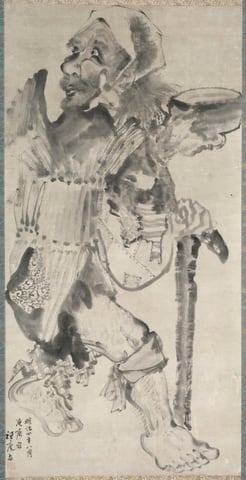
Beggar (Kojiki), by Hirafuku Suian, 1871
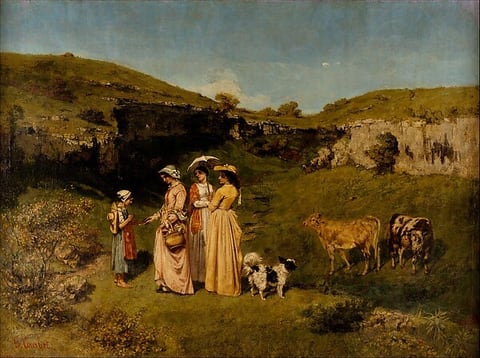
Young Ladies of the Village, by Gustave Courbet, 1851–52

The works in this room are listed below.

Works in this room

Paintings made in the 19th century, from every museum.

Section 1, north wall

  1. The Sea, by Edward Moran, 1870
    The SeaEdward Moran, 1870Courtesy of the Smithsonian American Art Museum
  2. A young, gangly, brown-skinned boy sits on a green chair and leans over the banjo he plays in this loosely painted, vertical composition. His body faces our right in profile, and his head leans to his left and away from us. Light comes from our left to highlight his ear and the side of his chin, but throws his profile into shadow against the lighter background. The boy has short black hair and wears a white shirt with the sleeves rolled up, black pants, and black shoes. The floor is loosely painted with streaks of earth brown, taupe, and dark moss green. The wall behind the boy is painted with visible strokes of parchment brown, peachy tan, pearl white, and fog gray. The space to our left of the boy is dark brown, and an outline of a standing person is sketched in the top left corner. A grid is overlaid across the boy’s body and the chair.
    Study for "The Dancing Lesson": The Banjo PlayerThomas Eakins, probably 1877Courtesy National Gallery of Art, Washington
  3. Eaton's Neck, Long Island, by John Frederick Kensett, 1872
    Eaton's Neck, Long IslandJohn Frederick Kensett, 1872Courtesy of The Metropolitan Museum of Art
  4. A young, pale-skinned woman sits with her back to us as she looks at a painting on an easel in a studio in this vertical painting. She sits in a ladder-back wood chair so her knees angle away from us, toward the back right corner of the studio. We look onto the side of her right cheek as she leans forward. Her brown hair is combed back and twisted into a bun wrapped with a raspberry-red ribbon that trails down her back. Touches of pearl white, pale pink, and silvery gray suggest flowers by the ear we can see. A cream-white chemise falls off the shoulder closer to us, under a grass-green bodice. She holds a mandolin down by her right side, which is closer to us, to nestle in the folds of her voluminous, olive-green skirt. She reaches forward with her other hand to touch the lower left corner of the painting resting on the easel. That vertically-oriented scene is loosely painted and shows a few people gathered in a landscape. A white and black dog stands with one front leg lifted to the left of the woman's chair, looking at her. The wall opposite us is parchment white over a strip of molding, like a high chair rail, and muted mauve pink below. An L-shaped pipe leads to an iron stove to our left of center. A narrow shelf tucked into the L of the pipe holds three hand-sized sculptures or casts. Small paintings and plaster casts hang around it on the wall above the molding. The artist signed the painting in the lower right: “COROT.”
    Corot's Studio: Woman Seated Before an Easel, a Mandolin in her HandJean Baptiste Camille Corot, c. 1868Courtesy National Gallery of Art, Washington

Section 1, south wall

  1. Beggar (Kojiki), by Hirafuku Suian, 1871
    Beggar (Kojiki)Hirafuku Suian, 1871Courtesy of the Cleveland Museum of Art
  2. Young Ladies of the Village, by Gustave Courbet, 1851–52
    Young Ladies of the VillageGustave Courbet, 1851–52Courtesy of The Metropolitan Museum of Art

Section 2, south wall
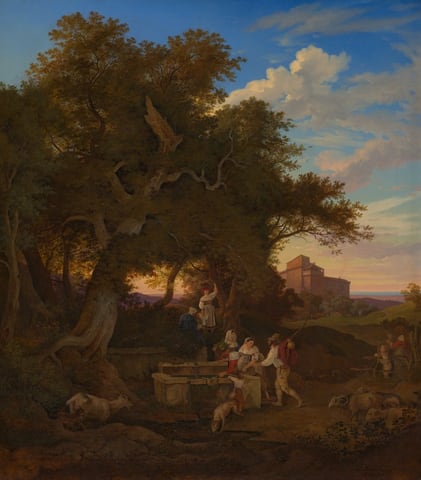
  1. A work made of oil on canvas.
    The Fountain at GrottaferrataAdrian Ludwig (Ludwig) Richter, 1832Courtesy of the Art Institute of Chicago
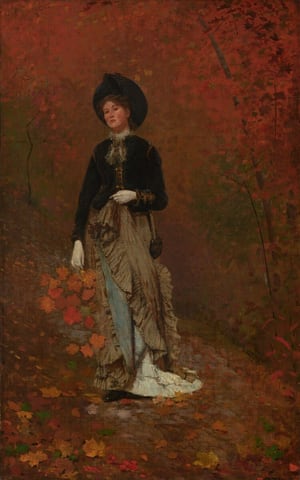
  2. A woman with smooth, pale skin and wearing a hat, long dress, and gloves, stands holding a bunch of pumpkin-orange leaves against a background of trees painted with touches of rust orange and pine green in this vertical painting. The woman tips her head back slightly to look at us with dark eyes under arched eyebrows. Her cheeks are flushed and her coral-pink lips closed. Her round black hat perches on the back of her head and she has an inky black, long-sleeved, hip-length jacket with bronze trim at the shoulders, cuffs, and down the front. A gauzy bow is tied at her neck. Her left elbow, on our right, is bent and she holds up her tan-colored, ruffled skirt with a white-gloved hand. The raised skirt exposes sky-blue lining and white, ruffled flounces at her feet. Her right arm, on our left, hangs at her side and holds the handle of a basket. Deep marigold-orange leaves cascade out of the basket. One black shoe peeks out from under her long skirt. She stands on a hill carpeted with crimson-red, tawny-brown, golden yellow, and forest-green leaves. The space behind her is filled with touches and dabs of red, orange, brown, black, and tan.
    AutumnWinslow Homer, 1877Courtesy National Gallery of Art, Washington
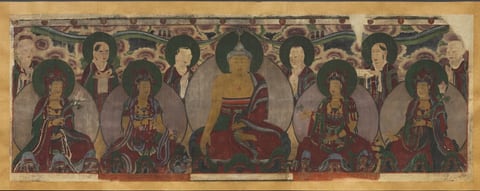
  3. Assembly of Buddhist Deities, 1846
    Assembly of Buddhist DeitiesUnrecorded Korean maker, 1846Courtesy of the Cleveland Museum of Art

Section 2, north wall
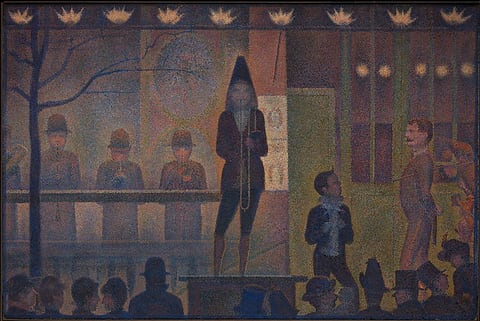
  1. Circus Sideshow (Parade de cirque), by Georges Seurat, 1887–88
    Circus Sideshow (Parade de cirque)Georges Seurat, 1887–88Courtesy of The Metropolitan Museum of Art
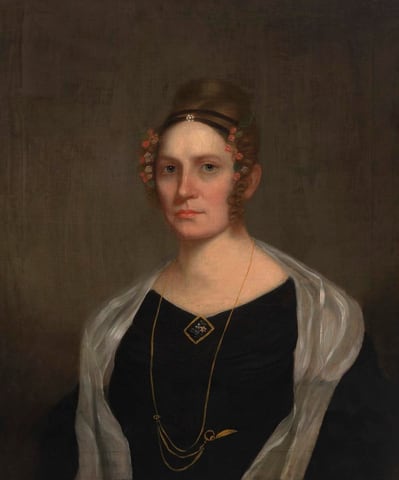
  2. Artist: Unidentified Artist, Sitter: Abigail Powers Fillmore, Current owner: National Portrait Gallery, Smithsonian Institution
    Abigail Powers FillmoreUnrecorded maker, c. 1840Courtesy of the National Portrait Gallery, Smithsonian Institution
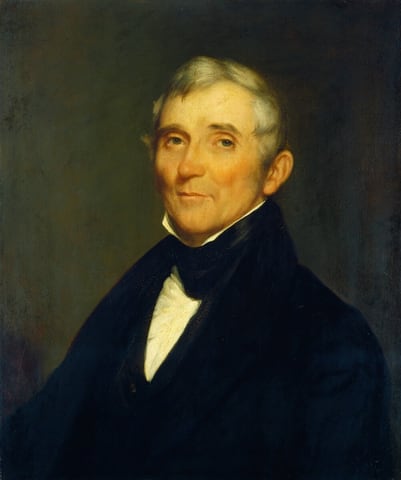
  3. The image is a portrait painting showing a man's upper body. He is positioned slightly turned to his right, with his head facing the viewer. The man has fair skin, defined cheekbones, and small, bright eyes. His hair is short, neatly combed, and grey or white. He is wearing a dark coat over a white shirt with a high collar, partially visible. The background is a muted, dark color, providing a simple setting that emphasizes the subject. There are no visible jewelry or objects in the image.
    Aaron BaldwinFrancis Alexander, c. 1835Courtesy National Gallery of Art, Washington

Section 3, north wall
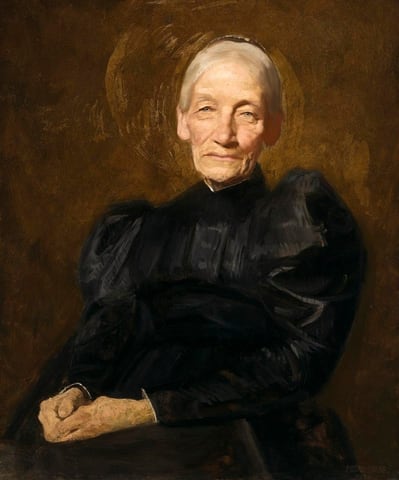
  1. Artist: Robert Bolling Brandegee, Sitter: Sarah Porter, Current owner: National Portrait Gallery, Smithsonian Institution
    Sarah PorterRobert Bolling Brandegee, 1896Courtesy of the National Portrait Gallery, Smithsonian Institution
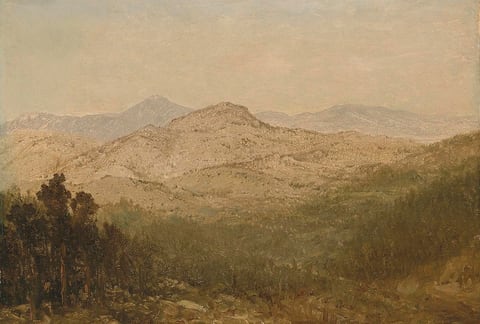
  2. Mountains in Colorado, by John Frederick Kensett, 1870
    Mountains in ColoradoJohn Frederick Kensett, 1870Courtesy of the Smithsonian American Art Museum

Section 3, south wall
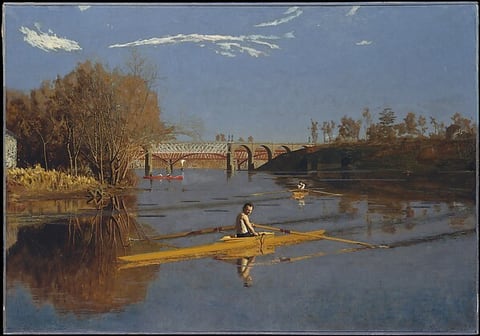
  1. The Champion Single Sculls (Max Schmitt in a Single Scull), by Thomas Eakins, 1871
    The Champion Single Sculls (Max Schmitt in a Single Scull)Thomas Eakins, 1871Courtesy of The Metropolitan Museum of Art
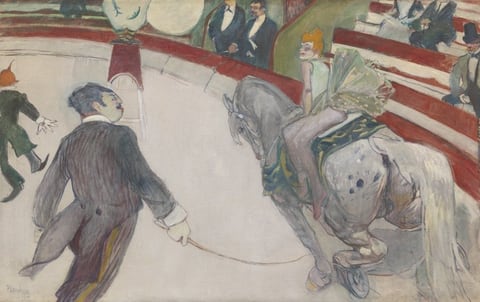
  2. Painting of a performance inside a circus ring. A man wearing a suit holds a whip in his hand and looks towards a woman with red hair riding a gray horse and wearing a green dress. Audience members wearing suits and top hats watch from red and white benches on the side.
    Equestrienne (At the Cirque Fernando)Henri de Toulouse-Lautrec, 1887–88Courtesy of the Art Institute of Chicago