Floor plan

Style galleriesNeoclassicism

Neoclassicism

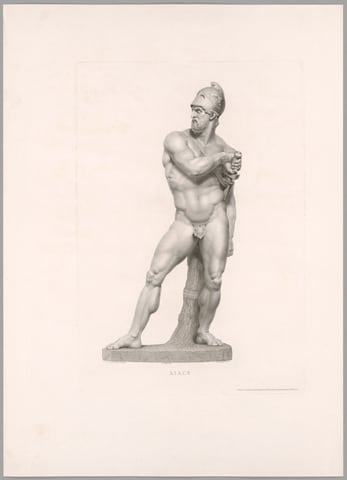
A work made of engraving and etching in black on ivory wove paper.
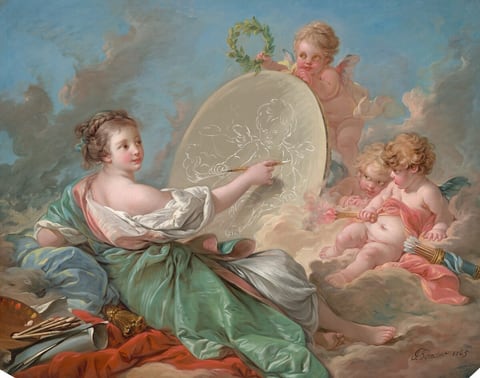
A young woman draws on an oval surface with white chalk while three winged, baby-like putti gather nearby, all on a bank of pale pink clouds in this horizontal painting. The woman and putti have pale, rosy skin, flushed cheeks, and hazel-brown eyes. To our left, the woman reclines with her upper body propped up on her far elbow, which rests on a steel-blue cushion as her legs stretch out to our right. Her light brown hair is braided and wrapped across the top of her head. She wears a loose, seafoam-green robe over a billowing ivory-white garment that has slipped off the shoulder closer to us. A round paint palette with brushes sticking out of its thumb hole and a roll of blue and white paper sit in the lower left corner, behind the woman. The woman and the objects are on a red cloth. In front of the woman is a rounded surface, perhaps a canvas, on which she draws. She holds up a gold-colored stylus with her right hand, closer to us, with a pointed piece of white chalk in one end and black chalk in the other. The canvas is taller than her head, so the child-like putto she draws on it is life-sized. The three nude putti on the far side of the canvas have copper or golden-blond, curly hair, flushed, rounded cheeks, short wings in white or peacock blue, pudgy torsos, and dimpled limbs. One putto, presumably the one the woman draws, sits back on the bank of clouds with a carnation-pink sash across his chest. He pulls his chin back and looks at her from under his eyebrows. He holds a gold-colored torch with a pink flame in one hand, and the other hand rests near a cylindrical quiver of arrows. Another putto peeks around the side of the canvas, and the third stands and props the canvas up. That third putto holds up a wreath of laurel leaves up over the canvas, above the woman’s drawing hand. The bank of clouds is parchment-brown with muted pink and blue highlights against a vivid blue sky. The artist signed and dated the lower right, “F Boucher – 1765.”
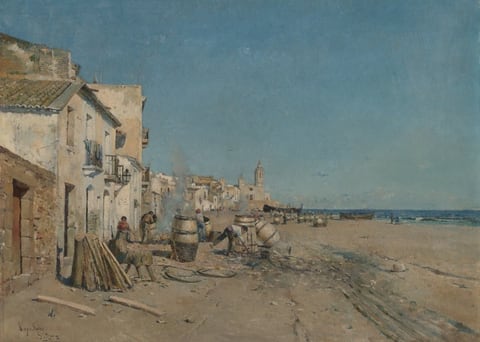
A work made of oil on masonite.
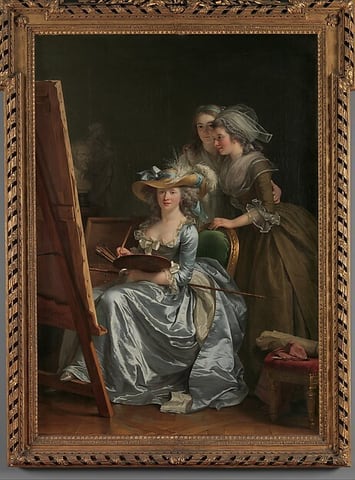
Self-Portrait with Two Pupils, Marie Gabrielle Capet (1761–1818) and Marie Marguerite Carraux de Rosemond (1765–1788), by Adélaïde Labille-Guiard, 1785
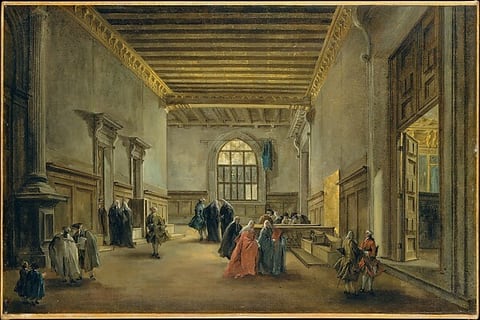
The Antechamber of the Sala del Maggior Consiglio, by Francesco Guardi, ca. 1765–68
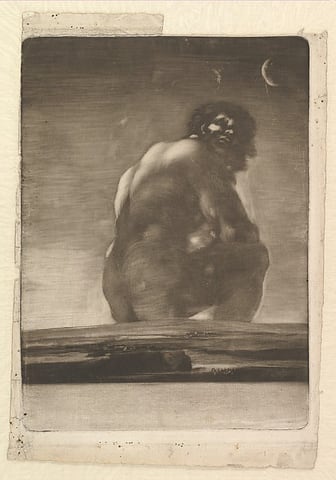
Seated Giant, by Francisco Goya, by 1818 (possibly 1814–18)

The works in this room are listed below.

Works in this room

Europe turns back to Greece and Rome: clear line, calm figures and civic virtue.

First room, north wall

  1. A work made of engraving and etching in black on ivory wove paper.
    Ajax, Front View, from Oeuvre de CanovaAntonio Canova, 1817Courtesy of the Art Institute of Chicago
  2. A young woman draws on an oval surface with white chalk while three winged, baby-like putti gather nearby, all on a bank of pale pink clouds in this horizontal painting. The woman and putti have pale, rosy skin, flushed cheeks, and hazel-brown eyes. To our left, the woman reclines with her upper body propped up on her far elbow, which rests on a steel-blue cushion as her legs stretch out to our right. Her light brown hair is braided and wrapped across the top of her head. She wears a loose, seafoam-green robe over a billowing ivory-white garment that has slipped off the shoulder closer to us. A round paint palette with brushes sticking out of its thumb hole and a roll of blue and white paper sit in the lower left corner, behind the woman. The woman and the objects are on a red cloth. In front of the woman is a rounded surface, perhaps a canvas, on which she draws. She holds up a gold-colored stylus with her right hand, closer to us, with a pointed piece of white chalk in one end and black chalk in the other. The canvas is taller than her head, so the child-like putto she draws on it is life-sized. The three nude putti on the far side of the canvas have copper or golden-blond, curly hair, flushed, rounded cheeks, short wings in white or peacock blue, pudgy torsos, and dimpled limbs. One putto, presumably the one the woman draws, sits back on the bank of clouds with a carnation-pink sash across his chest. He pulls his chin back and looks at her from under his eyebrows. He holds a gold-colored torch with a pink flame in one hand, and the other hand rests near a cylindrical quiver of arrows. Another putto peeks around the side of the canvas, and the third stands and props the canvas up. That third putto holds up a wreath of laurel leaves up over the canvas, above the woman’s drawing hand. The bank of clouds is parchment-brown with muted pink and blue highlights against a vivid blue sky. The artist signed and dated the lower right, “F Boucher – 1765.”
    Allegory of PaintingFrançois Boucher, 1765Courtesy National Gallery of Art, Washington
  3. A work made of oil on masonite.
    SitgesJuan Roig y Soler, 19th centuryCourtesy of the Art Institute of Chicago

First room, south wall

  1. Self-Portrait with Two Pupils, Marie Gabrielle Capet (1761–1818) and Marie Marguerite Carraux de Rosemond (1765–1788), by Adélaïde Labille-Guiard, 1785
    Self-Portrait with Two Pupils, Marie Gabrielle Capet (1761–1818) and Marie Marguerite Carraux de Rosemond (1765–1788)Adélaïde Labille-Guiard, 1785Courtesy of The Metropolitan Museum of Art
  2. The Antechamber of the Sala del Maggior Consiglio, by Francesco Guardi, ca. 1765–68
    The Antechamber of the Sala del Maggior ConsiglioFrancesco Guardi, ca. 1765–68Courtesy of The Metropolitan Museum of Art
  3. Seated Giant, by Francisco Goya, by 1818 (possibly 1814–18)
    Seated GiantFrancisco Goya, by 1818 (possibly 1814–18)Courtesy of The Metropolitan Museum of Art

Second room, south wall
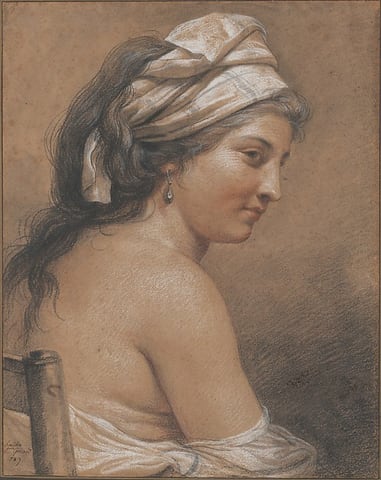
  1. Study of a Seated Woman Seen from Behind (Marie-Gabrielle Capet), by Adélaïde Labille-Guiard, 1789
    Study of a Seated Woman Seen from Behind (Marie-Gabrielle Capet)Adélaïde Labille-Guiard, 1789Courtesy of The Metropolitan Museum of Art
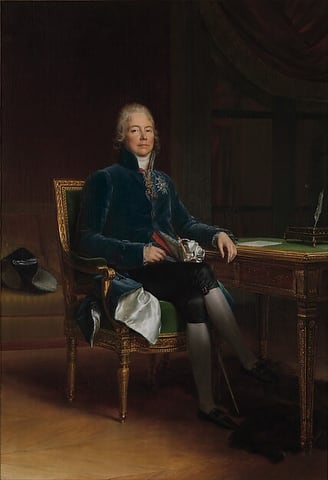
  2. Charles Maurice de Talleyrand Périgord (1754–1838), Prince de Bénévent, by baron François Gérard, 1808
    Charles Maurice de Talleyrand Périgord (1754–1838), Prince de Bénéventbaron François Gérard, 1808Courtesy of The Metropolitan Museum of Art
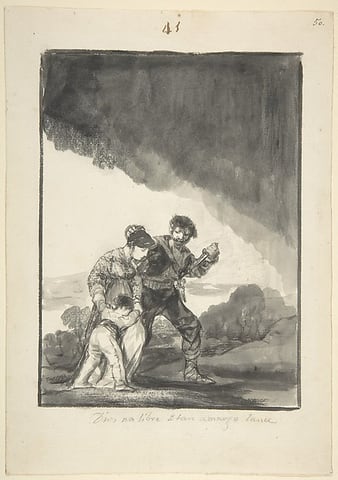
  3. God save us from such a bitter fate; a bandit threatening a woman and a child with a knife, page 41 from the "Black Border Album" (E), by Francisco Goya, ca. 1816–20
    God save us from such a bitter fate; a bandit threatening a woman and a child with a knife, page 41 from the "Black Border Album" (E)Francisco Goya, ca. 1816–20Courtesy of The Metropolitan Museum of Art

Second room, north wall
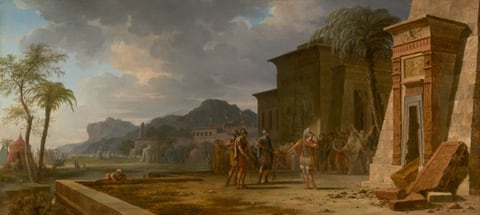
  1. A work made of oil on canvas.
    Alexander at the Tomb of Cyrus the GreatPierre Henri de Valenciennes, 1796Courtesy of the Art Institute of Chicago
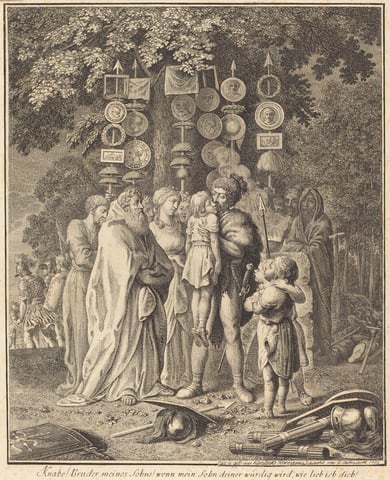
  2. The image depicts a group of people in varying poses and outfits. A central figure, possibly a child, is being held up by a man. Those around them are positioned differently, some standing closely. The figures have detailed faces and wear garments resembling classical attire. Shields and banners decorated with symbols are present in the background. Armor and helmets are scattered on the ground. Trees and a group of people in the distance are part of the background.
    Ancient TeutonsDaniel Nikolaus Chodowiecki, 1782Courtesy National Gallery of Art, Washington
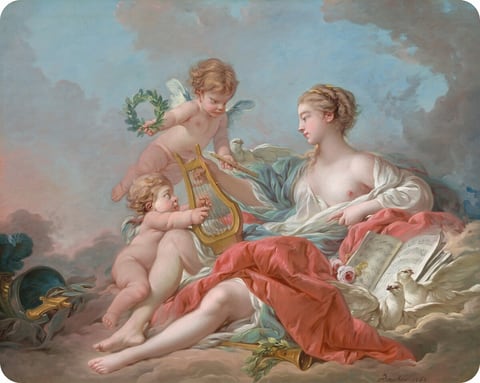
  3. A woman wearing flowing, pastel-colored robes and two, winged, child-like putti gather on a bank of clouds among musical instruments and sheet music in this horizontal painting. The people all have pale, pink-tinged skin. The woman sits to our right of center, facing our left in profile. She has straight nose, a rounded chin, and her small, pink lips are closed. Her ash-blond hair is pulled back under a yellow band. A voluminous white robe falls away over her left shoulder, to our right, to reveal a firm breast and small pink nipple. Sky-blue drapery wraps over her far arm, and deep rose-pink cloth falls across her lap and onto the clouds around her. Her legs extend to our left, her toes pointed. She leans back on her left elbow, closer to us, and points with that index finger to a lyre she props against her knee with her other hand. One chubby, nude putto reaches forward to strum the strings. The other putto hovers above, holding a ring of laurel leaves up in one hand and a flute in the other. Both putti have chubby limbs and torsos, blond curls lifted as if in a breeze, and short, ice-blue wings. Both look at the woman. In the lower left corner, a helmet with a topaz-blue feather and the gold hilt of a sword sit near the woman’s feet. Beneath the woman’s lower leg, at the bottom center of the painting, is a gold horn encircled by another wreath of laurel leaves. Two white doves with wings spread support an open book of sheet music and two pink roses tucked under the woman’s bent elbow. Fog-gray clouds billow up both sides of the scene against a pale blue sky. The clouds on which the trio gathers are parchment brown shaded with mauve pink. The outer corners of the image are white, indicating that the corners of the canvas were rounded. The artist signed and dated the painting in the lower right corner, “F Boucher 1764.”
    Allegory of MusicFrançois Boucher, 1764Courtesy National Gallery of Art, Washington

Third room, north wall
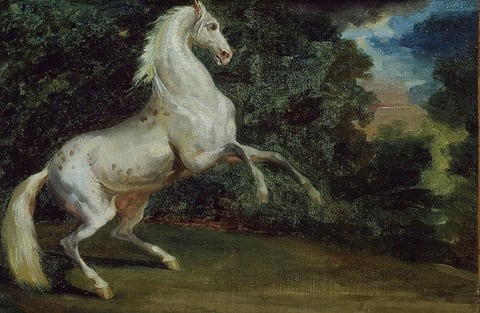
  1. A work made of oil on canvas.
    Prancing HorseFollower of Jean Louis André Théodore Géricault, 1808–12Courtesy of the Art Institute of Chicago
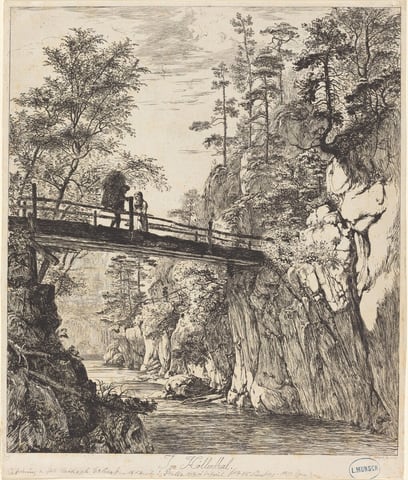
  2. The image shows a landscape with a wooden bridge crossing over a river in a valley. The scenery includes cliffs, trees, and flowing water below. The artwork features fine, detailed brushstrokes depicting the texture of the cliffs, foliage, and water. The color scheme is monochromatic with various shades of gray and sepia tones. Two figures are seen on the bridge, contributing to the sense of scale and activity in the serene setting.
    Im Höllenthal (In the Höllen Valley)Johann Christoph Erhard, 1818Courtesy National Gallery of Art, Washington

Third room, south wall
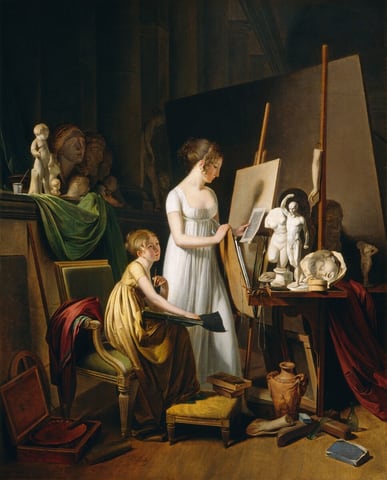
  1. In a room filled with easels, white plaster heads and statuettes, a box of paints, books, and papers, a young woman stands looking at a sketch and a young girl looks on, seated in an armchair, in this vertical painting. The scene is lit from the upper left, presumably from a window out of our view. Both women have smooth, pale skin, and their hair is swept up with curls framing their faces. They face our right in profile so their faces are in gentle shadow. They have straight noses, and their rose-pink lips are closed. They wear gowns with short sleeves, low, scooped necks, and floor-length skirts cinched under the bust. In the center of the painting, the young woman has chestnut-brown hair and wears a white gown tied with a sky-blue ribbon. She stands in front of a portfolio propped up against a tall easel. The portfolio is made of two stiff boards that tie together with pale blue ribbon to secure large sheets of paper. She rests her right hand, closer to us, on the front board of the portfolio and looks down at the sketch on a gray piece of paper she holds with her other hand. Next to her and closer to us, the younger girl sits in a gold chair upholstered with olive-green velvet. She faces our right almost in profile, and she looks up toward the drawing the other woman holds. The girl in the chair has blond hair and a gold-colored dress. Her feet are propped on a gold footstool, and she holds another portfolio on her lap. She supports the portfolio and holds a piece of paper with one hand, and a stylus or brush in the other hand, up by her chin. To the right of the easel, a wooden table holds a collection of plaster casts of faces, a hand, and small-scale bodies along with a glass vessel and a few other tools. Two translucent green bottles, boxes, a book, and a terracotta vase are collected on the footstool and the floor around the base of the easel. Garnet-red cloths are draped down the front of the table to our right and behind the girl on the chair. Next to her chair, in the lower left corner of the composition, is a wooden box with a paint palette and a handful of thin paintbrushes. A scroll of paper lies next to the box. A shelf at the standing girl’s shoulder height and behind the pair, to our left, is piled with white busts of a man, child, and woman, more figurines, and a brush in a small cup, all arranged across a moss-green cloth. The space with the girls and artist’s tools is enclosed by a large, dark brown form, presumably a canvas in shadow, that leans against the tall easels and mostly cuts off a view into the rest of the room. A glimpse of shadowy capitals is seen over the board, across the top of the painting, to suggest that a row of columns recedes into the space beyond. The artist signed the work as if he had painted his name on the floor next to the scroll, “L. Boilly.”
    A Painter's StudioLouis-Léopold Boilly, c. 1800Courtesy National Gallery of Art, Washington
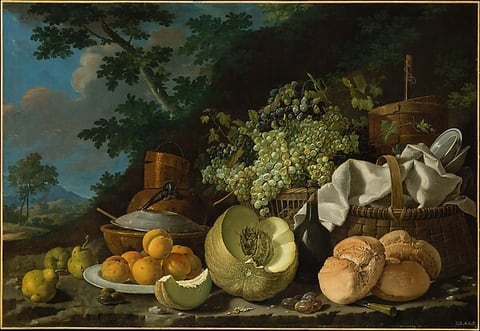
  2. The Afternoon Meal (La Merienda), by Luis Meléndez, ca. 1772
    The Afternoon Meal (La Merienda)Luis Meléndez, ca. 1772Courtesy of The Metropolitan Museum of Art