Floor plan

Style galleriesMughal and Rajput painting
Mughal and Rajput painting
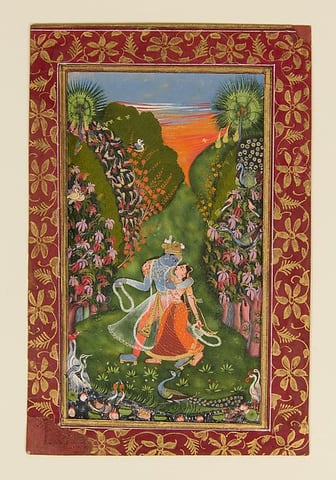
Radha and Krishna Walk in a Flowering Grove (recto); Krishna Fluting (verso), by the Kota Master, ca. 1720 (recto); ca. 1750–75 (verso)
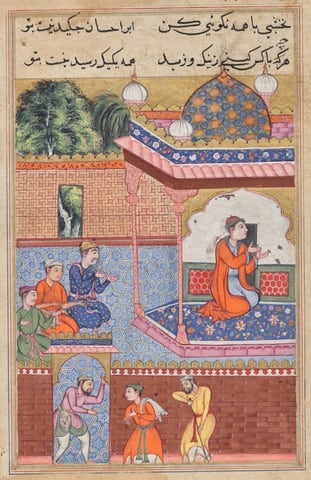
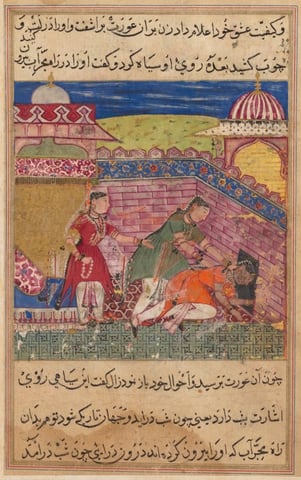
The deceitful wife ejects the procuress after blackening her face, from a Tuti-nama (Tales of a Parrot): Eighth Night, by Shravana, c. 1560
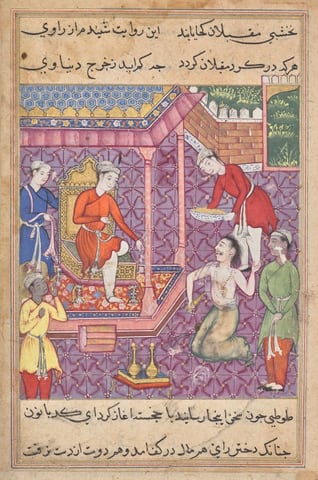
The magician disguised as a Brahman returns to claim his “daughter-in-law,” from a Tuti-nama (Tales of a Parrot): Thirty-fifth Night, c. 1560
Kaiwan, Latif, and Sharif arrive at a house of worship, where they seek help from Khurshid who has become a mystical healer, from a Tuti-Nama (Tales of a Parrot): Thirty-second Night, c. 1560
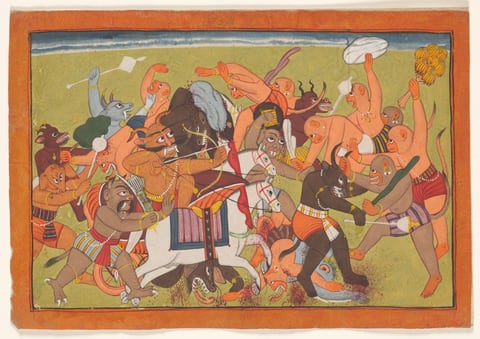
Battle between monkeys and demons, from the “Shangri” Ramayana, c. 1700
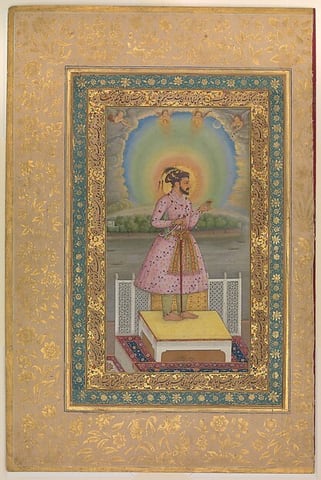
"Shah Jahan on a Terrace, Holding a Pendant Set With His Portrait", Folio from the Shah Jahan Album, by Chitarman, recto: dated 1627–28; verso: ca. 1530–50
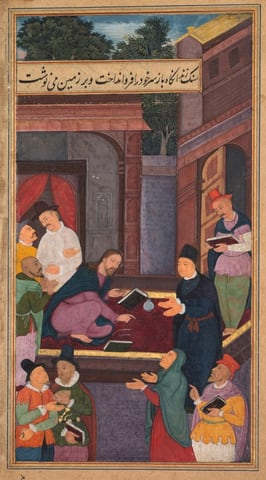
Jesus writes on the ground (folio 130 verso), from a Mirror of Holiness (Mir’at al-quds) of Father Jerome Xavier, 1602–4
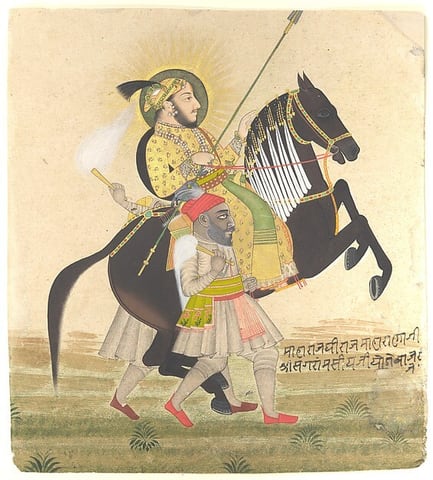
Maharana Sangram Singh Riding a Prize Stallion, by Stipple Master, ca. 1712

The works in this room are listed below.

Works in this room

Jewel-bright painting from the Mughal court and the Rajput and Pahari kingdoms of India.

First room, north wall

  1. Radha and Krishna Walk in a Flowering Grove (recto); Krishna Fluting (verso), by the Kota Master, ca. 1720 (recto); ca. 1750–75 (verso)
    Radha and Krishna Walk in a Flowering Grove (recto); Krishna Fluting (verso)the Kota Master, ca. 1720 (recto); ca. 1750–75 (verso)Courtesy of The Metropolitan Museum of Art
  2. The deceitful wife ejects the procuress after blackening her face, from a Tuti-nama (Tales of a Parrot): Eighth Night, by Shravana, c. 1560
    The deceitful wife ejects the procuress after blackening her face, from a Tuti-nama (Tales of a Parrot): Eighth NightShravana, c. 1560Courtesy of the Cleveland Museum of Art
  3. The magician disguised as a Brahman returns to claim his “daughter-in-law,” from a Tuti-nama (Tales of a Parrot): Thirty-fifth Night, c. 1560
    The magician disguised as a Brahman returns to claim his “daughter-in-law,” from a Tuti-nama (Tales of a Parrot): Thirty-fifth NightUnrecorded Indian maker, c. 1560Courtesy of the Cleveland Museum of Art
  4. Kaiwan, Latif, and Sharif arrive at a house of worship, where they seek help from Khurshid who has become a mystical healer, from a Tuti-Nama (Tales of a Parrot): Thirty-second Night, c. 1560
    Kaiwan, Latif, and Sharif arrive at a house of worship, where they seek help from Khurshid who has become a mystical healer, from a Tuti-Nama (Tales of a Parrot): Thirty-second NightUnrecorded Indian maker, c. 1560Courtesy of the Cleveland Museum of Art

First room, south wall

  1. Battle between monkeys and demons, from the “Shangri” Ramayana, c. 1700
    Battle between monkeys and demons, from the “Shangri” RamayanaUnrecorded Indian maker, c. 1700Courtesy of the Cleveland Museum of Art
  2. "Shah Jahan on a Terrace, Holding a Pendant Set With His Portrait", Folio from the Shah Jahan Album, by Chitarman, recto: dated 1627–28; verso: ca. 1530–50
    "Shah Jahan on a Terrace, Holding a Pendant Set With His Portrait", Folio from the Shah Jahan AlbumChitarman, recto: dated 1627–28; verso: ca. 1530–50Courtesy of The Metropolitan Museum of Art
  3. Jesus writes on the ground (folio 130 verso), from a Mirror of Holiness (Mir’at al-quds) of Father Jerome Xavier, 1602–4
    Jesus writes on the ground (folio 130 verso), from a Mirror of Holiness (Mir’at al-quds) of Father Jerome XavierUnrecorded Indian maker, 1602–4Courtesy of the Cleveland Museum of Art
  4. Maharana Sangram Singh Riding a Prize Stallion, by Stipple Master, ca. 1712
    Maharana Sangram Singh Riding a Prize StallionStipple Master, ca. 1712Courtesy of The Metropolitan Museum of Art

Second room, south wall
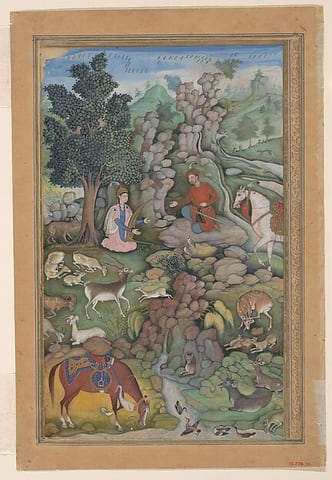
  1. "Bahram Gur Sees a Herd of Deer Mesmerized by Dilaram' s Music", Folio from a Khamsa (Quintet) of Amir Khusrau Dihlavi, by Amir Khusrau Dihlavi, 1597–98
    "Bahram Gur Sees a Herd of Deer Mesmerized by Dilaram' s Music", Folio from a Khamsa (Quintet) of Amir Khusrau DihlaviAmir Khusrau Dihlavi, 1597–98Courtesy of The Metropolitan Museum of Art
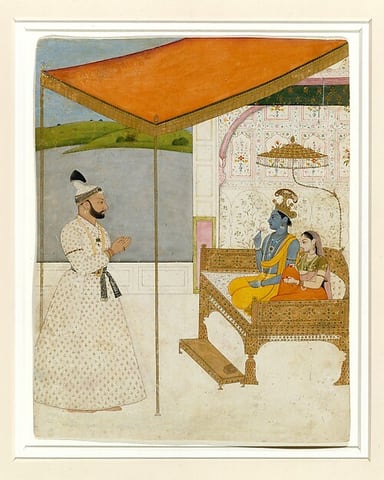
  2. Raja Balwant Singh’s Vision of Krishna and Radha, by Nainsukh, ca. 1745–50
    Raja Balwant Singh’s Vision of Krishna and RadhaNainsukh, ca. 1745–50Courtesy of The Metropolitan Museum of Art
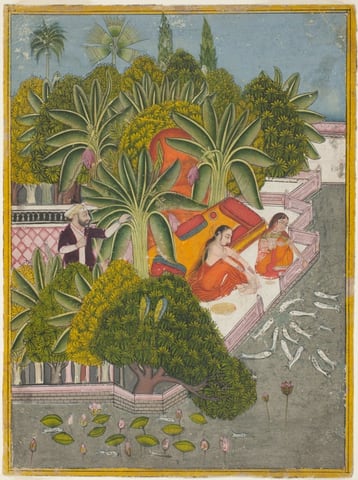
  3. A work made of opaque watercolor on paper.
    Royal Women Feeding FishUnrecorded Indian maker, c. 1740Courtesy of the Art Institute of Chicago
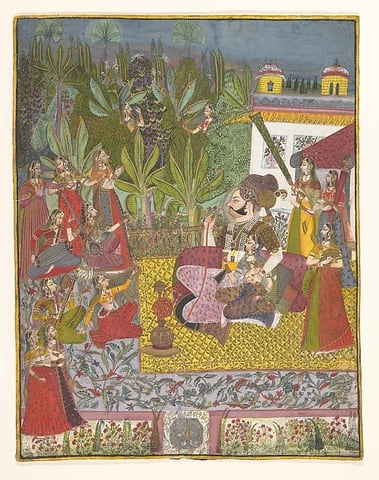
  4. Maharaja Bijay Singh in His Harem, ca. 1770
    Maharaja Bijay Singh in His HaremUnrecorded Indian maker, ca. 1770Courtesy of The Metropolitan Museum of Art

Second room, north wall
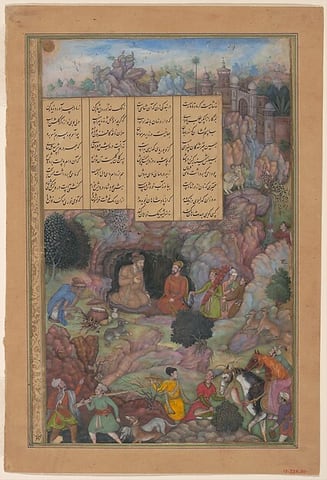
  1. "Alexander Visits the Sage Plato in his Mountain Cave", Folio from a Khamsa (Quintet) of Amir Khusrau Dihlavi, by Amir Khusrau Dihlavi, 1597–98
    "Alexander Visits the Sage Plato in his Mountain Cave", Folio from a Khamsa (Quintet) of Amir Khusrau DihlaviAmir Khusrau Dihlavi, 1597–98Courtesy of The Metropolitan Museum of Art
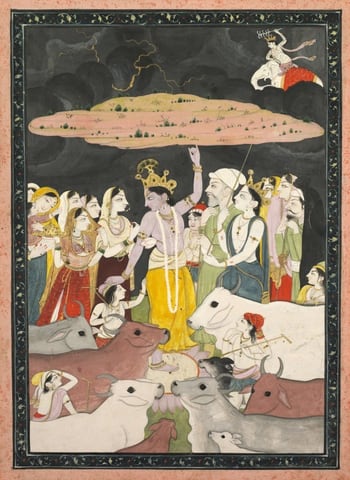
  2. Krishna Lifting Mount Govardhan, c. 1780–90
    Krishna Lifting Mount GovardhanUnrecorded Indian maker, c. 1780–90Courtesy of the Cleveland Museum of Art
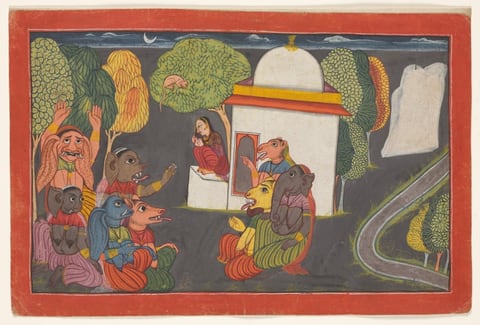
  3. Hanuman spies Sita in the Ashoka Grove, from the “Shangri” Ramayana, c. 1700–25
    Hanuman spies Sita in the Ashoka Grove, from the “Shangri” RamayanaUnrecorded Indian maker, c. 1700–25Courtesy of the Cleveland Museum of Art
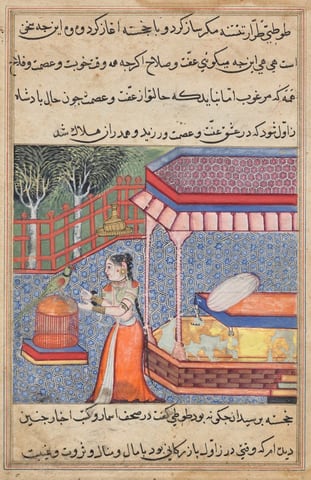
  4. The parrot addresses Khujasta at the beginning of the thirty-sixth night, from a Tuti-nama (Tales of a Parrot), c. 1560
    The parrot addresses Khujasta at the beginning of the thirty-sixth night, from a Tuti-nama (Tales of a Parrot)Unrecorded Indian maker, c. 1560Courtesy of the Cleveland Museum of Art