Floor plan

Style galleriesGeorgian Britain

Georgian Britain

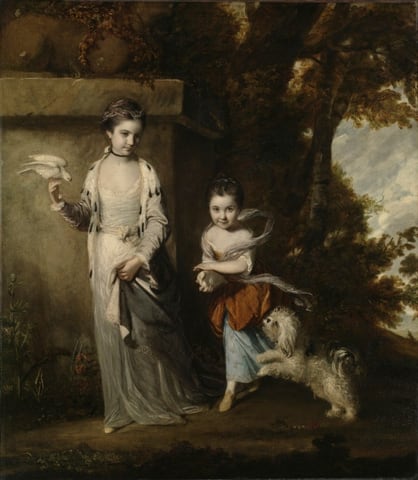
Portrait of the Ladies Amabel and Mary Jemima Yorke, by Joshua Reynolds, c. 1761
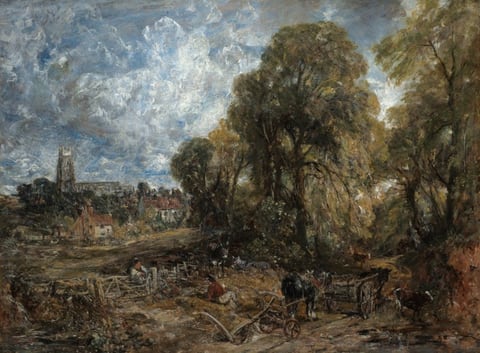
Large English country landscape painting, farmers with horses, green trees.
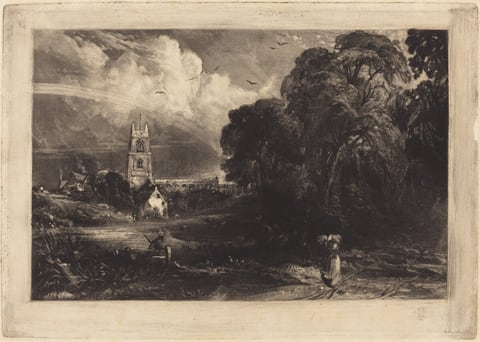
The image displays a landscape with a high vantage point. The horizon is low, with a row of trees. A church tower is off-center to the left. The church is surrounded by trees and buildings. A line of trees is on the right side. The sky has large, expressive clouds. A monochromatic palette of gray is used. A path winds through the scene, with two figures: one person working and another walking.
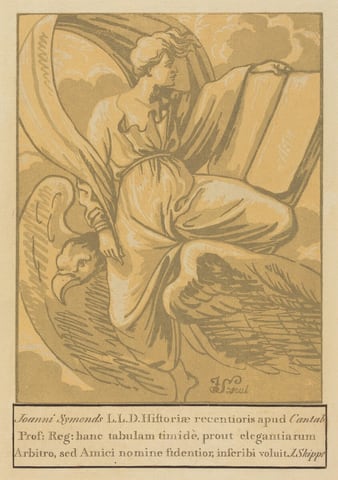
This is a drawing of a winged figure seated on a bird. The image depicts a figure with flowing robes, wings outstretched, holding an open book in one hand. The figure appears to be looking off to the side, with a serene expression. The lower part of the image includes a bird upon which the figure is seated. The bird's head is turned slightly upwards, following the direction in which the figure is gazing. The image is rendered in a warm, monochromatic palette. In the lower section of the image, there is some text, likely Latin.
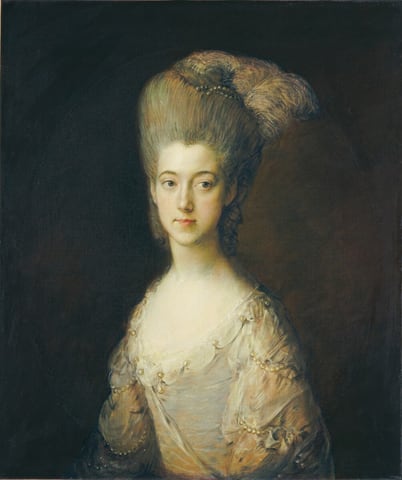
Shown from the waist up, a young, pale-skinned woman with her gray hair piled high atop her head is lit starkly against a dark background in this vertical portrait painting. The woman’s shoulders are angled to our left. Her face is square to us, but she looks off to our right from the corners of her eyes, which are gray rimmed with golden brown around the pupils. She has a thin face, smooth cheeks, a bow-shaped pink mouth, and a narrow chin. Her hair is mostly swept up high under a bank of pearl-white feathers and some sparkling ornaments. A few ringlets hang down the back of her neck. The bodice of her white dress scoops low across her chest and sits just above her sloping shoulders. The dress is adorned with pearls on the sleeves and around the neckline, and the fabric shimmers from silvery white to pale gold. The background is earth-brown around her face and deepens to almost black in the corners.
A work made of pen and black ink and brush and black ink wash, with touches of pen and brown ink, on ivory laid paper.
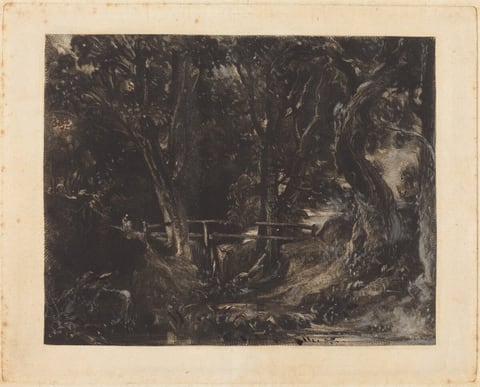
The image shows a landscape scene with a frontal view of a dense forest. A wooden bridge spans across a narrow ravine or creek. The painting features vigorous and textural brushstrokes with dark tones creating a shadowy effect. The color palette includes deep blacks, dark browns, and occasional highlights of light filtering through the canopy. In the distance, lighter areas suggest a path leading further into the woods, surrounded by trees and undergrowth.

The works in this room are listed below.

Works in this room

Portraits, conversation pieces and watercolour landscapes from Hogarth to Constable.

Section 1, north wall

  1. Portrait of the Ladies Amabel and Mary Jemima Yorke, by Joshua Reynolds, c. 1761
    Portrait of the Ladies Amabel and Mary Jemima YorkeJoshua Reynolds, c. 1761Courtesy of the Cleveland Museum of Art
  2. Large English country landscape painting, farmers with horses, green trees.
    Stoke-by-NaylandJohn Constable, 1836Courtesy of the Art Institute of Chicago
  3. The image displays a landscape with a high vantage point. The horizon is low, with a row of trees. A church tower is off-center to the left. The church is surrounded by trees and buildings. A line of trees is on the right side. The sky has large, expressive clouds. A monochromatic palette of gray is used. A path winds through the scene, with two figures: one person working and another walking.
    Stoke-by-NeylandDavid Lucas, 1830Courtesy National Gallery of Art, Washington

Section 1, south wall

  1. This is a drawing of a winged figure seated on a bird. The image depicts a figure with flowing robes, wings outstretched, holding an open book in one hand. The figure appears to be looking off to the side, with a serene expression. The lower part of the image includes a bird upon which the figure is seated. The bird's head is turned slightly upwards, following the direction in which the figure is gazing. The image is rendered in a warm, monochromatic palette. In the lower section of the image, there is some text, likely Latin.
    Saint John the EvangelistJohn Skippe, 1771Courtesy National Gallery of Art, Washington
  2. Shown from the waist up, a young, pale-skinned woman with her gray hair piled high atop her head is lit starkly against a dark background in this vertical portrait painting. The woman’s shoulders are angled to our left. Her face is square to us, but she looks off to our right from the corners of her eyes, which are gray rimmed with golden brown around the pupils. She has a thin face, smooth cheeks, a bow-shaped pink mouth, and a narrow chin. Her hair is mostly swept up high under a bank of pearl-white feathers and some sparkling ornaments. A few ringlets hang down the back of her neck. The bodice of her white dress scoops low across her chest and sits just above her sloping shoulders. The dress is adorned with pearls on the sleeves and around the neckline, and the fabric shimmers from silvery white to pale gold. The background is earth-brown around her face and deepens to almost black in the corners.
    Mrs. Paul Cobb MethuenThomas Gainsborough, c. 1776/1777Courtesy National Gallery of Art, Washington
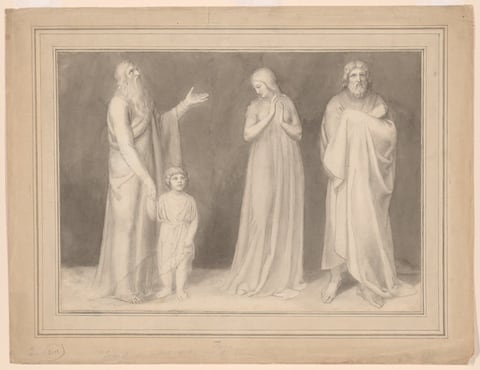
  3. A work made of pen and black ink and brush and black ink wash, with touches of pen and brown ink, on ivory laid paper.
    Hannah Presenting Samuel to EliJohn Flaxman, c. 1783Courtesy of the Art Institute of Chicago
  4. The image shows a landscape scene with a frontal view of a dense forest. A wooden bridge spans across a narrow ravine or creek. The painting features vigorous and textural brushstrokes with dark tones creating a shadowy effect. The color palette includes deep blacks, dark browns, and occasional highlights of light filtering through the canopy. In the distance, lighter areas suggest a path leading further into the woods, surrounded by trees and undergrowth.
    A Dell at Helmingham Park, SuffolkDavid Lucas, 1830Courtesy National Gallery of Art, Washington

Section 2, south wall
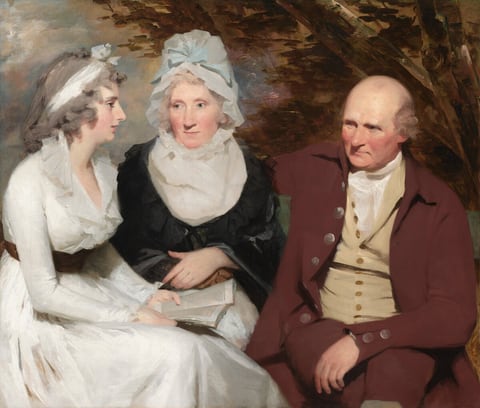
  1. John Johnstone, Betty Johnstone, and Miss Wedderburn, by Sir Henry Raeburn, c. 1790/1795
    John Johnstone, Betty Johnstone, and Miss WedderburnSir Henry Raeburn, c. 1790/1795Courtesy National Gallery of Art, Washington
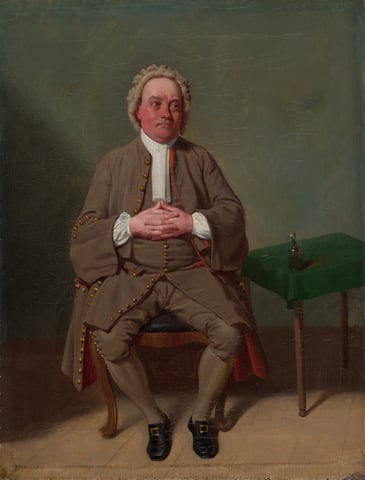
  2. A work made of oil on canvas.
    Mr. Quick as Vellum in Addison's DrummerSamuel De Wilde, 1792Courtesy of the Art Institute of Chicago
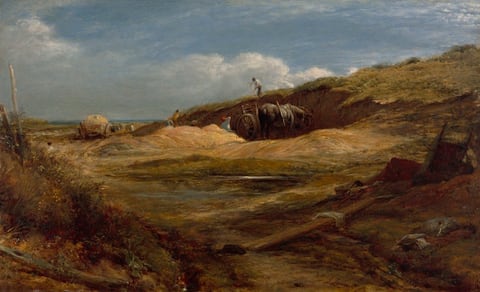
  3. A work made of oil on panel.
    The Sand Pits, Hampstead HeathJohn Linnell, 1834Courtesy of the Art Institute of Chicago
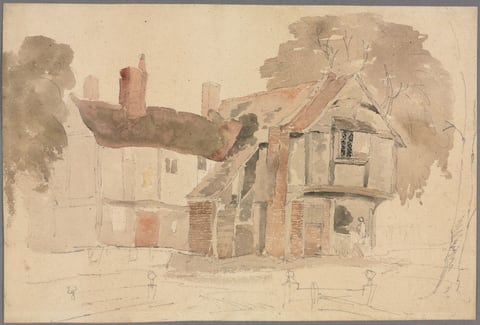
  4. Bray Church Yard, by John Varley, 1807
    Bray Church YardJohn Varley, 1807Courtesy of the Cleveland Museum of Art

Section 2, north wall
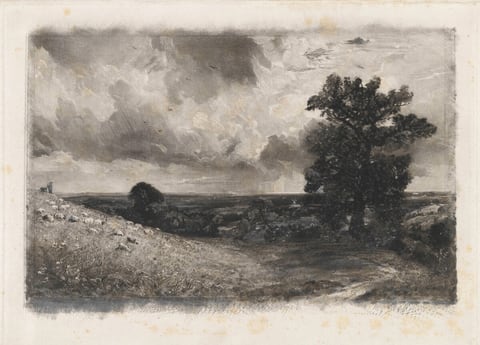
  1. The image shows a landscape with a rolling hill in the foreground sloping downward. The horizon is high, providing a view over fields and sky. Sheep graze on the hill, tended by a person. A large, dark tree is on the right. Brushstrokes vary in the sky and land, with broad strokes for clouds and finer ones for grass and foliage. The color palette is mainly black, white, and shades of grey, highlighting light and shadow.
    NoonDavid Lucas, 1830Courtesy National Gallery of Art, Washington
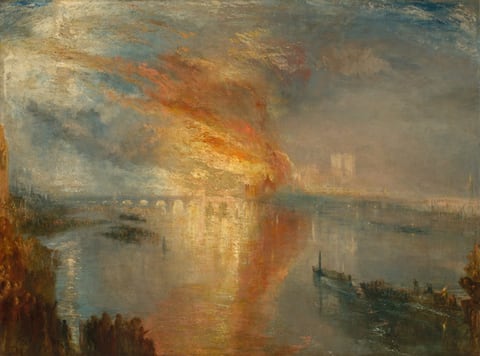
  2. The Burning of the Houses of Lords and Commons, 16 October 1834, by Joseph Mallord William Turner, 1835
    The Burning of the Houses of Lords and Commons, 16 October 1834Joseph Mallord William Turner, 1835Courtesy of the Cleveland Museum of Art
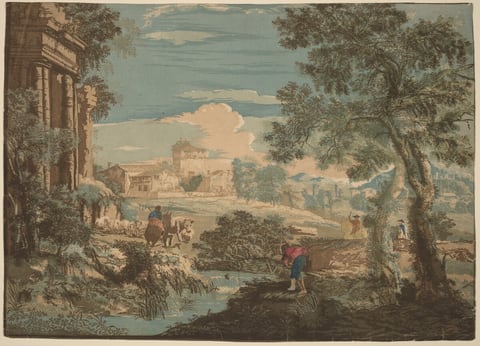
  3. The image shows a landscape scene from an elevated viewpoint. There are large columns of a classical ruin and a leafy tree on the left. On the right, there is a spreading tree with intricate leaves. In the background, there is a pastoral landscape with figures and animals. A shepherd and a cow are guiding a flock of sheep, and buildings can be seen in the distance. The horizon divides the image into sky and earth. The brushstrokes are detailed, capturing textures effectively. The color palette consists of earthy tones with touches of brighter colors on the figures' clothing.
    Heroic Landscape with Fisherman, Cows, and HorsemenJohn Baptist Jackson, 1744Courtesy National Gallery of Art, Washington

Section 3, north wall
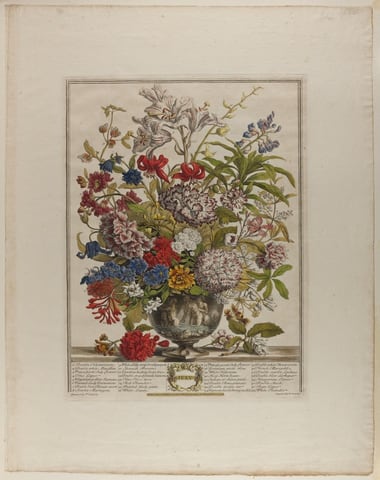
  1. A work made of engraving in black ink with opaque and translucent watercolor on cream laid paper.
    July, from Twelve Months of FlowersHenry Fletcher, n.d.Courtesy of the Art Institute of Chicago
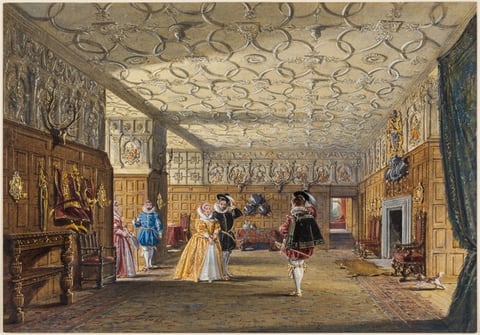
  2. A work made of watercolor and gouache, heightened with white gouache, over graphite selectively gum varnished on cream wove card.
    The Hall, Levens, WestmorelandJoseph Nash, n.d.Courtesy of the Art Institute of Chicago