Floor plan

Style galleriesGeorgian Britain

Georgian Britain

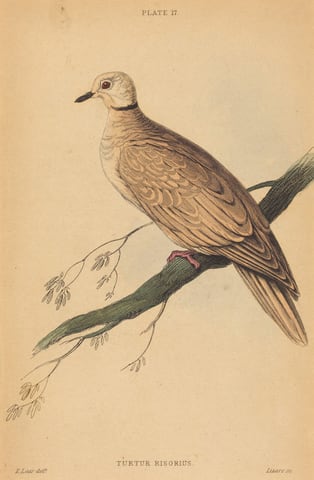
This is a drawing of a bird perched on a branch. The bird is detailed and identified as "Turtur Risorius." It rests on a green textured branch against a plain background. The bird has a black ring around its neck, soft brown plumage with intricate feather patterns, and light pink legs. Its eye is prominent and outlined within its head design. The branch is minimalist with small buds and thin twigs.
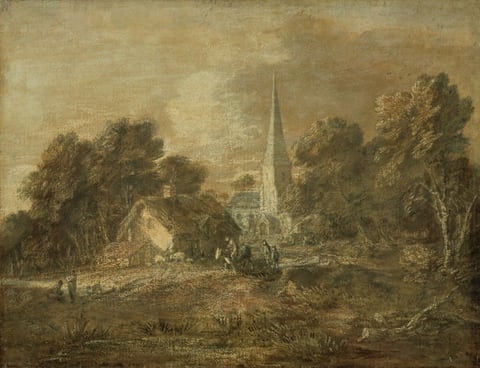
A work made of varnished gouache, over black and red chalks, on cream laid paper, laid down on canvas, stretched on a wooden stretcher and varnished again.
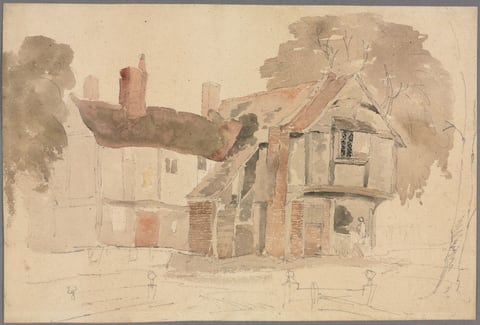
Bray Church Yard, by John Varley, 1807
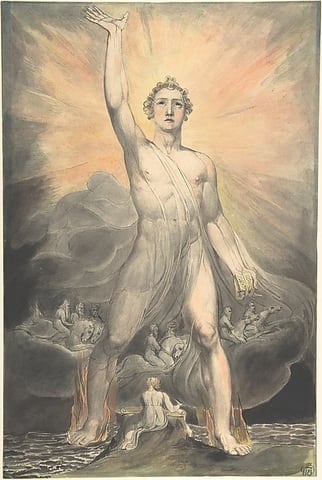
Angel of the Revelation (Book of Revelation, chapter 10), by William Blake, ca. 1803–5
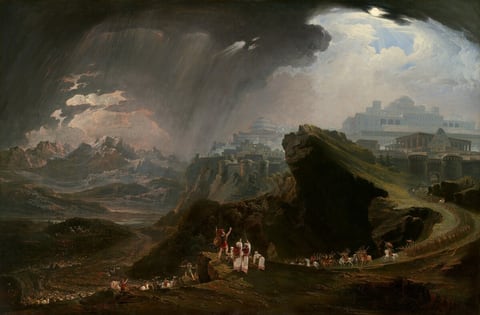
Armies of men march and battle along a rocky outcropping set among huge rock formations and massive buildings under a stormy sky in this horizontal landscape painting. The people we can see all have pale skin. Sheets of rain fall from flint-gray clouds on our left into a valley, though hints of peach brighten the clouds along the mountainous horizon there. In the right half of the sky, light pours down from a brilliant white sun that breaks through white clouds to reveal topaz-blue patches of sky. The horizon comes about halfway up the composition and is lined with rugged white, pale pink, and olive-green mountains on our left and silvery-white buildings along the right half. These structures include two domed buildings and a colosseum among many others. The buildings are all enclosed within city walls buttressed with towers. The land dips precipitously from the rocky cliffs supporting the buildings, to sweep down toward us. A huge outcropping angles up like a ramp between us and the buildings in the distance. A road runs from the walled town toward us, down along the ridge and in front of the outcropping. Countless warriors march in rows of four or five across on the road past a man wearing a feathered helmet and armored breastplate. This man, Joshua, stands on a rocky precipice facing away from us with his right hand raised. He wears a scarlet-red toga under his breastplate, and a royal-blue cape flutters at his left side. He holds a round, copper-colored shield and a spear in his other hand. Two men with gray beards stand near Joshua with their backs to us. Both gesture up to the sky. One holds a slender staff and the other a curling horn. They and another pair of men, who stoop to hold poles used to carry a chest, all wear long, ivory-white robes, cherry-red drapery, and white turbans. The column of soldiers on foot and horseback pass in front of Joshua to a massive battlefield to our left. The fight takes place in a valley that leads back to a river. A bolt of lightning zigzags from the storm clouds and strikes a city in the deep distance. The artist signed the painting in the lower right, “J. Martin.”
John Johnstone, Betty Johnstone, and Miss Wedderburn, by Sir Henry Raeburn, c. 1790/1795

The works in this room are listed below.

Works in this room

Portraits, conversation pieces and watercolour landscapes from Hogarth to Constable.

Section 1, north wall

  1. This is a drawing of a bird perched on a branch. The bird is detailed and identified as "Turtur Risorius." It rests on a green textured branch against a plain background. The bird has a black ring around its neck, soft brown plumage with intricate feather patterns, and light pink legs. Its eye is prominent and outlined within its head design. The branch is minimalist with small buds and thin twigs.
    Turtur RisoriusWilliam Home LizarsCourtesy National Gallery of Art, Washington
  2. A work made of varnished gouache, over black and red chalks, on cream laid paper, laid down on canvas, stretched on a wooden stretcher and varnished again.
    Wooded Landscape with Village SceneThomas Gainsborough, early 1770s (not later than 1772)Courtesy of the Art Institute of Chicago
  3. Bray Church Yard, by John Varley, 1807
    Bray Church YardJohn Varley, 1807Courtesy of the Cleveland Museum of Art
  4. Angel of the Revelation (Book of Revelation, chapter 10), by William Blake, ca. 1803–5
    Angel of the Revelation (Book of Revelation, chapter 10)William Blake, ca. 1803–5Courtesy of The Metropolitan Museum of Art

Section 1, south wall

  1. Armies of men march and battle along a rocky outcropping set among huge rock formations and massive buildings under a stormy sky in this horizontal landscape painting. The people we can see all have pale skin. Sheets of rain fall from flint-gray clouds on our left into a valley, though hints of peach brighten the clouds along the mountainous horizon there. In the right half of the sky, light pours down from a brilliant white sun that breaks through white clouds to reveal topaz-blue patches of sky. The horizon comes about halfway up the composition and is lined with rugged white, pale pink, and olive-green mountains on our left and silvery-white buildings along the right half. These structures include two domed buildings and a colosseum among many others. The buildings are all enclosed within city walls buttressed with towers. The land dips precipitously from the rocky cliffs supporting the buildings, to sweep down toward us. A huge outcropping angles up like a ramp between us and the buildings in the distance. A road runs from the walled town toward us, down along the ridge and in front of the outcropping. Countless warriors march in rows of four or five across on the road past a man wearing a feathered helmet and armored breastplate. This man, Joshua, stands on a rocky precipice facing away from us with his right hand raised. He wears a scarlet-red toga under his breastplate, and a royal-blue cape flutters at his left side. He holds a round, copper-colored shield and a spear in his other hand. Two men with gray beards stand near Joshua with their backs to us. Both gesture up to the sky. One holds a slender staff and the other a curling horn. They and another pair of men, who stoop to hold poles used to carry a chest, all wear long, ivory-white robes, cherry-red drapery, and white turbans. The column of soldiers on foot and horseback pass in front of Joshua to a massive battlefield to our left. The fight takes place in a valley that leads back to a river. A bolt of lightning zigzags from the storm clouds and strikes a city in the deep distance. The artist signed the painting in the lower right, “J. Martin.”
    Joshua Commanding the Sun to Stand Still upon GibeonJohn Martin, 1816Courtesy National Gallery of Art, Washington
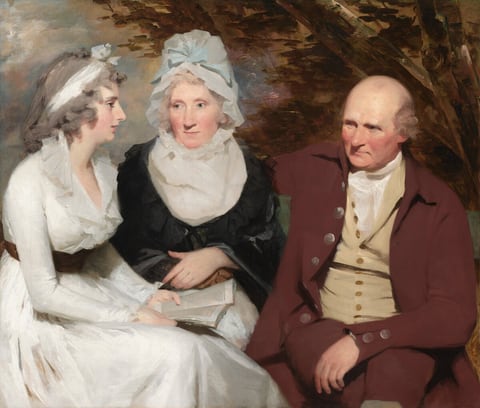
  2. John Johnstone, Betty Johnstone, and Miss Wedderburn, by Sir Henry Raeburn, c. 1790/1795
    John Johnstone, Betty Johnstone, and Miss WedderburnSir Henry Raeburn, c. 1790/1795Courtesy National Gallery of Art, Washington

Section 2, south wall
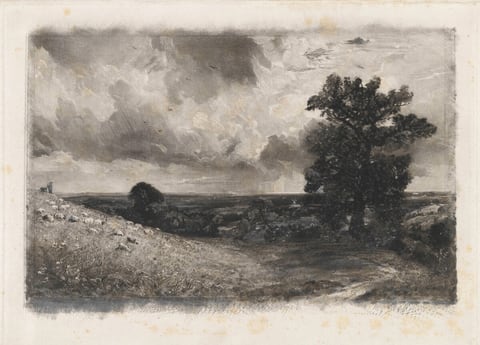
  1. The image shows a landscape with a rolling hill in the foreground sloping downward. The horizon is high, providing a view over fields and sky. Sheep graze on the hill, tended by a person. A large, dark tree is on the right. Brushstrokes vary in the sky and land, with broad strokes for clouds and finer ones for grass and foliage. The color palette is mainly black, white, and shades of grey, highlighting light and shadow.
    NoonDavid Lucas, 1830Courtesy National Gallery of Art, Washington
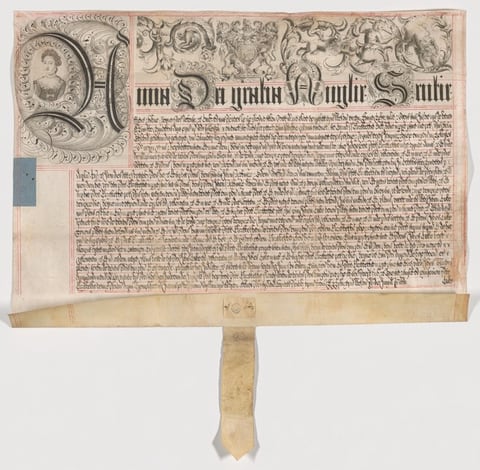
  2. A work made of engraved letterhead, pen and ink calligraphy, and graphite ruling on parchment, folded with strap and (missing) seal.
    Recovery Document (Land Title Grant)Unrecorded British maker, 1702/14 (Queen Anne period)Courtesy of the Art Institute of Chicago
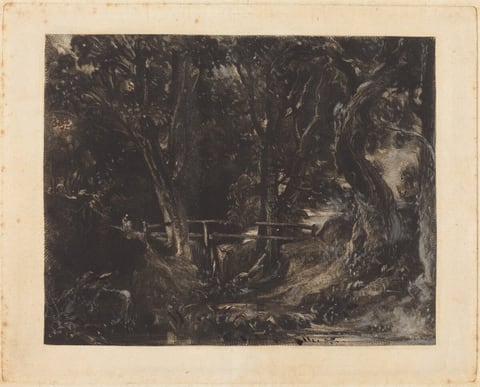
  3. The image shows a landscape scene with a frontal view of a dense forest. A wooden bridge spans across a narrow ravine or creek. The painting features vigorous and textural brushstrokes with dark tones creating a shadowy effect. The color palette includes deep blacks, dark browns, and occasional highlights of light filtering through the canopy. In the distance, lighter areas suggest a path leading further into the woods, surrounded by trees and undergrowth.
    A Dell at Helmingham Park, SuffolkDavid Lucas, 1830Courtesy National Gallery of Art, Washington
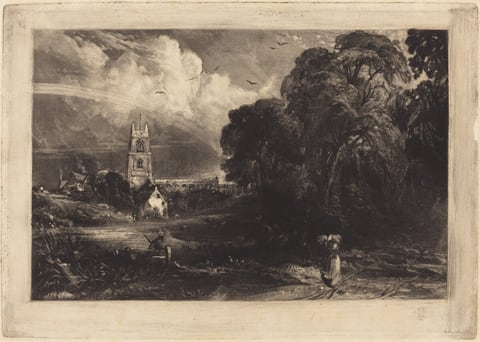
  4. The image displays a landscape with a high vantage point. The horizon is low, with a row of trees. A church tower is off-center to the left. The church is surrounded by trees and buildings. A line of trees is on the right side. The sky has large, expressive clouds. A monochromatic palette of gray is used. A path winds through the scene, with two figures: one person working and another walking.
    Stoke-by-NeylandDavid Lucas, 1830Courtesy National Gallery of Art, Washington

Section 2, north wall
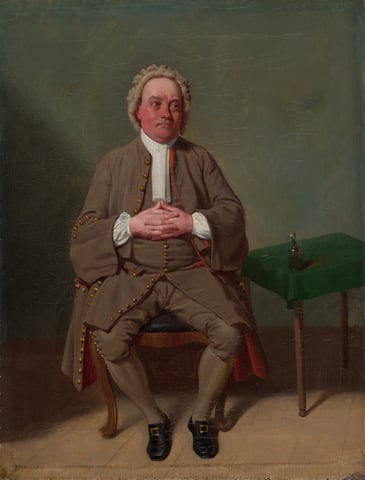
  1. A work made of oil on canvas.
    Mr. Quick as Vellum in Addison's DrummerSamuel De Wilde, 1792Courtesy of the Art Institute of Chicago
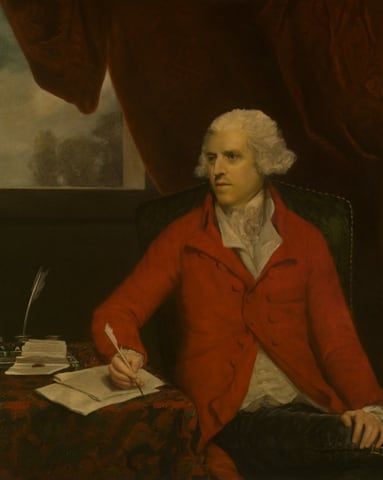
  2. A work made of oil on canvas.
    Sir Thomas Rumbold, Bt.Joshua Reynolds, 1788Courtesy of the Art Institute of Chicago
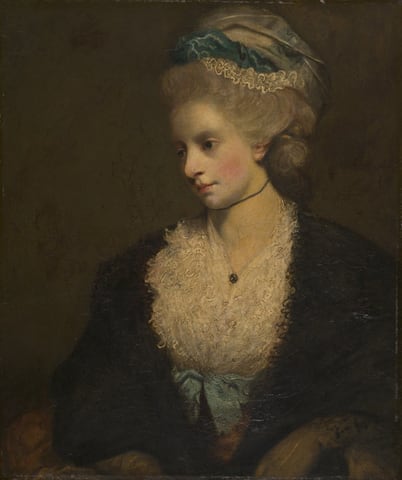
  3. A work made of oil on canvas.
    Theophilia GwatkinJoshua Reynolds, 1776–81Courtesy of the Art Institute of Chicago
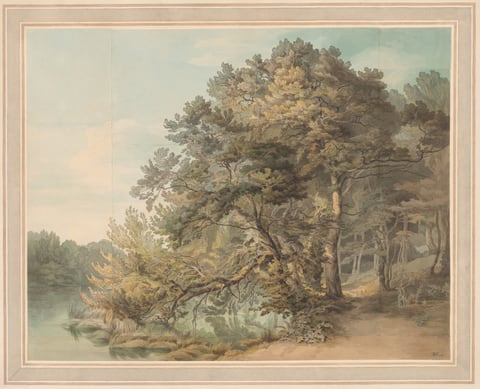
  4. The image shows a forest by a serene, tree-lined body of water. The horizon is high with tall trees extending close to it, creating a sense of depth. The brushstrokes and watercolor application are delicate, capturing textures of leaves and water gently. The color palette includes muted greens, soft browns, and hints of blue and cream. Closest to us is a dense cluster of trees on the right, curving over the water. Across the water, other tree clusters and shrubs recede into the misty background towards the left.
    Peamore, DevonJohn White Abbott, 1799Courtesy National Gallery of Art, Washington

Section 3, north wall
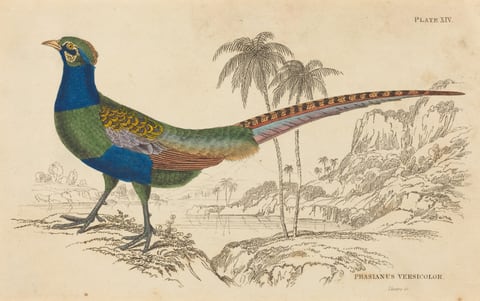
  1. The image shows a pheasant with vivid green and blue plumage and intricate golden patterns on its wings. The bird has long, patterned tail feathers extended to the right. The background includes palm trees, rocky outcrops, and distant hills.
    Phasianus VersicolorWilliam Home LizarsCourtesy National Gallery of Art, Washington
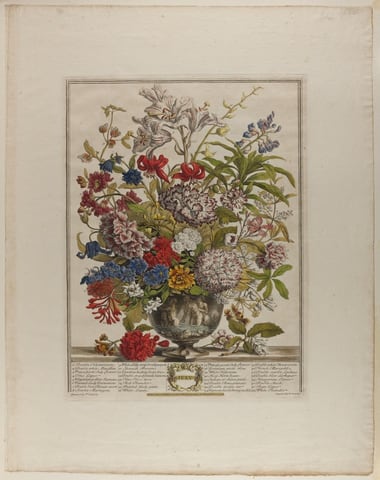
  2. A work made of engraving in black ink with opaque and translucent watercolor on cream laid paper.
    July, from Twelve Months of FlowersHenry Fletcher, n.d.Courtesy of the Art Institute of Chicago