Floor plan

Style galleriesDutch and Flemish Baroque
Dutch and Flemish Baroque
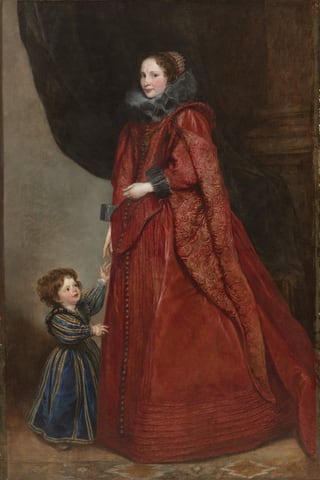
A Genoese Lady with Her Child, by Anthony van Dyck, c. 1623–25
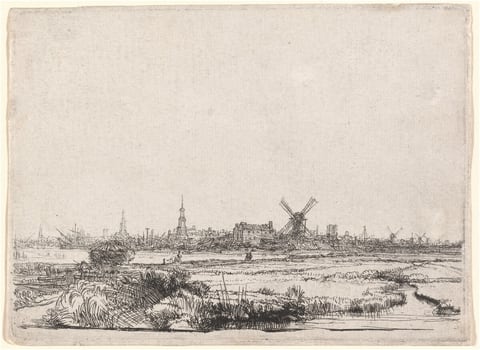
View of Amsterdam from the Northwest, by Rembrandt van Rijn, c. 1640
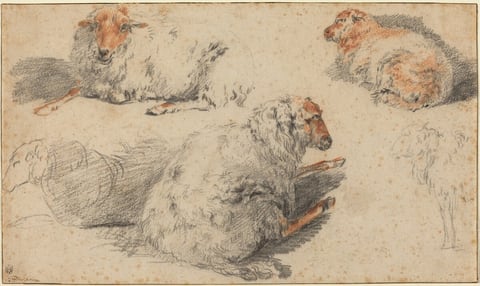
This is a drawing of multiple sheep in various poses. The full-page illustration depicts several sheep lying down. The fur of the sheep is textured with detailed pencil strokes, and there are subtle hints of shadow beneath each animal. There is a combination of different angles and poses, showing the sheep from different perspectives. The drawing also contains some rough sketches and outlines, suggesting movement and presence without complete detail. The background is plain.
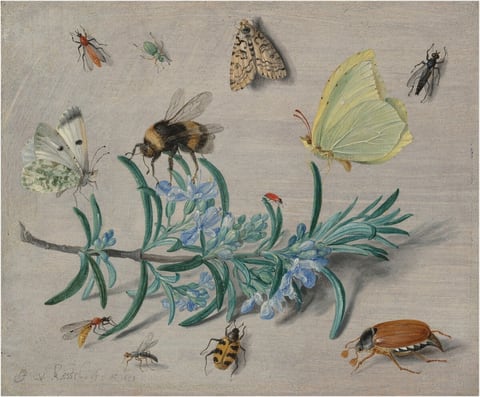
A sprig of flowering rosemary lying against an ivory-white background and the twelve insects that surround it fills this horizontal painting. Stretching nearly the length of the composition with the cut end to our left, the rosemary has blunted, needle-like, gently curling teal-green leaves and small periwinkle-blue flowers along the ash-brown stem. Several insects perch on the sprig while others are seen as if looking from overhead, resting on the white background. The three largest insects perch along the top of the sprig, with an ivory-white butterfly with moss-green and black markings to the left, a black and golden, fuzzy bumblebee near the center, and a lemon-yellow butterfly with red antennae to our right. A tiny red insect, perhaps a ladybug without spots, sits on a leaf between the bee and yellow butterfly, and a small wasp-like insect rests on a leaf in at the lower left. Another mosquito-like insect alights on the surface nearby, next to a beetle with a honey-orange body with black, almost tiger-like stripes. A large cockroach sitting near the lower right corner has six spindly legs, a mahogany-colored abdomen, a black thorax, and tiny, black head. Spaced somewhat evenly across the top of the panel are a brick-red, winged insect to the left, a mint-green, beetle-like bug near a moth patterned with bone white and black, and a black, fly-like insect to our right. Lit from the upper left, the rosemary and insects cast shadows on the surface. The artist signed and dated the work with gray in the lower left corner: “J v. kessel . . f. Ao 1653.”
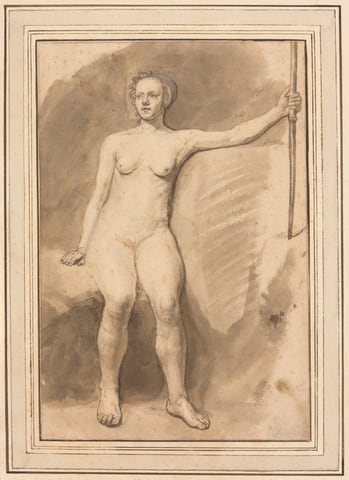
A work made of pen and brown ink and brush and brown wash, with traces of black chalk and opaque white watercolor, on cream laid paper, laid down on cream laid paper.
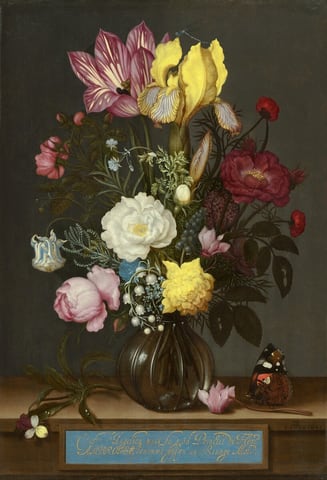
Gathered in a round glass vase, a tall bouquet of flowers in shades of light and deep pink, sunshine yellow, and white with pine-green leaves nearly fills this vertical still life painting. Shown against an gray background, the vase sits on a narrow ledge, perhaps made of wood. A label with looping, cursive French text painted in gold against a baby blue background is affixed to the front of the ledge, along the bottom edge of the composition. The text reads, “C'est l'Angelicq main du grad Peinctre de Flore AMBROISE, renommé jusqu' au Rivage Moré.” A few of the flowers draw the eye, including a tulip and iris at the top of the bouquet. To our left, the tulip is mauve pink with cream-colored streaks, and one petal folds down to reveal the stamen inside. Next to it, a damselfly, an insect like a delicate dragonfly, rests on the vibrant yellow iris. The petals curling down from the iris are veined in muted burgundy red. Flowers filling in the bouquet below include a shell-pink cyclamen, a white gardenia, a closed blue and white striped columbine, a slate-blue grape hyacinth, lily of the valley, pale blue forget-me-nots, and a pink peony interspersed with leaves and greenery. The round glass vase has a narrow opening. A sprig of viola rests to our left of the vase on the ledge, and an orange, black, white, and brown butterfly perches on the stem of a pink cyclamen laying to our right of the vase. The artist signed the painting with a monogram and dated it in dark paint to our right on the face of the ledge: “AB 1621.”
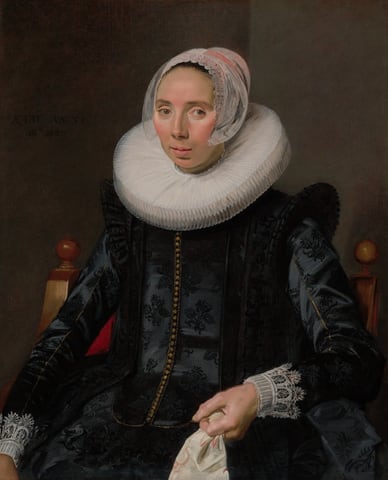
A work made of oil on canvas.
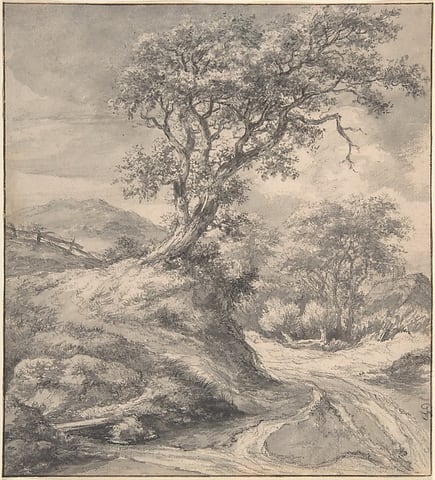
Dune Landscape with Oak Tree, by Jacob van Ruisdael, 1650–55

The works in this room are listed below.

Works in this room

The Low Countries in the 1600s: Rubens's Antwerp and the painters of the Dutch Republic.

First room, north wall

  1. A Genoese Lady with Her Child, by Anthony van Dyck, c. 1623–25
    A Genoese Lady with Her ChildAnthony van Dyck, c. 1623–25Courtesy of the Cleveland Museum of Art
  2. View of Amsterdam from the Northwest, by Rembrandt van Rijn, c. 1640
    View of Amsterdam from the NorthwestRembrandt van Rijn, c. 1640Courtesy National Gallery of Art, Washington
  3. This is a drawing of multiple sheep in various poses. The full-page illustration depicts several sheep lying down. The fur of the sheep is textured with detailed pencil strokes, and there are subtle hints of shadow beneath each animal. There is a combination of different angles and poses, showing the sheep from different perspectives. The drawing also contains some rough sketches and outlines, suggesting movement and presence without complete detail. The background is plain.
    SheepNicolaes BerchemCourtesy National Gallery of Art, Washington
  4. A sprig of flowering rosemary lying against an ivory-white background and the twelve insects that surround it fills this horizontal painting. Stretching nearly the length of the composition with the cut end to our left, the rosemary has blunted, needle-like, gently curling teal-green leaves and small periwinkle-blue flowers along the ash-brown stem. Several insects perch on the sprig while others are seen as if looking from overhead, resting on the white background. The three largest insects perch along the top of the sprig, with an ivory-white butterfly with moss-green and black markings to the left, a black and golden, fuzzy bumblebee near the center, and a lemon-yellow butterfly with red antennae to our right. A tiny red insect, perhaps a ladybug without spots, sits on a leaf between the bee and yellow butterfly, and a small wasp-like insect rests on a leaf in at the lower left. Another mosquito-like insect alights on the surface nearby, next to a beetle with a honey-orange body with black, almost tiger-like stripes. A large cockroach sitting near the lower right corner has six spindly legs, a mahogany-colored abdomen, a black thorax, and tiny, black head. Spaced somewhat evenly across the top of the panel are a brick-red, winged insect to the left, a mint-green, beetle-like bug near a moth patterned with bone white and black, and a black, fly-like insect to our right. Lit from the upper left, the rosemary and insects cast shadows on the surface. The artist signed and dated the work with gray in the lower left corner: “J v. kessel . . f. Ao 1653.”
    Insects and a Sprig of RosemaryJan van Kessel the Elder, 1653Courtesy National Gallery of Art, Washington

First room, south wall

  1. A work made of pen and brown ink and brush and brown wash, with traces of black chalk and opaque white watercolor, on cream laid paper, laid down on cream laid paper.
    Seated Female NudeSamuel van Hoogstraten, 1647/78Courtesy of the Art Institute of Chicago
  2. Gathered in a round glass vase, a tall bouquet of flowers in shades of light and deep pink, sunshine yellow, and white with pine-green leaves nearly fills this vertical still life painting. Shown against an gray background, the vase sits on a narrow ledge, perhaps made of wood. A label with looping, cursive French text painted in gold against a baby blue background is affixed to the front of the ledge, along the bottom edge of the composition. The text reads, “C'est l'Angelicq main du grad Peinctre de Flore AMBROISE, renommé jusqu' au Rivage Moré.” A few of the flowers draw the eye, including a tulip and iris at the top of the bouquet. To our left, the tulip is mauve pink with cream-colored streaks, and one petal folds down to reveal the stamen inside. Next to it, a damselfly, an insect like a delicate dragonfly, rests on the vibrant yellow iris. The petals curling down from the iris are veined in muted burgundy red. Flowers filling in the bouquet below include a shell-pink cyclamen, a white gardenia, a closed blue and white striped columbine, a slate-blue grape hyacinth, lily of the valley, pale blue forget-me-nots, and a pink peony interspersed with leaves and greenery. The round glass vase has a narrow opening. A sprig of viola rests to our left of the vase on the ledge, and an orange, black, white, and brown butterfly perches on the stem of a pink cyclamen laying to our right of the vase. The artist signed the painting with a monogram and dated it in dark paint to our right on the face of the ledge: “AB 1621.”
    Bouquet of Flowers in a Glass VaseAmbrosius Bosschaert, 1621Courtesy National Gallery of Art, Washington
  3. A work made of oil on canvas.
    Portrait of a LadyFrans Hals, 1627Courtesy of the Art Institute of Chicago
  4. Dune Landscape with Oak Tree, by Jacob van Ruisdael, 1650–55
    Dune Landscape with Oak TreeJacob van Ruisdael, 1650–55Courtesy of The Metropolitan Museum of Art

Second room, south wall
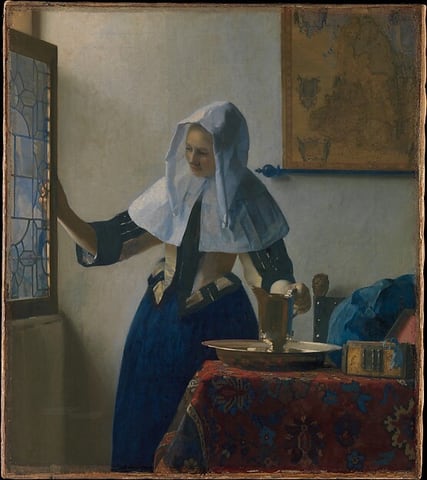
  1. Young Woman with a Water Pitcher, by Johannes Vermeer, ca. 1662
    Young Woman with a Water PitcherJohannes Vermeer, ca. 1662Courtesy of The Metropolitan Museum of Art
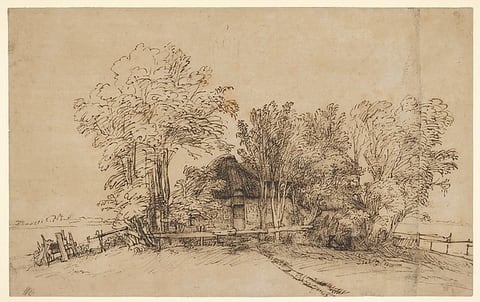
  2. Cottage among Trees, by Rembrandt van Rijn, ca. 1650
    Cottage among TreesRembrandt van Rijn, ca. 1650Courtesy of The Metropolitan Museum of Art
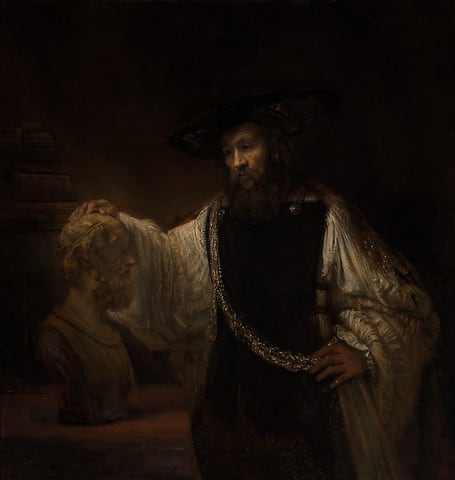
  3. Aristotle with a Bust of Homer, by Rembrandt van Rijn, 1653
    Aristotle with a Bust of HomerRembrandt van Rijn, 1653Courtesy of The Metropolitan Museum of Art
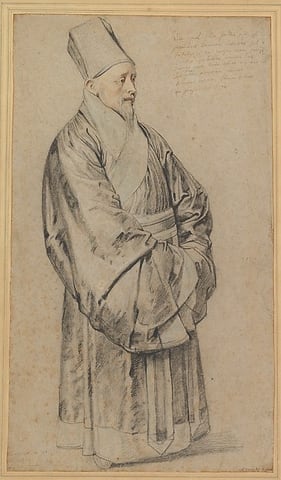
  4. Portrait of Nicolas Trigault in Chinese Costume, by Peter Paul Rubens, 1617
    Portrait of Nicolas Trigault in Chinese CostumePeter Paul Rubens, 1617Courtesy of The Metropolitan Museum of Art

Second room, north wall
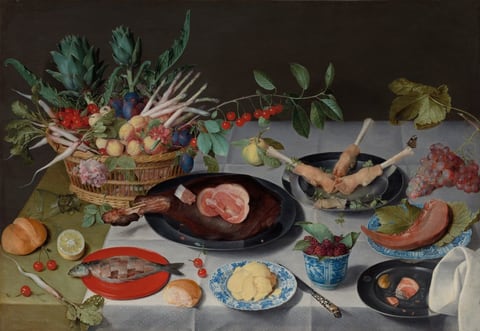
  1. Still Life with Meat, Fish, Vegetables, and Fruit, by Jacob van Hulsdonck, c. 1615–20
    Still Life with Meat, Fish, Vegetables, and FruitJacob van Hulsdonck, c. 1615–20Courtesy of the Cleveland Museum of Art
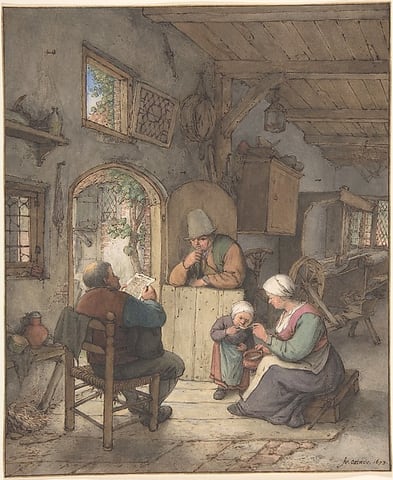
  2. Reading the News at the Weavers' Cottage, by Adriaen van Ostade, 1673
    Reading the News at the Weavers' CottageAdriaen van Ostade, 1673Courtesy of The Metropolitan Museum of Art

Third room, north wall
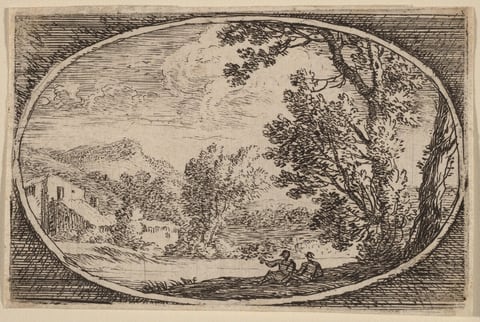
  1. The image shows an oval framing a scene with mountains, clouds, and trees. Delicate etched lines create textures in the landscape. The color palette is monochrome. Two figures are sitting under leafy trees, with a structure nearby.
    Two Men Seated Near the WatersideHerman van SwaneveltCourtesy National Gallery of Art, Washington
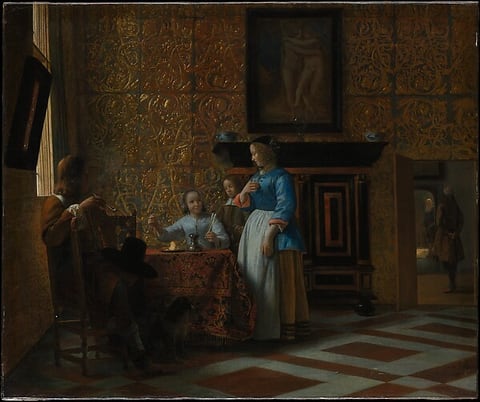
  2. Leisure Time in an Elegant Setting, by Pieter de Hooch, ca. 1663–65
    Leisure Time in an Elegant SettingPieter de Hooch, ca. 1663–65Courtesy of The Metropolitan Museum of Art