Floor plan

Style galleriesAntebellum America

Antebellum America

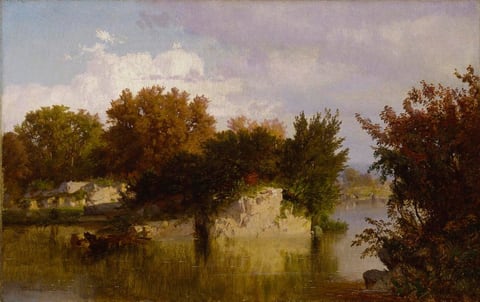
Trees along Stream in Fall, by William Trost Richards, 1861
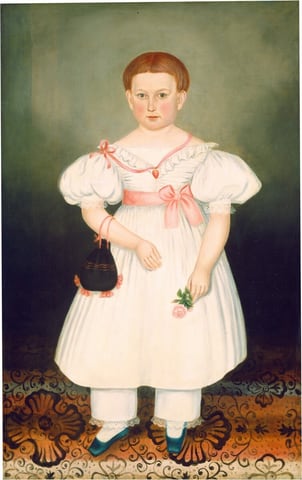
The image shows a child standing upright, facing forward. They have fair skin, rounded cheeks, short reddish-brown hair, and are wearing a white dress with lace details and a pink ribbon, white pants with lace trim, blue shoes, a red necklace and a heart-shaped pendant. They hold a light pink rose in their left hand and a small black drawstring purse with red accents in their right hand. The background is a gradient from dark green to light green, with a floral-patterned carpet in black, brown, and red on the floor.
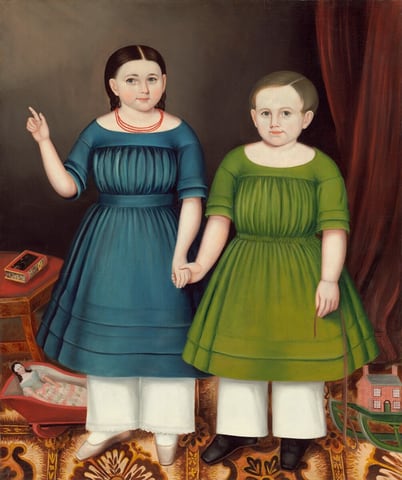
The image features two young children standing side by side. The child on the left extends one arm sideways and has the other arm lowered, while the child on the right has both arms relaxed by their sides, one holding a string. Both children have round faces with light complexions; the child on the left has dark brown hair styled in waves down to the shoulders, while the child on the right has light brown hair. The child on the left is dressed in a blue dress with a loosely gathered waist and short sleeves, white stockings, white shoes, and a red beaded necklace. The child on the right wears a green dress with similar design features, white stockings, and black shoes. Near their feet are a toy doll in a red cradle and a small toy house. In the background, there is a plain dark wall, a deep red drapery, a carpet with elaborate patterns, and a small wooden table with a box on top.
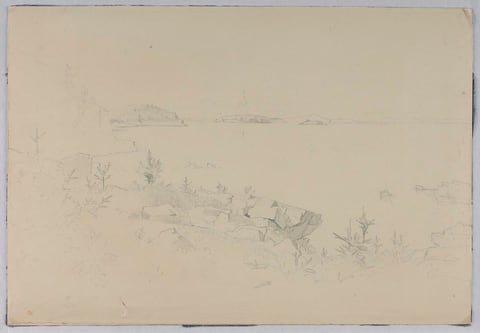
STUDY OF SEASCAPE. PORCUPINE ISLANDS, BAR HARBOR, ME
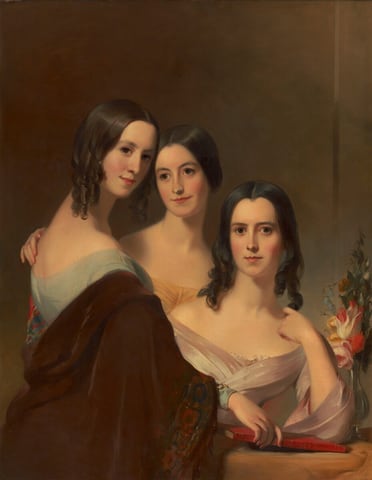
In this painting, three women are depicted standing and sitting closely together. The women have fair complexions and dark hair in ringlets, and they are smiling slightly. The woman on the left appears to be standing, and her body is turned to the right while her head is turned over her shoulder to face us. She wears a light blue dress with a brown shawl, and she is holding the edge of a red book that rests on a small table in the bottom right corner. The woman in the middle also appears to be standing, and she is wearing a golden-yellow off-the-shoulder garment. One of her hands is on the shoulder of the woman on the left. The woman on the right is seated at the small table, and she wears a pale pink off-the-shoulder dress. She looks directly out at us. The small table is covered in a golden cloth, and on the right is a vase of colorful flowers. The wall behind the woman is a blend of brown, tan, and pale blue tones.
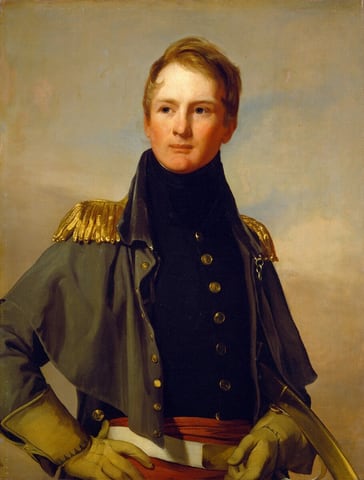
Major Thomas Biddle, by Thomas Wilcocks Sully, 1832

The works in this room are listed below.

Works in this room

American art between the young republic and the Civil War.

First room, north wall

  1. Trees along Stream in Fall, by William Trost Richards, 1861
    Trees along Stream in FallWilliam Trost Richards, 1861Courtesy of the Smithsonian American Art Museum
  2. The image shows a child standing upright, facing forward. They have fair skin, rounded cheeks, short reddish-brown hair, and are wearing a white dress with lace details and a pink ribbon, white pants with lace trim, blue shoes, a red necklace and a heart-shaped pendant. They hold a light pink rose in their left hand and a small black drawstring purse with red accents in their right hand. The background is a gradient from dark green to light green, with a floral-patterned carpet in black, brown, and red on the floor.
    Girl with Reticule and RoseJoseph Whiting Stock, c. 1840Courtesy National Gallery of Art, Washington
  3. The image features two young children standing side by side. The child on the left extends one arm sideways and has the other arm lowered, while the child on the right has both arms relaxed by their sides, one holding a string. Both children have round faces with light complexions; the child on the left has dark brown hair styled in waves down to the shoulders, while the child on the right has light brown hair. The child on the left is dressed in a blue dress with a loosely gathered waist and short sleeves, white stockings, white shoes, and a red beaded necklace. The child on the right wears a green dress with similar design features, white stockings, and black shoes. Near their feet are a toy doll in a red cradle and a small toy house. In the background, there is a plain dark wall, a deep red drapery, a carpet with elaborate patterns, and a small wooden table with a box on top.
    Mary and Francis WilcoxJoseph Whiting Stock, 1845Courtesy National Gallery of Art, Washington

First room, south wall

  1. STUDY OF SEASCAPE. PORCUPINE ISLANDS, BAR HARBOR, ME
    Study of seascape. Porcupine Islands, Bar Harbor, MEWilliam Stanley Haseltine, 1859Courtesy of Cooper Hewitt, Smithsonian Design Museum
  2. In this painting, three women are depicted standing and sitting closely together. The women have fair complexions and dark hair in ringlets, and they are smiling slightly. The woman on the left appears to be standing, and her body is turned to the right while her head is turned over her shoulder to face us. She wears a light blue dress with a brown shawl, and she is holding the edge of a red book that rests on a small table in the bottom right corner. The woman in the middle also appears to be standing, and she is wearing a golden-yellow off-the-shoulder garment. One of her hands is on the shoulder of the woman on the left. The woman on the right is seated at the small table, and she wears a pale pink off-the-shoulder dress. She looks directly out at us. The small table is covered in a golden cloth, and on the right is a vase of colorful flowers. The wall behind the woman is a blend of brown, tan, and pale blue tones.
    The Coleman SistersThomas Sully, 1844Courtesy National Gallery of Art, Washington
  3. Major Thomas Biddle, by Thomas Wilcocks Sully, 1832
    Major Thomas BiddleThomas Wilcocks Sully, 1832Courtesy National Gallery of Art, Washington

Second room, south wall
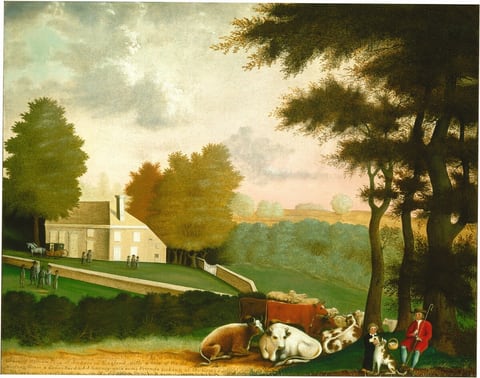
  1. This painting shows a pastoral setting with a large white-and-gray house on a hill to the left. Distant people stand in front of the house, along with a horse-drawn wagon. In the bottom right corner, two people sit in the grass under a tree, one dressed in red holding a tall crook and the other wearing a black garment and a yellow hat and petting a large brown-and-white dog. There is a basket on the ground between them, and next to them is a large herd of cows and sheep, all resting on the grass. The landscape includes trees with green leaves and yellow hills in the distance. The sky above is in pastel shades of pink and blue, with fluffy clouds. In the bottom left, a patch of yellow ground has several lines of text written over it.
    The Grave of William PennEdward Hicks, c. 1847/1848Courtesy National Gallery of Art, Washington
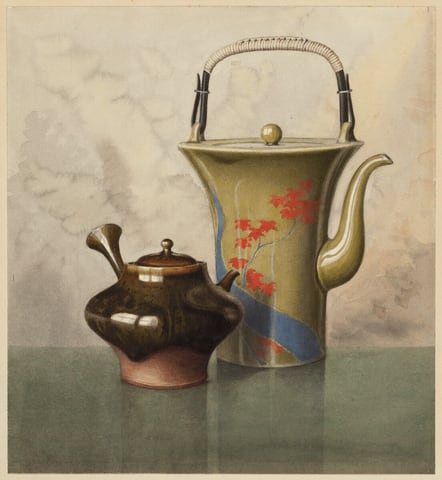
  2. There are two teapots in the image. The larger teapot has a decorative pattern of red leaves and blue curve on an olive-green background, with a white handle. The smaller teapot has a dark brown glossy finish. The color palette consists of earthy tones like browns, olive green, red, and blue. The larger teapot is positioned slightly to the right, behind the smaller one, which is in the foreground on a reflective green surface. The background has a light beige appearance.
    Asian Tea PotsHenry Farrer, n.d.Courtesy National Gallery of Art, Washington
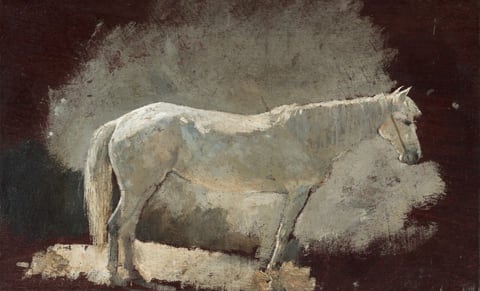
  3. White Mare, by Winslow Homer, c. 1868
    White MareWinslow Homer, c. 1868Courtesy of the Cleveland Museum of Art
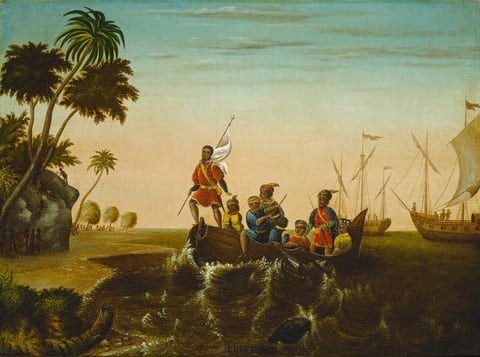
  4. The painting features a scene showing men in a boat landing on a shore. The horizon is low, with larger sailing ships seen in the distance on the right, floating on the dark green water. The central boat has around eight men in it, all with tan skin and dark hair, dressed in bright garments in shades of red, blue, and gold. Many of them wear plumed helmets and have jewelry or badges adorning them. The boat is heading towards land on the left, and one man stands at the front of the boat, holding a white flag. The land on the left is green, with tall palm trees and a rocky gray mountain. People with dark skin can be seen in on the land in the distance, some climbing the mountain and others standing beneath trees. The sky is a gradient from pinkish-orange near the horizon to light blue at the top of the painting, with a few faint gray clouds.
    The Landing of ColumbusEdward Hicks, c. 1837Courtesy National Gallery of Art, Washington

Second room, north wall
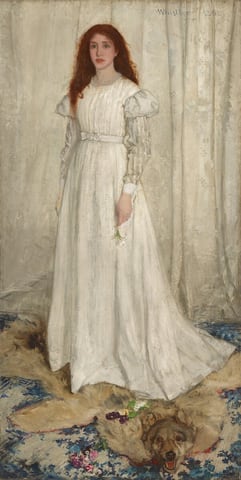
  1. A young woman with pale, peachy skin, wearing a long, flowing white dress, stands in front of a white curtain in this vertical portrait painting. Her auburn-red hair cascades down over and behind her shoulders. She looks to our left with green eyes, and her pink, full lips are closed. Her dress has puffed shoulders above a white-on-white striped pattern on the long sleeves. She stands on an animal pelt; it is not clear whether it is a wolf or a bear. The pelt spans the width of the painting and overlaps a blue patterned carpet. The animal’s mouth gapes to show sharp teeth. Its glassy eyes are wide open, and it seems to look at us. The edges of the animal skin are red. The woman holds a white lily by her side in her left hand, while yellow and purple flowers lie scattered on the pelt.
    Symphony in White, No. 1: The White GirlJames McNeill Whistler, 1861-1863, 1872Courtesy National Gallery of Art, Washington
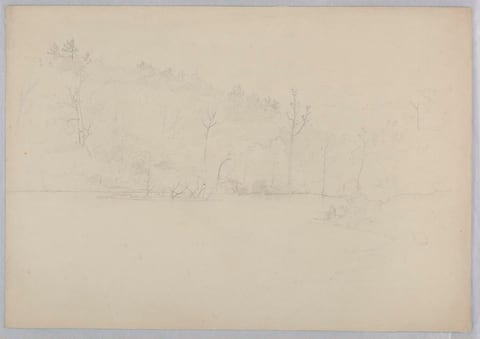
  2. STUDY OF LANDSCAPE, DELAWARE RIVER
    Study of landscape, Delaware RiverWilliam Stanley Haseltine, ca. 1855Courtesy of Cooper Hewitt, Smithsonian Design Museum
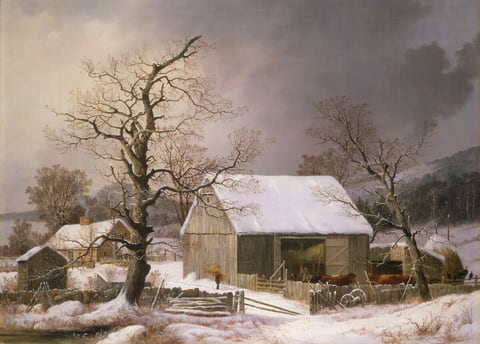
  3. This painting shows a winter landscape with snowy, rural terrain. It includes a large barn, a farmhouse, and some bare trees covered in snow. Some brown cows are fenced in by the barn on the left, and a person walking along a snowy path brings them a bundle of golden hay. The sky is overcast, with dark gray clouds, and the color palette of the painting consists of earth tones with variations of grey and brown among the white snow.
    Winter in the CountryGeorge Henry Durrie, c. 1859Courtesy National Gallery of Art, Washington

Third room, north wall
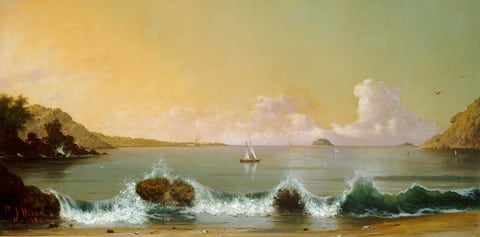
  1. Across a short stretch of sand in front of us, waves of bottle-green water break over two boulders on the shoreline, with sailboats in the water beyond, in this wide, horizontal painting. One boulder is at the left edge of the painting; the other is a short distance away, about a quarter of the way across. The water cascades down between those large rocks. Across the rest of the beach, the waves flare up to break toward us in white, foamy surf. The land curves back into view on both sides of the canvas with muted, sage-green hills and, to our left, dark green trees on more craggy boulders. A more distant finger of land to our left stretches nearly halfway across the horizon, which comes about halfway up the composition. Minuscule in scale there, smoke pours out of a chimney, which is surrounded by pale yellow buildings. A mound emerges from the horizon to our right of center. About ten sailboats float on the water. The closest one to us is near the center of the painting, and the tiny forms of people aboard can just barely be made out. The other boats become smaller as they move back to the horizon, and some are only a touch of white or gray on the canvas. White and pale lavender-purple clouds sweep up from the horizon into the sky, which glows butter yellow along the left edge. The sky cools to mint green in the upper right corner. Several white or brown birds fly across the sky or low over the water. The artist signed and dated the lower left, “M. J. Heade 1864.”
    Rio de Janeiro BayMartin Johnson Heade, 1864Courtesy National Gallery of Art, Washington
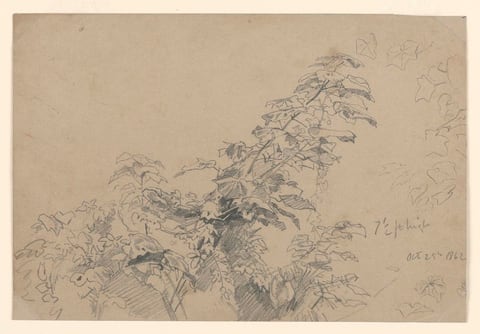
  2. STUDY OF FOLIAGE
    Study of foliageWilliam Trost Richards, October 25, 1862Courtesy of Cooper Hewitt, Smithsonian Design Museum
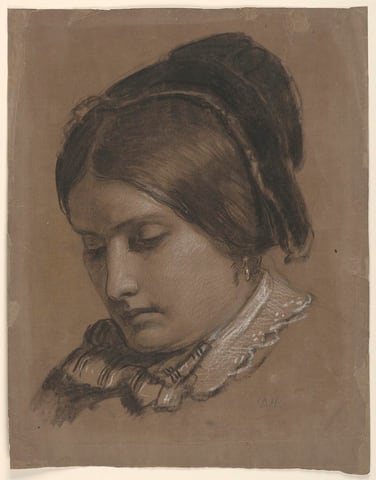
  3. THE ARTIST'S WIFE SOPHIE
    The Artist's Wife SophieDaniel Huntington, 1853Courtesy of Cooper Hewitt, Smithsonian Design Museum