Floor plan

Style galleriesAntebellum America

Antebellum America

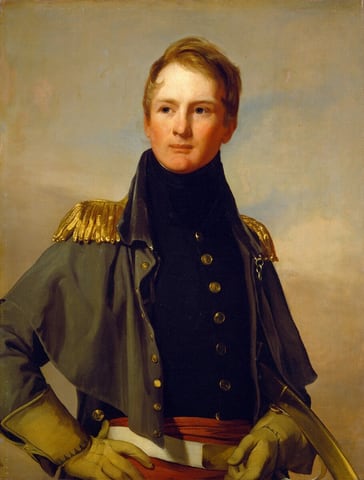
Major Thomas Biddle, by Thomas Wilcocks Sully, 1832
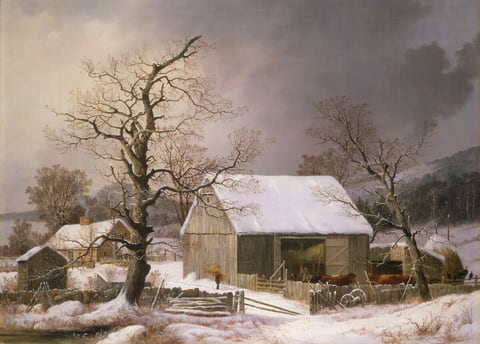
This painting shows a winter landscape with snowy, rural terrain. It includes a large barn, a farmhouse, and some bare trees covered in snow. Some brown cows are fenced in by the barn on the left, and a person walking along a snowy path brings them a bundle of golden hay. The sky is overcast, with dark gray clouds, and the color palette of the painting consists of earth tones with variations of grey and brown among the white snow.
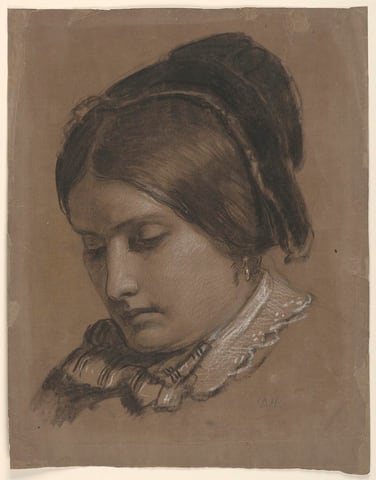
THE ARTIST'S WIFE SOPHIE
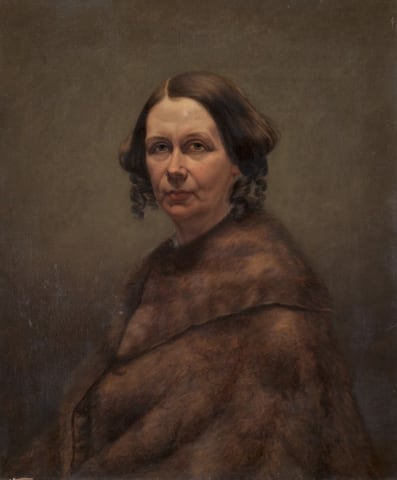
Mrs. Goss (The Woman in Fur), by Caroline L. Ransom, c. 1850s
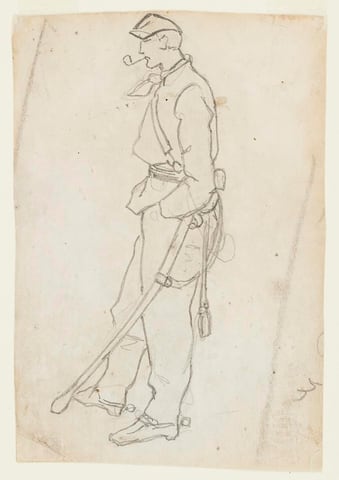
SOLDIER WITH SWORD AND PIPE
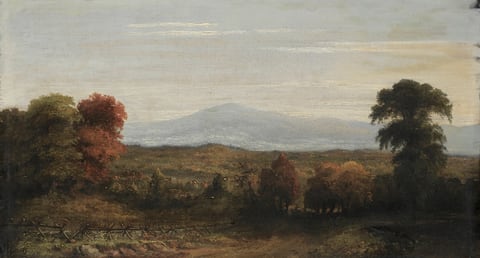
Landscape, by Jasper F. Cropsey, before 1918

The works in this room are listed below.

Works in this room

American art between the young republic and the Civil War.

First room, north wall

  1. Major Thomas Biddle, by Thomas Wilcocks Sully, 1832
    Major Thomas BiddleThomas Wilcocks Sully, 1832Courtesy National Gallery of Art, Washington
  2. This painting shows a winter landscape with snowy, rural terrain. It includes a large barn, a farmhouse, and some bare trees covered in snow. Some brown cows are fenced in by the barn on the left, and a person walking along a snowy path brings them a bundle of golden hay. The sky is overcast, with dark gray clouds, and the color palette of the painting consists of earth tones with variations of grey and brown among the white snow.
    Winter in the CountryGeorge Henry Durrie, c. 1859Courtesy National Gallery of Art, Washington
  3. THE ARTIST'S WIFE SOPHIE
    The Artist's Wife SophieDaniel Huntington, 1853Courtesy of Cooper Hewitt, Smithsonian Design Museum

First room, south wall

  1. Mrs. Goss (The Woman in Fur), by Caroline L. Ransom, c. 1850s
    Mrs. Goss (The Woman in Fur)Caroline L. Ransom, c. 1850sCourtesy of the Cleveland Museum of Art
  2. SOLDIER WITH SWORD AND PIPE
    Soldier with Sword and PipeWinslow Homer, 1862Courtesy of Cooper Hewitt, Smithsonian Design Museum
  3. Landscape, by Jasper F. Cropsey, before 1918
    LandscapeJasper F. Cropsey, before 1918Courtesy of the Cleveland Museum of Art

Second room, south wall
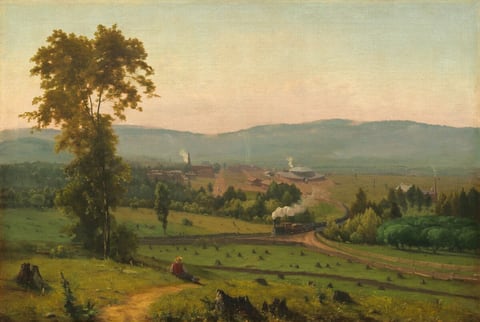
  1. We look across and down into a valley with a person sitting near a tall tree and a train puffing smoke beyond, all enclosed by a band of mountains in the distance in this horizontal landscape painting. Closest to us, several broken, jagged tree stumps are spaced across the painting’s width. A little distance away and to our left, the person wears a yellow, broad-brimmed hat, red vest, and gray pants. He reclines propped on his left elbow near a walking path beside a tall, slender tree with golden leaves. The green meadow stretching in front of him is dotted with tree stumps cut close to the ground. Beyond the meadow, puffs of white smoke trail behind a long steam locomotive that crosses a bridge spanning a tree-filled ravine, headed to our left. The ravine creates a diagonal line across the canvas, moving subtly away from us to our left. The train has climbed out of the valley, away from a cluster of brick-red buildings. The most prominent structure is a train roundhouse, a large building with a high, domed roof to the right of the tracks. Smoke rises from chimneys on long, warehouse-like buildings, and a steeple and smaller structures suggest a church and homes to our left. Hazy in the distance, a row of mountains lines the horizon, which comes about halfway up the composition. The sky above deepens from pale, shell pink over the mountains to watery, pale blue above. The artist signed the work in tiny letters in the lower left corner: “G. Inness.”
    The Lackawanna ValleyGeorge Inness, c. 1856Courtesy National Gallery of Art, Washington
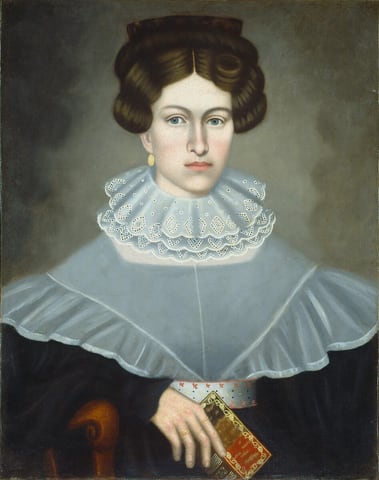
  2. The image shows a woman portrait from the waist up. She is seated upright, holding a book in her left hand. She has blue eyes, dark brown hair styled with rolls and a braided crown, and wears elegant 19th-century clothing with a lace collar, a blue-gray garment, and gold earrings. The background is plain, and she is seated on a wooden chair.
    Woman Holding a BookErastus Salisbury Field, c. 1835Courtesy National Gallery of Art, Washington
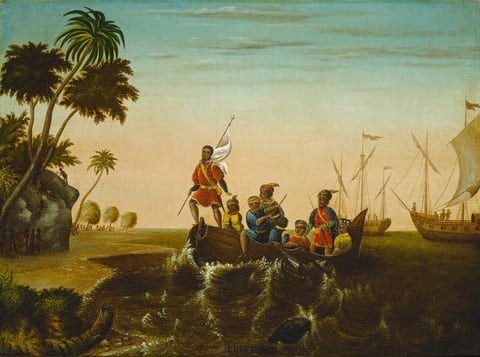
  3. The painting features a scene showing men in a boat landing on a shore. The horizon is low, with larger sailing ships seen in the distance on the right, floating on the dark green water. The central boat has around eight men in it, all with tan skin and dark hair, dressed in bright garments in shades of red, blue, and gold. Many of them wear plumed helmets and have jewelry or badges adorning them. The boat is heading towards land on the left, and one man stands at the front of the boat, holding a white flag. The land on the left is green, with tall palm trees and a rocky gray mountain. People with dark skin can be seen in on the land in the distance, some climbing the mountain and others standing beneath trees. The sky is a gradient from pinkish-orange near the horizon to light blue at the top of the painting, with a few faint gray clouds.
    The Landing of ColumbusEdward Hicks, c. 1837Courtesy National Gallery of Art, Washington

Second room, north wall
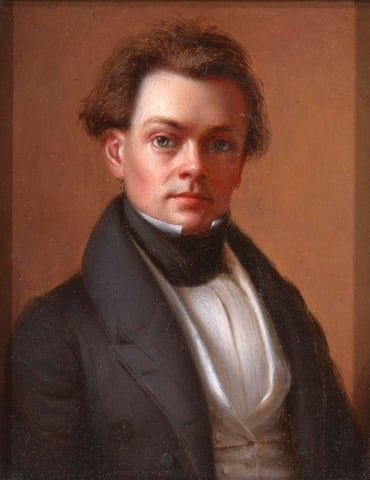
  1. Self-Portrait, by Oliver Tarbell Eddy, ca. 1850
    Self-PortraitOliver Tarbell Eddy, ca. 1850Courtesy of the Smithsonian American Art Museum
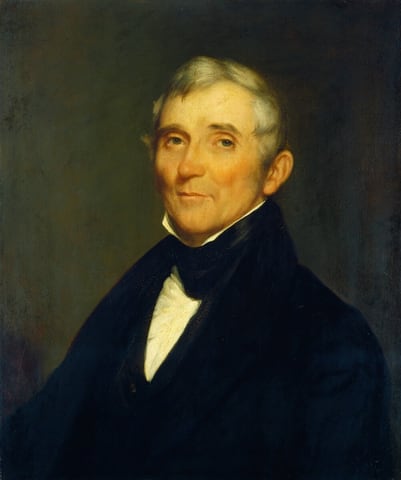
  2. The image is a portrait painting showing a man's upper body. He is positioned slightly turned to his right, with his head facing the viewer. The man has fair skin, defined cheekbones, and small, bright eyes. His hair is short, neatly combed, and grey or white. He is wearing a dark coat over a white shirt with a high collar, partially visible. The background is a muted, dark color, providing a simple setting that emphasizes the subject. There are no visible jewelry or objects in the image.
    Aaron BaldwinFrancis Alexander, c. 1835Courtesy National Gallery of Art, Washington
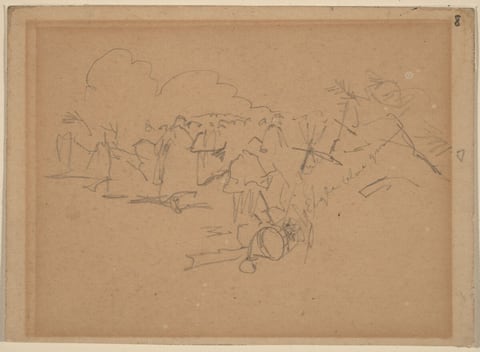
  3. The image displays curved and angular lines creating an abstract composition hinting at humanoid shapes and possible vegetation or trees. The lines suggest motion and activity, with shapes resembling drums and sticks scattered around. The overall impression is of a gathering or event, with figures depicted standing or moving, along with lines indicating movement or sound waves from musical instruments.
    End of the March [recto]Winslow Homer, 1862Courtesy National Gallery of Art, Washington
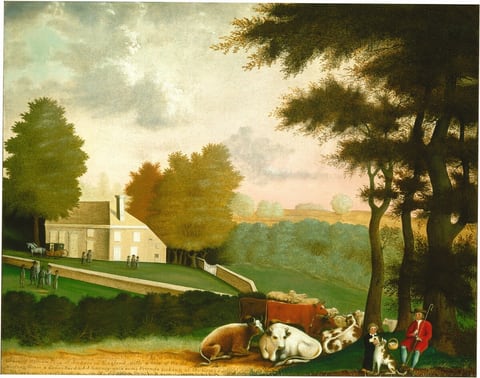
  4. This painting shows a pastoral setting with a large white-and-gray house on a hill to the left. Distant people stand in front of the house, along with a horse-drawn wagon. In the bottom right corner, two people sit in the grass under a tree, one dressed in red holding a tall crook and the other wearing a black garment and a yellow hat and petting a large brown-and-white dog. There is a basket on the ground between them, and next to them is a large herd of cows and sheep, all resting on the grass. The landscape includes trees with green leaves and yellow hills in the distance. The sky above is in pastel shades of pink and blue, with fluffy clouds. In the bottom left, a patch of yellow ground has several lines of text written over it.
    The Grave of William PennEdward Hicks, c. 1847/1848Courtesy National Gallery of Art, Washington

Third room, north wall
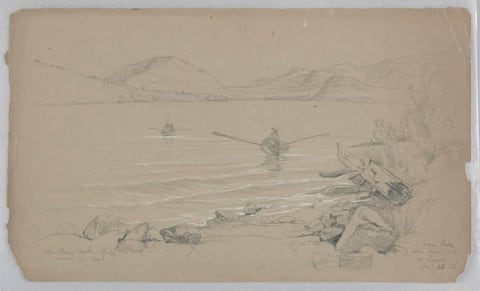
  1. EAGLE LAKE, MT. DESERT
    Eagle Lake, Mt. DesertDaniel Huntington, August 23, 1856Courtesy of Cooper Hewitt, Smithsonian Design Museum
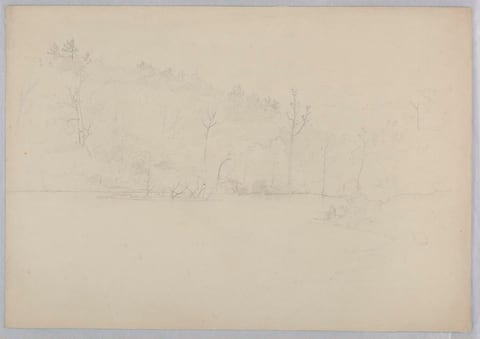
  2. STUDY OF LANDSCAPE, DELAWARE RIVER
    Study of landscape, Delaware RiverWilliam Stanley Haseltine, ca. 1855Courtesy of Cooper Hewitt, Smithsonian Design Museum
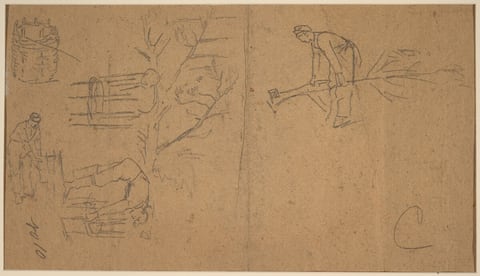
  3. This is a drawing of various sketches related to woodcutting or carpentry. The drawing features several pencil sketches on tan paper. On the left side, there are depictions of a barrel or basket, and beneath it, several outline sketches of figures engaged in activities involving woodwork. The right side of the drawing shows a figure bent over a large beam or branch. The sketches are simple, with minimal detail, capturing the basic form and movement of the figures and objects involved in woodwork-related activities.
    Soldiers felling sapling, and weaving saplings into baskets [verso]Winslow Homer, 1862Courtesy National Gallery of Art, Washington