Floor plan

Style galleriesThe American Gilded Age
The American Gilded Age
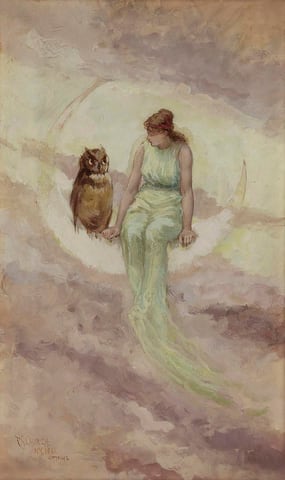
The Witch's Daughter, by Frederick Stuart Church, 1881
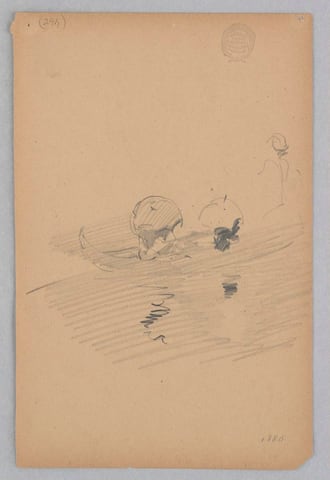
VIEW OF VENICE, ITALY
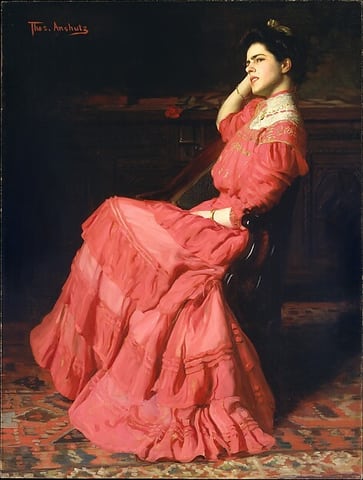
A Rose, by Thomas Anshutz, 1907
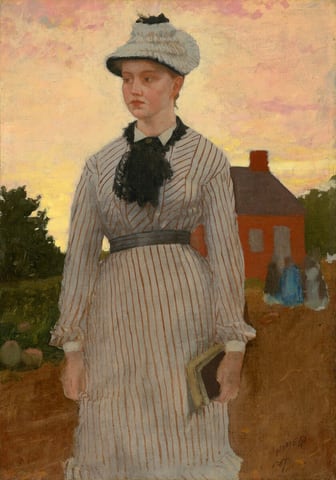
Shown from the knees up, a pale-skinned woman stands close to us with a red schoolhouse in the distance under a sunset sky in this vertical painting. The woman’s body faces us, but she turns her head to look off to the left with light brown eyes. She has a short, straight nose, full pink lips, and a round face. Her blond hair is pulled up under a round white hat layered with ruffles, which lies like a pancake over the top of her head. Her white dress is vertically striped with thin rust-red lines and has a long-sleeved, tight-fitting bodice and a long skirt. A dark gray belt is cinched around her narrow waist, and she wears a black, lacy ruffle around her neck. The woman’s arms hang by her sides, and she holds two paperback-sized books in her left hand, to our right. An earth-brown lawn stretches back to the schoolhouse, which has crimson-red walls, a chimney, and a dark gray roof. Three forms painted with a few streaks of dark or light gray or topaz blue suggest people standing near the door of the schoolhouse. Trees and a grassy lawn beyond the building are loosely painted with blended strokes. The sky is shaded pale lemon yellow and light peach with touches of rose pink. The artist signed and dated the lower right corner, “HOMER 1873.”
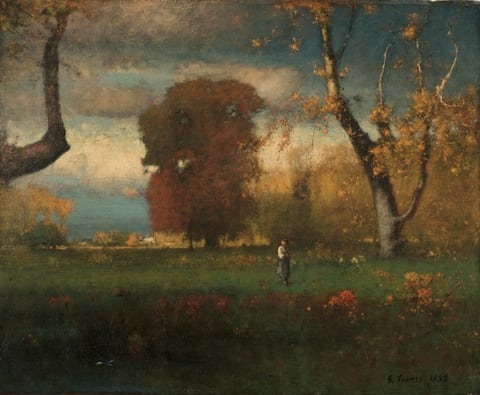
Landscape, by George Inness, 1888
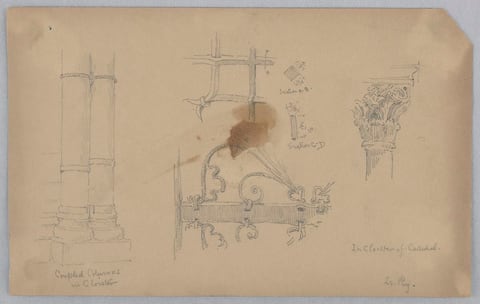
IN CLOISTER OF CATHEDREAL, LE PUY
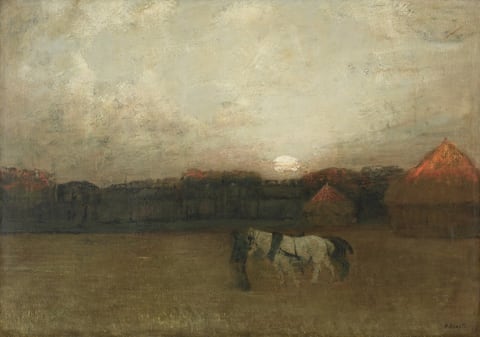
The Stubble Field, by Henry Golden Dearth, c. 1909

The works in this room are listed below.

Works in this room

Painting and design in the United States from the Civil War to 1910.

First room, north wall

  1. The Witch's Daughter, by Frederick Stuart Church, 1881
    The Witch's DaughterFrederick Stuart Church, 1881Courtesy of the Smithsonian American Art Museum
  2. VIEW OF VENICE, ITALY
    View of Venice, ItalyRobert Frederick Blum, 1880Courtesy of Cooper Hewitt, Smithsonian Design Museum
  3. A Rose, by Thomas Anshutz, 1907
    A RoseThomas Anshutz, 1907Courtesy of The Metropolitan Museum of Art
  4. Shown from the knees up, a pale-skinned woman stands close to us with a red schoolhouse in the distance under a sunset sky in this vertical painting. The woman’s body faces us, but she turns her head to look off to the left with light brown eyes. She has a short, straight nose, full pink lips, and a round face. Her blond hair is pulled up under a round white hat layered with ruffles, which lies like a pancake over the top of her head. Her white dress is vertically striped with thin rust-red lines and has a long-sleeved, tight-fitting bodice and a long skirt. A dark gray belt is cinched around her narrow waist, and she wears a black, lacy ruffle around her neck. The woman’s arms hang by her sides, and she holds two paperback-sized books in her left hand, to our right. An earth-brown lawn stretches back to the schoolhouse, which has crimson-red walls, a chimney, and a dark gray roof. Three forms painted with a few streaks of dark or light gray or topaz blue suggest people standing near the door of the schoolhouse. Trees and a grassy lawn beyond the building are loosely painted with blended strokes. The sky is shaded pale lemon yellow and light peach with touches of rose pink. The artist signed and dated the lower right corner, “HOMER 1873.”
    The Red School HouseWinslow Homer, 1873Courtesy National Gallery of Art, Washington

First room, south wall

  1. Landscape, by George Inness, 1888
    LandscapeGeorge Inness, 1888Courtesy of the Cleveland Museum of Art
  2. IN CLOISTER OF CATHEDREAL, LE PUY
    In Cloister of Cathedreal, Le PuyArnold William Brunner, 1883Courtesy of Cooper Hewitt, Smithsonian Design Museum
  3. The Stubble Field, by Henry Golden Dearth, c. 1909
    The Stubble FieldHenry Golden Dearth, c. 1909Courtesy of the Cleveland Museum of Art

Second room, south wall
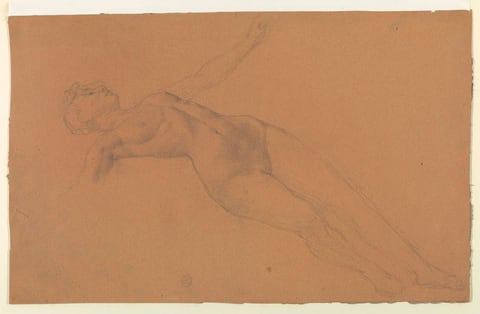
  1. STUDY FOR "DIANA AND HER ATTENDANTS AMONG THE CONSTELLATIONS"
    Study for "Diana and Her Attendants among the Constellations"Francis Augustus Lathrop, ca. 1894Courtesy of Cooper Hewitt, Smithsonian Design Museum
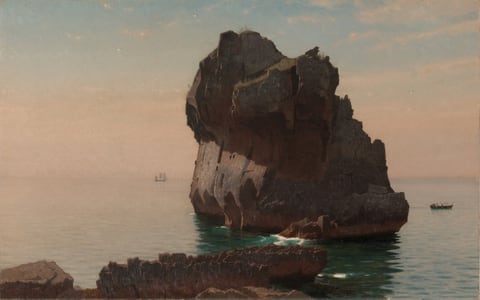
  2. Capri, by William Stanley Haseltine, 1869
    CapriWilliam Stanley Haseltine, 1869Courtesy of the Cleveland Museum of Art
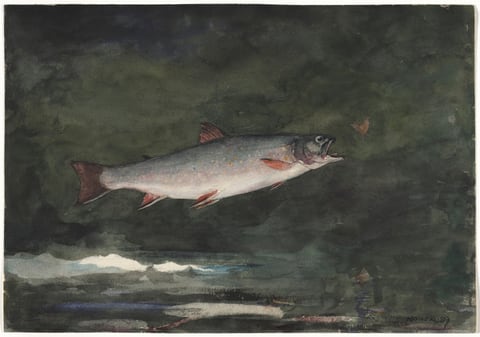
  3. Leaping Trout, by Winslow Homer, 1889
    Leaping TroutWinslow Homer, 1889Courtesy of the Cleveland Museum of Art
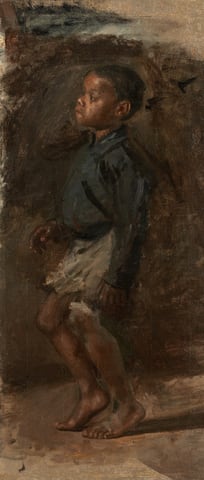
  4. Study for "The Dancing Lesson": The Boy, by Thomas Eakins, probably 1877
    Study for "The Dancing Lesson": The BoyThomas Eakins, probably 1877Courtesy National Gallery of Art, Washington

Second room, north wall
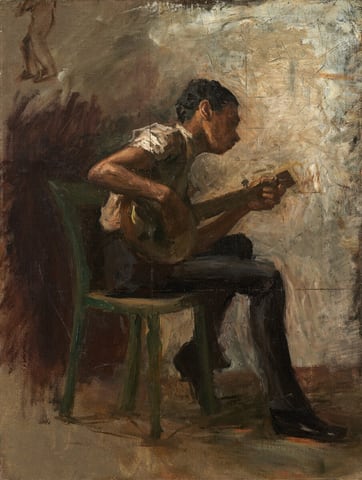
  1. A young, gangly, brown-skinned boy sits on a green chair and leans over the banjo he plays in this loosely painted, vertical composition. His body faces our right in profile, and his head leans to his left and away from us. Light comes from our left to highlight his ear and the side of his chin, but throws his profile into shadow against the lighter background. The boy has short black hair and wears a white shirt with the sleeves rolled up, black pants, and black shoes. The floor is loosely painted with streaks of earth brown, taupe, and dark moss green. The wall behind the boy is painted with visible strokes of parchment brown, peachy tan, pearl white, and fog gray. The space to our left of the boy is dark brown, and an outline of a standing person is sketched in the top left corner. A grid is overlaid across the boy’s body and the chair.
    Study for "The Dancing Lesson": The Banjo PlayerThomas Eakins, probably 1877Courtesy National Gallery of Art, Washington
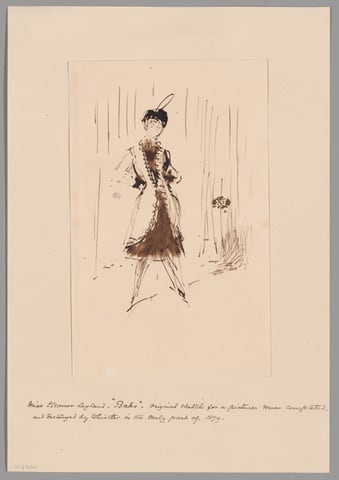
  2. A work made of pen and brown ink, with brush and brown ink, on cream pseudo-laid paper tipped onto cream wove paper.
    Study for "The Blue Girl: Portrait of Miss Elinor Leyland"James McNeill Whistler, c. 1879Courtesy of the Art Institute of Chicago
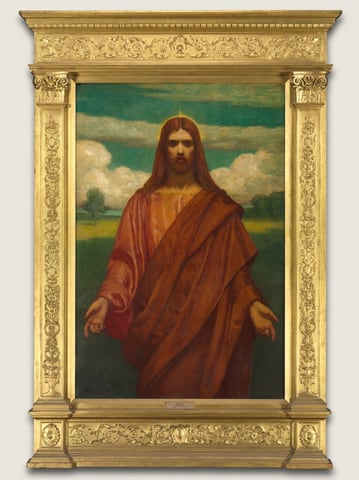
  3. Christ, by Kenyon Cox, 1905
    ChristKenyon Cox, 1905Courtesy of the Cleveland Museum of Art

Third room, north wall
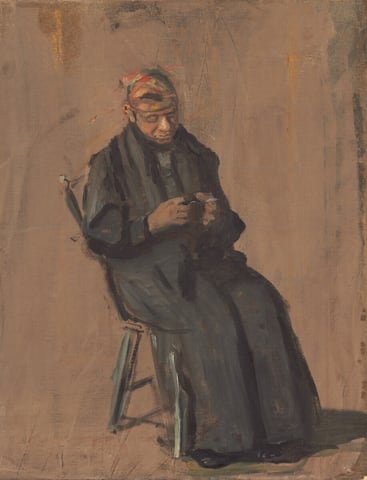
  1. This painting shows a person seated on a stool or chair, wearing a long, dark-blue robe or gown. They are slightly turned toward the right, looking downward at something they hold in their hands, and their head is covered with a cloth or cap. The background is textured with earthy tones, mostly tan with some patches of yellow ochre and gray.
    The ChaperoneThomas Eakins, c. 1908Courtesy National Gallery of Art, Washington
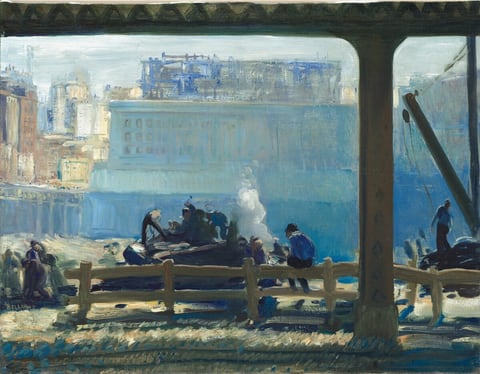
  2. From under an elevated train track, we look at a cluster of people hammering and working on the far side of a wooden fence, all against a silvery-blue building that fills most of the background in this horizontal painting. The scene is loosely painted mostly in tones of hazy and saturated blues, so many of the details are indistinct. About a quarter of the way in from the right edge of the composition, a thin iron column holds up the train platform. The column nearly spans the height of the painting, and the track it supports runs across the top edge of the canvas. At the foot of the column, along the bottom edge, are two parallel tracks embedded in an area otherwise painted with short, diagonal strokes in topaz blue, olive green, and straw yellow. Just beyond the tracks, the split-rail wooden fence runs across most of the painting, though there is an opening at the left edge of the canvas. A man sits with his back to us on the railing to our right of center. He wears a dark cap, a lapis-blue shirt, and navy-blue pants. Several men work on or near a mound-shaped form, perhaps a piece of machinery, just beyond the fence, near the center of the painting. One man holds a hammer high overhead while another reaches down or strikes the mound with his feet planted wide. More people work together to our left, and a man to our right stands near a crane. The people and these areas are painted with broad strokes and touches of cobalt blue, charcoal gray, khaki brown, and a few swipes of shell pink and bright white. A puff of white smoke billows up behind the central group, before the land drops precipitously away. The chasm is painted with shimmering tones of aquamarine and cerulean blue. A sky-blue, rectangular building perches at the far edge. A few windows are outlined in royal blue to our left but the rest of the building is loosely painted with long, vertical strokes so no architectural details can be made out. Behind this structure are more city buildings, suggested with strokes of muted rust red, parchment and bright white, and cobalt blue. The ice-blue sky fills the band between the top of the buildings and the train track running overhead. The artist signed his name near the lower left corner, “BELLOWS.”
    Blue MorningGeorge Bellows, 1909Courtesy National Gallery of Art, Washington