Floor plan

Time and placeGermany

Germany

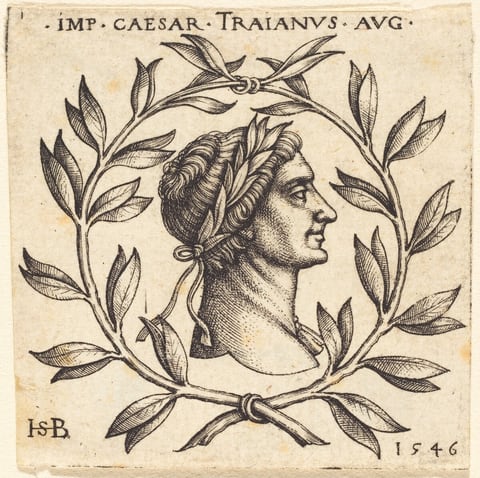
The image shows a profile of a person's head and partial neck within a circular laurel wreath. The individual has distinct facial features, including a prominent nose and chin. The hairstyle is tight, wavy locks pulled back, and a laurel wreath crowns the head. The background is plain, with an inscription reading "IMP. CAESAR. TRAIANVS. AVG." Below the portrait are the initials "ISB" and the year "1546". The overall style resembles a classical engraving, featuring detailed line work and traditional iconography.
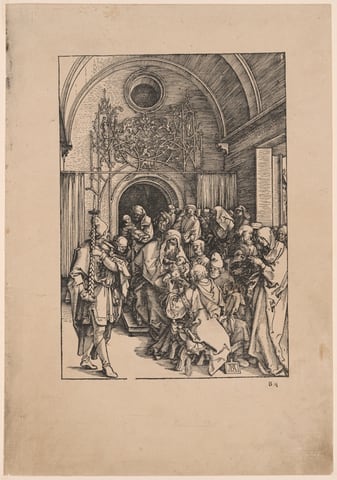
A work made of woodcut in black on tan laid paper.
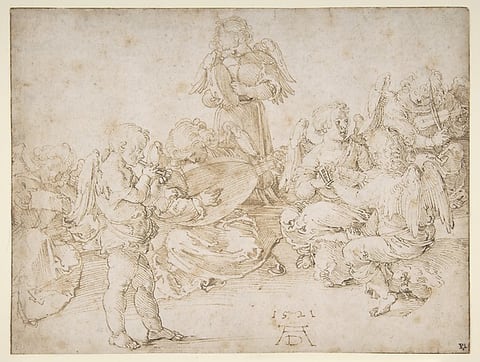
Music-Making Angels, by Albrecht Dürer, 1521
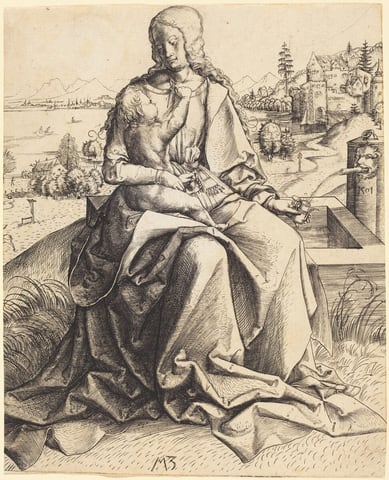
The image shows a woman sitting with a child on her lap. The woman has a gentle expression and long hair, wearing a flowing robe. The child is facing her, reaching up with one hand. In the background are trees, hills, a building, and a fountain with a lion's head spouting water into a basin. The illustration is detailed, capturing textures and elements in the scene.
Saint John on Patmos, by Hans Baldung (called Hans Baldung Grien), ca. 1511
Landscape with a Double Spruce, by Albrecht Altdorfer, ca. 1521–22
The Entrance Hall of the Regensburg Synagogue, by Albrecht Altdorfer, 1519
This is a painting of an architectural scene with decorative and religious elements. The painting features a grand interior setting, possibly a church or cathedral, dominated by ornate columns and a ceiling structure. Figures appear on pedestals atop the columns. In the background, there is a depiction of a religious or ceremonial space with detailed balustrades and steps, where figures are shown in dynamic poses. The color palette consists of warm golden hues contrasted with cooler grey tones, highlighting the intricate details of the architecture and figures. This is in the style of Giovanni Battista Tiepolo.

The works in this room are listed below.

Works in this room

Works made in Germany, from every century in the collection.

First room, north wall

  1. The image shows a profile of a person's head and partial neck within a circular laurel wreath. The individual has distinct facial features, including a prominent nose and chin. The hairstyle is tight, wavy locks pulled back, and a laurel wreath crowns the head. The background is plain, with an inscription reading "IMP. CAESAR. TRAIANVS. AVG." Below the portrait are the initials "ISB" and the year "1546". The overall style resembles a classical engraving, featuring detailed line work and traditional iconography.
    TrajanSebald Beham, 1546Courtesy National Gallery of Art, Washington
  2. A work made of woodcut in black on tan laid paper.
    The Circumcision of Christ, from The Life of the VirginAlbrecht Dürer, c. 1505, published 1511Courtesy of the Art Institute of Chicago
  3. Music-Making Angels, by Albrecht Dürer, 1521
    Music-Making AngelsAlbrecht Dürer, 1521Courtesy of The Metropolitan Museum of Art
  4. The image shows a woman sitting with a child on her lap. The woman has a gentle expression and long hair, wearing a flowing robe. The child is facing her, reaching up with one hand. In the background are trees, hills, a building, and a fountain with a lion's head spouting water into a basin. The illustration is detailed, capturing textures and elements in the scene.
    Madonna and Child at a FountainMaster MZ, 1501Courtesy National Gallery of Art, Washington

First room, south wall

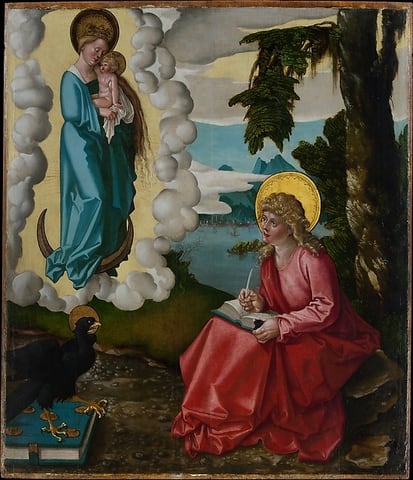
  1. Saint John on Patmos, by Hans Baldung (called Hans Baldung Grien), ca. 1511
    Saint John on PatmosHans Baldung (called Hans Baldung Grien), ca. 1511Courtesy of The Metropolitan Museum of Art
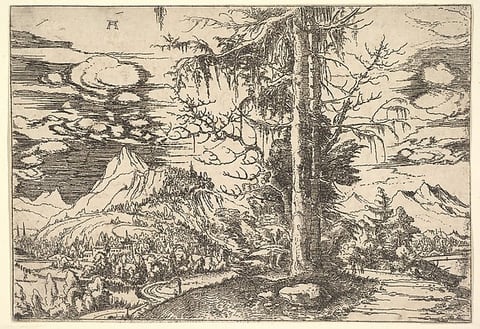
  2. Landscape with a Double Spruce, by Albrecht Altdorfer, ca. 1521–22
    Landscape with a Double SpruceAlbrecht Altdorfer, ca. 1521–22Courtesy of The Metropolitan Museum of Art
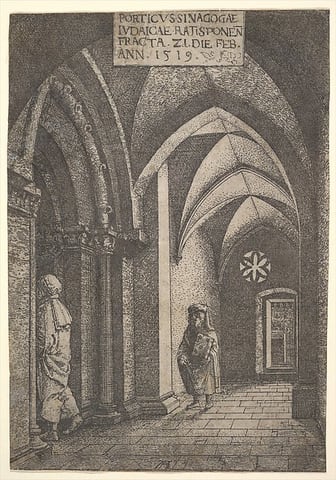
  3. The Entrance Hall of the Regensburg Synagogue, by Albrecht Altdorfer, 1519
    The Entrance Hall of the Regensburg SynagogueAlbrecht Altdorfer, 1519Courtesy of The Metropolitan Museum of Art
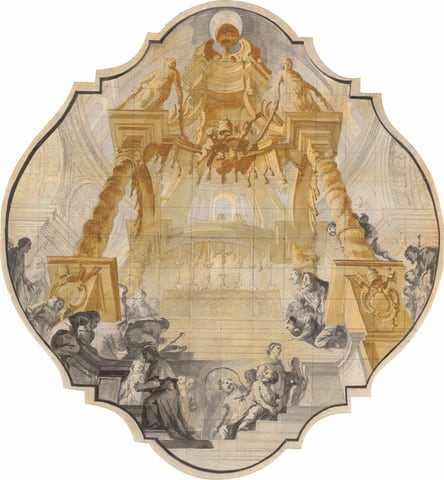
  4. This is a painting of an architectural scene with decorative and religious elements. The painting features a grand interior setting, possibly a church or cathedral, dominated by ornate columns and a ceiling structure. Figures appear on pedestals atop the columns. In the background, there is a depiction of a religious or ceremonial space with detailed balustrades and steps, where figures are shown in dynamic poses. The color palette consists of warm golden hues contrasted with cooler grey tones, highlighting the intricate details of the architecture and figures. This is in the style of Giovanni Battista Tiepolo.
    Worshippers at the Tomb of Saint PeterMatthäus Günther, 1740/1741Courtesy National Gallery of Art, Washington

Second room, south wall
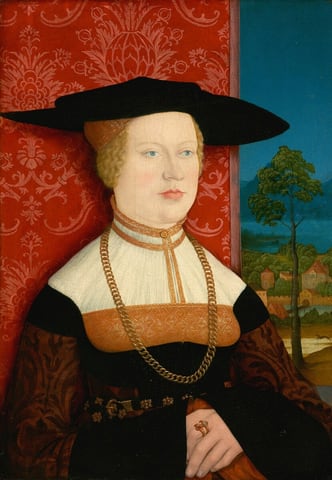
  1. Shown from the waist up, a light-skinned woman sits angled slightly to our right in this vertical portrait painting. The woman has blue eyes, faint brows, and a sloping nose ending in a small bulb. Her upper lip is thin and her lower lip full over a slight double chin. Her blond hair is pulled back under a gold, cap-like headdress and a black, wide-brimmed hat with a shallow crown. She wears a high-necked white, black, and gold dress with intricate detailing, a gold chain necklace that falls to her waist, and a black belt with a gold clasp and medallions. She wears two gold rings set with gems on the pointer finger of her left hand, which is folded across her belly over the other hand. A scarlet-red wallcovering with pink floral designs fills two-thirds of the space behind her. The rightmost third of the background opens onto a landscape with a tall, spindly tree, a leaping animal, presumably a dog, and a bridge across a body of water leading to a town. Across another body of water, perhaps a lake, mountains are marine blue in the distance under a clear, celestial-blue sky.
    Margarethe Vöhlin [obverse]Bernhard Strigel, 1527Courtesy National Gallery of Art, Washington
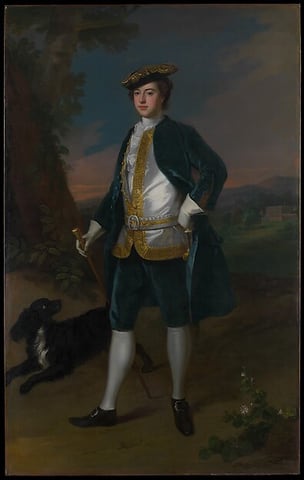
  2. Sir James Dashwood (1715–1779), by Enoch Seeman the Younger, 1737
    Sir James Dashwood (1715–1779)Enoch Seeman the Younger, 1737Courtesy of The Metropolitan Museum of Art
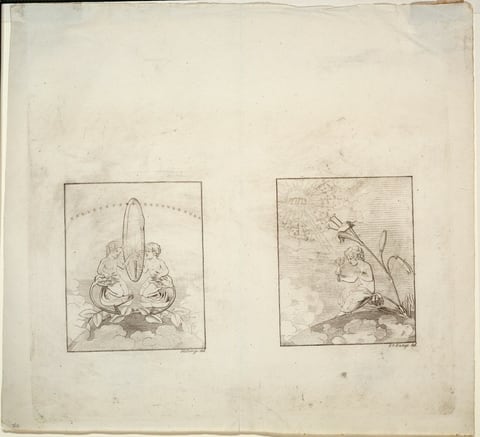
  3. A work made of etching on ivory wove paper.
    Child with RosebudPhillip Otto Runge, n.d.Courtesy of the Art Institute of Chicago
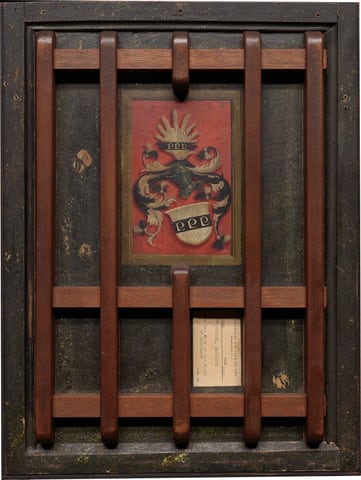
  4. The image shows a pattern of vertical and horizontal wooden bars forming a grid-like design. In the center, there is a rectangular panel with a decorative emblem against a red background. The emblem features swirling shapes. The structured wooden grid and ornate emblem suggest a vintage heraldic shield or coat of arms.
    Margarethe Vöhlin [reverse]Bernhard Strigel, 1527Courtesy National Gallery of Art, Washington

Second room, north wall
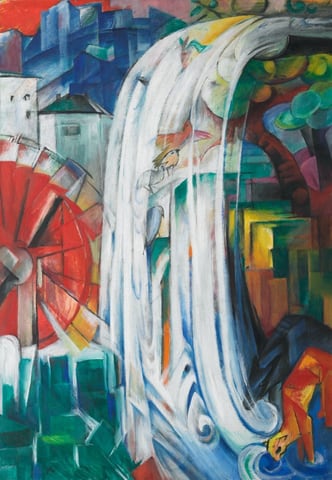
  1. Vibrantly colored geometric painting of a central white and blue waterfall with birds visible through it. A stylized red jungle cat and black wild boar drink at bottom right. Red water wheel at left, angular blue and white cityscape top at left, tree top at right.
    The Bewitched MillFranz Marc, 1913Courtesy of the Art Institute of Chicago
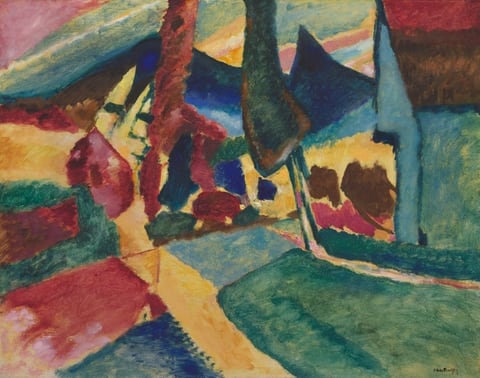
  2. Vibrant yellow, red, blue, and green painting of landscape with trees and mountains.
    Landscape with Two PoplarsVasily Kandinsky, 1912Courtesy of the Art Institute of Chicago
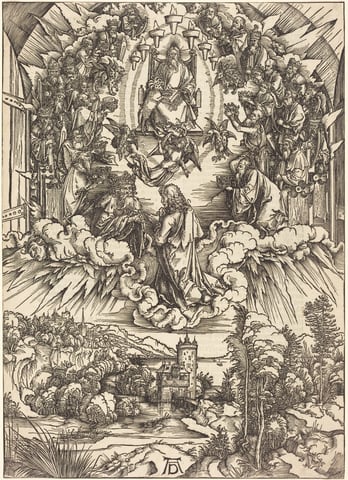
  3. The image features a celestial scene with multiple figures depicted from head to waist. Two central figures are engaged in a conversation amidst clouds. One figure appears seated, possibly on a throne, holding a book. Both figures have long hair and beards. The robes worn by the figures are detailed. Other figures surround them in a semi-circle, some wearing crowns, holding items like bowls. Heavenly hosts with wings are seen above. The background shows a detailed landscape with trees, a river, and castles nestled in hills.
    Saint John before God and the EldersAlbrecht Dürer, probably c. 1496/1498Courtesy National Gallery of Art, Washington
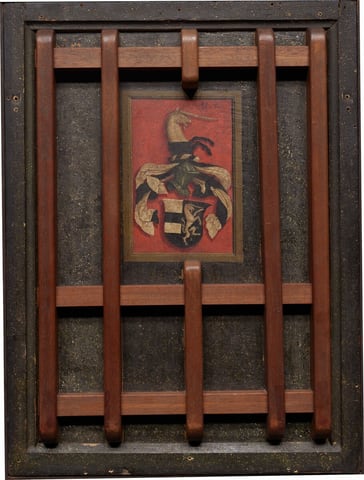
  4. This is a painting depicting a heraldic coat of arms. The image features a detailed coat of arms with a central shield, adorned with black and gold sections, and additional decorative elements above it. There is a figure resembling a unicorn emerging from the crest. The background is a deep red hue. The artwork is displayed within a wooden frame with crossbars. This style is associated with displaying family crests and lineage.
    Hans Roth [reverse]Bernhard Strigel, 1527Courtesy National Gallery of Art, Washington