Floor plan

Time and placeFlanders

Flanders

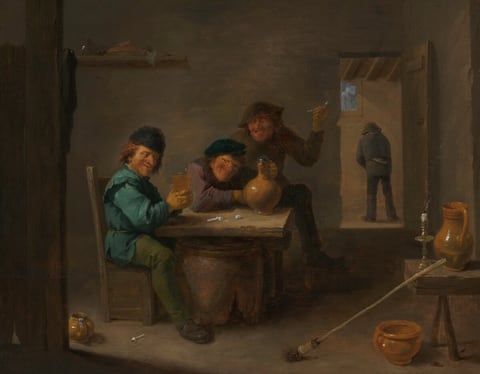
Three pale-skinned people gather around a wooden table in a dimly lit tavern as a fourth person urinates against a wall in a back room in this horizontal painting. The table is a square board resting on a broken barrel. All three men at the table have prominent, reddened noses set in wide faces, and they wear clothing and hats in tones of spruce blue, olive green, muted purple, gray, or brown. One man sits on the left side of the table, holding a glass of beer with both hands. He wears what might be a furry cap. His face is turned slightly toward us but he looks down and to our right. The other seated man is across from us. He grins widely as he hunches over one forearm and holds the neck of a lidded ceramic jug with his other hand. He has a long, chunky chin and stares out at us from under a prominent brow ridge. The third man here stands behind, holding up a white clay pipe. His mouth is open, his eyes slitted, possibly crossed, and he hunches down. One foot rests on a low wooden box, a foot warmer. Another white clay pipe and the broken bowl of a pipe sit on the table, and another pipe lies by the first man’s feet. Also across the floor are two pots and a stubby broom, the long handle of which lies against a table holding a brass candlestick. A wisp of smoke rises from the wick in the candle stub. A shelf hung on the wall near the upper left corner of the painting holds a glass vessel and perhaps a plate. Two wooden beams line the left edge of the composition, and a cloth is draped over a nail there. The floor and wall are nearly uniform taupe gray. A rectangular doorway opens into the next room, in the top right corner of the painting. There a man stands facing the wall with both hands down in front of his torso. A window is set high in the wall there and the timbered ceiling is visible. The artist signed the lower left corner the painting, “D Teniers f.” The first two digits of the date read “16.”
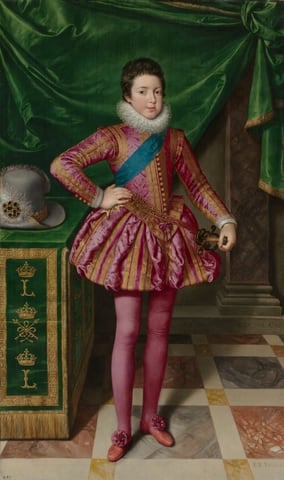
Portrait of King Louis XIII of France, by Frans Pourbus, 1611
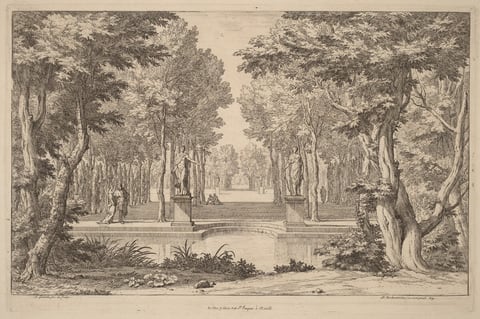
The image shows a formal garden or park with a symmetrical view. It is taken from a slightly elevated position, revealing the vast space beyond a foreground of foliage and low-growing plants. The horizon line is positioned near the midpoint, where a tree-lined pathway extends into the distance. Flanking the pathway are two statues on pedestals under leafy trees. The scene is detailed with intricate line work emphasizing textures and forms. The color palette is monochromatic in various shades of brown, creating a classic appearance. Paved steps and a bridge over a small body of water add to the ordered elegance of the garden.
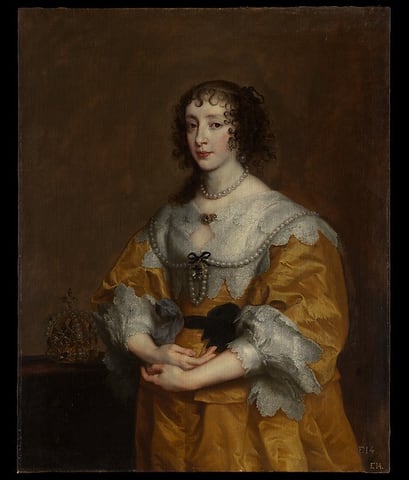
Queen Henrietta Maria, by Anthony van Dyck, 1636
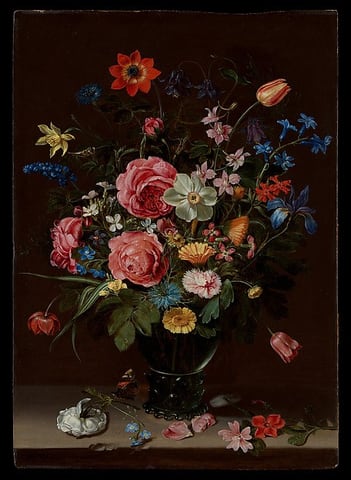
A Bouquet of Flowers, by Clara Peeters, ca. 1612
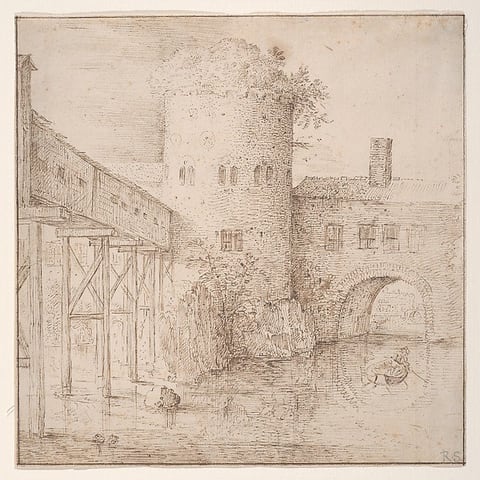
A Mill with a Fortified Bridge, a Rowing Boat in the Foreground, by Roelandt Savery, 1596–1639
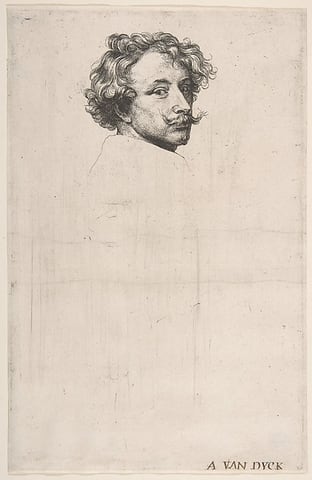
Self-Portrait, from "The Iconography", by Anthony van Dyck, ca. 1640

The works in this room are listed below.

Works in this room

Works made in Flanders, from every century in the collection.

First room, north wall

  1. Three pale-skinned people gather around a wooden table in a dimly lit tavern as a fourth person urinates against a wall in a back room in this horizontal painting. The table is a square board resting on a broken barrel. All three men at the table have prominent, reddened noses set in wide faces, and they wear clothing and hats in tones of spruce blue, olive green, muted purple, gray, or brown. One man sits on the left side of the table, holding a glass of beer with both hands. He wears what might be a furry cap. His face is turned slightly toward us but he looks down and to our right. The other seated man is across from us. He grins widely as he hunches over one forearm and holds the neck of a lidded ceramic jug with his other hand. He has a long, chunky chin and stares out at us from under a prominent brow ridge. The third man here stands behind, holding up a white clay pipe. His mouth is open, his eyes slitted, possibly crossed, and he hunches down. One foot rests on a low wooden box, a foot warmer. Another white clay pipe and the broken bowl of a pipe sit on the table, and another pipe lies by the first man’s feet. Also across the floor are two pots and a stubby broom, the long handle of which lies against a table holding a brass candlestick. A wisp of smoke rises from the wick in the candle stub. A shelf hung on the wall near the upper left corner of the painting holds a glass vessel and perhaps a plate. Two wooden beams line the left edge of the composition, and a cloth is draped over a nail there. The floor and wall are nearly uniform taupe gray. A rectangular doorway opens into the next room, in the top right corner of the painting. There a man stands facing the wall with both hands down in front of his torso. A window is set high in the wall there and the timbered ceiling is visible. The artist signed the lower left corner the painting, “D Teniers f.” The first two digits of the date read “16.”
    Peasants in a TavernDavid Teniers the Younger, c. 1633Courtesy National Gallery of Art, Washington
  2. Portrait of King Louis XIII of France, by Frans Pourbus, 1611
    Portrait of King Louis XIII of FranceFrans Pourbus, 1611Courtesy of the Cleveland Museum of Art
  3. The image shows a formal garden or park with a symmetrical view. It is taken from a slightly elevated position, revealing the vast space beyond a foreground of foliage and low-growing plants. The horizon line is positioned near the midpoint, where a tree-lined pathway extends into the distance. Flanking the pathway are two statues on pedestals under leafy trees. The scene is detailed with intricate line work emphasizing textures and forms. The color palette is monochromatic in various shades of brown, creating a classic appearance. Paved steps and a bridge over a small body of water add to the ordered elegance of the garden.
    The Two StatuesAbraham Genoels IICourtesy National Gallery of Art, Washington

First room, south wall

  1. Queen Henrietta Maria, by Anthony van Dyck, 1636
    Queen Henrietta MariaAnthony van Dyck, 1636Courtesy of The Metropolitan Museum of Art
  2. A Bouquet of Flowers, by Clara Peeters, ca. 1612
    A Bouquet of FlowersClara Peeters, ca. 1612Courtesy of The Metropolitan Museum of Art
  3. A Mill with a Fortified Bridge, a Rowing Boat in the Foreground, by Roelandt Savery, 1596–1639
    A Mill with a Fortified Bridge, a Rowing Boat in the ForegroundRoelandt Savery, 1596–1639Courtesy of The Metropolitan Museum of Art
  4. Self-Portrait, from "The Iconography", by Anthony van Dyck, ca. 1640
    Self-Portrait, from "The Iconography"Anthony van Dyck, ca. 1640Courtesy of The Metropolitan Museum of Art

Second room, south wall
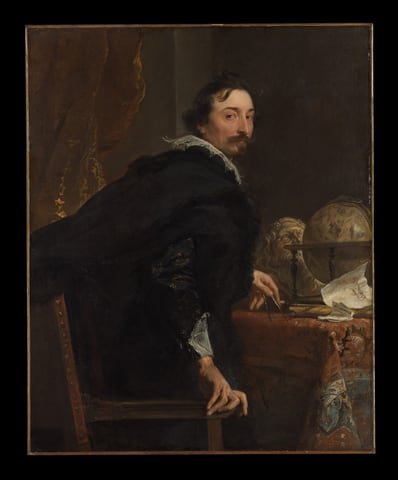
  1. Lucas van Uffel (died 1637), by Anthony van Dyck, ca. 1622
    Lucas van Uffel (died 1637)Anthony van Dyck, ca. 1622Courtesy of The Metropolitan Museum of Art
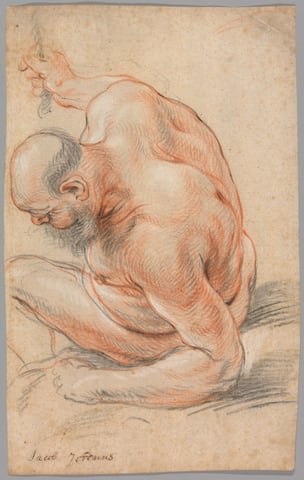
  2. A work made of red and black chalk, with touches of white chalk, on cream laid paper.
    Nude Old Man Seated, Leaning on His Forearm, Facing LeftJacob Jordaens, c. 1640Courtesy of the Art Institute of Chicago
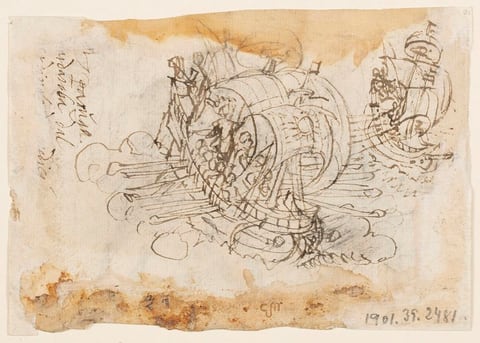
  3. TWO GALLEYS AT SEA
    Two Galleys at SeaJan van der Straet, called Stradanus, ca. 1587 – 1590Courtesy of Cooper Hewitt, Smithsonian Design Museum

Second room, north wall
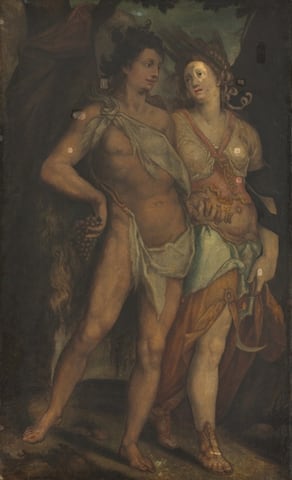
  1. Ceres and Bacchus, by Bartholomaeus Spranger, 1600s
    Ceres and BacchusBartholomaeus Spranger, 1600sCourtesy of the Cleveland Museum of Art
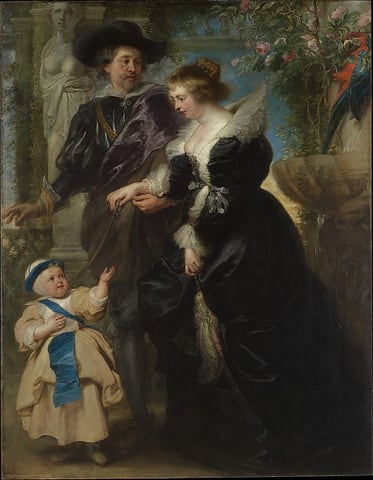
  2. Rubens, Helena Fourment (1614–1673), and Their Son Frans (1633–1678), by Peter Paul Rubens, ca. 1635
    Rubens, Helena Fourment (1614–1673), and Their Son Frans (1633–1678)Peter Paul Rubens, ca. 1635Courtesy of The Metropolitan Museum of Art
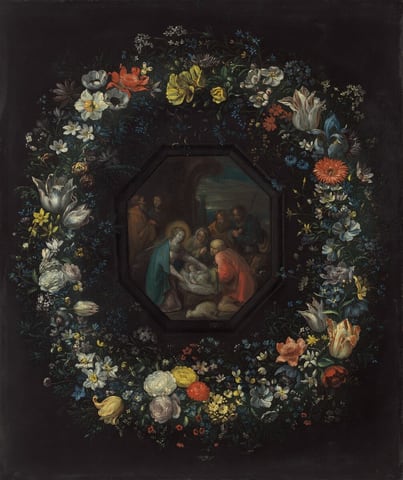
  3. A scene with seven men and women gathered around an infant is enclosed in an eight-sided, octagonal painted frame, which is surrounded by a wreath of flowers in this vertical painting. The painted black frame-within-a-frame resembles molding. The people in the scene have pale skin and wear robes in shades of teal blue, burnt orange, red, muted purple, or red. A woman reaching for the bed on which the child lies and the child have gold halos. Others crouch or bend toward the child, and one pair, to our left, turn toward each other, presumably talking. The nighttime-blue sky is streaked with nickel-gray clouds beyond a partially ruined stone arch. A lamb with all four feet tired together lies at the foot of the child’s bed. The wreath surrounding the painting-within-a-painting is dense with tulips, roses, daffodils, poppies, violets, and other flowers and greenery painted in shades of lemon and butter yellow, opal and pearl white, brick and coral red, and sky and slate blue against an inky-black background. One artist signed the painting-within-a-painting near the bottom left corner, “FF F.” The second artist who painted this signed his initials, “HDB”, on the bottom edge of the painted frame.
    Garland of Flowers with Adoration of the ShepherdsFrans Francken the Younger, c. 1625/1630Courtesy National Gallery of Art, Washington

Third room, north wall
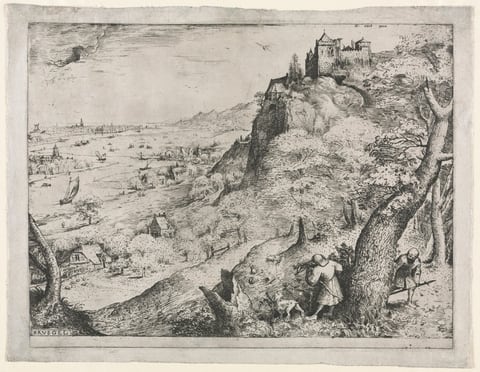
  1. The Rabbit Hunt, by Pieter Bruegel, 1560
    The Rabbit HuntPieter Bruegel, 1560Courtesy of the Cleveland Museum of Art
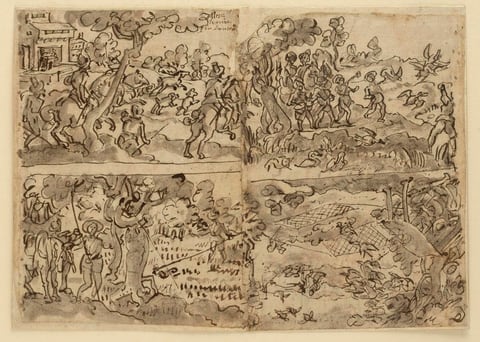
  2. 1901-39-151-a: DEER HUNT WITH HOUNDS [ABOVE]; SKYLARK HUNT WITH FALCONS [BELOW]; 1901-39-151-b: GOOSE AND DUCK HUNT WITH FALCONS [ABOVE RIGHT]; GOOSE HUNT [BELOW RIGHT]
    Goose and Duck Hunt with Falcons [above right]; Goose Hunt [below right]Jan van der Straet, called Stradanus, ca. 1596-99Courtesy of Cooper Hewitt, Smithsonian Design Museum
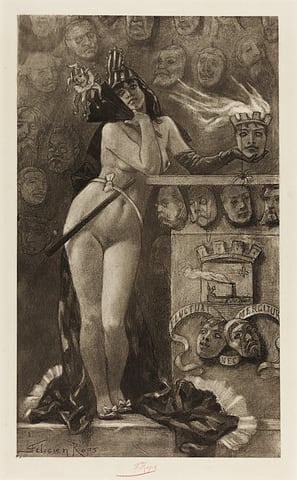
  3. A work made of photogravure in dark brown retouched with soft varnish (vernis mou), roulette and blue handcoloring on thick cream wove paper.
    Modern MasksFélicien Rops, 1889Courtesy of the Art Institute of Chicago